|

Film noir -- in color, or...
Body Fever (1969)
a.k.a. Supercool, Deadlocked, and The Last Original B Movie
Written by Ray Dennis Steckler
Directed by Steckler
Details at the IMDB, US.IMDB
A good novel tells us the truth about its hero;
but a bad novel tells us the truth about its author.
G. K. Chesterton (1874-1936)
Professional undergraduates. Every major university probably has at least one.
During the 1970's at Indiana University, the local pro-undie was a political cartoonist, T-shirt designer, and minor celebrity. He always took at least one course so he still counted as a student. And always changed his major. And never filed for a degree. He never seriously progressed toward the general goal of 99.44 percent of the student body. Why? Because after ten-plus consecutive years as an active undergraduate, he'd found a unique niche. To cross the line to "graduate" would have been the end of the way he'd defined himself. (I've heard that the man eventually accepted a degree. Damn, there must've been a party on that day.)
Why bring this up? This article's feature attraction was the work of Ray Dennis Steckler. When you look one of his movies, you might think you're watching a student film. See a couple more, and you might ask why he never graduated.
Contents
The Plot
The Thin Man
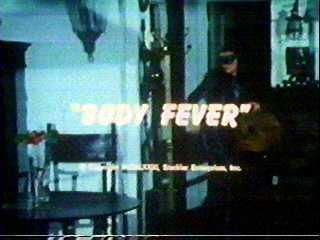
We open with a single point light source. (Must be one of those Castle Rock movies.) It's a flashlight. (Nope.) The soundtrack cues up some Melodramatic Organ Music™. After getting a little more light on the scene, we can see that a woman (Carolyn Brandt) in a funky cat-suit and mask is holding the flashlight. She opens a cabinet and grabs a tan satchel. While she leaves, go to opening credits. The credits continue over the action, which has the same jump-cut quality as a series of flashbacks. She runs down a street for a while. Eventually, she enters an apartment, but there's a man (Gary Kent) waiting for her. He roughs her up a little, takes the bag, and leaves. She rolls around in frustration.
Elsewhere, the robber's robber cooks some stuff in a spoon. A redhead rolls up her sleeve. Close-up of a needle. End of opening credits.
And elsewhere yet again, a stocky older guy called Big Mac (Bernard Fein) is on the phone. He's mad because someone called Carrie Erskine ripped him off. After he finishes his call, he kicks everyone out of the room except a rotund mountainoid in a yacht cap called Bret (uncredited, but we assume Bret Zeller) (And since Bret is always wearing that cap, we'll be referring to him as "Skipper Bret."). Big Mac (hereafter referred to as BM) tells Bret that Fergerson has cost their operation some big bucks, so he wants the man dead. Skipper Bret suggests that this could be a mistake; if they kill Fergerson now, they'll never get their money back. BM likes it. Skipper Bret now has to tell Fergerson he has three days to make good.
And in an office well beyond all this, private detective Charles Smith (Ray Dennis Steckler) snoozes at his desk while the phone rings. His secretary Stella wakes up and suggests he should answer the phone. It could be a case. However, our hero wants a day off, so he's not taking any cases. The phone continues to ring. Of course, if he did take a case, they might have money for a change. Stella reaches to answer the phone, but too late. Charlie decides he's going to his boat. His secretary asks how he plans to get there; after all, his car was repossessed.
 |
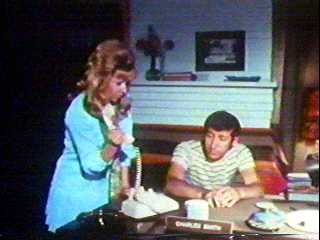 |
| Meanwhile, Catwoman was committing yet another purr-fect crime.... | Where are they now? After his eighth rescue, Gilligan became an associate producer for Survivor. |
Cut to Charlie hitchhiking. In a voiceover, our hero explains that he keeps his boat for a sense of class. (And yes, this is over shots of him on the hooked thumb trail.) And no one knows about it besides him.
After he gets to the marina, he doesn't notice that Skipper Bret is lurking about.
A man in a business suit arrives at the boat and, sees Charlie, and asks to speak to the owner. After some defensive stand-off dialogue between Charlie and the mystery man, the suit breaks the deadlock by mentioning money, as in giving some to Charlie the detective. He introduces himself as Harris Fergerson and says he'll pay three thousand dollars to find a girl. The time limit is three days. Then he gives Charlie two thousand up front and an envelope. The envelope has info on the girl, Carrie Erskine, including a photograph. (Natch', it's the girl we saw in the cat-suit earlier. During this scene, we also learn that Charlie has some amazing facial hair follicles. When he was at the office, he had morning shadow, but now he has about three days worth of beard. Thanks, continuity.)
Charlie follows a few leads from the information. (His beard has vanished again. Lets assume he shaved it really good because it doesn't vengefully reappear in the rest of this picture.) He hitchhikes out to some flats where guys race their muscle cars. A big guy called Moose (uncredited, but it looks like Atlas King) threatens to readjust Charlie's frame, but also tells him that Carrie was a model. He should go check with Fritz the photographer. End the scene with a shot of a car racing over the flats. (And it's as close to a car chase as we'll get in this picture.)
Fritz (Ron Haydock) is busy taking outdoor pictures of girls in various states of undress when Charlie arrives. (Ever wonder why models don't have perpetual hypothermia?) When the detective asks about Carrie, Fritz very quickly explains that he never heard of her and that he's too busy right now -- until Charlie crosses his palm with some green.
Next stop, per Fritz, is Carrie's old roommate, Carol Hollister. Fortunately for Charlie, Carol's place is about a mile down the road. Unfortunately for Charlie, Carol is suffering from drug withdrawal and entertaining a big sadistic man in black called Frankie, and this is the same guy who ripped off Carrie in the opening credits. When Charlie comes to the door, Frankie tells the lady of the house to get rid of him. She does this by denying any knowledge of Carrie. And there's not even someone here called Carol, she says. And then she tries to get him to accept some copies of Watchtower. Nah, just kidding about the Watchtower thing, but that would make a lot of people scram. After the detective leaves, Frankie rewards Carol. We get a tight close-up of the syringe.
Charlie goes back to his office. Stella is impressed by the amount of cash he suddenly has. He cuts her a share and tells her to go shopping. She leaves. (Out of the movie, too.)
While Charlie looks at the photo of Carrie again, cross-fade to Carrie
walking in the dark (to the tune of Melodramatic Organ Music™). She
runs into Skipper Bret. He wants to know where the stuff is. She says
it's gone and she doesn't know who took it. The hefty hood tells her about the
detective that's looking for her and then starts to rough her up.
She whips out a small handgun on the tough guy. While keeping him
covered, she steps back and fades into the shadows.
The Dame Curse
Next day, Charlie is following another lead. He's at the mystic residence of Waco the hippie fortune teller, who keeps a small harem of flower girls. (Can a musical number be far behind?) Waco tells our hero that he once saw Carrie with a guy called Big Mac. Charlie asks where he can find BM, and the host with the most says BM has a pool hall on Hollywood Blvd.
Cut to various shots of the seedier side of Hollywood Blvd. at night. In a voiceover, Charlie assures us of his people skills, ending with, "Watch how well I handle this, because I'm only going to do this once." He goes into a pool hall. Skipper Bret is shooting at a table. (No, dammit, he's playing pool at a table.) Charlie goes over to a table, but a stocky guy in the background tells him this is BM's table. Our hero says it's OK because he's an old friend of BM. While Charlie racks the balls and gets ready to break, he and the stocky guy laugh it up about what a ladies man BM is. And just as Charlie cues his break, the stocky guy lets him in on the gag -- he's Big Mac. Charlie's shot spins off to the left. (Would've been a cute scene if we weren't introduced to BM earlier in this picture.)
Charlie and BM shoot a game. BM is all big guy congeniality until Charlie brings up the subject of Carrie. That's when BM slams the back end of his cue into Charlie's midsection. While our hero is doubled over, BM tells Skipper Bret to take him out and finish him.
Outside, Skipper Bret roughs up Charlie. The maritime mountainoid makes the mistake of trying to intimidate Charlie by announcing that he knows who he is and what he does for a living. Our hero rushes Skipper Bret fast enough to take him down and runs for it.
At the office that was robbed during the opening credits, a man (Herb Robins) answers the phone. He tells the caller that Fergerson isn't in and he won't be back until Monday. (We don't get a name for this office character, so let's call him the Ferg Flunky.)
The next day (and by our count, make that the third day), Charlie passes by a theater marquee advertising The Maltese Falcon. While Charlie philosophizes in a voiceover about the importance of being tough in his business, the camera lingers over posters of Humphrey Bogart. Our hero says, "My whole life has been a movie, but I keep getting the reels mixed up."
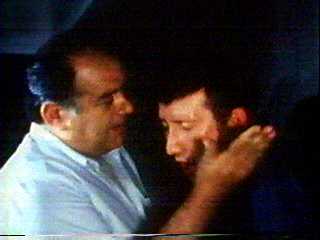
Charlie passes by a self service laundry. The owner Coley (Coleman Francis) sits inside. Our hero asks him what's happening. Coley says his business went bust because of all the people cheating him. (Art imitates life? Who knows....) Charlie asks if he's OK and, after a bit of small talk, pushes some money on him.
 |
 |
| "Say
it, blast you! Say it!" "Alright! I'll never make another monster movie with dance routines." |
Coleman Francis gives creative advice to Steckler. ("Voiceovers. Audiences love those. You could do a whole movie with those.") |
And our hero's back on the case again. He drops in on the home of Shawn Call. She used to be a dancer with Carrie. When she answers the door, she's tired. After all, it's only noon. Through the doorway, Charlie can see a man getting dressed. (By the way, it's the Ferg Flunky.) The detective asks the lethargic lady about Carrie. She hedges her answers because she thinks Charlie's a cop. He says he isn't, but tells her he's a private detective. She refuses to believe that; she's seen movies, and he doesn't look like a private detective. Finally, she tells him to come back later.
After Charlie goes away, the Ferg Flunky asks Shawn about they guy at the door. He thinks Fergerson sent him.
Charlie goes to the pool party residence of Wade the agent, who seems to have no shortage of scene distracting poolside girls. (Like we said earlier, it's almost a set-up for a musical number.) The agent doesn't know where Carrie is now, but he does remember that she was friends with Julie Richards, and Wade knows where she lives.
Elsewhere, The Ferg Flunky talks to Fritz about a business proposition. He wants to undersell Frankie. Fritz doesn't like the idea, and as a visual aid, shows him the gap in his smile. Frankie did that to him. The photographer tells him to give it up. (He also calls him by name: Herb. Sorry, but we're sticking with calling him the Freg Flunky 'cause it's more fun to say.)
Charlie goes to see Julie. The lights are out, but the door is unlocked. He lets himself in. Julie's in the living room. She's disoriented and asks Charlie if he's a bird. (OK, the lights are out and no one's home....) Charlie takes a seat and says he's looking for Carrie. Julie dances around the room for a while and tells Charlie to fly like a bird to find Carrie. She tries to float around the room but doesn't float so much as fall -- onto Charlie.
The detective makes love to Julie. (That would be PG lovemaking. Your ethical view may vary regarding banging the drum slowly with someone who can't decide on a fixed plane of existence.) Afterwards, she tells him that for cherchez la femme, he should see Frankie Roberts, Carrie's ex-boyfriend.
Go to a party at night. Enter Charlie. He passes through the groovy mod stuff happening at this scene, baby, and helps himself to some punch. (Heh, wonder what they've been using to flavor their Kool-Aid.) Frankie is at this party. While getting a cup of punch, he asks Charlie what he's doing here. The detective says he's looking for a woman. When he says his name, Frankie does a spit-take. (Would've been a cute scene if the reaction wasn't telegraphed.)
Shawn Call is at the party, too. Charlie asks her about Carrie. She doesn't want to talk. They leave. And Frankie watches them go. And elsewhere in the room, apparently invisible to everyone else there, is Carrie. She's in her funky cat-suit, leaning against post and grooving to her own private Melodramatic Organ Music™.
Shawn and Charlie go to the beach. They kiss. Fade out over the water.
At Fergerson's office, the Ferg Flunky phrases to Frankie that the
phantom front founder won't be found here until Monday. Fine. The tough guy says he'll be back with
money, and Fergerson had better be there.
The Glass Key Largo
Daybreak. (And by our reckoning, that'd be fourth daybreak. So much for the three day deadline.) Shawn is at Charlie's boat. She says she'll help him find Carrie, but he should be careful because she's weird. (Weird? Relative to what other women in this movie?)
Charlie goes to Carrie's apartment, but he can't remember the room number. He picks a likely number and knocks on the door. A woman's voice tells him to come in. He opens the door. It's Carrie. She's wearing a black leotard number and dancing to Melodramatic Organ Music™. (Actually, dancing isn't the right word. It's more like Tai Chi for showgirls.) She says Fergerson sent him. He quips, "Hey, who's the real detective here?" (Uh, heh.)
She offers him a chance to earn seventy-five thousand. Negotiations begin. There's a hundred-and-fifty grand of heroin on the line. She explains to Charlie that she took the stuff from an importer, but she was robbed by Frankie the pusher. (They show us the action from the opening credits. Knew it had a flashback quality to it, didn't you?) Now she's caught between Fergerson, who wants the stuff back, and Frankie, who is going to sell it. Her deal: Help her get the junk back, and she'll split it fifty-fifty.
They go to Frankie's and wait for him leave. In they go. She knows exactly where it is -- under a pile of wood. Charlie digs through the pile. (Insert your own lumbering japes about wooden acting here.) He finds the satchel. Unfortunately, one of Frankie's flunkies picks that moment to enter. Our hero rushes him, knocking him over. The two robbers get away, running hand-in-hand.
Frankie returns. He digs through the woodpile. Elsewhere, Charlie and Carrie play catch with the satchel to the tune of tough, staccato music. (Heh, betcha thought they'd go with that Melodramatic Organ Music™.) But back at Frankie's, his flunky says the guy who bagged the bag was at the party last night. He left with Shawn Call. So Frankie pays a little visit to Shawn. The pusher shoves her around until she spills about Charlie and his boat called the Rogue.
So Frankie goes to the marina. After a few shots of him checking out the sterns on a few boats (heh, Frankie's a stern man), he finally finds the Rogue. Fortunately for Charlie and Carrie, they aren't in the boat; they were on the bank of the shore. They can see him from where they sit, and vice versa. They run. Frankie follows. It's a chase scene on foot. Frankie gains on them. When the pursuer is within striking distance, Charlie lets him have the satchel -- in the midsection, real hard. Frankie goes down. Charlie and Carrie continue running with the satchel.
The chase continues through a train depot. Our heroes try to lose him by running between some freight cars, but no go. Frankie gains on them again. He tackles Charlie. Fisticuffs follow, and neither of these guys fight fair. Carrie takes the opportunity to grab the bag, but she drops to the ground while catching her breath. The boys continue beating each other senseless. Frankie wins. (Charlie apparently had a shorter distance to senseless.) He stands over Charlie, but is interrupted by the sound of a gunshot. Down he goes.
Charlie shakes it off and gets up. He looks around, but can't see the shooter. Carrie is still on the ground catching her breath. They leave before they get shot, too.
Later, Charlie and Carrie make out. He's distracted by the loose thread. Who shot Frankie? He asks Carrie if Fergerson's a good shot. When she says she doesn't know, he decides to forget it and return to the business at hand. They make love in bed to the tune of (no pun) Melodramatic Organ Music™.
Fade to black. The end, no end credits. No, wait. That was just a deceptively long blank screen before the next scene. There's more movie, but it's the policy of B-Notes not to give away an ending if we respect the movie enough. And strangely enough, we do.
 |
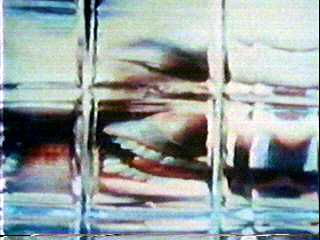 |
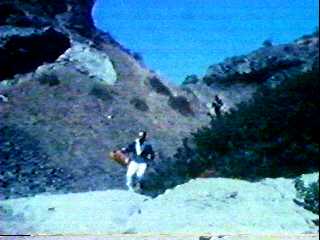
| Later in the movie, we get Bronson Canyon and a distorted face seen through a water dispenser bottle. It's déjà vu all over again. | |
The Good Stuff
Eccentric Originality
Movies by Ray Dennis Steckler tend to be fiercely independent.
They have their own way of looking at things, tending toward an unexpected
sense of originality. Body Fever breaks a few rules and warps
a few expectations. It may be debatable if some of the things tried
actually work, but the basic eccentricity of a Steckler movie assures some
uniqueness.
Plot Complications
The framework for the plot is complicated. And you can further note that it's ambitiously complicated for a B movie. The story introduces a few characters at a time and intentionally obscures how they fit into the big picture. This is a good technique for mysteries; to give the audience all the facts will make them lose interest during the exposition. Teasing with a few facts can hook viewers into paying attention so they won't miss a scene with a plot pay-off.
Fortunately, the plot doesn't become convoluted. As each
character is revealed, it usually happens that he or she knows one of the
other characters, for good or ill. Character interrelationships
become complex. Since the story stays in a
relatively tight locality, and given the close-knit nature of the
characters' subculture, it's not a violation of credible probability that
they would know each other.
Living Within Means
Veteran B movie viewers can tell you that the biggest mistake a budget
conscious movie can make is pretense. The more pretentious the
concepts, the more the actors try to convince the audience that these
events are significant, and the tackier the props and production design,
then the greater the unintentional entertainment value. Steckler
wisely keeps the plot limited within the reach of his production
budget. This is a story about lowlifes, so some production tackiness
should be accepted in set design, costume, etc. Form follows
function.
Wrought Irony
Several scenes include voiceovers from Steckler's character. They're ironic by formula. Some of them follow the pattern of the character telling the audience that he's a classy guy and a skilled professional, but the associated action shows the character falling flat on his great expectations. (This works very well for audience members who are annoyed by what sounds like a sincerely egotistical boast, and then amused when that gag pays off with the action.)
And given Steckler's record as a filmmaker, he probably earned that irony honestly.
The Bad Stuff
Additive Identity
As with other Steckler movies, the presentation is mostly a collection
of staged scenes with filler for transitions. The staged scenes in Body
Fever are fairly effective for communicating the story, but the fill
kills. Despite the entertaining travelogue value of some of them,
the function of these runtime additives is too obvious, and they have a
style different from the staged scenes. They break
the flow of the presentation.
Impoverished Improvisation
Although the characters are eccentric elements in a complicated story, they still lack depth. That's not to say the actors are inefficient. OK, some of them are, but that's not to say it. It's more like Steckler didn't (or couldn't) film the characters to make the most of them on screen. There are several scenes with awkward character placement in the frame. And when the presentation relies on the character interaction, this directorial inadequacy is a major deficit in the finished product.
Steckler had a reputation for improvisation while making a movie.
That is, he'd rewrite scenes shortly before shooting them. Although the positive side of this is an unexpected sense of originality
(as noted above), the drawback is that this kind of inventiveness is not a
group activity. What might've seemed natural to Steckler may not
have seemed natural to the other actors. Some of the scenes could've
benefited from rehearsal. For example, there's the scene at the
party where Charlie states his business and Frankie does a spit
take. The set-up and timing for Frankie's reaction is too
awkward. You get the feeling they wrote that spit bit about five
minutes before shooting it. And since they were probably on a rushed
production schedule, there'd be only one take.
Cheap Shots
Although the movie lives within its budget, the tatty tone is too
obvious. When a perception like this happens, it's usually due to a
lack of craftsmanship. Consider: Directors like John Carpenter and
Robert Rodriguez could, in their early careers, get exceptional product
from limited material, and they accomplished this by attention to detail
and creative application. Steckler, on the other hand, didn't show
these talents in Body Fever. When you see it, you know you're
watching a cheap movie because no effort has been made to distract you
from that liability.
Gratuitous Frolicking
Another questionable choice by Steckler is frolicking. That is, there are scenes where he expresses his character's joy by gleefully capering about. Now let's be honest here. Some people don't look good when they exaggerate a smile. That's not to say they shouldn't smile, but that does mean they probably shouldn't use a big smile to express happiness when acting. If you've ever seen Steckler cavort in a movie, you also know that some actors shouldn't emote with that exaggerated expression of joy, either.
The Who Cares Stuff
Notes on the Cast and Crew
Ray Dennis Steckler (Charlie Smith, writer, director, and producer) has had an interesting career in the movies. See Roots, Shoots, and Other Compares below.
Carolyn Brandt (Carrie Ersksine) was a regular in Steckler's movies.
Gary Kent (Frankie Roberts) worked in various other movies as a bit player and stunt arranger. Some of the movies he worked on were better (stunts and bit part in Targets (1968)) than others (make-up and bit part in Dracula Vs. Frankenstein (1971)). He also directed Devil Wolf of Shadow Mountain (1964)
Bernard Fein (Big Mac)
was a regular on The Phil Silvers Show (1955-1959) and was Charlie
Bananas in the Rat Pack gangster musical Robin and the 7 Hoods (1964).
Coleman Francis (Coley) gained undying fame after making three of the
worst movies in American history:
Night Train to Mundo Fine (1966, a.k.a. Red Zone Cuba), The
Skydivers (1963), and The Beast of Yucca Flats (1961). How did he
get into this movie? According to a tidbit in Daddy-O's
Drive-In Dirt, "Steckler had just completed filming the last scene, when walking to his car, he saw Francis drunk and lying in the gutter.
Steckler felt so bad about Francis's condition that, even though he had finished work on the movie, he offered Francis some work on it, adding some scenes just to give Francis some work and some badly needed cash, which the director gave him before the the next day's filming.
Steckler and his crew were astonished when Francis showed up for work bright-eyed, clean shaven and nicely attired--which was a bit of a problem, since Steckler had wanted him to play the part of a disheveled bum!
Francis had used the advance pay to buy a decent second-hand suit and make a trip to the barber."
Ron Haydock (Fritz) was Rat Pfink in Rat Pfink a Boo Boo (1965), and he wrote that screenplay, too.
Herb Robins (Herbie)
wrote and directed high-brow entertainment like The Brainsucker (1988)
and The Worm Eaters (1977).
Roots, Shoots, and Other Compares
Steckler-Mania - Ray Dennis Steckler movies are generally hard to find. (If you want to seek them out, we recommend Sinister Cinema and Movies Unlimited.) But add to their rarity the fact that Steckler used a variety of aliases during his career as a filmmaker. It makes them even more challenging to catalogue.
The following movies were made by Steckler as a director or producer. This list is not complete; he made some other movies that haven't been listed in reliable sources like the Internet Movie Database and the All Movie Guide. Steckler's job on each movie follows the title. Rather than give them all chronologically, they're broken down by whichever alias Steckler was using at the time.
The Flagg Days - Early in Steckler's career, he directed under his own name but did his acting under the alias Cash Flagg. Since most of these are popular with cult audiences, it's easier to get details on them.
Wild Guitar (1962) - Director, writer, and actor. An innocent musician hooks up with an unethical agent. Steckler appears as one of the agent's thugs. Stars Arch Hall Jr. as the the musician, and this was made about the time Steckler had a bit part in Arch Hall Sr.'s Eegah!
Goof on the Loose (1962)
- Steckler's first project on his own. Comedy short with the
Frankenstein monster. Cf. The Lemon Grove Kids below.
The Incredibly Strange Creatures Who Stopped Living and Became Mixed-Up
Zombies (1963, a.k.a. a whole bunch of other titles) - Producer,
director, and actor. Semi-mystical carnival hypnotist turns men into homicidal
drones.
She does her thing on a goalless youth (Steckler) and sends him to do in a dancer (Carolyn Brandt).
Includes staged girlie-show dance routines, so it was billed as a musical monster movie.
Popular attraction on MST3K.
By the way, the original title was going to be The Incredibly Strange Creatures, or Why I Stopped Living and Became a Mixed-Up Zombie. Lawyers associated with Kubrick's Dr. Strangelove or: How I Learned to Stop Worrying and Love the Bomb leaned on Steckler until he changed his title. Result: Free publicity.
The Thrill Killers (1964, a.k.a. The Maniacs are Loose and Mad Dog Click) - Director, writer, and actor. Two homicidal brothers (one of them is Steckler) and a couple of equally dangerous friends cut loose for a while. Literally. They're into axes. They eventually get around to chasing Carolyn Brandt. Filmed in black an white. Some effective suspense. Steckler later revisited this plot under his Wolfgang Schmidt alias (see below).
Some versions
of this movie had a gimmick called Hallucinogenic Hypno-Vision. At
the beginning of the movie, a hypnotist called The Great Ormond
"hypnotized" the audience so they would see the killers running
out of the movie and into the audience. (Cf. Horrors of the Black
Museum (1959).) But wait, there's more. Steckler's movie distributor
(who was a professional magician) sent Steckler to Don Post studios and
had latex masks cast from his face. These masks, which glowed in the
dark, were sent to the theaters with the film, along with some cardboard
axes. You do the math.
Rat Pfink a Boo Boo (1965) - Producer, director, and cinematographer. Some bored thugs
kidnap a woman (Carolyn Brandt -- gee, what a surprise). Fortunately (?), a
couple of guys who like to play Batman and Robin come to her rescue.
See a review at
The Bad Movie Report.
And once again, Steckler had another title change on his hands. This was supposed to be called Rat Phink and Boo Boo, but the title card had a typo.
Lemon Grove Kids Meet the Monsters (1965, a.k.a. The Lemon Grove Kids Meet the Green Grasshopper and the Vampire Lady from Outer Space) - Producer, director, writer, actor. According to legend, Steckler and his friends shot a few hours of skits featuring The Lemon Grove Kids, who were an homage to the Bowery Boys. Steckler assembled this together (various versions exist), and the result was marketed as either a comedy or a scary children's show, depending on the cut.
But here's what really happened -- according to an article by Ron Haydock. Steckler made a feature called The Lemon Grove Kids at the Big Race. In this movie, the heroes are in a cross-country race, but a local criminal (played by Coleman Francis) has bet against them, so the fix is on. And the bad guys are resourceful, because they not only mess with a few road signs, they also throw a few monsters at the good guys.
Steckler took his movie and edited it down to a short called The Lemon Grove Kids Meet the Monsters. Then he made another Lemon Grove Kids short, this time with an alien, called The Green Grasshopper From Outer Space and the Vampire Lady. He was having problems getting exhibiters to take either short, so he re-edited the whole thing into another feature called The Lemon Grove Kids Meet the Monsters. There. Got all that?
And now the final plot: The Lemon Grove Kids travel cross-country and run into monsters, a spy, and a gorilla. (Easily frightened talking dog with a speech impediment not included.) At some of the theaters, members of the staff were asked to dress up like the monsters and run through the audience at strategic moments. (Cf. The Thrill Killers above.)
Body Fever goes at the tail end of this group.
Although Steckler didn't use the Cash Flagg alias, he finished this movie
in 1969. And then it sat in the can for about ten years.
Sven Cinema - Steckler used aliases with the first name Sven on
a few features.
Sinthia, the Devil's Doll (1968, a.k.a. Teenage She Devil) -
Directed as Sven Christian.
Girl dreams of murdering her father, and it's hinted that she's possessed. Questionable attempts at arty filmmaking follows.
The Mad Love Life of a Hot Vampire (1971) - Directed as Sven Christian. Dracula is a pimp in Las Vegas, and his staff drains a bit more than the average stable of call girls.
Sexorcist Devil (1974, a.k.a. Undressed to Kill) - Directed
as Sven Hellstrom.
Reporter investigates a devil cult.
The Films of Wolfgang Schmidt - For a time, Steckler adopted a Wolfgang Schmidt alias while producing and directing.
Ski Fever (1967) - Producer. Probably as close as Stecker would get to an A picture is this B picture. (Matter of fact, this is so out of line with Steckler's other work that we wonder if this instance of Schmidt is really Steckler's alias.) Ski instructor finds out he's expected to entertain some of his female students. Directed and co-written by Curt Siodmak (?!).
Blood Shack (1971, a.k.a. The Chooper and Curse of the Evil Spirit) - Director, writer. Woman (Carolyn you-know-who) inherits property that may be haunted by a homicidal Native American spirit called the Chooper (which is why this is not another title card typo). Features lots of rodeo footage to pad out the running time, so if you're not into that sort of thing, be sure to keep your finger on the fast-forward button.
The Hollywood Strangler Meets the Skid Row Slasher (1979, a.k.a. The
Hollywood Strangler and The Model Killer) - Director.
Guy called Click (see Thrill Killers above) hates women because he thinks they're sluts, so he kills 'em.
Meanwhile, someone else has been doing in drunks. Of course, they
cross paths. Given their differing standards, will things work out between them?
Cindy Lou Flicks - Steckler made porn under the alias Cindy Lou Sutters. (This was back when this sort of thing was expected to have a plot and something resembling character development.)
Perverted Passion (1974, a.k.a. Fire Down Below) - Director
Sex Rink (1976) - Director. Over-aged teens get
busy at a roller rink.
Teenage Dessert (1976) - Director. Fun and games in Venice, CA
Plato's Retreat West (1983) - Director. Pretend documentary about Plato's Retreat.
Weekend Cowgirls (1983) - Director. Woman spies on her friends having sex.
Las Vegas Serial Killer (1986, a.k.a. The Hollywood Strangler in Las Vegas) - Director. The continuing adventures of Click and his unusual view on social reform.
Summer Fun (1998) - Director. Family film. No, really. Steckler's daughter Bailey plays a girl going through a series of misadventures.
The Bottom Line
Eccentric private detective searches for a woman in a seedy drug trade sub-community. Could be Ray Dennis Steckler's best film, but that's not saying much. Quirky and ironic. Surprisingly complicated character interrelationships. Staged set pieces with travelogues padding the transitions. Story's setting works within the production's limited budget, but improvised, rushed production methods make the finished product look even cheaper. Recommended for independent film radicals.
Originally published on 11 May 2001.
 |
   |
A
Proud Annex of....
|
|