|

How the West Was Hun, or...
Cowboy Commandos (1943)
Written by Clark L. Paylow and Elizabeth Beecher
Directed by S. Roy Luby
Details at the IMDB, US.IMDB
As love, if love be perfect, casts out fear,
So hate, if hate be perfect, casts out fear.
- Alfred Tennyson (1809–1892)
B Westerns. You've seen one or two, you've seen 'em all. And "all" in this case means literally hundreds. Production companies like Republic and Monogram cranked them out by the gross during the late 1930's through early 1940's. None of these films really distinguished themselves from the others. As movies, they were generic products.
But every now and again, one of them throws you a curve ball. Maybe you're watching it on TV out the corner of your eye. Outrageous western costumes. Horse chases. Cute cowgirl. Fist fights. Singing cowboy. (Yawn.) Gun fights. The same musical score over and over. Nazis.
Nazis? Whoa! Time out!
Contents
The Plot
Annie Get Your Gunmen
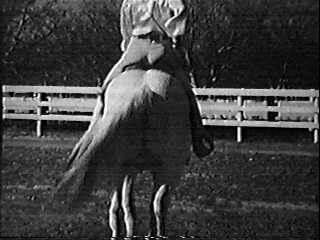
Go to opening credits (white on a folksy rustic western drawing of a wall) and a medley that includes "Home on the Range." (Lookout! It's got the Monogram seal of reproval.) After the credits, we see Joan (Evelyn Finley) doing a riding demonstration for the camera. She puts her white (or "gray" if you are technical) horse through a simple dressage. (Mrs. Apostic used to ride show. I asked her, "Could you ride like that?" "Of course," she said.) After this, she does some trick riding, which includes standing while her arms are pointing up and her horse is at a gallop. For her big demonstration of talent, a blindfolded Joan rides with her body fully extended and parallel to her galloping horse, one foot in a stirrup and one hand on the saddle horn. ("I used to ride like that too," said Mrs. Apostic. "Only not on purpose.")
 |
 |
|
| Not to be confused with "Plowboy Partisans." | It's not a good omen when these are two of the earliest faces you see in a movie. |
Finally, Joan's back in the saddle. She's carrying an American flag on a staff. After approaching the camera, she tells the audience not to applaud - they should use their hands to dig deep for their last seven dollars and buy bonds. (Wait a minute. The average audience member back then had seven bucks on him?)
Crash (Ray Corrigan) and Denny (Dennis Moore) have been watching her. Crash offers to buy a hundred dollars worth. Denny ups the ante for two hundred. Crash laughs and says not on their budget. (No lie. This ain't an A picture, y'know.) They both tell Joan she did well on rehearsal and they can hardly wait to take their show to New York. However, the promise of fame and fortune (in the name of patriotism) gives way to some "which is the better cowboy" one-upmanship between Crash and Denny. Crash settles the matter by drawing his revolver and shooting four bottles. (Dang, those motionless bottles didn't stand a chance. Perhaps for an encore, he'll out-ride some quadriplegics.)
Alibi (Max Terhune) enters. He has a message for Joan. She opens it and reads it, expecting happy news about the upcoming show. Unfortunately, it's news that her brother, a sheriff in a mining community, has been killed. She has to cancel her part in the show and go see her Uncle Dan. The others decide they should go with her and just cancel the show altogether. (They must not have seen Annie Get Your Gun.)
Later, Crash has been sworn in as sheriff. (We're not sure how
this works. "Hi, I'm Crash Corrigan, entertainer, and I'd like
to be your new sheriff." "Why sure, Mr. Corrigan. Here's
your badge and the keys to the jail." Nope. Don't see
it.) And now the bad news. Dan (Steve Clark) explains to our
heroes there are
saboteurs working against his local industry, which is mining magnesite.
He doesn't tell them (or us) what magnesite is, but he does assert that it's very important for winning
the war. (How so? Although magnesite has a variety of
industrial ceramic applications, and it's a source for some heat intensive
fuels, Dan doesn't cite examples of why it's needed by the Allies to beat
the Axis. Perhaps Patton was going to awe the Afrika Corps into
submission with his endless supply of magnesite.)
(And while we're pondering the effective kill potential of a bag of
magnesite....) Wipe fade to a Nazi sittin' room. (You can tell
it's a Nazi sittin' room by the big swastika flags on the wall and the two
sittin' cowboys.) A standing, shadowy figure reprimands his henchman Fraser (John Merton) for being a
wuss and not killing the last sheriff. This meant that Fraser's
partner Mario (Frank Ellis) had to do it. The scheming silhouette
announces that they need to find a more effective way to stop the
magnesite deliveries. Course of action: Mario will take some men and
instantly retire the new sheriff.
Fade back to the good guys. Now that we're sure Dan isn't just paranoid about foul play nor self-delusional about his magnesite, he tells our heroes that the previous sheriff had an idea who was leading the saboteurs but died before announcing his suspicions. Now they need to catch those hornswaglin' hitmen. They could beef up security by hiring more deputies, but that still wouldn't solve the problem of catching the leader of the bad guys. (They could also give the job of sheriff to a real lawman instead of a professional entertainer, but this doesn't occur.)
The good guys decide to work undercover, like
commandos. (Actually, that's like counterintelligence, but we
digress. And we see no need include a wordplay on "counterintelligence"
because it's just too easy.) "Cowboy commandos," says
Crash. (That's either an intentional sound bite for advertising or a
reminder to the audience which disposable oater this is.) They
decide to hire some deputies and stash them nearby. (Uh, those
wouldn't be commandos, either; that'd be a militia.) Denny, Joan,
and Alibi will get jobs at the mine to keep an eye on things.
The Big Spy Country
Later, at the mine office, Joan and Dan are doing some paper work. Fraser enters with Alibi. Dan "fires" Alibi for incompetence. After Alibi vows revenge, Fraser tells the potential disgruntled employee to meet him at Katie's place. Dan leaves, giving Fraser a chance to ask Joan for a date. While he's making his sales pitch, Denny enters and gets snippy with Fraser for asking Joan out. Tough talk follows, and Joan excuses herself. The two guys start fighting. Cue "exciting music." After about three minutes of phony blows and rearranging some of the furniture, Fraser is down and Denny excuses himself for his date with Joan. (Glad they were able to work something out. Maybe later, Denny will clean Fraser's clock for looking at his horse.)
Alibi has gone to Katie's place, which is a bar way off the beaten path. It's the first time Alibi has been there, so he strikes up a conversation with the matronly owner (Edna Bennett) while her non-person husband Warner (Budd Buster) pours drinks. While they talk, Katie explains that this is the end of the line for cars because the road beyond is too rough for them. Alibi rants about what lousy management they have at the mine. Katie gives him a drink and goes to tend something else. While no one is watching, Alibi pours his drink into a spittoon. (Argh! Alcohol abuse.) Warner serves him another, and Alibi covertly disposes of that one, too.
At the sheriff's office, Crash is getting spiffied up. Enter Slim (Johnny Bond), this picture's designated comic relief. Crash offers to make Slim acting sheriff, and his first duty will be to sweep out the office. (Insert obligatory observation of "acting" sheriff here.) After Crash leaves, Slim pauses his sweeping to look at the wanted posters. One of them says "Wanted for Murder" and has a picture of Adolf Hitler. Slim draws his revolver, points it at the picture, and drops the hammer on a couple of empty chambers. (Must be from the Barney Fife school of arms; his one bullet is no doubt in his shirt pocket.)
Slim sits down in a chair, pretends to play the broom like a guitar (the soundtrack obliges) and sings this feature's deeply spiritual tune, "I'm Gonna Get der Führer, Sure as Shootin'." (Lyrics for this song can be found at this article's endnotes. How a goof sitting on his backside is going to be the one to lynch the leader of the Nazi party, we don't know.)
Later, Slim tries on one of Crash's hats. It probably wouldn't look bad on the owner, but on Slim it looks like there's an aircraft carrier on his head. While he's admiring the effect in a mirror, the door behind him opens and an unseen assassin throws a knife. It sticks into the wall next to Slim. He freaks and runs out the door (and somehow doesn't run into whoever threw the knife).
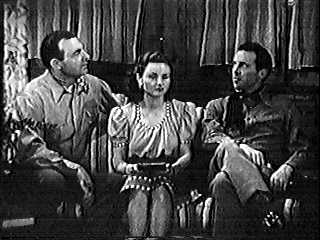
Crash and Denny are at Joan's. They're sitting on a couch with her while she looks through a recipe book for how to make fudge. Crash tells her he knows how. Denny scoffs, and the two silly suitors bicker over Crash's culinary skills. Joan threatens them by saying she won't make any fudge for them. They calm down. (Gee, wouldn't it have been nice if Fraser knew about this weakness. "Hey, Denny. If I give you some fudge, can I take Joan out? Maybe look at your horse, too?")
 |
 |
|
| At the jail, Slim entertains the prisoners with his broom-guitar rendition of "Stairway to Heaven." | Crash and Denny ask Joan why her place is decorated just like the jail. |
Slim arrives and excitedly tells them that someone shot up the jail. The number of shooters increase with each sentence. "Musta been a dozen! Two dozen!" Crash starts to go check it out, but Denny suggests that whoever did this was probably gunning for the sheriff. Denny goes to the jail, and Crash goes to check on Alibi.
Alibi? He's still at Katie's, pretending to be drunk. He does some card tricks, and for his patter he talks about attacking Dan. Over to the side, Mario and Fraser talk, and Alibi listens in. Mario lost his best knife. Fraser still doesn't like idea of wasting another sheriff. Katie tells Fraser to be quiet. Alibi pretends to be passed out.
Crash enters. He reprimands Katie for selling too much booze to miners and uses Alibi as an example. The the sermonizing sheriff picks up the designated drunk and helps him walk while complaining that this man is too drunk to work. Alibi takes advantage of the moment to whisper to Crash that he should look out for Mario.
And speak of the devil-may-care attitude around here, Mario gets tough with Crash. A two-man brawl follows; cue the music. After going through a trick bottle and some furniture, Mario is down and Crash leaves. (Yif! Good thing Mario wasn't sweet on Joan, too.) After Crash is gone, the others help Mario. Alibi cozies up to them.
At the sheriff's office, our heroes sum up what they've learned.
They know the leader of the saboteurs isn't Fraser or Mario because
they're sure someone else is directing their actions. Could it be
Katie or her husband Warner? They doubt it; Warner's hen-pecked and
Katie's just a woman. (Heh.) They also know that Mario wants
Fraser to take over a job, but they don't know what. There's a
shipment of magnesite heading out from the mine tomorrow. Should
they post extra guards? They decide to play it like they're not suspicious
but keep ready to move if there's trouble.
Wagon Heels
The next day, the shipment of magnesite leaves the mine by buckboard. Slim's riding escort. Joan and Denny watch it leave. They notice Fraser's not around. (Maybe he's making a batch of bribe worthy fudge.)
Fraser is off the side of the road. He watches the coach pass and rides to a shack. Cue the music. Fraser gets two henchman called Fred (George Chesebro) and Hans (Bud Osborne) to ride out after the buckboard. (Now there's a tactic. Why Fred and Hans had to be at the shack instead of ready with Fraser for an ambush, we don't know.) The two riders catch up with their target and start shooting. The buckboard driver pulls the wagon off to the side. It's a stand off. Slim and the driver shoot back, but Slim takes a bullet graze on the arm. He rides away to get help, leaving the buckboard driver to hold off the bandits.
Slim gets to Denny and Joan and tells them what's happened. (No, the number of bandits in his report do not rise exponentially. Slim has suddenly become competent, and the bullet mark makes him heroic for this story's purposes. Wounding can make any goofball seem noble. See Stagecoach (1939), wherein an arrow wound justifies Andy Devine's comic relief character.) Denny mounts up and flies off to the buckboard while Joan tends to Slim's arm. After taking care of Slim, Joan rides after Denny.
Back at the standoff, the bandits and the buckboard driver are still shooting it out, maybe thirty yards from each other. (Damn! How much ammunition have these guys gone through? And the most firefight damage thus far is a guy getting nicked in the arm? What the...?) Denny arrives and starts shooting. (We're not bothering with counting shots, because it is a well known fact that revolvers in these movies pack an infinite number of bullets.) The bandits give up (Why not? No one is hitting anyone here.) and beat hooves back to their hideout.
Denny rides after them. Joan arrives at the buckboard in time to see which way everyone went. Denny follows the bandits to the shack. He dismounts and hitches his horse to a fence. (With his back to the shack, yet. You do the math.) Denny goes to the shack and peaks into a window, but the bandits get the drop on him from behind and offer him a no option invitation to go inside. Hans leaves to take care of Slim. This leaves Fred holding Denny at gunpoint while they banter about who's going to win the war. Unfortunately for Fred, (1) Denny tires of banter fairly quickly, and (2) Denny is allowed to get the drop on anyone. In this case, Joan taps on the window and distracts Fred. While Fred is trying to get a shot at the window, Denny decks him.
And so back at the Sheriff's office, Denny, Joan, and Crash interrogate Fred. Crash asks the other to leave so there won't be any witnesses. After the others have gone, Crash calls Fred his fine feathered friend and begins the questioning in earnest. (Fine feathered friend? Maybe he means stool pigeon. Maybe Fred gave him the bird while we weren't looking. No idea here.)
After a few dire predictions about hanging, Fred is ready to talk. Unfortunately, he gets as far as "The leader is..." when someone opens the door and shoots him dead. It's Mario and Hans, but they've got bandanas over their lower faces. (In a town this small, no one's going to recognize Mario?) Crash throws a stool at Mario. (Ok. So maybe it was a stool pigeon reference.) The slick sheriff goes hand-to-hand with Hans, but as soon as our hero takes him out, Mario shrugs off his stool problem and shoots Crash. Crash, uh, crashes to the floor. The bad guys leave. As soon as they're gone, Crash gets up. (You suppose maybe Crash was one of those kids who cheated at playing war? "Bang! Bang! Hey, you're dead!" "No, I'm not.")
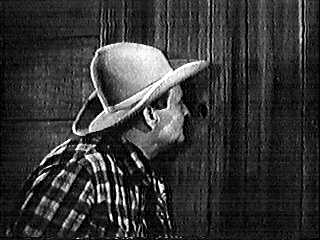
Elsewhere, Alibi is outside prying a knot out of a plank in a wall. He peeks through the hole. The room on the other side is decorated with Nazi flags. He replaces the knot and goes around to the front. It's Katie's place. He goes inside and takes a comfortable seat, pretending to be sleepy. Mario and Hans enter. Katie tries to get Alibi to leave for a little bit. He won't go, but he does play one of them fancy new pinball machines she's got over on the other side of the room.
Slim arrives and asks Katie for a drink, but he doesn't want liquor because it gives him headaches. (It's almost a setup for being hit over the head with a bottle, but no go.) Katie gives him two glasses, one with water and the other with some Bromo-Seltzer powder. She tells him to add the water to the powder. As soon as he does this, the stuff foams up quickly. Slim puts his hand over the top of the glass to stop it, but it shoots out. (OK, God's in His Heaven, and Slim is back to doing comedy relief. All is right with the world again.)
Slim goes over to Alibi, who is still playing pinball, and talks quietly to him . The pretend drunk quickly briefs the pretend comic relief lawman. Slim leaves. When Alibi turns around, Mario and Hans are gone. He walks over to the bar. Katie offers him a drink, and then notices that a hinged panel in the wall is open. (Oops. Katie now has a German accent throughout the rest of this movie. Thank you, continuity.) While closing it, she mumbles about how her husband is always leaving cupboards open.
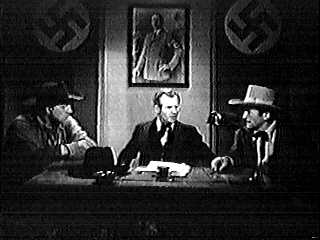
Alibi excuses himself. He goes outside and sneaks around to the back. After prying the knot out again, he listens to someone chewing out Hans and Mario for being lousy Gestapo agents. Alibi can now see who the leader is: It's Warner. (OK, who here is surprised? Anyone? Anyone at all?) Warner poses in front of a portrait of Hitler and tells the other two his master plan. At six, they will blow up the entrance to the mine. (Aw, shoot. Why didn't these espionage experts just do this in the first place?)
 |
 |
|
| Alibi in Porky's IV: Frontier Floozies | We've lost track. This is either the bad guys in this movie or somewhere in modern day Montana. |
Spy Smashers
Somehow, Slim has already managed to head over to the sheriff's office, update Crash, and come back to help Alibi. Alibi tells him to keep an eye on Katie while he warns the others about the leader's plan. He goes to Joan and tells her. Then he goes to get Crash and Denny while she rides off like Paul Revere to round up those deputies they've stashed around here. Cue the music.
But the bad guys have already assembled near the mine, and they've got about eight men all together. Fraser arrives with a box of explosives labeled "Hercules Powder." (Hmmm. Product placement? We don't know.) The leader sends Fritz and Mario to take out the guards at the mine entrance and selects Hans plus another man to go further back to act as lookouts. Fortunately for the guards at the mine entrance, the blood thirsty Nazi operatives just bean them over their heads and tie them up. Fraser arrives with the dynamite and starts setting it up.
This would be about the time the good guys arrive, so now we have our principals plus about six extras that Joan managed to round up. Cue the music and loop it a lot. Instead of heading straight to the mine, they circle around to another side. Denny and Alibi run into the two sentries and keep them busy while the others continue forward. Denny takes one out per plain old garden variety hand-to-hand. Alibi grapples with Hans, but stops to do the Nazi salute. When Hans responds by reflex, Alibi takes advantage of that distraction and decks him. (We'd like to think that no servicemen were killed in the real war while trying to emulate that trick.)
The bad guys have hooked up the wires from the dynamite to a plunger box, but they're interrupted by the sudden arrival of uninvited good guys. It's a shootout. A couple of the bad guys drop, but we don't see any good guys going down. (Gee, what a surprise. We also note that nobody from the bad team bothers to take about one second finish what they came here to do.) The bad guys run away.
Elsewhere, Slim is still patrolling around Katie's place. He walks over to a car. Katie looks outside and sees Slim letting the air out of the tires. (We assume it's Katie's car. That, or it's a German car and Slim's wartime jingoism has gotten to the better of him.) Joan arrives. She and Slim go into the bar. Katie's not there, but Slim knows there's a false panel here somewhere. They look for it.
Back at the mine, the bad guys are down to four men and they're cornered behind a big boulder. Fraser suggests to Warner that they should give up. Warner observes that Fraser is least likely to be shot on sight and lets him and another flunky go out with a flag of truce. While the good guys are sizing up this parley play, Warner and Mario beat feet the other way. Crash and Denny give chase.
The runners split up. Mario sprints into a shack. Denny goes in and takes him out again. (No, wait. Denny vs. Fraser. Crash vs. Mario. Crash vs. Hans with a Mario chaser. Denny vs. Fred. OK, skip that "again" part; easy to lose track of matches here.) Warner jumps on a horse, and so does Crash. (Not on the same horse, you jokers.) Crash chases Warner for a while. When he catches up to the generic bad guy, Crash jumps from his horse and tackles Warner. (OK, maybe on the same horse after all, you jokers.) Both men fall into a gully. Guess which one stands up first. End looping the music cue.
Back at Katie's place, the good guys arrive from the mine. They hear shooting in the back and go through the not-so-secret-anymore panel. Slim is shooting up the portrait of der Führer. "Told you I'd get him," says Slim. (Y'know, there's a blurry line between crowd pleasing propaganda and just plain psychotic. Guess you had to be living back then to know which one this was.) Katie is sitting in a chair with her suitcase on her lap. (They didn't bother keeping guard on her nor tying her up. But, after all, she's just a woman. Heh.)
Dan takes Katie away. Joan turns to leave, Crash offers his arm to her, and they promenade out. Denny realizes he's been outmaneuvered and starts after them, but Slim jokingly offers his arm to Denny. The man's not in the mood for comic relief endings, so he pushes away Slim's arm and runs after Joan and Crash. Slim turns around and offers his arm to Alibi. They strike a mock serious pose and promenade out. (Hey, waitaminute! That was actually funny.) The end.
The Good Stuff
Old West Show
This is an old B western, which means cardboard characters and lots of action. Production companies like Republic and Monogram cranked them out at a phenomenal rate, and there wasn't a lot to distinguish one from another. Therefore, Cowboy Commandos shares all the good and bad points with all the other B westerns from this time.
So on the plus side, the actors had only one lofty goal in mind: to entertain an audience for about an hour. They're like the old traveling wild west shows that would come to your town and amuse you with feats of riding, some athletic comedy, and maybe crowd pleasing song or two. Nobody expected artistic merit in any of those shows. Nobody should look for artistic merit in an old B western. If you get action, some comedy, and a song, the checkpoints are met.
The Bad Stuff
"Gettin' Old" West Show
However, Cowboy Commandos was near the end of the line for the ubiquitous oaters of the 1930's and 1940's. By this time, the formula for these things became as automatic as a plot for a Harlequin novel. It was getting old and unimaginative. And a boring B western is a pathetic thing.
For example, Crash demonstrates his skill as a shooter by drawing his revolver and speed shooting four bottles. In real life, that's pretty good. But in a movie where the character should be larger than life, it's not what you'd call entertaining. Maybe if the bottles were tossed in the air. Maybe if Crash shot two normally, followed by one shot over his shoulder and one shot under the leg. Something imaginative would've helped here. By the end of the movie, when Crash jumps off his own horse and tackles another rider, it's too little too late.
Likewise, Alibi's comic relief is sadly unimpressive compared to his
earlier work. His drunk act at Katie's is by-the-numbers. His
card trick is poorly played for the camera. Once again, no
imagination until the very end, and that's too little too late, too.
Life on the Range During Wartime
The imagination for this movie went into the plot device, and that's giving imagination more credit than should be due. Fans of Universal's Sherlock Holmes movies may recall how later entries in the series had the world's most famous consulting detective fighting Nazi spies instead of just plain old Moriarty. Several other series type movies from this period were injected with wartime flavorings. The only thing in Cowboy Commandos that distinguishes itself from other oaters is the novelty of Nazi bad guys. And as wartime propaganda, this gets ugly.
There were two kinds of propaganda messages in the United States during World War II: "Work hard for our side (and buy bonds)" and "The enemy is evil. (Kill him and buy bonds.)" Of the second type, some filmmakers took the high road. For example, Frank Capra's Why We Fight series of documentaries took a relatively pragmatic approach to America's involvement in the war by explaining what the leaders of the Axis nations were doing before telling the audience that these men were evil and should be stopped. (Sidenote: Capra felt guilty about making propaganda -- until he found out, after the fact, what had been happening in Germany's concentration camps.)
The low road for "the enemy is evil" was more like "the enemy is evil, ugly, stupid, and easily defeated. (Kill lots of them and buy some more bonds.)" This was the most common form injected into wartime adventure movies, and that's what we have here in Cowboy Commandos. The war comes to the Range Busters, not the other way around. One-sided wartime diatribes occasionally punctuate the dialogue. Slim's song fantasy about lynching Hitler might've been a crowd pleaser back then, but looking at it today, it's downright neurotic.
Ah, well. At least it's not as psychotic as Gung Ho (1943), which was more at "the enemy is evil, ugly, stupid, subhuman Japanese that dies in droves. (Oh, and buy bonds.)" Compare that one to Nazi Germany's Der Ewige Jude (1940), which, uh, educated (for lack of better word) the audience about those "evil, ugly, stupid, subhuman Jews that should be exterminated in droves. (And buy bonds, er, build glory.)"
The Who Cares Stuff
Notes on the Cast and Crew
Before referencing the careers of the cast and crew, we should say a few words about the the Three Mesquiteers and the Range Busters.
The Three Mesquiteers was series of B westerns produced by Republic from the mid 1930's through the early 1940's. The heroes were a group of Great War (a.k.a. World War I) vets who had adventures in the west. The lineup often changed; at one time, they had a temp called John Wayne. Ray Corrigan and Max Terhune were regulars.
In 1940, Monogram wanted their own Mesquiteers, and the Range Busters were born. Once again, Corrigan and Terhune were regulars. During a four year run, there were a total of twenty-four Range Busters movies. Cowboy Commandos near the end of that run.
For more some impressively well detailed information on the Three Mesquiteers, the Range Busters, and other B western teams, check out The Old Coral.
S. Roy Luby (director) was a film editor in the early 1930's for Phil Goldstone's Tiffany brand westerns. He added director to his career in the mid 1930's for Willis Kent's westerns and did several of the Range Busters movies. Cowboy Commandos was near the end of his regular career, but he continued editing and directing a few westerns for the minor league studios. He later edited for TV shows like The Adventures of Wild Bill Hickok (1951-1958) and Rocky Jones, Space Ranger (1954).
Clark L. Paylow (story, and assistant director) was early in his career. He mostly worked as an assistant director and production manager, and his resume would become an eclectic mix: Directed the notoriously bad Ring of Terror (1962), assistant director on The Atomic Submarine (1959), The Time Travelers (1964), The Silencers (1966), and a reputable war biopic Hell to Eternity (1960). His track record as a producer/production manager ranges from Madmen of Mandoras (1963, recut in 1968 as They Saved Hitler's Brain) to The Conversation (1974) and Close Encounters of the Third Kind (1977).
Elizabeth Beecher (screenplay) wrote at least eighteen produced scripts for Monogram, including several of the Range Busters movies. She also wrote some children's books with western characters.
Ray Corrigan (Crash) got into movies as a physical trainer for actors. His nickname typified his positive "just do it" kind of attitude. After doing various bit parts in some Gene Autry westerns and a few prestige pictures in the early 1930's, he hit the top part of the bill, playing "himself" in The Undersea Kingdom serial, followed by his run with The Three Mesquiteers.
By the 1940's, he was playing "himself" again in the various adventures of the Range Busters. You can also see his work as a guy in a gorilla suit for various B shockers like The Ape (1940), Captive Wild Woman (1943), and as the Martian stowaway in It! The Terror from Beyond Space (1958). When he wasn't on screen, Corrigan built an impressive studio lot for westerns called the Corriganville Movie Ranch.
Dennis Moore (Denny) worked in various B westerns under the name Denny Meadows in the late 1930's. He also had various parts as airplane pilots and other aviation types during the late 1930's. (Go figure the one not called Crash was a pilot.) You can also see him in various roles in various examples of the East Side Kids movies. He had a recurring role as one of the Range Busters for only a few movies, plus star billing in The Purple Monster Strikes serial (1945), but mostly did bit work.
Max Terhune (Alibi) was a vaudevillian specializing in juggling and birdcalls. He did radio with Gene Autry, then went into movies. He often played a ventriloquist as comic relief, and his regular sidekick dummy was called Elmer. Most of his later career was working with Corrigan, both on screen and off. You can find out more about him at Hoosierworld.
Most of the other men in this movie were in several other westerns, averaging about 250 appearances each. We should also note that stocky Bud Osborne (Hans) racked up about 450 screen appearances. Impressive, you may say. He rounded out the end of his long career as a regular in movies by Edward D. Wood, Jr.
Most of the crew worked on various other westerns,
too. But as we've mentioned for Bud Osborne, we also note that Lyle Willey
(sound) and William L. Nolte (executive in charge of production)
would also be working for Wood in their later careers. Willey also did the sound for
Phil Tucker's Robot
Monster (1953)
Roots, Shoots, and Other Compares
Hybrid Westerns, From 1932 to 1969
Ah, the hybrid western. Combine cowboys with something out of their ordinary and you may have something new. Sometimes it was new stuff dropped into what would've been a routine western. Else, a western setting and characters were used for what would've been weird without the cowboys. Please note that the list below does not include movies with characters who just happen to be cowboys in non-cowboy settings, as in Mighty Joe Young (1949) and Dr. Strangelove (1964).
Broadway to Cheyenne (1932) - New York mobsters move in on a small western town. Western gangsters (as opposed to plain old gangs) would appear in various westerns hereafter.
The Phantom Empire (1935) - 1930's science fiction goes west. The ancient yet scientifically advanced civilization of Mu survives in tunnels under Gene Autry's ranch.
Ghost Patrol (1936) - Cowboys vs science enhanced bad guys.
Riders of the Whistling Skull (1937) - At an archeological site, The Three Mesquiteers explore a supposedly haunted lost city.
Harlem on the Prairie (1937) - Urban segregation goes west. See also, Two Gun Man From Harlem (1938), The Bronze Buckaroo (1939) and Harlem Rides the Range (1939). These were westerns with primarily black casts intended for exhibition at theaters in segregated, black neighborhoods. Because of their anticipated audience, they're not black exploitation (or "blaxploitation") movies. But there'd be exploitation aplenty of another kind in...
Terror of Tiny Town (1938) - Exploitation goes west when midgets ride the range on Shetland ponies. See reviews on this one at Oh! The Humanity! and Badmovies.org.
The Kansas Terrors (1939) - The Range Busters run afoul of a ruthless Caribbean dictator.
The Phantom Plainsmen (1942) - The Three Mesquiteers vs. Nazi horse traders.
Texas to Bataan (1942) - The Range Busters vs. German and Japanese cattle rustlers. (Y'know, I can't see coming all the way from Germany for some beef. On the other hand, given what they pay for a hamburger in Tokyo....)
Valley of Hunted Men (1942) - Nazi spy escapes from Canada and tries to steal a new scientific discovery in the same town that The Three Mesquiteers happen to be in.
Haunted Ranch (1943) - The Range Busters look for gold in a mysterious mansion. (Cf. Spook Town (1944).)
Black Market Rustlers (1943) - Cattle thieves willingly sell beef to people without ration stamps, and The Range Busters are there. (To stop them, dammit!)
The Whispering Skull (1944) - Masked super villain type kills at night, and it's up to the Texas Rangers (one of PRC's B western teams) to stop him.
Pursued (1947) - Western meets moody film noir.
Heaven Only Knows (1947) - "It's a Wonderful West" when an angel tries to help a gambler.
The Ernie Kovacs Show (1952 - 1956) - Ran a skit on hybrid westerns, including scenes from The Amazing Colossal Cowboy (he came from a flying saucer) and The Incredible Shrinking Cowboy.
The Beast of Hollow Mountain (1956) - Cowboy reckons a dinosaur's been at the local cattle. Cf. The Valley of Gwangi below.
Teenage Monster (1957) - Boy in old west gets zapped by a meteor and turns into a Bigfoot type critter.
El Grito de la Muerte (1958, a.k.a The Living Coffin) - Poe's "Premature Burial" goes west.
The Fiend Who Walked the West (1958) - Western remake of Kiss of Death (1947). Tries to be creepy by using Bernard Herman's theremin themes from The Day the Earth Stood Still (1951). (Unlike Reese's candies, some things should not go together.)
Curse of the Undead (1959) - Unbeatable hired gun shows up in town. Turns out he's unbeatable because he's a vampire. Awesome trick ending. See review by Dr. Freex.
The Twilight Zone (1959 - 1965) - Various episodes in this anthology series included the western genre to a degree. "Mr. Denton on Doomsday" has a past-his-prime gunfighter and a magic potion. A condemned man is saved by a scientist with a time machine in "Execution." Going the other direction, a settler in the 1800's crosses time when he walks "A Hundred Years Over the Rim." "The Grave" is a haunted outlaw story; by converse, outlaws haunt a TV actor in "Showdown with Rance McGrew," and the spirits of Custer's troops haunt a battlefield in "The 7th is Made Up of Phantoms."
Devil Wolf of Shadow Mountain (1964) - A drink of the wrong stuff makes a cowboy turn into a werewolf. (Heh, talk about going for a hair of the dog that bit you....) Cf. Mad at the Moon (1992).
The Wild, Wild West (1965-1970) - Government agents vs. a few scientifically enhanced bad guys. There was a movie of sorts in 1999....
Billy the Kid vs. Dracula (1966) and Jesse James Meets Frankenstein's Daughter (1966) - The notorious double bill at the end of William "One Shot" Beaudine's career. For reviews of the latter feature, see Cold Fusion Video and And You Call Yourself a Scientist.
The Devil's Mistress (1966) - Extremely evil outlaws run into a female vampire.
Star Trek (1966 - 1969) - Just as the western found its way into The Twilight Zone's weird tales, it can also be found the science fiction TV series -- particularly those that borrowed from other genres. In "Specter Of The Gun," aliens force five of the crewmen to participate in a surrealist reenactment of the gunfight at OK Coral. Compare with the "Billy the Kid" episode from The Time Tunnel (1966 - 1967), the space cowboys "West of Mars" from Lost in Space (1965 - 1968), and the planet of the cowboys in "The Lost Warrior" from Battlestar Galactica (1978 - 1979).
Moon Zero Two (1969) - Hammer production that asks the question, "What if cowboys lived on the moon?" (This is what happens when you let the Brits make a western not set in Australia. See also Shalako (1968) and Charley One-Eye (1972).) Cf. various toyetic cartoons of the late eighties and Petticoat Planet (1996).
The Valley of Gwangi (1969) - The Lost World goes west. Cowboys discover a hidden valley of prehistoric critters and rope up an allosaurus (or, as we call him in our home, Tyrannosaurus Tex). See reviews at Oh! The Humanity!, Stomp Tokyo, and Cold Fusion Video.
And after 1969? Well, things
get a little weirder. But that'd be another set of stories...
"I'm Gonna Get der Führer, Sure as Shootin'"
And now, as a public service, the words to this movie's musical number:
I'm gonna get der Führer, sure as shootin',
With my rootin' tootin' .45, I swear.
We'd get our man without much tally hootin'.
So old pickle puss, I'm warning you, beware.
With a noose around his head,
And his body full of lead,
I'll deliver him as dead as dead can be.
I'm gonna get der Führer, sure as shootin',
And that ought to make a hero out of me.
I'm gonna get der Führer, sure as shootin'.
When we cowpokes go out huntin' we don't stop.
I'll send his band of bandits all a scootin',
And make a clean up of the filthy lot.
My lariat I'll twine
Around that silly swine,
And I'll spank the Nazi Heinie*, wait and see.
I'm gonna get der Führer, sure as shootin',
And that ought to make a hero out of me.
* Why, yes, that is a wartime epithet for Germans and a reference to the backside.
Somehow, it's just not as catchy as "Der Fuehrer's Face" per Spike Jones.
The Bottom Line
Routine B western, made near the end of Monogram's run of Range Busters movies. Would be indistinguishable from other Iron Age oaters were it not for Nazi bad guys, "war effort" dialogue, and some surprisingly harsh jingoism. Recommended for those who collect WWII propaganda and fans of unintentional surrealism.
Originally published on 14 March
2001
All Your Base Are Belong to Us
 |
   |
A
Proud Annex of....
|
|