|

Werewolves are from Mars, vampire witches are
from Venus. Or...
The Craving (1980)
Details at the IMDB or US.IMDB
As the saying is, I have got a wolf by the ears.
Terence. 185-159 B. C.
Somewhere between the classy Hammers of yesterday and the slick knives
of today, there was time when doing things in the '60's gothic style was
still marketable. Enter Jacinto Molina. He made movies the
way they used to; some may argue a little too much like they used to.
Contents
- The Plot
- The Good Stuff
- The Bad Stuff
- Rub a Dub Redub
- Yo, Establish This!
- Who Was That Stereotype I Saw You Maul Last Night?
- You Call That a Pentagram?
- The Who Cares Stuff
- The Bottom Line
The Plot
Getting There is Half the Fun
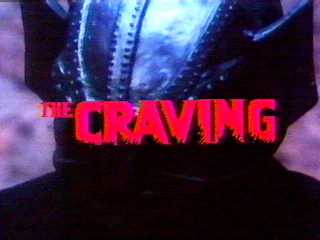
We open with a trial set in medieval European castle. A gothic caption says, "Hungaria Siglo XVI." The guest of honor at the trial is Elisabeth, Countess of Bathory; fans of weird history know her as "Countess Dracula," who allegedly bathed in the blood of young girls to preserve her beauty. This story's Elizabeth seems to be into the same bad habits, along with witchcraft and devil worship. She is sentenced to burn at the stake.Her flunkies are on trial as well, and this includes Waldemar Daninsky (Jacinto Molina), who could become a wolf. Since none of them were
able to cut a good plea bargain, they are sentenced to beheading and such.
Sentences are carried out. Somebody is beheaded. (For some
reason, the actually beheading is not shown.) Elisabeth's pyre is
torched, and she vows revenge. (Yeah, yeah, yeah, tell it to the
appeals board.) They put an iron mask on Waldemar and pound a big
silver dagger into his chest (and a lightning bolt is superimposed over
the event). Cut to credits. Well, cut to them eventually; there's
a looong pause with a looong chord, which may mean the dubbing crew fell
asleep at the wheel.
|
|
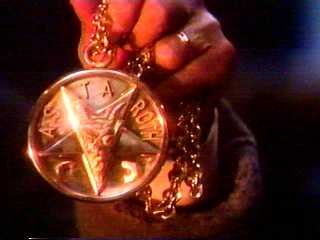
| This is probably not what Dumas had in mind. | As Ta Roth? (Probably not what Phillip Roth had in mind, either.) |
After the credits, we go to modern day Rome. Well, it's as modern day Rome as the film allows. A group of college students are showing their superiority by debating the truth about Elisabeth and Waldemar. Three of the students, Erica, Karen, and Barbara, are arguing that Elisabeth and Waldemar existed. They are travelling to Hungary to prove it. In particular, Erica is a little too focused on proving her theory.
Later, Erica is talking to one of her professors about her upcoming trip and how she's convinced she knows the location of the graves. She also knows the professor has a mystic medallion used by Elisabeth and asks for it. In the background, a face can be seen in the fireplace. Erica admits how deeply she is into her research and that she intends to resurrect Elisabeth. (She's not just the president of the Elisabeth fan club, she's also intends to be a client.) She throttles the tenure out of the professor and takes the medallion.
Meanwhile, two philosophical grave robbers, Mr. Veria (who has a Fagin thing going for him) and Goyo, are discussing their trade while on their way to Waldemar's grave. (Coincidence? You have to ask?) They pop open the coffin, ignoring the curse written on it. The body in the box still has the iron mask and the silver dagger in the chest. While guestimating the value of the dagger, they pull it out. The lightning bolt superimposition flashes again, and, by golly, it just happens to be a full moon. As with pulling a stake out of a vampire, the body in the box gets real lively and strangles Veria and Goyo.
The scene shifts of the sort of Central European pub you'd see in an early Universal monster movie. Erica, Karen, and Barbara are buying a car while being warned about robbers. It's not really an idle warning, as some robber-rapists are listening to the conversation. Later at night, the girls are driving the car when a tree drops in front of their car and the robber-rapists jump the car. (Don't take that literally; this does tend to be a weird movie, but it ain't that weird.) Erica pulls a gun on them, but it doesn't work. Suddenly, a man dressed as Waldemar, wearing the mask and silver dagger at his side, and armed with a crossbow, shoots one of the robbers. He's unnaturally quick on the reload; if you've ever tried to reload an older crossbow, you know it's not likely you'd be ready for the second shot before the first man hits the ground. The crossbowman takes out all three robbers and vanishes into the night.
In the morning, the girl's car breaks down, but as luck would have it
they are already at the ruins of the castle they're looking for.
While the group explores the ruins, it becomes obvious Karen and Barbara
don't have the right temperament for this job, as they are easily creeped
out by things like red eyed rats. Erica and Barbara find Waldemar's
grave and realize someone has already beaten them to it. Karen runs
into a woman with some nasty facial scars and it freaks her out.
She runs outside, sees the crossbowman, faints and falls into a hole.
Meanwhile, Erica and Barbara continue (through some pretty poorly lit scenes)
searching the ruins and find Elisabeth's grave.
Hey, What's for Dinner?
The scene jumps to a better castle at dinnertime. The crossbowman, who calls himself Janus Bulkow, and the scarred woman, Mikaiya, are apologizing for frightening Karen. Later that night, Mikaiya puts the silver dagger under Karen's pillow. Erica and Barbara discuss their host and decide he's Waldemar. Erica knows the story about the dagger in the heart. For some odd reason, this trick will work again only if done by a woman on the night of a full moon. They make plans to make some silver bullets.
|

|
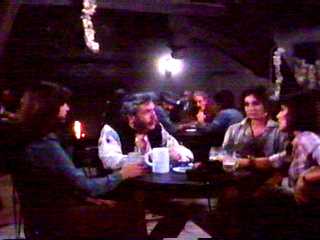
| It's either Little Transylvania at Universal Studios or the Gilroy Garlic Festival. | Sure, he uses UltraBrite, but is his hairspray hypoallergenic? |
Meanwhile, a howl is heard in the distance. Two stereotypical gypsy campers (guy and a girl) are discussing the cigarettes they are delivering. They start making out and a wolfman drops in on them. The guy grabs a gun and shoots him. The wolfman breaks the gun and the guy. He carries the girl away.
In the morning, Mikaiya tells Janus that Karen is the one who can end the curse, and that he should watch out for Erica. Later, Erica is planning the resurrection of Elisabeth. The time is right for this; they've been there for two full moons. Not sure they mean two cycles of the full moon (about two months) or the two full moons at the ends of a full lunar cycle (about one month) or two nights of full moon. Given how the movie jumps, it would not be unlikely that two months have passed.
Mikaiya sees Janus and Karen talking. They're really hitting it off. Karen knows and accepts Janus is really Waldemar. Waldemar explains that Mikaiya had been burned at the stake but was saved when a storm started.
That night (we assume), Waldemar wolfs out while Karen watches. He starts to attack her, but Mikaiya holds him off by holding the silver dagger like a cross. Waldemar runs off for walkies and finds a lone camper. (Gee, after the last two, you'd think this wouldn't be as likely.) Back at the castle, Mikaiya explains to Karen that she saw what happened to the grave robbers that woke Waldemar, and that Karen must use "the true cross" (meaning the silver dagger). During this, Waldemar is still out for walkies and stalks a girl who was drawing water from a well; guess she went to the well one time too many.
Meanwhile, Erica does some Mesmerism on Barbara. She hangs Barbara over Elisabeth's coffin and slits her throat. While the blood drips onto the bas-relief top, some smoke and wind brew up and the lid levitates off. Out comes Elisabeth, who kisses Erica on the neck and draws blood while the coffin lid is still floating in the background. She points to the ground and a troll like thing pops out of the soil. We're not sure if it's one of her old henchmen or a demon arriving by special devilry, er, delivery.
In the morning, Waldemar comes dragging in after a rough night of dogging it. Karen meets him. They decide to not talk about it. That night (we assume, and assume further it's not a full moon) Waldemar and Karen make out.
Meanwhile, Elisabeth is preparing for a world-beating spell, but she needs the wolfman to make it work. She tells Erica to enslave Mikaiya. Bat noises can be heard near Mikaiya, and suddenly she's facing down Erica the vampire. Mikaiya plants the cross shaped silver dagger on Erica's forehead and it has the expected allergic reaction. Erica puts the bite on Mikaiya anyway. The next morning, Waldemar and Karen find signs of the crime: the silver dagger with some goopy stuff on the handle and some silk from Erica's nightgown.
Later, while Elisabeth is enjoying a refreshing bloodbath, a preacher and his follower are having dinner with Waldemar and Karen. The guests are talking about how the townfolk are terrorized by either a wolfman or vampires; they're not sure. What they are sure about is everybody should buy lots and lots of garlic. After dinner, the preacher and his follower discuss their plans to rob Waldemar. Unfortunately, Elisabeth, Erica, and Mikaiya, who've gone full-on mystic vampyre, interrupt them mid-plan.
The scene jumps to daylight. Waldemar and Karen have just finished burying a couple of potential vampires, which they've capped per tradition (staked through the heart and decapitated with holy wafers in the mouth). Because of the sudden jump in scene, we're not sure but it's likely the victims were the preacher and his flunky. By the way, Waldemar and Karen look remarkably clean for having just done this. Waldemar decides to go after Elisabeth, but must wait for the full moon. They make preparations for a stand.
Elisabeth finally gets around to putting the bite on Mikaiya. Erica (with cross scar) visits Waldemar and does that eye thing all movie vampires seem to be able to do. She gets on top of him to do the bite thing. In the mirror, you can see Waldemar but not Erica. Meanwhile, Barbara attacks Karen, but she sticks her with the silver dagger. After Barbara turns into smoke, it's bitus interruptus when Karen rescues Waldemar by crossing Erica.
The next morning, while Waldemar is upset about being "nearly" dominated by "that zombie" ("zombie" may be questionable, and "nearly" even more so), they go to the ruins to find the vamps resting-place. They run into the special order undead troll critter, which is disappointingly easy to destroy. The girls aren't there.
It's another night. Some coffin deliverymen are dropping off an
order in an unspecified location. (Why not? Would it be a surprise
this country may not have a Dominos, but you can get some caskets delivered
fresh to your door?) The vamps are spying on them. Elsewhere,
Waldemar is trying to persuade Karen to leave; the full moon is coming.

|

|
| Pledge night at the Delta Omega Alpha sorrority. | The mystic sign of the Department of Defense. |
Twilight of the Dogs
Waldemar studies some maps of the area, trying to deduce where the vamps have set up their new sorority house. Elisabeth visits Karen and telekinesis a cloth over the silver dagger, which was sitting on the nightstand. She puts the bite on Karen.Another day, and Waldemar and Karen are trying to plan a search pattern to find the vamps. That night, Karen puts on a sexy nightgown for Elisabeth. Elisabeth recites a spell, appears to Waldemar, and stakes him. (We wondered if the phallic symbolism of that act was intentional.) The next morning, Waldemar wakes up. It was just a dream. Waldemar warns Karen the coming night will have a full moon. After he leaves, Karen admires her hickeys.
Waldemar preps some crosses. He is interrupted by Karen, who konks him over the head with a silver tipped cane. This must've been a good thing, because when he wakes up at sunset, he's figured it out; the girls are holed up in the lower levels of his castle. He heads down to the basement with his antivamp kit and sees Karen asleep on top of a coffin. Just as he pulls Karen off to the side, one of the other coffins opens and out comes Mikaiya. He pegs her.
Just then, he looks over his shoulder and, through the window (don't all castle basements have windows?) he sees the full moon. When Wile Coyote walks over the edge of a cliff, he won't fall until he realizes he's run out of cliff; likewise, Waldemar doesn't seem to be affected by the full moon until he notices it. He turns into is own version of Wile Coyote.
Coffin number two opens and it's Erica. She looks like she's gonna try the eye thing on him, but no go. She jumps at him, and he pushes her into some handy wooden shards. Does the trick.
And now coffin number three opens. Yup, it's Elisabeth. She tells him to heel and roll over. Not really, but she does try that mystic will trick on him. He's having none of that, so she telekinesis a coffin at him. That didn't work, so she pulls a torch on him and he leaps at her. Wolfman-fu and vamp-witch-fu follow; they both go for the throat. She throws the torch, which results in spontaneous rubbish combustion. She tries to bite and he tries to bite. He wins. Then he puts her back in her box and buries her for later. Nah, just kidding. But Karen's hickeys vanish while Elisabeth does the vampire depreciation thing.
Karen gets up and grabs the dagger. He mauls her and she sticks
him with dagger. While he goes down to die, they make eye contact.
He reverts back to his human form. She throws torch at a coffin,
and more spontaneous rubbish combustion follows. (Our theory is that
all lumber in this country was harvested from sassafras.) She
crawls on top of him to die. End. Roll credits. Well,
we expected credits, but none followed. This is why, in the above
plot description, names were spelled as guesses and the characters were
not associated with the actors playing them.
The Good Stuff
Old Fashioned Kind o' Fun
Like Ye Olde Universal monster blenders of '40's (as in Frankenstein meets the Wolfman, House of Frankenstein, House of Dracula, et al), this movie combines a werewolf with vampires with some witchcraft thrown in. The monsters are played per Universal tradition, but the sense of morality and symbolism make it a cousin to the Hammer films of the '60's.Having said this, one could argue that the film lacks originality. Maybe, but when treading over ground familiar to audiences the filmmakers don't have to explain the Rules of Engagement for vampires and werewolves. They also managed to show some respect for the material. It is questionable to hit a Spanish film for doing things previously found in English speaking films. It didn't feel like a rip-off nor an homage; it just was. Compare this with a recent big-green-iguana blockbuster, which dissed the source material and the audience, and you'll see what I mean.
You don't get much of a chance to get bored.
The core love story (Waldemar and Karen as doomed lovers, with Karen
seduced by Elisabeth) doesn't come across very well, but they made a try
for it. At least this was effective as mentioned at the end, when
Karen and wolf-Waldemar look into each other's eyes.
His Suit is Hirsute
In this film, as in the other films with Molina as the wolfman, the werewolf make-up tended toward the look Oliver Reed had in Curse of the Werewolf (1961), but with more hair on the face. The teeth are too white for a convincing wild creature; otherwise it's a pretty good job. (Your sense of lycanthropic aesthetics may vary....) Since this predates the world wide distribution of The Howling (1980) and An American Werewolf in London (1981), no fancy prosthetics were used during the transformation scenes; they were mostly done by camera cut-away. By the time Molina made this movie, he had his wolfman down pat.By the way, we would not be very surprised to learn that this movie
had been rushed through distribution in America that year as a cash in
on The Howling (hence the name change).
The Bad Stuff
Rub a Dub Redub
One of the more infuriating things about watching The Craving is the dubbing. Although the (uncredited) dubbing crew was competent, one gets the sensation that several flaws resulted during the reproduction. If the movie was bad on its own, it's hard to tell. (Frankly, the author would love, at his own convenience, of course, to see this film in its original state with subtitles.)Yo, Establish This!
As noted in the plot description, there are several jumps in continuity. Characters are discussing something in one scene and suddenly the film jumps to the next day. Although you don't get much of a chance to get bored, there is no real sense of transition between scenes. Confusion results. We couldn't tell if that's poor filmmaking in the original release, a poor re-editing in the American redistribution we saw, or a cultural tradition in Spanish storytelling we don't understand. Let's just say it probably wasn't intentionally confusing (as in an Alain Resnais film).Who Was That Stereotype I Saw You Maul Last Night?
Although Hungary and the other countries of Central Europe are steeped in tradition, too many of the minor characters felt like stereotypes found in those old Universal movies. This is particularly noticeable when characters are introduced long enough to let the audience see the words "Designated Victim" shortly before their immanent demises. Compare this with the "Old Fashioned Fun" comment above. Old school monsters are one thing; old school monster fodder means a lack of suspense for what is about to happen.While talking about the characters, another problem is the way they
are introduced. We had to watch this thing twice to figure out who
some of these people were. It wasn't because of the complexity of
the plot; too many of the characters look alike or are introduced too abruptly.
Regarding the latter, it is once again hard to tell if this was in the
original production (as a flaw or an allowed method) or a result of the
dubbed reproduction.
You Call That a Pentagram?
One of Waldemar's mystic traits in his human form is a pentagram on his body. That's what they call it in the film. Please see the picture of this, and decide what you'd call it....The Who Cares Stuff
Notes on Cast and Crew
The lack of complete credits on this film means only one person can be adequately discussed. Jacinto Molina grew up during the Spanish Civil War and went on to become a champion bodybuilder and stuntman. He submitted a script about a wolfman named Waldemar Daninsky versus a vampire couple, but when they couldn't cast the wolfman, he was selected. He took it as a challenge; there's no werewolf tradition in Spain and he was playing a Pole. Since that first movie, he's played the wolfman in several films, most of them with the human component named Waldemar Daninsky. (I'll accept that; how many times did Lon, Jr., play a guy called Talbot?) Below are (most of) the films where he's really put on the dog, followed by the popular titles in American distribution.La Marca del Hombre-lobo (1968) (Frankenstein's Bloody Terror) -- Werewolf seeks cure, but his care givers turn out to be vampires. Note: In the American distribution, the werewolf is called Wolfstein, and is labeled a descendent of Frankenstein, alegedly because the distributors wanted a Frankenstein movie.
Las Noches del Hombre Lobo (1968) (Nights of the Werewolf) -- Unfinished project.
Los Monstruos del terror (1969) (Assignment Terror, Dracula Vs. Frankenstein) -- Plan 9 from Outer Space meets the Universal studios when aliens use monsters (werewolf, vampire, Frankenstein's monster, mummy) to take over the world. The werewolf Waldemar Daninsky and Frankenstein's monster are both played by Molina.
La Noche de Walpurgis (1971) (The Werewolf Versus Vampire Women, Black Harvest of Countess Dracula)
Dr. Jekyll y el Hombre Lobo (1972) (Dr. Jekyll Vs. the Wolfman)
La Furia del Hombre Lobo (1972) (The Fury of the Wolfman) -- Scientist turns into a werewolf
El Retorno de Walpurgis (1973) (Curse of the Devil) -- Descendent of witch hunters is turned into a werewolf.
La Maldición de la bestia (1975) (Night of the Howling Beast) -- Waldemar is back and this time his sparring partner is a Yeti.
Buenas noches, señor monstruo (1982) -- Character's name is H. L. and he's a (surprise) hombre lobo.
La Bestia y la spada mágica (1983) (The Beast and the Magic Sword) -- Samurai versus everyone's favorite Spanish/Polish werewolf.
Licantropo (1996) -- No details available, but, gee, the poster
looks like a werewolf....
Roots, Shoots, and Other Compares
In addition to the Universal traditions and the other Molina movies listed above, note in particular the following two Hammer films:Dracula: Prince of Darkness (1966) -- Features the "resurrect the vampire by hanging a body over the remains and cutting the throat" trick.
Countess Dracula (1971) -- Ingrid Pitt as Countess Elisabeth,
played here as a ruthless tyrant who accidentally discovers rejuvenation
via bloodbath and develops a nasty habit which she tries to keep secret.
May in turn remind some of The Leech Woman (1960), except Elisabeth
needs the blood of those hard to find virgin women instead of the hormones
of those easy to find horny men.
The Bottom Line
Wolfman meets some girls; one girl is a bad witch, one girl is really bad vampire witch, and one girl is good but is fated to kill him. Borrows heavily from Universal and Hammer traditions, but still has some sense of originality. Not very good, but not the worse werewolf flick out there. Unusual sense of time and abrupt character introductions lead to confusion, but impossible to tell if this was due to the original film (intentionally or per bad filmmaking) or the dubbed reproduction. Old fashioned Saturday afternoon type fun for those who are not very demanding.Published 15 June 1999
 |
   |
A
Proud Annex of....
|
|