|

The Oneida Cult was Never Like This, or...
Invasion of the Blood Farmers (1972)
Written by Ed Adlum and Ed Kelleher
Directed by Ed Adlum
Details at the IMDB, US.IMDB
We understood
Her by her sight; her pure and eloquent blood
Spoke in her cheeks, and so distinctly wrought
That one might almost say her body thought.
Dr. John Donne (1573-1631)
Social historians tell us how much the automobile changed our lives. We all know, for example, that individualized transportation allowed people to move away from where they worked. This led to the development of the suburbs, which in turn led to the development of economies away from the hearts of cities. Despite the fact that the United States has become more urbanized, most people associated with the larger cities will not live the the centers of them; they live and shop elsewhere, and they can do it because they have cars.
Another facet of social change attributed to the automobile, but one that isn't discussed as much, is how it changed sexual mores. With all the changes that have happened to dating in the last century, think what a difference the rumble seat and the back seat made. And, in turn, the drive-in theater.
And it is in this place in time we visit. It's the early '70's, and, by reputation at the time, no one ever went to the drive-in to watch the movie. The stereotype was, all you needed was eighty-six minutes of film, and the drive-ins would pay you to show it. Who cared if it was a good movie?
And where else, but in an economic environment like this, could a movie like this get made?
Contents
The Plot
This Ain't the Summer of Love
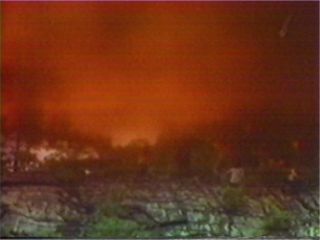
We open with a long shot of hooded figures on a hill with torches under a red sky. Someone (Joel Vance, uncredited) doing a James Mason impression performs an opening monologue. He explains that the Druids, shrouded in mystery by the passage of time, were not of this Earth. They were Sangroid blood eaters. (To be fair, this was made before the Wiccan movement became what it is today; whatever that is.) Run opening credits, with various shots of torches.
 |
 |
| Red skies at night, Blood farmer's delight. Red skies at morning, Blood farmer take warning. |
Brought to you by the Farmers Insurance Group |
Jump to day shot of a back road with a man staggering. He's wearing a white pleated tux shirt and is spattered in red. Then we get a daytime establishing shot of the Huddle II, the local tavern. Inside, while the bright sunny day outside streams through the window, Clint Strong pretends to not be worried about his wife, Helen, who is missing. He leaves, and the bartender says, "Good night." (Confused? Don't worry. You will be.) After Strong is gone, Deputy Shirley "Shorty" Koppel tells the other bar patrons that he's not interested in fixing this up; he's waiting for his chief to return from Capitol City and take care of it. (Apparently, this is one of those comic book universes where places have names like that. Or maybe the chief is cutting a record deal.) They also talk about how they haven't seen Jim Carey for over a week now. (Must be one of those towns where they watch Dumb and Dumber at least once a week for inspiration.)
They see the man in the ruffled shirt staggering toward the tavern and identify him as Carey. (Man, he must've taken the bad business and Academy Award snub on Man in the Moon badly.) He comes in, spews a little more red stuff, and falls flat on his face.
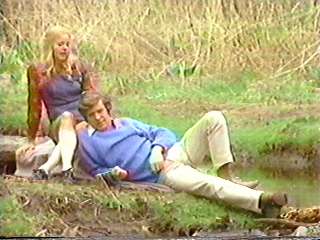
Elsewhere, perpetual boy scout Don (Bruce Detrick) and his blonde girlfriend Jenny (Tanna Hunter) are making small talk by a stream. The soundtrack plays what sounds like library music from either Wagner's Tristan und Isolde or Bellini's Norma, High Priestess of the Druids; we can't tell, so we will be referring to as The Ubiquitous Opera Theme™. She chides him for working so hard with her father in his lab.
But on another outdoor set, we see a guy which we assume is Clint Strong; his earlier appearance at the Huddle II didn't make him look very distinctive. He's looking at a wedding picture of his wife. Cut to a shot of a semi-conscious girl (the girl in the picture?) chained to a wall. She has red stuff trailing from her nose and mouth. A transparent tube runs along her leg, showing bits of red fluid slurping down the tube. A motor is running in the background. She passes out. A fellow in a pointy hood and overalls checks her out. He removes the tube from her arm (?). There's a large motor on the floor near her. Cut to a shot of pigeon in a coop. (Huh?)
Back to Don and Jenny. They're playing some cutesy chase in Jenny's back yard (the house kind) and Don catches her. She says she needs to go to the Whitakers to return a cookbook, but Don tells her the Whitakers are not very outgoing people. The subject of her father comes up again. Don, like her father, is a pathologist. He takes this opportunity to remind her that pathologists don't make a lot of money. (He also takes this opportunity to demonstrate his ability to talk through his nose with an annoying voice. This guy has a serious need for a nasal decongestant.) Then he explains to her that her father is one of the best in the business, which is why he came to work for him. (Question time: Is Jenny as thick as a brick for not knowing any of this stuff, or was that just some hackneyed exposition? And why is the best in the business working in this backwater community?)
Jenny asks when they're going to get married. The pathetic pathologist evades the question. Then the subject of Carey comes up. Don saw the body; he says it looked like he blew up. (Not that we saw any of that, you understand.) They continue making small talk about recent weirdness here in Jefferson Valley (like the disappearance of Clint's wife) while Don feeds some pigeons. (The coop was an establishing shot?) Jenny's father, Roy (Norman Kelly), comes out of the house. He shouts, "Don, come down to the lab! You won't believe what's happening!
Roy has samples of Carey's blood in a beaker and a graduated cylinder. The red stuff is both containers is reproducing rapidly. (Amazing. No, not the part about blood reproducing without marrow. Maybe we can allow for some weird science. But it's been reproducing without any added matter.) Roy questions what Carey could've been exposed to. Don realizes it was this rapid reproduction of blood that caused Carey to burst at the seams.
 |
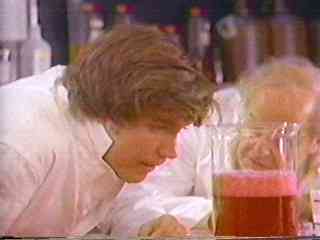 |
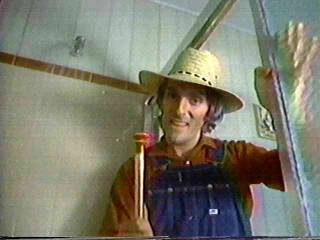
| OK. Girl in short skirt. Guy with head near her lap. He's looking the other way playing with a pole. I dunno... | Although the green beer sold well on St. Patrick's Day, they were having doubts about their promotional gimmick for St. Valentine's Day. |
Cut from a close-up of a beaker with the foaming red stuff to a hand scrubbing red goo on the floor. Tex, the local slow talker, is trying to clean up the spot at the Huddle II where Carey fell. It's taking him forever because the stain keeps growing. (No, sorry. No time for "Out! Out, damn spot.") Then Tex says he saw something that looked like a UFO sighting with weird people at the Whitaker place. The bar patrons laugh at him. And they talk about how Doc Anderson is trying to figure out what happened to Carey.
Two patrons, wearing overalls and straw hats, are not laughing. They talk like a couple o' furiners to the bartender and ask for directions. (For those of you not familiar with general American small town customs, a furiner is someone who's not from around "these parts.") Outside, one of the furiners called Egon (Jack Neubeck) tells the other to report their findings to Creton and limps away on his fancy, furin walking stick.
Back at the lab, Don and Roy calculate that the lab will be full of foaming red stuff in a week. While they talk, Egon spies on them. He slips and taps the window with his walking stick. Upstairs, Jenny is in bed. Buster, the family dog, jumps off the bed and runs out of the room. Egon limps away, but the dog is chasing him. After he gets to a brook some distance from the house, he beats Buster to death with his cane. Then he picks up the pummeled pooch, but drops an old fashioned key into the brook without noticing.
Jenny comes outside calling for Buster. A hand with a quilted comforter sneaks up on her. (We assume this is supposed to be scary.) It's Don. Jenny explains she was having bad dreams about the Whitakers and Helen Strong. Don tells her she's way overdue for bed. (What? It's broad daylight?) Don and Jenny both lean into the camera for an approaching kiss shot. (Shudder!) Cut to a close-up of Egon biting Buster on the throat, which is all red and gooey. (Shudder, but not as much.)
Agents of (Mis)Fortune
Next morning (?), Jenny tells her father she's worried about Buster. Don arrives. They make some more small talk, which includes the missing Buster. Since Jenny's mind is elsewhere, she's not attentive to Don. He says to Roy, "We're not married yet, and already she's treating me like a husband." She says, "Don't you wish." (We assume this is what passes for slick double entendre in these parts.)
The doorbell rings, and we see someone crawling into some bushes. Jenny goes to door and sees Buster hanging over the porch. Don runs out of the house (in no apparent direction) and finds the dropped key in the brook. He picks it up and sees a farmhouse (which we later learn is the Whitaker place). Later, Don tells Roy about the blood at the brook, but he doesn't mention the key.
Back at lab, Don and Roy check over the dog. Roy trying to figure how to tell Jenny that Buster was drained. For old business, they've started calling their blood riddle "marked accelerated progeneration." Roy talks about the impossibility. (Yeah, like where is all that blasted extra mass coming from? Does it teleport in from the same place Banner gets his extra mass when he transforms into the Hulk?)
Go to a room at a motel. A young guy enters, and a woman's voice (Lucy Grant) says, "Melvin, you're supposed to carry me over the threshold." He does so, and they fall onto the bed while The Ubiquitous Opera Theme™ cues up. They talk about watching the late show (but, once again, it looks like daylight). She goes into bathroom to freshen up. He strips down for bed. (Do we really have to watch this event?) She comes out wearing a tight teddy.
He goes to take a shower. The Ubiquitous Opera Theme™ turns up. She gets busy dumping things off the bed while he starts his shower. (It might've been cool and apropos if blood started coming of the showerhead, but no go). She impatiently calls for Melvin, looks up, and sees a tight close-up of a grinning Egon. (Wait, how in the heck did he get in there?)
While Melven showers, we are treated to a quick image of a blonde woman with her eyes closed. (Huh?) Egon interrupts the shower by beating the crap out of Melvin with his furin cane. The girl Melvin came in with is lying on the bed; she's convulsing.
Back at Chez Anderson, Don is talking to Jenny, who is in bed. They tried to call Chief Spanno, but storms are cutting off the phone lines to Capitol City. (We learn from this scene that (1) Capitol City must be quite a distance away since they're having bad storms but it's bright daylight in Jefferson Valley, and (2) Jenny must either have a graveyard shift job or suffering from some kind of depression, because she sleeps a lot during the day. Bad "day-for-night" shooting? You decide. Aw, the heck with it. Maybe this is midsummer in Alaska.) Don and Jenny are interrupted by Roy, who is shouting, "Don, come quick! You won't believe what's happening!"
Over at the Whitaker place, the two furiners in overalls are carrying two big bundles into what looks like a stable. Elsewhere, the amazingly effeminate Creton (Paul Craig Jennings), who is wearing a purple robe with an upside-down cross, is talking to an unconscious girl in a glass coffin (or a really big aquarium). This is the queen of the Sangroids. (The girl, not the guy.) Creton tells his sleeping Queen Onhorrid that the feast of Mennonite grows near, and this time they will be ready. (The ancient Druids were Amish? Wow, the things you can learn from movies!) Sontag (Richard Erickson), who looks relatively respectable compared to the rest of this crew, enters and tells Creton that Egon has brought two more. One of the overall furiners enters with a sample and they realize the girl they bagged at the motel is not the one they've been seeking. Back in the barn, they've tied Melvin down and hooked him up to a pump with a tube. They turn it on. He convulses for a while.
 |
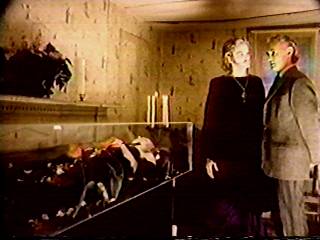 |
| Later, Norman Bates would develop a fixation on Mel Tillis, with predictable results. | The occasional visitor to Juan Peron also got to meet Eva. |
Back in the glass coffin room, Creton and Sontag banter some plot exposition. If they fail to bring their queen back, they're history. Criswell, er, I mean Sontag, vows that they will survive. Eros, darn, I mean Creton, counters with their shortcomings and his disappointment with Egon's excessive methods and clumsiness -- he was the one who let Carey escape. (Given the acting styles involved here, it's easy to confuse them with characters from Plan 9 from Outer Space (1958).) He calls for the rest of his henchmen and sends them out to find "the one."
At Chez Pathology, Roy tells Don that he's managed to stop the growth, but they need a reagent. Don is absent-mindedly playing with the key he found at the brook. Roy asks to see it. (Roy seems to be fascinated by bright shiny objects.) The doddering doctor says he can't recognize the alloy and asks if he found it near the blood at the brook. He decides to call someone at the local university who might be able to identify this strange artifact. (Hey, it's a key. What more do you need to know?) Roy picks up the phone and dials.
The phone rings at a stock shot of a university. Someone called Cameron answers the phone. He tells Roy that Kinski did have this office, but he left on a research project, no details. Roy gets the forwarding number, which is a six-digit number. (Huh?). He dials it.
And at the Whitaker place, Sontag answers the phone as Kinski. He sounds very interested in this artifact. After the call, Sontag tells Creton that Egon lost the Key of Mennonon. Creton calls Egon and asks for the key. Egon can't find it. Creton expresses his displeasure by telling the luckless lackey he'd better find the key he's going to be lunch. Sontag volunteers his info and says he can get it, but Creton, who is in a hissy fit, sends out his flunkies for some new blood samples.
E.T.I. (Extraterrestrial Idiocy)
Clint Strong has stopped looking at the picture of his missing wife. He's walking around his back yard with a pruning axe. Then he hears something in the bushes. He goes to look, and a guy in a pointy hood squirts him in the eye with some red stuff.. (Huh?) Clint drops his axe and runs, but the guy in the pointy hood picks up the axe and cuts him off at the pass -- the one between the head and shoulders.
Tex is no longer trying to clean up that red spot at the Huddle II. He's stumbling along a back road when an old car pulls up next to him. He leans toward the car. The door opens, but instead of a cute girl asking him if those are Bugle-Boy jeans, a hand grabs him and pulls him inside. The car drives away.
Don and Jenny return from a date. She says she's planning to go to the Whitakers. He advises against it until Chief Spanno gets back. Their radio's relevant plot sensor kicks in; there's a news bulletin about the double kidnapping at the motel. When asked about the case, Deputy says "No comment." (For some reason, the news reader on the radio calls the kidnap victim "Milton" vice Melvin, and the deputy as "Culp" vice Koppel. An observation by the writers on bad radio journalism, or poor script continuity. You decide.) They turn off the radio. Don tells Jenny to go to bed (and it's friggin' broad daylight again) and drives off.
Jenny enters the living room. Roy and Sontag (in his Kinski guise, remember) are there discussing the artifact. Jenny excuses herself. Kinski tells Roy that the key is just a trinket. In her room, Jenny pulls out a scrapbook and leaves the house. We assume this is the cookbook she was going to return to the Whitakers.
And over at the Whitakers, the overall furiners have some guy hooked up to the blood pump. Outside, Jenny hears the scream. A hand drops on her shoulder. It's Sontag. (False starts are strangely unscary here.) After she leaves, Sontag goes inside. He gives the key to Creton, who was also happy with the recent blood drive.
At the Huddle II, the regulars hassle the deputy about his radio bit. They quiz him about the missing honeymooners. He knows nothing, but he tries to cover his ignorance by saying he can't talk about an open investigation. The phone rings, and the deputy answers it. "Police Annex," he says. Unfortunately, Chief Spanno is on the line, and he cusses out the lethargic lawman.
Back at the glass coffin showcase room, Creton takes a sip from a bowl. He passes it to one of his hooded henchmen, who lifts the hood from his mouth, takes a drink, and kisses sleeping beauty. The sound effects editor drops in the allegedly creepy sound of gas escaping. (Not surprisingly, she doesn't wake up and sing "Someday, My Prince will Come.") Creton passes the bowl to another hooded henchmen, who lifts the hood from his mouth, takes a drink, and kisses sleeping beauty. The sound effects editor drops in the allegedly creepy sound of gas escaping. (Not surprisingly, she doesn't wake up and sing "Someday, My Prince will Come.") Creton passes the bowl to another hooded henchmen, who lifts the hood from his mouth, takes a drink, and kisses sleeping beauty. The sound effects editor drops in the allegedly creepy sound of gas escaping. (Not surprisingly, she doesn't wake up and sing "Someday, My Prince will Come.") Creton passes the bowl to -- aw skip it.
Roy calls Chief Spanno, who has returned from Capitol City. The camera spins around, and Spanno is at the Anderson place. Roy and Jenny greet him. Spanno asks Jenny, "How's Buster?" She freaks and runs. Roy starts to tell Spanno about the recent weird events. (We doubt he tells him about how the sun hasn't set for three days.) Outside (where it resembles night for a change), Egon is spying on them to the tune of The Ubiquitous Opera Theme™. He also looks up and sees Jenny's shadow in the window.
 |
 |
| The Blood Farmers at harvest time. ("Ve vill (::clap::) pump you out!") | Dr. Anderson describes recent events to Officer B'ar Brady, er, Chief Spanno. |
Spanno goes to the Whitaker place (where it's broad daylight, so we can't tell if this is the next day or yet another strange solar phenomenon). Sontag answers the door and introduces himself as Kinski and bulls a cover by explaining that the Whitakers are out of town and the nature of his research involves nuclear bombardment from a particular set of the solar spectrum. (God knows they get plenty of sunlight around here for this.) The police chief is easily bamboozled by all this science stuff; he leaves.
At the lab, Roy and Don find a simple reagent by using iodine and ammonia. (Huh?) The phone rings. Spanno tells Roy about Kinski at the Whitaker place. Roy finds this odd.
The phone rings at Whitaker place. Egon answers the phone, freaks at the caller, says something unintelligible, and points at the receiver. It pops and sparks. (Don't you wish you could do this to telemarketers?) Then he says there is no Kinski there. Sontag enters and takes the phone away from Egon. He lays it thick for Roy about his research.
At his office, Spanno answers the phone. He tells the caller that their missing daughter is nothing to worry about. (Nothing to see here. Move along....)
Elsewhere, a girl in a striped dress walks in the woods while The Ubiquitous Opera Theme™ plays. She takes off her shoes and dips her toes into a stream. Then we are shown limping feet with cane. While the girl walks through the woods, Egon follows her. We get a drop shot of Queen Hemorrhoid, er, Onhorrid. She lies down on a big flat rock. Egan gently sets head of cane on her head and pulls back. After another drop shot of Onhorrid, there's blood on the girl's forehead. (OK, we have no idea why this scene is in the movie. Is this the girl that Chief Spanno got the call about? She didn't look like she was missing for long. Why didn't they include this with the other abductions a few scenes earlier?)
Don't Fear the Sleeper
Back at the lab again, where they're still working on a reagent. Roy reminds Don that he has a date with Jenny. Outside, they make small talk. Since Don was planning to give Jenny the key as a necklace charm, he reminds Roy to get the key back from Kinski. (Picture this, if you will. "Oh, honey, what a cute key necklace! Thank you! Where did you buy it?" "I, uh, found it." "Oh, OK. Where did you find it?" "Over in the brook out back, where someone tore up Buster." "WAAAAAAAAAAAAAAAAAAAAAAAH!")
Roy calls the Whitaker place. One of the henchmen who doesn't speak English answers the phone. (And the conversation is as effective an exercise in communication as this movie in general.)
We see a night shot of Don's car on the road. And then Kinski visits Roy at home. (From the light outside at the door, it looks like daylight. Next day? Give up?) Kinksi says the key was just a cheap trinket and he threw it away. They make small talk about Kinski's research. Roy offers to fix Kinski a drink. Kinski says he'll have a Bloody Mary. They do more small talk, and Roy tells Kinski he's doing work with Don on rare blood diseases. Kinski asks to see Roy's lab. The phone rings. While Roy is out of the room, Kinski goes downstairs.
In the lab, Kinski checks out the set up. While investigating the samples and Anderson's work, he carefully picks up the phone and monitors the conversation. Cameron at Stock University is telling Roy that Kinski is in Pennsylvania. After the call, when Roy finds the man he calls Kinski in the lab, he asks him about the Quaker State. Kinski tells him that he was there for a day, didn't like it, and moved his research to the Whitaker place. (Wow! Sure is a good thing he listened in on that call; he might not have been able to invent that air-tight cover story.)
Outside, Roy gives Don a case with samples of their work to take to Capitol City. Before Don leaves, Roy tells Don that he and Jenny are going to go see a movie. (Presumably a better one than this). They expect to be back home by six.
Sontag tells Creton that Roy has a reagent. Creton declares he must be eliminated. At the Anderson place, Roy and Jenny (who is wearing a blouse and jeans) are settling in after their afternoon out. Egon is sneaking around outside with a supposedly scary syringe. Elsewhere, Don is making a call on a pay phone. Then we see a shot of Roy's house and hear the sound of a phone ringing, plus a remarkably long scream. (Gee, who knew they'd get so excited about a phone call. Must've been a lifeline for someone on Who Wants to Be a Millionaire.) When no one answers the phone, Don looks at his watch; it's about ten after six. Cut to a shot of Don driving at night.
Back at Chez Druid, Roy and Jenny (who is now in purple dress) have been tied up. They're introduced to Creton, who clears up that Kinski/Sontag thing. Then the prissy priest rants a bit, and says that tonight, May 1st, is the Feast of Mennonite. (Ah, well, scratch that earlier "midsummer in Alaska" theory.) Sontag explains that the process they encountered increases red cell growth by one hundred times. He doesn't explain how it's able to do this without marrow or added mass, but he does say that the Key of Mennonon causes this effect. Furthermore, the one who is not affected by the key will be the chosen one. (It's not explained how the bad guys were able to do the blood workups on the kidnapped honeymooners without the key.)
Roy goes to cops and gets Chief Spanno. (We have to admit some confusion here. Did Don drive all the way to Capitol City and back? Did he make that phone call from Capitol city, or on the way to Capitol City, or on the way back from Capitol City? I mean, it's daylight again. How many hours elapsed since he left. Did we miss the Feast of Mennonite? We figure that, like the old British Empire, the sun never sets on Jefferson Valley. Or maybe Don didn't go to Capitol City -- he just drove around the corner to the Huddle II, spent all this time knocking back a few, and that nighttime shot of him driving was a subjective presentation of him blacking out at the wheel.) Don and Spanno get in a car and take off. After a few scenes, they stop somewhere. (Oh, yeah, and it's still daylight.)
One of Creton's overall flunkies tests a sample of Jenny's blood with the key. By amazing (?) coincidence, she's the chosen one. Creton looks forward to resurrecting Queen Hemorrhoid, er, Onhorrid, taking her as his bride, and really cutting loose on humanity.
Don and Spanno arrive at the stable where the overall flunkies have been doing all their blood work-ups. After they split up, a hooded guy ambushes Spanno and stabs him to death. (Sure is a good thing they waited for Spanno to come back from Capitol City before doing anything.)
Elsewhere, the Druids are doing a procession under a red sky. Some of them are waving torches. (Oh my God! They've started the movie again! Noooooo! No, wait. That guy doing the James Mason impression is not saying any thing. Whew. Close one.)
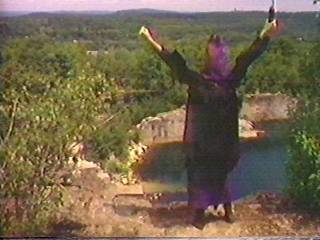
And then, under a daylight sky, Creton is wearing a pointy hood. He gives a big speech about how their time is at hand. During this presentation, he gesticulates madly. (Is the madness in Creton, the actor, or the filmmakers? You decide. Either way, the dubbed sounds of his speech do not match his wild posturing. Dubbers often overlook this when adding dialogue for people who have their mouths covered.)
While a couple of henchmen hold onto Roy, some of the others tie Jenny down to some planks and cut her arm. They let the blood drip into a bowl. Creton puts some of the blood on the queen's (Onhorrid's not Creton's) lips while everyone shouts, "Hail Onhorrid!" She wakes up. There's the sound of an approaching storm. (No, there's not a dark cloud in this daytime sky; surprised?)
Don arrives and tries to break up the party, but the hooded henchmen grab him. Onhorrid walks toward him. Roy tells Don to use the reagent. (What a great coincidence. Don just happens to have some of that stuff in a syringe in his pocket.) In an incomprehensible group shot, he squirts her with the reagent, and all the bad guys drop and get red splotches on their necks. A torch falls on one of the flunkies, and he starts to burn. All the the normals beat feet. The camera tilts up. (To a starlit, nighttime sky. Nah, just kidding.)
 |
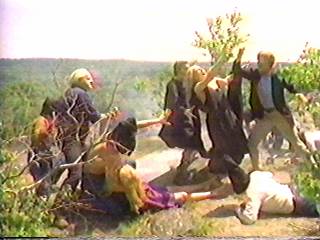 |
| ACTING! | Don saves the day (night?) with an intricate move, which you can clearly see in this carefully photographed scene. |
Dénouement. At the Anderson place, Don and Jenny do some cutesy post horrors stuff. Roy shouts, "Don come quickly! You won't believe what's happening." Roy has something covered with a blanket. He pulls back the cover and shows them a poodle puppy. (Oh, how cute. Retch!) Everyone (except the dog) engages in cutesy smiles and laughing. The End. No end credits.
The Good Stuff
Some Novel Ideas and Images
To this movie's credit, the gimmick for the plot is fairly unique for when it was made. The ancient Druids were magic using alien vampires. That's a heck of an idea for when this thing was made. Also, the psycho farmers feeding off others in the neighborhood was not a popular genre in the early '70's either. Although this was made about ten years after Herschell Gordon Lewis put a crazy Egyptian mystic to work as a caterer in Blood Feast (1963), it's still two years before the genre became popularized by Tobe Hooper in The Texas Chain Saw Massacre (1974).
And there are a couple of scenes that are effective in their own way. The shot of the procession under a red sky is pretty good. (I saw this for the first time at the Incredibly Strange Film Festival in New Zealand. On the big screen from a clean print, the effect was relatively striking.) And the first time you clearly see it in this movie, the blood pump scene is effectively painful to watch.
The Bad Stuff
Speaking of Bad Stuff
One of the biggest problems in this movie is the dialogue. In several scenes (like at the Huddle II which has the opening expository dialogue) it's hard to hear. I had two watch this thing a couple of times before I had a clue that this was Clint Strong at the bar.
In other scenes, when you can hear it, the presentation is laughable. The cutesy banter between the young couple leads is unintentionally funny. The overplayed "scientific" discussions between the two pathologists are overplayed for their significance, making them a great unintentional comedy. But the greatest laughs are in the self important mystic chats between Creton and Sontag. Given the script in those scenes, plus the over-the-top presentation by the two performers, you could remake those scenes with Bill Murray as Creton and John Lovitz as Sontag and get fewer laughs.
Someday, Bloody Someday
As noted in the plot description, the concept of rapidly growing blood is poorly played. First, red blood cells usually do not reproduce without marrow. Second, not all blood is red blood cells. Aside from the other unique bodies found in that substance, a huge component of blood is the liquid itself. They make a big deal about the growth of red cells, but no mention is made of the plasma. (The thought of a huge mass of red blood cells is interesting in itself; it could've been played as a horrible visual and been interesting watching the pathologists go from effect to cause.)
Then there's the question of mass. If you overlook the earlier objections about red cell reproduction because it's caused by an outside influence, it's still difficult to overlook that there's a lot of extra mass coming from somewhere. It's not like they were, if you can pardon the simplicity of this, feeding the red cells so they could multiply.
And if the incredulity of all this has not been enough, there's the lack of historical precedent in myth. Consider: These guys have been around for a very long time. And they've had this key trick for accelerating red cell growth, which also causes mass to come from no where. You'd think they would've had an accident before, where some of this stuff was left in a room, and a week later, the room is literally filled with blood. A few weeks after that, you'd have a valley full of the stuff. In less than a year, someone like Noah is going to have to build another ark, because it's going to start covering the surface of the Earth. Aside from a visual element from a dream in Kubrick's The Shining (1980), I can't think of any stories about a flood of blood; can you? (And, no, turning water to blood, as in the book of Exodus, doesn't count.)
No, it's time to throw in the towel on this one and go back to the original context. The real explanation for this scientific effect is because someone thought it would look cool on film, and then invested their time to make it look cool on film without trying to soften the audience's "aw, c'mon" factor.
Night and Day
We've all seen bad day for night shooting. On of my personal favorites was Billy the Kid vs. Dracula (1966), which showed the public domain villain roaming the countryside at night with broad daylight. They tried to filter the scenes, but no go. And then there's the cult favorite Plan 9 from Outer Space (1958) which abruptly jumps from day shots to night shots during individual sequences.
In Invasion of the Blood Farmers, they don't even try to cover their day for night shooting. Individual instances of this have been noted in the plot description, but the opening scene at the Huddle II, where the bartender tells a departing character "Good night" during broad daylight, kind of sets the tone for what will be many unintentionally surreal examples of dialogue not matching the setting. This would reach a climax of awkward silliness at near the end, when, during the nighttime Feast of Mennonite (which, by name, is silly in this context by itself), the action takes place in clear daylight. Oh, well, at least they picked an area with good scenery in the background.
The Who Cares Stuff
Notes on the Cast and Crew
Ed Adlum (writer, director, producer) has only one other known credit in the Internet Movie Data Base: The notorious Shriek of the Mutilated (1974).
Ed Kelleher (writer, associate director) also co-wrote Shriek of the Mutilated. He wrote some other supernatural stories for film, but his best work may have been a one-act play about kinkiness in 1930's Hollywood called Stand-Ins, which was made into a movie in 1997.
Jack Neubeck (Egon) was also in Shriek of the Mutilated. (Are we seeing a trend yet?)
Michael Findlay (cinematographer, editor) produced and directed (under the pseudonym Julian Marsh) and starred in (under the pseudonym Richard West) various kinky thrillers during the '60's. This included some stripper killer movies and the astoundingly cluttered A Thousand Pleasures (1968). His wife Roberta Findlay worked with him on these features. He would later return for another helping of upstate New York hospitality as the director of (you guessed it) Shriek of the Mutilated.
The Findlays made names for themselves with the movie Snuff (1974), but unfortunately, Mr. Findlay became the victim of a real life tragedy: he died three years later during a helicopter crash. (I'm not sure, but I believe this was when a helicopter lost a landing gear on the Pan American Building heliport, which showered waiting passengers with shrapnel when the spinning blades hit the deck and caused the helicopter to fall over the edge. My verification of Findlay's association with this accident continues.) Mrs. Findlay would team up with Ed Kelleher to make the astoundingly cluttered Lurkers (1988).
And lurking in the credits is Fred Elmes, who was the assistant cameraman. What we want to know: Is this the same Frederick Elmes who started working for David Lynch a few years later? The same Frederick Elmes who did the special effects and cinematography for Eraserhead (1977)? The same who won awards for cinematography on Blue Velvet (1986), Night on Earth (1991) and recently did some awesome work on Ride with the Devil (1999)? And if it is the same person, would you be surprised he doesn't put Invasion of the Blood Farmers on his résumé?
Roots, Shoots, and Other Compares
Bio/Chem Vampires, Alien Vampires, and Some Just Plain Crazies
The Return of Doctor X (1939) -- Bodies start turning up empty, and a pre-megastar Humphrey Bogart turns up as a suspect.
House of Dracula (1945) -- One of the basic Universal monster blenders. Both Dracula and the Wolfman try to find medical cures for their respective conditions.
The Thing from Another World (1951) -- Vegetable man man from outer space drinks human blood. Proof that a silly premise can be effective in competent hands.
I am Legend by Richard Matheson (1954) -- A plague turns everyone into vampires except for one man who is immune. During the day, he hunts the vampires; at night, they hunt him. Made into at least two movies: L'Ultimo Uomo della Terra (1964, a.k.a. The Last Man on Earth) and The Omega Man (1971).
Not of this Earth (1957) -- Vampire from another world looks for redder pastures for the folks back home. Remade in 1988 as a Traci Lords style show and again in 1995 as a B movie homage. See also Star Portal (1998).
Blood of the Vampire (1958) -- Warden of a prison hospital is a mad scientist with anemia, and he has an unethical way of dealing with his deficiency.
First Man into Space (1959) -- Astronaut exposed to weirdness in space turns into a blood drinking monster.
Color Me Blood Red (1965) -- Herschell Gordon Lewis feature about an artist using his own blood as a medium, but the demand for his work increases, so.... (For other examples of that supply and demand problem, see A Bucket of Blood (1959), where an artist becomes successful after working with a new technique, and Little Shop of Horrors (1960), where the main character realizes he hasn't got enough blood to feed a talking plant. See also Renaissance (1994))
The Queen of Blood (1966) -- Spaceship from Earth travels to Mars and picks up the survivor from an alien expedition. Fortunately for the men on board the Earth ship, the alien is humanoid, female, cute, and definitely mammalian. Unfortunately, she has this dietary requirement....
Theatre of Death (1967) -- A series of "vampiric" murders are connected to a traveling theater company. Played as a detective story.
The Blood Beast Terror (1967, a.k.a. The Vampire Beast Craves Blood) -- Strange attacks by a flying creature leave victims drained of blood, and it's...a humanoid vampire moth?
Scream and Scream Again (1969) -- Serial killer in London drinks the blood of his victims. (Actually, that's just a relatively normal subplot.)
Jonathan (1970) -- An unusual "what if" scenario and, according to some, an allegory of the rise and decline of Hitler. Vampires during the early Renaissance aren't allergic to sunlight. They form a totalitarian aristocracy that dominates Europe. And then the humans revolt. (For the other end of the spectrum, see Vampire Hunter D (1985).)
House of Dark Shadows (1970) -- The gothic soap opera is reshot as a feature film. In one of the subplots, Barnabas the vampire seeks a medical cure for his condition from resident mad scientist Dr. Hoffman.
Horror of the Blood Monsters (1970, a.k.a. a whole lot of other titles) -- A vampire epidemic on Earth is caused by alien vampires and, apparently, a lot of stock footage of dinosaurs.
The Immortal (1970-71) -- Variation on The Fugitive plot gimmick. A racecar driver learns after an accident that his blood is self regenerating, making him rapidly healing, immune to all diseases, and effectively immortal. Unfortunately, he's also blood type O- (a universal donor) and a wealthy industrialist wants to keep him around permanently for transfusions. And the chase begins.
Countess Dracula (1971) -- The legend of Countess Elisabeth of Bathory, who discovered that bathing in the blood of virgins has a rejuvenating effect. Retold by many other movies.
The Amazing Spiderman, 101 (1971) -- A list of science fiction styled vampires would be incomplete without Marvel Comics' contribution to the genre: Michael Morbius, a.k.a. Morbius, the Living Vampire. Also note that Marvel had a memorable vampire tradition of its own. See Blade (1998) and its upcoming sequel.
Martin (1978) -- Teenager, who claims to be an ancient vampire, goes gore guzzling in Pittsburgh.
Thirst (1979) -- Clandestine aristocratic group drinks human blood, evidently because they can. They keep a secret farm for this. The story centers on their attempt to recruit a young woman into their ranks. Some bold ideas, but overrated.
Buck Rogers in the 25th Century (1979 - 81) -- So, how silly did this series get? Think Lost in Space silly. Case in point: The "space vampire" episode with the Nosferatu lookin' alien, which is called a Volvon or something like that. Kind of hard to get scared of a monster with a species name that sounds like a car.
Inseminoid (1981, a.k.a. Horror Planet) -- Alien rip-off about a woman who is attacked by a strange creature and goes on blood binge.
Lifeforce (1985) -- Vampires from outer space drain the living essence from their prey while blowing up a few things in some overly flashy explosions.
The Arrival (1990) -- No, not the one with Charlie Sheen. This one is about a man turning into a vampire after a close encounter with a meteor.
Sorority Girls and the Creature from Hell (1990) -- Man is possessed by a spirit that turns him into a blood drinking monster and encounters several women that spend a lot of time out of their clothes. (Nobody really watches a movie like this for the monster, do they?)
Gao yang yi sheng (1992, a.k.a. Dr. Lamb) -- Taxi driver develops and unusual thirst and becomes a serial killer. Recommended for Western audiences who wonder how this sort of character study would play in Cantonese.
The Addiction (1995) -- Vampirism played as drug addiction. (C.f. Frank Lupo's Werewolf series (1987-88), where lycanthropy is sometimes analogous to AIDS.)
Vampirella (1996) -- Based on the Warren comics horror hostess (circa 1969) turned adventure protagonist. Alien from the planet Drakulon, where the seas are made of blood, has a few adventures on Earth.
The Narrator Confesses
As noted in the plot description, there's an opening monologue describing the Druids. The performer of that piece wrote about his tenuous association with the movie. In the following passage, he describes what happened when the producer-director asked him to come to a recording studio. After meeting the screenwriter...
[The author] handed me a slip of paper with a typewritten paragraph of copy on it.
"That," said the author, "will bring the running time of the picture up to the required 86 minutes. Otherwise the distributor can't sell the movie to the theater owners."
Eddie said: "We finished up the movie, paid off all the actors, cleaned up the mess..."
The author nodded, the brim of his soft leather hat flopping. "We had to wash a lot of ketchup off the walls. I get killed in the picture. Eddie does, too. Gory."
"Right," Eddie said. "When you see it, you'll throw up. Anyway, we've got the film in the can. We run an answer print and find out we're six minutes short. So here's what we're gonna do -- we have some leftover shots of the bad guys running around in bathrobes -- we didn't have the budget for real costumes. They're jumping up and down and waving torches."
The author said: "The reason they're jumping up and down is because we didn't have the budget for real torches. So we rolled up newspapers and set them on fire. They burned quick and the actors were scared of their hands getting fried."
Eddie tapped the paper I was holding. "So you'll read this copy slowly and we'll overdub your voice on the bathrobe shots. That'll give us the extra six minutes we need. Try it out for effect."
I looked at the paragraph:
They were demons. They thrived on the lives of innocents. They were the blood drinking Druids! For thousands of years they lay silent and forgotten. Then, suddenly, they awoke! Some say that when the winds howl and the sea beats against the rocky shore, it is again the night of the Druids. It is...The Invasion of the Blood Farmers.
I read it in a Peter Lorre voice. Than a Karloff voice. Eddie and the author shook their heads.
"No. Too familiar. You sound like like the runner-up at an amateur night contest."
I said: "How about Jimmy Stewart?"
"Far out!" they chorused. "We'll roll the tape."
The engineer signaled from the control boot. The red RECORD light came on.
"Wal, now, y'see, these--these--these--Druid fellers..."
Eddie and the author pondered.
"Roll the tape again," I said. "I'll do it as James Mason."
I did it. Eddie gave a conspiratorial giggle. "We love it. That's the one we'll use. But you realize that if the real James Mason sues us you'll have to come into court and prove you talk like that all the time."
(Excerpted from "The Invasion of the Blood Farmers and Me" by Joel Vance, Monster Times, No. 45, January 1976. I'll legalize this verbatim quoting when Warren Publishing, who has acquired the Monster Times, decides what the heck they're going to do with the rights besides let these fine articles fade into permanent obscurity.)
The Bottom Line
A secret blood cult of alien mystics goes on a rampage in upstate New York. Unintentionally hilarious. There are a couple of good visuals here, but this film has some of the worst (and unapologetic) day for night shooting ever committed to film. Astoundingly funny dialogue, not due to intention, but due to pretense and excessive performances. Extremely poor science in a movie with the trappings of science fiction. Recommended for B movie enthusiasts and people who are easily creeped out by the Amish.
Published 26 February 2000
 |
   |
A
Proud Annex of....
|
|