|

"I see," said the blind man as he picked up his hammer and saw. Or...
Nightfall (1988)
Details at the IMDB, US.IMDB
See if Reel.com has this in a dark corner
If the stars should appear one night in a thousand years, how would men believe and adore; and preserve for many generations the remembrance of the city of God which had been shown! But every night come out these envoys of beauty, and light the universe with their admonishing smile.
In 1941, a young pulp fiction writer named Isaac Asimov was having a conversation with John W. Campbell. They were discussing the above passage from the first paragraph of Emerson's essay "Nature." Campbell said he thought the sight of the stars would not bring people to wonder; it would drive them mad. Then he said he wanted someone to write the story. Within a month, Asimov had a story about a civilization that had only known light and its tragic destruction by blinding darkness. It has since been recognized as one of the finest science fiction stories ever written.
In 1988, the movie rights to the story had been sitting around with
no takers. It was finally translated to film without Asimov's consultation.
The result was a blinding tragedy of a movie.
Contents
- The Plot
- The Suns. The Spice. Is There a Connection?
- "What Do You See When You Turn Out the Light?"
- Liver Has Lots of Iron, Too
- "My God! It's Full of Stars!"
- The Good Stuff
- Bad Stuff
- The Who Cares Stuff
- The Bottom Line
The Plot
The Suns. The Spice. Is There a Connection?
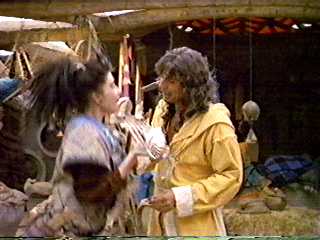
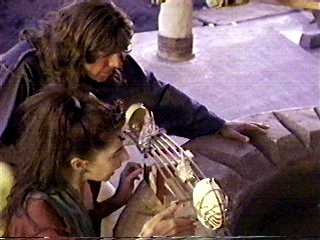
We open with credits over various shots of a trinary (three suns) star system. Electronic musical stylings set the "science fiction" mood. As the credits come to a close, the shots show a single red planet among the suns, and the sequence ends with views of the surface of Arakas or whatever desert planet this is supposed to be.A voice-over (James Barry Blakely) tells us our background while we are shown our cast of characters in their relatively primitive setting. The blind prophet Sor (Alexis Kanner) has foretold that a destroying darkness is coming. He's based his prediction on a set of metal blocks, which he can read. Aton (David Birney) rejected this notion because they live on a "planet of light." (If you've got nothing to study besides three suns in the sky, how in the heck are you going to know what a planet is?) Not that Aton is pressing his argument. It seems Aton's got a little bit of fluff (Andra Millian) without a name. We'll be referring to her as Whatshername. Aton is so busy with Whatshername that he's lost interest in his city and his observatory. (When you've only got three stars in your catalogue, astronomy is not going to be the fascinating field it could be.)
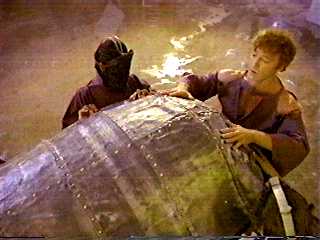
While Aton is busy with his newfound home entertainment center, Sor is leading an archeological expedition next door. The diggers break the seal on what looks like a crypt and pull out what looks like giant Jiffy-Pop pan. They open it. Inside are two skeletons. Sor feels up the remains and tells his crew it could use about ten minutes more on medium. Nah, what he really says is that the two people inside the Amazing Colossal Bake Ware couldn't stand the darkness. Then his hands find an amulet that will prove everything. (Don't worry. That's never explained.)
Back at Aton's place we meet one of his excitable associates (Susie Lindeman) who we will be referring to as
Hypergirl. (We'd refer to
her by her character name Boffin, but there's no place in the finished
film where anyone calls her that. We won't, either.) She tries
to get his attention by handing him what looks like a stringed instrument
with seashells. He seems as interested in it as the average adolescent
boy is in Camus. He tosses the seashell contraption to the side and
wakes up Whatshername so they can make out. After a bit, he shows
her the contraption. She doesn't know what it is, either, so she
plays keep away with it. Aton takes it back and dumps her into the
pool. Ah, the wild life of a scientist.

|
|
| To this film's credit, the title does not say Isaac Asimov's Nightfall. | When it was first introduced, the IUD wasn't the compact device it is today. |
Now we meet the Kin (Charles Hayward). He's playing what looks like a set of corroded copper bells. He must be real good, because he's making it sound just like a celesta in a recording studio. His woman Bet (Starr Andreeff), who is Aton's daughter, claps her hands when he's through. Kin and Bet talk, but instead discussing how he could make such pieces of junk sound good, they talk about Sor.
Back at Aton's place, the distracted scientist and Whatshername make cutesy small talk. Aton has a violent headache. (Must've realized what kind of movie he was in.) Afterwards, he explains that he'd had very bad headaches as a child, but after he started studying the suns and their movements, his headaches went away. Whatshername says his science is all made up, like a song. (That would no doubt be a disco song. A three-object sky is going to get annoyingly repetitive.)
Jump back to Bet and Kin talking about Roa, Aton's ex-mate, which means we're obliged to see her. Cut to Roa (Sarah Douglas) trying to get Aton to join Sor's darkness cult. Meanwhile, Sor is at his temple talking to his chief flunky Zol (Russel Wiggins) about the changes in climate. For illustration, the scene jumps to two beekeepers wondering why their bees are acting strangely. Back at the temple, Sor talks to Zol about the coming nightfall, when the unbelievers will be swallowed up. As they speak, Whatshername wanders around in the temple. Sor predicts she will be the death of someone.
After some filler in the form of love scene with Aton and Whatshername (which doesn't happen at the temple), cut to Aton's architect (Jonathan Emerson) and Kin talking about the prophesied coming darkness. The architect says the natives, who believe in reincarnation, are going back to their old ways. Kin suggests that Aton is three or more people. Yeah. Whatever. (Perhaps if this movie had been called The Three Faces of Aton, it might have found more focus.)
Kin visits Aton and tells him that Sor is dangerous. Aton is more interested in trivial pursuit (that is, Whatshername). He tells Kin to go home and be artistic. Later, some public-spirited extras drop in on Aton, knocking him out and grabbing Whatshername. They wrap her up and put her on a horse, which one of them leads off the set. They hope that, with Whatshername out of the picture, Aton will start paying attention to his civic duties. (It is given, but never clearly stated, that Aton is some kind of local lord of the village. As with the villagers, we could also hope with Whatshername out of the movie, the story will start paying more attention to its cinematic duties.)
Aton doesn't take this well. He comes outside looking for her, but the barbarian Rotarians block his path. The architect tries to get him to be reasonable, and Aton expresses his intense dislike of Sor. Yeah. Whatever.
Aton goes back to work at his observatory. One of the suns has
set. Sor visits Aton and tells him that sun will not be returning.
Aton retorts by insisting that this is the City of Light. (OK, so
now they're in Paris.) Later, Hypergirl is playing with her shell
game contraption. She explains to Aton that the noises it makes tell
the user where distant objects are, and she's using it to track the sun
on the other side of the horizon. (Fascinating. She's developed
a powerful radar telescope using their esoteric crystal technology.)
Then she explains that it works by bouncing sound off a target. (Through
the vacuum of space? May I please withdraw my earlier "Fascinating"
comment?) Finally, she dubs it a "telescope for the blind."
(We can also dub it a gizmo for the scientifically illiterate. Whatshername
was right; the science is made up.)
|
|
|
|
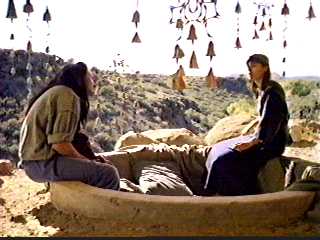
"Incredible, sir. Where did you find
it?"
"It was under that huge wooden horse the Greeks left behind." |
"What Do You See When You Turn Out the Light?"
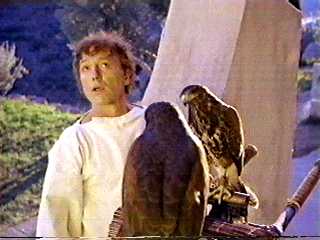
Back at the temple, Sor has some of his faithful (who wear masks that look like bowls of seaweed) put Roa into the giant Jiffy-Pop container. During her period of sensory deprivation, she has visions of footage from later in the movie. She's greatly distressed, so she must know how bad the rest of the story is. Later, Sor tells Zol that Roa will be one of his leaders in the new world order. They have a ceremony for her. Sor puts an open-eyed mask over Roa while some altar boys put a wicker contraption with two falcons over Roa's face. (By the way, these are ventriloquist birds, as they can screech without opening their beaks. Thank you, sound effects.) For some reason, they beak out her eyes. After the messy ophthalectomy, Sor puts a rope blindfold on her and says, "The blind shall lead the sighted."Aton is having some dialogue flashbacks. He goes to see Kin, who is in bed with Bet. While he asks Kin to find Whatshername, Aton feels up his daughter's leg. (Don't ask me, folks. I just call them as they happen.) Although he agrees to do this out of loyalty to Aton, he protests that she might be hard to find. (Here's a hint. She's a neurotic, homeless artist who shacks up with rich guys. Try southern California.)
Sor and Roa talk about Aton while making it. (You can tell that Sor is supposed to be a bad guy because, unlike Aton, he can't afford a body double for his back.) Back at Aton's place, the architect shows Aton some plans for some labyrinths that were done up by Aton's great grandfather. They blame Sor for their problems again. Yeah. Whatever. Sor visits Aton, and the blind seer reiterates about the coming disaster, which he has read on the metal plates. He calls it a book. Aton asks about the book. Sor says only the blind can read it. This upsets Aton, who doesn't believe in such things. (Apparently, Aton has never encountered the Braille instructions on a drive-up ATM.) Sor asks Aton what he wants to do. Aton says he wants to discover things. Sor tells him he's discovered some fun, but that's about it.
Aton calls a meeting with some locals. He tells them the bad news and the good news. The bad news is that all three of the suns will set and things will get ugly. The good news is that he's building a shelter for everyone to wait it out. When asked a reasonable question like, when will the suns return? Aton says he doesn't know and tries to gloss it over like it doesn't matter.
The above scene is crosscut with Sor telling his followers that nightfall is approaching, and that it will take faith to survive the new world of darkness. In other words, Aton and Sor are pretty much saying the same thing, but since Sor is a religious historian without a personal trainer, he's obviously in the wrong.
Kin finds a group in the desert doing an interpretive dance. Whatshername is one of the dancers. Although it would've been a nice touch if the dancers were presenting the story of the three suns falling over the horizon, it instead turns out to be about two guys falling for a girl and fighting over her. She makes the two stop fighting and chooses one. Yeah. Whatever. After they're done, Kin talks to Whatshername. While the other dancers are preparing to leave, she says they believe in the present only. Kin looks at the dancers, who have already left, and then looks again and they are still there. Yeah. Whatever.
Cut back to the city. Hypergirl uses her shell game contraption
to confirm that the second sun is going. (Well, duh!) This
scene is crosscut with Sor announcing the event from his prophecy blocks.
Somehow the latter is more impressive than the former.
 |
 |
|
(Get it? Falcon? Mwahahaha-aw, skip it) |
"It says, 'If found, please return to The Professor, care of The Island.'" |
Liver Has Lots of Iron, Too
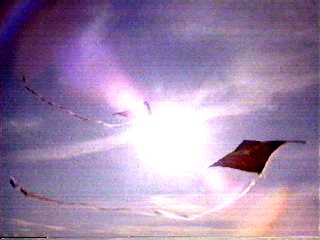
Back in the desert, Kin and Whatshername play peek-a-boo with some burlap maché masks. (The masks look like they were left over from someone's art fair. Perhaps if they'd had more time, they could've stuck rolls of toilet paper on them and played Mummenschanz.) Then the girl takes his crystal dagger and plays with his ear bauble. Yeah, whatever.Back at city, Zol tells Sor that Aton's group is buying food. At a bazaar, Aton sees some kites. He wonders if they have a useful purpose. Later, he uses his superior engineering skills to build a spinning contraption that generates lights from crystals. Flying kites pull a handle up and down, and this drives the device. Rube Goldberg would be proud. Have these people got a prohibition against manual labor? Why can't they just move the damn handle up and down by themselves?
Back in the -- aw, you know the drill by now. Kin and Whatshername have noisy sex by a fire in a cave. Later, while they're sleeping it off, a snake bites Kin. (And his scream is more convincing than during the sex scene.) Whatshername immediately sucks out the venom. Later, Whatshername plays with the snake and calls it a her. She's interrupted by a jump in scene. Kin and Whatshername argue violently. She doesn't want to go back to the city. As an odd tactic, Kin asks how she knows the snake is a female. He grabs it and whips it, breaking its spine. Whatshername writhes on the ground as if her back was broken.
Back at city, Roa encounters Aton. Aton realizes Roa can't see anymore. Roa tries to get Aton to join their club again. Elsewhere, on of the temple's masked seaweed heads cuts the cords on the kites. Aton sends some goons to get Sor. Instead of thanking the blind holy man for helping them realize the kite thing was pretty lame, Aton grills him for it. Sor says he didn't have the cords cut, and he didn't foresee his arrest in his book. Aton declares that Sor may be the interpreter of his book, but he's the interpreter of his own city. (And such a fine job he's been doing. I'd suggest his lame leadership and abuse of power should've gotten him impeached, but, well....)
Over at the temple, Sor has himself put into a wickery cage. Zol gives a dagger to one of the faithful and tells her she will use it later. Cut to the beekeepers, who are still upset that their bees are acting weird. (If they'd take a look around the rest of the movie, their apiary wouldn't seem so confused.)
Kin returns to his place with Whatshername wrapped inside a carpet. Bet enters and welcomes him back. She's not happy with his success. Later, Aton sees Whatshername at his home. She tells him the following story.
There was a snake princess who heard the song of a golden bird. She wanted to understand the song, so she went to a wise old snake. (No, not Groucho Marx.) The wise old snake told her that to understand the song of the golden bird, she would have to eat the liver of a snake. When she declared she couldn't do that to one of her own people, the sage serpent told her that she would have to eat her own liver. This wouldn't kill her, but she would change. She opened up her own side and ate her own liver and turned into a human princess. Then she understood that the song of the golden bird was a love song to his wife. The princess could never go back to her own people. Desire had caught the snake princess by the tail. (While she tells this story, shots of Roa with a snake are dropped in.)
Yeah. Whatever.
Later, the architect tells Aton that bringing back the girl was a bad thing. Oblivious to this, Aton wanders into the next scene. The temple member with the dagger (remember her) attacks Aton. He pulls what looks like a crystal ruler on her, and the reflected light causes the amateur thugge to roll her eyes and pass out. (He might've achieved similar results by telling her how kites are a better power source than manual labor.) After this thrilling break in the plot, Aton makes apocalyptic small talk with Whatshername. He tells her, "Your eyes are so dark. You are my nightfall." (Such a romantic! Maybe he'll follow it up with a chorus of either "You are My Sunshine" or "You Steal My Sunshine.")
In the shelter, the Architect and Hypergirl are trying to find solutions for potential problems. Rather than help them come up with practical solutions, Aton coughs up some blindly optimistic platitudes. "Nothing is impossible!" he shouts. (Activity Time: Insert your own witty "impossible" jibes here.) Later, one of the citizens in the shelter freaks out from claustrophobia. Hypergirl reassures him by saying everything is in the mind, and then she drops into airhead mode while dishing the same platitudes Ator was serving earlier. (That Doom of Darkness cult is starting to look better and better.)
Bet and Kin talk. Bet is upset about the Whatshername. Kin
lets it slip that he has a thing for the subject of their conversation.
Later, Kin visits Whatshername. He wants to take her back out to
the desert. (At about this point in the movie, characters start calling
her Ana. Although it would be proper to refer to her by this name
during the rest of this plot description, the sudden choice is not explained.
Because of this peculiarity, we won't be referring to her by that name.
Besides, calling her "Whatshername" is a lot more fun.)
"My God! It's Full of Stars!"
The third sun sets, and our heroes go walking off into the sunset. No, sorry. There's more movie, and for a world plunged into darkness, all of the following scenes are well lit. We are treated to various cuts of characters at the moment of nightfall. Aton's group piles into the keep. Hypergirl plays with a crystal while watching the sun set. Kin arrives and pesters her until it's obvious this scene is going nowhere. Elsewhere, Aton calls for Whatshername while looking for her. (Ah, maybe that's why they decided to give her a name; having the hero run around shouting "Hey, you!" is not as dramatic.)Whatshername shows up at Aton's place, but finds Kin instead. They make out. Meanwhile, Aton shows up at Sor's place. (Guess he figured since Sor was able to land Roa, he might've pulled off the same trick with Whatshername.) After Aton departs, Sor tells Roa to bring others in. In what seems to be the moment of his vindication, Sor says, "And the beginning is near."
Aton wanders aimlessly through a montage of his citizens in anarchy mode. Since he's in a live and let live kind of mood, he lets them continue destroying themselves. A few small fires burn. Women are raped. Two sumo wrestlers square off. (Uh, no. I didn't make up that one.) Elsewhere, Bet strikes a few erotic poses with Kin's crystal dagger. (We'd assume Aton and Bet are doing these things because the night has driven them mad, but these actions are not terribly different from their normal activities.)
Eventually, Aton finds Whatshername and Kin in snuggle mode. He asks why. Kin says it has to be because they're in a dream; they wake, they die. Aton's pretty upset about this discovery (and he's not in a mood to sing "Row, Row, Row your Boat"), so he challenges Kin to a duel. They fight with crystal swords that make a funky noise when they hit each other. In the background a thunderstorm brews. The wind increases. A cheap bell made of bent metal makes sounds like a cast iron church bell. The maniacal monarch beats Kin. He falls backwards and asks for mercy. The evenhanded lord of the city rushes him anyway and runs him through. (Hey, Sor was right. That girl was the death of somebody.) Aton seems to sense he's no longer needed in this scene and wanders off. Whatshername picks up Kin's ear bauble.
Aton wanders through the village some more. He looks at some of the fires, which are going out. Then he encounters some people who have some big magic glowing crystals. (Could it be any more obvious that the actors are holding flashlights under these things?) Meanwhile, Bet shows up with the crystal dagger at Aton's place. She finds Whatshername, who is holding Kin's ear bauble in her open hand. When Bet reaches for it, Whatshername snatches it away. Bet sticks Whatshername in the abdomen with the dagger, waits for her to die, and moves on. (We're not shown if Whatshername takes advantage of her new opening by eating her own liver, so that she can turn into a human princess.)
Aton shows up at the temple carrying one of those magic glow crystals. Sor is standing on a cliff's edge. Aton goes up to him and grabs him by his rope necklace. Sor is surprised Aton found his way up there. Aton tells Sor he's been a bad boy because he scares people. (Hey, buddy, look in a mirror lately?) He spins Sor around and asks him what his sense of direction is. Sor goes over the edge. (Not content with murdering his son-in-law because he's been more effective at banging his mistress, the story's hero has now murdered a blind man because he found him annoying. Maybe for an encore he'll molest a girl with cerebral palsy.)
Roa finds Bet in the darkness. Since Roa can find her way in the dark, she takes Bet by the hand and recites, "The sighted will be led by the blind."
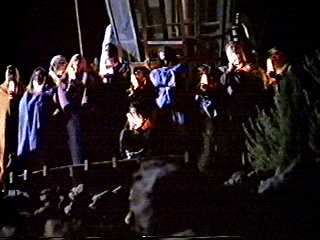
Back at the observatory, Aton and several others gather with their magic
glow crystals. Given the way they assemble, facing the camera behind
Aton, one gets the uneasy sensation they are about to perform a musical
number. They don't, so we've finally found a point in the film's
favor.
 |
 |
| In attempt to avoid the mistakes of the past, Daedalus and Icarus switched to hang gliders; however,.... | o/' "I'd like to teach the world to sing
"In perfect harmony [Perfect harmo-]" |
They're looking up at the stars. (None of them seem to figure
they might see more without those magic glow crystals; but then, that would
be something Sor would've told them.) Some white stuff starts falling,
but we can't tell if it's snow, nuclear fallout, bat guano, or the ashes
from Dr. Asimov's original story. Aton says, "It's possible that
nothing important has yet been said or even understood." (Uh huh.)
Then a big cloud of the white stuff falls. Yeah. Whatever.
Run credits.
The Good Stuff
Seeing things a new way
The scene with Bet's rescue by Roa is good. There's satisfaction in seeing her using her handicap to her advantage. Somehow, though, I doubt the filmmakers wanted this to be good; after all, Roa's blindness was the handiwork of a religious bad guy.The very last scene, where the characters are seeing the rest of the
universe for the first time, is actually quite inspiring. Perhaps
if they'd found a way to cut out the eighty-some minutes it took to get
there and junked the notion they were doing Asimov's story, this would've
been a better movie.
Bad Stuff
Good is to Evil as Pretty is to Plain
So many old stories follow the pattern. Good guys are good looking. Bad guys are not. Usually a movie can get away with that kind of prejudice because the good guy does good guy things. To merely expect that the audience will buy that a character is a good guy because he looks like a good guy should be an intellectual insult by now, and this movie is pretty insulting.There's Aton. He's tanned, muscled, and wears a wig so he looks like a rock star. He can afford a personal trainer and has a good on screen presence. He's also the popular leader of the locals. So he's the good guy. The good guy murders his son-in-law over a woman, murders a blind man over a disagreement, and (we're not sure) seems to have a thing for feeling up his adult daughter.
And there's Sor. He's pale, has short frizzy red hair, and he's not what you'd call cut. He disagrees with the good-looking one, so he's the bad guy. Bad acts are warning people that darkness is coming and shacking up with Aton's ex. Oh, yeah, and he's religious, so he must be evil.
I've said it before and I'll say it again. Characters who have solid values and act on them are more interesting than characters who are merely pushed onto the audience with the expectation that the audience will like them. If the character has problems acting on his or her values, then you have a realistic character. Sor seems to have a stronger set of values than Aton. Aton has a few shallow values, and he rarely acts on those. This could have been played for tragedy, but Aton never pays a heavy price for his personal shortcomings or personal excesses, and he doesn't have a moment of epiphany when he realizes those shortcomings and makes a positive change. On the other hand, Sor has some hubris, and he pays for it. He even has a moment of epiphany just before Aton murders him. Maybe this movie should've been about him.
One could argue that Aton's actions are justified because he lives in a culture that is alien to our own. That would be a convincing argument if the renowned writer/director had created or borrowed a convincing alien culture. For example, it might've been acceptable if the characters lived by high standards of honor, and if Aton was bound by that standard to kill two characters. However, the civilization presented is about as foreign as an artist's colony in Arizona, and Aton is killing for strictly personal reasons. The closest we get to an examinable alien culture is Sor's cult, and the filmmakers are not making allowances for those actions.
There's also an arguement that Aton was driven insane by the night. This has already been addressed in the plot description.
Not that this matters. Aton is the hero. Accept him. You have no choice. Like him, because the filmmakers did, and if you don't, then there must be something wrong with you. Yeah. Whatever.
(As a sidenote on this whole issue, consider an observation made by
a British humorist about the TV series Dallas. He said that
it appeared the old west was populated by two kinds of people: the Randolph
Scotts and the Not Randolph Scotts. The Randolph Scotts did good
deeds, looked nice, and always won. The Not Randolph Scotts did evil
deeds, were not photogenic, and always lost. It seemed likely that,
by natural selection, that the Randolph Scotts would survive and the entire
state of Texas would be populated by their descendants. However,
Dallas
had several characters that looked like Randolph Scotts doing some very
Not Randolph Scottish things. According to the author, trying to
reason this out was why the English watched the series faithfully.)
Silly Science
As noted in the plot description, the main characters track the suns on the other side of the planet using sonar. It's amazing. They must live in an alternate universe where sound travels in a vacuum. It doesn't help that the device in question looks more like an abstract art project than a scientific device.Perhaps the writer was basing his science on episodes of Star Trek. In that series, the bad guys on one planet try to knock out the Enterprise, which is up in space, with a sonic weapon. Serious fans of the series remember that obvious science glitch with clinched teeth; children with fundamental science in their education can tell you why that won't work. Apparently, a renowned scriptwriter and director could not. Perhaps a line like, "In space, no one can hear you scream" would have been a total mystery beyond it's existential quality.
There's also the question of the mechanics of the trinary system. To the story's defense, it would be questionable to slam them for the improbability of the arrangement, since they are basing this notion on a story by one of the best hard-science fiction authors of all time. On the other hand, given what has been discovered between the time Dr. Asimov wrote his story and this movie was made, it is very unlikely that a trinary (or larger) system will support planets. Real science fiction will find counter arguments to make the allowance. Faux science fiction by artists with no clue will not.
Although it may be pointless to nit-pick the science and make trite,
overbearing comments about it, please consider that the most obvious paying
audience for this feature would be people who are familiar with Dr. Asimov's
work. Those people are not slackers when it comes to science.
(There's also the question of faithfulness to Asimov's original story,
but that will be addressed elsewhere.)
The Loose Ends
One of the characters refers to other characters as "the natives." The cultural differences are never explored. I mean, who are these people to refer to the others as the natives? Did their group conquer the area? Does this lead to problems with a balance of power? What kind of problems do the settlers have maintaining their authority? Do the natives have cultural traditions that include a previous nightfall? Could their belief in reincarnation be based on a previous nightfall? Did anyone care? That last one seems to have the easy answer.Early on, Aton has a dramatic headache. Yes, that does sound silly, but follow. After the headache passes, he explains that be became an astronomer because it helped to make his headaches go away. This is an interesting character trait, but it's never explored. Although the audience gets several headaches throughout the rest of the story, Aton never does. So the question is, why was that bit put into the story? Was it to make us sympathize with Aton? Was it put there as a sign that Aton is a sensitive intellectual? Frankly, all it did for me was serve as a reminder that Caligula had dramatic headaches....
It is suggested that Sor is a powerful telepath. When the assassination
attempt on Aton fails, Sor's meditation is interrupted by what looks like
a seizure. Apparently, we are to take it that Sor has been controlling
the temple member through telepathy. This ability is never explained.
What was the Point?
When a story is presented as simply as this, it could be a fable or allegory. Fables have morals and allegories have points. This movie has neither.Is it telling us there's a conflict between religion and science, and that science is good? Nope. Aton represents science and his actions, relative to Sor, are downright reprehensible. Besides, Sor tended to make more accurate predictions. Aton is no Gallileo.
Is it telling us that optimism is good and pessimism is evil? Perhaps, if optimism means refusing to believe that anything can go badly (it isn't), and if pessimism means never making any logical preparations for bad times (ditto).
Is it telling us that sensitive artists are naturally superior to people
who have to work for a living? Yeah. Whatever.
The Who Cares Stuff
Notes on the Cast and Crew
Paul Mayersberg (writer, director) wrote the screenplay for the disturbed feature The Man Who Fell to Earth (1976). Now, that's not an insult; Walter Tevis' original novel was pretty darn different, and Mayersberg followed it well. However, Mayersberg's tactic of intentional confusion did not work well in his next script, The Disappearance (1977). He later started doing scripts, some of which he directed, about cultural clashes.Mayersberg also has a habit of changing the attitude of the ending of his adapted works. For example, consider The Man Who Fell to Earth. At the end of the novel, the title character, who has been drinking, collapses. His server suggests he needs help. In the movie, the server says he's had enough. Mayersberg change to the ending attitude of Nightfall was much less subtle. (And from what I've heard from others, much less acceptable.)
TV's David Birney (Aton) has been doing stuff for the small screen since the 1960's. He'll probably be remembered for his work on the St. Elsewhere series and as the (ex)husband of TV's Meridith Baxter. He's also done several stage shows, been a panelist on The National Endowment for the Arts, and chaired the American Diabetes Association. Something is terribly, terribly wrong when an actor with such credentials turns in such an uninspired performance in such an uninspired movie.
Serious fans of The Prisoner may remember Alexis Kanner as the marginally weird Kid, and he does a pretty good job here as the marginally weird Sor. In the time between those two shows, he worked on a few small films. If he's made anything since this one, there doesn't seem to be a record of it.
Sarah Douglas (Roa) does a good job in this movie as a woman caught up in a cult. Regular movie watchers might remember her as a villain that looked good in back; she was Ursa in Superman II (1980) and the evil queen in Conan the Destroyer (1984). In the '90's, she started doing mostly B movies, like Puppet Master III (1991), Return of the Living Dead 3 (1993), and Voodoo (1995).
Starr Andreeff (Bet) has played screen-queen in several B movies, such as The Terror Within (1988), Amityville: Dollhouse (1996), and Vampire Journals (1997).
Jonathan Emerson (Architect) never really got a big break in the movies.
Here, his character doesn't have a name, and later, he'd get a lot more
screen time without a real character name, too. He was the LT in
84
Charlie Mopic (1989).
Roots, Shoots, and Other Compares
"Oh, Mamma, Can this Really be the End?" Not all apocalypses are created equal. Some are more astronomical (both literally and figuratively) than others.The following list is not all-inclusive. Also note that the "big rock from the sky" movies have become a subgenre unto themselves. And what a flooded subgenre it became in 1997. For that reason, several titles about meteor and comet impacts are not included below.
Off on a Comet by Jules Verne (1877) – Fantasy about a comet sideswiping the earth, pulling up some land, atmosphere, and people. The people survive the transplant and learn to live on their new world as it continues its journey through the solar system.
Le Fin du Monde (1931) – Those French and their comets. After an astronomer predicts a comet is going to hit Earth, anarchy follows. Remade for English speaking audiences as The End of the World (1934).
When Worlds Collide (1951) – Earth is on a collision course with another planet, and the race is on to build a space ark.
The Magnetic Monster (1953) – Odd substance grows at a geometric rate, and will very soon force the earth out of its orbit.
Uchujin Tokyo arawaru (1956, a.k.a. Warning from Space) – A comet is going to slam into the Earth, and some aliens try to help humans figure it out.
The Night the World Exploded (1957) – Seismologists develop an "earthquake predictor" and, by amazing coincidence, an earthquake epidemic begins. Credible, you ask? Well, it was released on a double bill with The Giant Claw….
Voyage to the Bottom of the Sea (1961) – It's the Seaview to the rescue when Irwin Allen's belt, er, I mean, the Van Allen belt starts to burn.
The Day the Earth Caught Fire (1961) – Simultaneous polar nuclear test explosions cause the Earth to alter its orbit into the sun.
Valley of the Dragons (1961) – Movie version of Off on a Comet, with dinosaurs and cavemen thrown into the mix.
Yosei Gorasu (1962) – This is also known as Gorath. The problem: a giant rock is headed toward Earth. The solution: put rockets on the Earth and move it out of the way (while fighting off a giant walrus).
Crack in the World (1965) – Scientist tries to breach the Earth's crust with a subtle thermonuclear bomb. Unfortunately, it causes a growing fissure that may split the planet.
Na komete (1970, a.k.a. On the Comet) – Czech version of Off on a Comet.
Where Have All the People Gone? (1974) – Solar flares cause humans to evaporate. This added a new wrinkle to the "everyone vanishes" subgenre.
Lucifer's Hammer by Larry Niven and Jerry Pournelle (1977) – As a comet approaches Earth, a few people make preparations for the disaster. After the impact, prepared survivors fight off the ill prepared ones (who have reverted to cannibalism). Compare with Hammer of God by Arthur C. Clarke (1993) and just about every cinematic entry in the "big rock from the sky" genre.
Space: 1999 (1975-1977) – You know the drill. Nuclear explosions knock the Moon out of orbit. Story follows the survivors on the Moon, but disasters on Earth were hinted.
Meteor (1979) – Asteroid is knocked into a collision course with Earth and political squabbles follow.
Quintet (1979) – In the distant future on Earth, another Ice Age has begun. Bored people either freeze to death or die in a strange parlor game. Meanwhile, most of the audience is bored to death.
Night of the Comet (1984) – In another entry to the "everyone vanishes" subgenre, Earth passes through the tail of a comet, wiping out all intelligent life and leaving behind two val' gals.
Solar Crisis (1990) – A solar flare heats things up in a movie that runs a little too cold.
Doomsday Rock (1997) – An ancient prophecy convinces an astronomer that a comet is going to collide with earth, so he hijacks a missile silo.
Armageddon (1998) and Deep Impact (1998) – For fun, try running both of these at the same time on two separate TV sets, then decide which characters would've done a better job in which film.
Nightfall (2000?) – The only thing I know about this is that
Roger Corman announced (in 1998) that his group was going to try this again
in India. I say "again" because Julie Corman (Roger's wife) is credited
as the producer this 1988 version. Hopefully, they have learned from
past mistakes. (I'm crossing my fingers on it real hard.)
As Different as Day and Night
Although the movie Nightfall leaves much to be desired, those who have read Asimov's story will find the movie less tolerable. The original had several good points that were missing from Mayersberg's film. In particular, Asimov described the effect darkness had on the people; night drove them permanently insane with claustrophobia. They'd burn everything during the darkness for the sake of light. And I mean everything. Their entire civilization became ashes in a few hours.Instead of continuing to compare the movie to the source material, I'd rather recommend reading the story for your self. However, there is one other important difference that cannot be denied, and that's the ending:
Aton, somewhere, was crying, whimpering horribly like a terribly frightened child. "Stars–all the Stars–we didn't know at all. We didn't know anything. We thought six stars in a universe is something the Stars didn't notice is Darkness forever and ever and ever and the walls are breaking in and we didn't know and anything–"[The above is transcribed from The Asimov Chronicles, edited by Martin H. Greenberg, and published by The Berkley Publishing Group (New York) in 1990.]Someone clawed at the torch, and it fell and snuffed out. In the instant, the awful splendor of indifferent Stars leaped nearer to them.
On the horizon, in the direction of Saro City, a crimson glow began growing, strengthening in brightness, that was not the glow of a sun.
The long night had come again.
The Bottom Line
Starry-eyed optimist saves an art colony in the desert from darkness. One of the finest science fiction stories ever written becomes the basis for one of the worst movies ever made. Heroic main character evokes less sympathy than the bad guy does. Very poor science. Random placement of sex scenes redefines "gratuitous." Interesting notions suggested but never realized. The shallow, upbeat ending will disgust those who remember the original story. Recommended for New Age crystal-heads, students too lazy (and unwise) to read the original, and anyone wanting a spiritual ipecac without a catharsis.Published 2 October 1999
 |
   |
A
Proud Annex of....
|
|