|

I died early the day I woke up, or...
Scared to Death (1947)
(a.k.a. Accent on Horror, The Autopsy)
Written by Walter Abbott
Directed by Christy Cabanne
Details at the IMDB, US.IMDB
Thou'rt wondrous frolic, being to die so soon,
And passing proud a little colour makes thee.
Sir Richard Fanshawe (1608–1666)
Are your dreams in black and white or in color? They say that a dream in color is a more lucid and dramatic experience than a dream without it.
Sometimes the presence of colors is important. In the post-dream memory, the brilliance of hues is stronger because the intensity and quality of the colors were the foci of a moment. Also, people who can interact with their dreams may be able assign a higher priority to color, allowing them to "turn up the hue" during their time in the arms of Morpheous.
Unfortunately, as we
are about to see in this article's feature presentation, color in a
dreamlike experience does not
always guarantee lucidity and drama....
Contents
The Plot
Dead Woman Talking
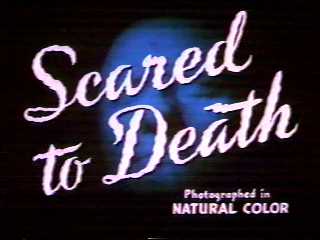
After the opening credits (superimposed over a powder blue death mask), we join two medical examiners (Stanley Andrews and Stanley Price) in a morgue. They are discussing their dislike of the task ahead of them, which is doing an autopsy on a good looking woman (Molly Lamont). The pathologist tells his intern that he wonders what her very last thoughts might've been.
Suddenly, the movie accommodates that (not so subtle) setup line. In a close-up of the woman, an approaching blue mask is superimposed into the picture. A woman's voice screams in protest...
 |
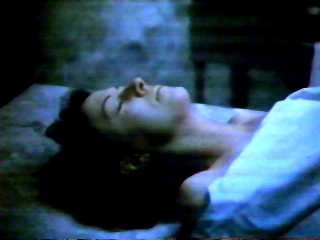 |
| Oh, yes. He looks very natural. | Molly Lamont takes a moment to recall the things that killed her career. |
And cut to the lady of the slab protesting against a pair of hands trying to put a gauze bandage over her eyes. Instead of the morgue, she's now in a doctor's office. She pushes away the hands of Dr. Josef Van Ee (George Zucco). He asks her, calling her Laura, why the bandages frighten her; do they remind her of something? Laura asserts with fear that they don't. ("Asserts with fear" you ask? Call it her primary character trait. Aw, shoot, lets just formalize it now: Asserts with Fear™, a.k.a. Freaking Out®)
While she's still Freaking Out®, er, Asserting with Fear™, she hears a noise that she doesn't like. Dr. Van Ee goes to the window and tells her it's only a branch tapping against the window. Then the dour doctor tells her that he can't help her unless she tells him what frightens her. She counters with the claim that someone is trying to frighten her away, but it won't work. (Darn straight. As we have seen thus far, there's nary an effective fright in this whole movie.)
Laura's husband Ward (Roland Varno) enters. He asks her to stop bothering his father. In return, she puts on some calm bravado and badgers her husband, accusing him of wanting to strangle her. (This would make him different from how many other men right now?) She hands him a red robe. It's the only gift he ever gave her, and now she's returning this used present. (Yif! Good thing he didn't buy her a gift wrapped box of tampons.)
After she leaves the room, Ward and his father discuss what they can do about Laura. They're interrupted by their maid Lilly Beth (Gladys Bake). She tells them that Mrs. Williams is waiting to see the doctor. On her way out, Ward gives Laura's robe to Lilly Beth, which she accepts gracefully and leaves. When they're alone again, Dr. Van Ee tells Ward that marrying Laura was fatal mistake, but not to worry. The doctor has a plan.
Fade to Laura on the slab, with fade accompanied by a musical cue. She says through a voice over that Dr. Van Ee had a mysterious caller. Fade to the action, accompanied by the musical cue. (That's right, folks. This movie is now being hosted by a dead woman, and I don't mean Elvira)
(And while we're all scratching our heads about the last paragraph,) Mrs. Williams (Dorothy Christy) asserts that something strange is going on here. Dr. Van Ee denies it. (And while we're all scratching our heads about this paragraph, too...)
Lilly Beth tells Bill Raymond (Nat Pendleton) to stop following her around. Bill is a private detective on retainer by the doctor, but he seems more interested in shadowing Lilly Beth than staying on the alert for potential troublemakers.
The musical cue announces Laura on the slab again. She says, "Then came a sinister pair." Fade away with the musical cue again. (We weren't sure this was working the first time. We're pretty sure it's not on the second try.)
Lilly Beth and Bill answer the door bell. When the maid opens the door, Professor Leonide (Bela Lugosi) and his dwarven manservant Indigo (Angelo Rossitto). After flattering Bill, he insists on seeing Dr. Van Ee and asks if his associate Indigo could wait here. Bill says there's a tree out back, but it doesn't have any coconuts.
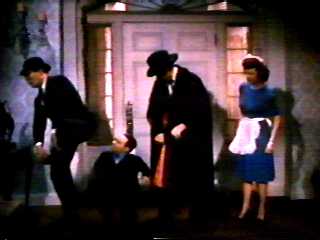
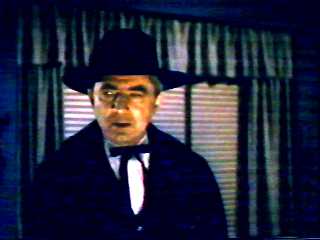
Indigo nearly levels the dim detective by stomping on his foot. Leonide explains that Indigo is a deaf mute, but he can read lips and he has a (dare we say it) short temper. While Indigo makes himself comfortable on a couch, Leonide barges into Dr. Van Ee's office.
Dr. Van Ee and Professor Leonide square off. The doctor belittles Leonide for his career as a magician, while the magician hints that people would be interested in knowing about the scandal in the doctor's past. After these pleasantries, Leonide announces that he and his associate will be staying at this house. Dr. Van Ee agrees; he can't turn his cousin away.
Fade, musical cue, Laura says her husband asked questions about her past, musical cue, and fade. (Yikes! How many times are they going to do this?)
Leonide and Ward make small talk. Then Ward shows Leonide a promotional photograph for a dance team called Rene and Laureate. They're advertised as doing the "dance of the green mask" in a club called the Green Room in Paris. (Guess their manager didn't have a lot of color imagination.) Both dancers are wearing masks. Ward thinks the girl in the green mask may be his wife, and he asks Leonide if he's ever heard of this act. (We also note that the photograph is in black and white; when did he decide it was a fact the girl in the photo is wearing a green mask?) Leonide says he played all over occupied Europe, including the Green Room, but never heard of them.
While they talk, a blue mask looks in through an open window. (To let us know this is important, they throw in a dramatic chord.)
Good Help is Hard to Find
Fade, musical cue (aw, c'mon already), Laura says she had a terrible fight the next morning, musical cue, fade.
Laura is in her room. Lilly Beth delivers a package. Laura asks what it is and Asserts with Fear™ that the maid has been opening the mail. Lilly Beth hasn't opened it, but tells her (with a dramatic chord) it was addressed in green ink
Laura opens the package and screams. It's a fake human head, female, with eyes wide open (and a dramatic chord). She pulls it out of the box and screams a little more. Bill enters and asks what the problem is. Laura hasn't met Bill yet, so she Asserts with Fear™ that someone sent him to spy on her. Bill explains that his highest ambition on this job is to solve a murder and get back his old job as a homicide detective; she'd be doing a him a real favor if she'd get murdered. (Us, too.)
 |
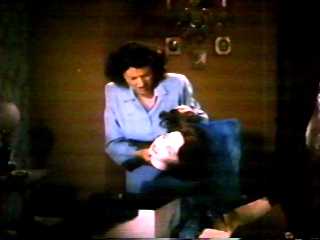 |
| While Bill favors his injured foot, Leonide warns him about Indigo's favorite target with a meat mallet. | Laura in Bring Me the Head of Nicole Garcia |
She doesn't seem interested in his plight, so she shouts at him in a mostly unintelligible language, calling him a cochon. Then she pulls a handgun on him and tells him to get out. Bill says next time she screams, he'll assume she's faking. (Heh.)
Fade, musical cue (arrrrgh!), Laura says "I became afraid, and my mind began to crack." (Yeah, ours too, lady). Musical cue, fade.
In Laura's room, Laura has Lilly Beth in a choke hold. Lilly Beth protests that she doesn't know anything about a missing photograph. Laura lets go and says she must find that picture so she'll know what he looks like when he comes. The maid pauses, smiles a little "get even" grin, and says that she may have seen the man in the picture, and he may be in the house. She turns to leave. Laura throws the fake head at her. It misses, going through the doorway. Bill was outside the room listening. He catches the head and freaks.
Bill takes the head to Dr. Van Ee and complains. He wishes someone would commit a murder already instead of all this fake stuff. The doctor recognizes the head from part of his anatomical specimen collection which he keeps in the cellar.
Outside, Bill turns on the charm for Lilly Beth again, but she returns his overtures with sweet nothing-doings. She accuses him of tracking up her clean floors. Looking down, she notices the cobwebs on his shoes and asks him if he's been in the cellar. He admits that he has, but it was part of his job.
Fade, musical cue. (There's no place like home. There's no place like home....) Laura says, "Yes, I was scared. Scared of my life!" Musical cue, fade.
In Dr. Van Ee's office, Bill tells the doctor that he's suspicious of Leonide and his friend. Dr. Van Ee explains that Leonide was a patient here, back when this house was an institute for the insane. And while Leonide was here, he designed several secret passages for the guards. One night, he used a passage to escape. A few years later, they heard that he was in Europe.
The mere mention of an exotic locale like Europe puts stars into Bill's eyes. He wanders out. Dr. Van Ee picks up the phone and calls the police. Someone hits him on the back of the head and pulls the phone cord out of the wall.
Elsewhere, Bill professes his love to Lilly Beth, offering to buy her things like jewels and cars and saying that he'd love to serve her breakfast in bed. She looks off to the side, smiling. He realizes what he's saying and questions his own mental capacity. Lilly Beth says she wouldn't want to hang by the neck waiting for all this. Bill says it'd probably be a good thing if she didn't, because she'd get blue in the face. And on that cue (plus a dramatic chord), a blue mask looks through an open window.
After Lilly Beth leaves, the doorbell rings. Bill answers the door. A couple (Douglas Fowley and Joyce Compton) stand at the doorway. Bill quickly takes off his own hat and covers his face. "The doctor ain't seein' nobody," says Bill, but the man at the door pushes his way in. Then the man recognizes Bill, calling him Bull, and asks him if he's shot any more dummies lately. Bill asks him (and we learn his name is Terry Lee) to keep that quiet. Terry introduces Bill to his date, Jane Cornell. She remembers the story of how Bill was chasing a fleeing murder suspect and mistakenly shot up a mannequin while the suspect got away.
Terry asks Bill where the body is. Bill tells him there is no body. Terry tells him there was a call to the police from here, but the call was cut off. And Jane, who was the operator on that call, tipped him off. As a reporter, he wants the story. So, where's the body? (We'd like to know when a body was mentioned during the above.)
They go into Dr. Van Ee's office. Bill says there's no body in there. Terry holds up the disconnected phone cord for Bill, but the private detective is not impressed. Jane, on the other hand, is so impressed by a body lying on an examination couch that she screams. Whoever it is, it's covered by a white sheet. Then it sits up. (Are we scared to death yet?) Hands reach up and pull the sheet away. It's Dr. Van Ee. (Gee, what a shocking surprise.) He doesn't know what he was doing on the couch, so Terry tells him he got there via the head injury express. Then the rabid reporter wants to know what's going on here. Dr. Van Ee denies foul play and asks them all to leave his office. (Oh, sure. Blunt head trauma is what being a creepy psychiatrist is all about.)
Terry, Jane, and Bill repair to the parlor. While Jane makes a few dizzy blonde remarks, the reporter divides his time between asking Bill questions about Laura and badgering his girlfriend to be quiet. After some grilling, Bill admits that he knows what Terry already knew. It seems that Laura was a singer at a night club, and Ward was drunk. His friends dared him to marry the singer. When Ward woke up, he was married.
Meanwhile, the dramatic chord announces the blue mask bobbing around outside, as seen through the open window. (Oooooh, scary, scary.)
Professor Leonide and Indigo enter. The magician admits in his own grandiose way that he was eavesdropping. Terry recognizes him and lays on the compliments about Leonide's skill as a magician, and the illusionist magnanimously accepts these compliments. Then Terry mentions the time the box office receipts vanished. Leonide doesn't seem too upset that this man has made the connection, but then he learns Terry is a reporter. "Press, huh?" says Leonide. "Nice knowink you," and he turns to leave.
Laura enters. As soon as she realizes Terry is a reporter, she Asserts with Fear™ that she's being kept here against her will while they continually drive her mad. The dramatic chord/unnoticed blue mask in the open window punctuates her story.
Ward and Dr. Van Ee enter. They confront Laura's accusations. Terry takes her side. (Chivalry or a smarmy quest for fame; you decide.) This pleasant little chat is interrupted by Lilly Beth. She walks in a trance holding a blindfold at arm's length in front of her. Then she tries to put it on Laura, who Asserts with Fear™ that she doesn't like it. Lilly Beth falls down. Dr. Van Ee takes her pulse. She's dead. (Aw, dambit! They just killed off the most likeable character in this movie. Why couldn't they have whacked the reporter?)
Fade, musical cue. (One bullet in cylinder. Spin cylinder. Barrel to temple. ::Click!:: Sigh....) "Then I knew that he was here." Musical cue, fade.
hex, pries, and secret escape
Interlude. Indigo scampers around in the main hall. (OK, maybe it's not politically correct to refer to a vertically challenged person as "scampering." But the man is making a buck on his physical stature here, so let's let it go. However, we're not sure why this was dropped into the flow of the story -- such as it is -- aside from letting us know he's still in this movie.)
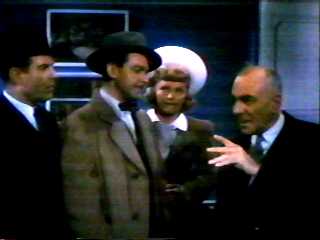
In Laura's room, the owner is lying on her bed. Dr. Van Ee, Ward, Terry, Jane, and Bill are gathered around her. The doctor wants to give her a sedative, but Terry accuses him of trying to shut her up. Dr. Van Ee maintains that she shouldn't dwell on her fear just now because she may snap. (Well, we could use some snap to this movie.) Terry continues the accusations, but Ward takes him outside to talk. (We could wish he was taking him outside to teach him some manners, but no go.) On his way out of the room, Terry tells Bill to guard the room.
 |
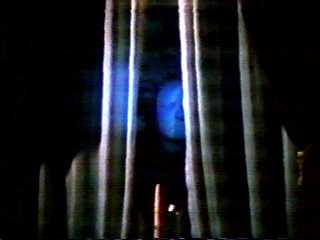 |
| Dr. Van Ee describes his war injury. "Yes, I was shot in the hand. Fortunately, surgeons were able to replace the tendons with consonants from my surname." | Meanwhile, our heroes are haunted by the avenging ghost of Braveheart. |
Downstairs in the sitting room, Ward tells Terry that he doesn't appreciate his accusations. For one thing, how does Ward know that Terry really is a reporter? Terry pulls out his wallet and shows him his press pass. Ward accepts the man's authority to be here. (And also the man's authority to be a jackass. This was back when the Fouth Estate had greater jurisdiction than the police and could destroy more lives without impunity. Not that this has changed....)
Terry sees something outside. He pushes Ward away from the window, and this hacks off the harried husband. The reporter shouts, "Can it be?" (Oh, great, now we have another character withholding information from the audience.)
Terry and Ward go to the Dr. Van Ee's office. Leonide is there, talking to the body of Lilly Beth, which is laid out on the examining table. Terry asks the magician if that was him "barking at the moon" a moment ago. Leonide magnanimously suggests that the reporter must be confusing this movie with The Wolf Man (1941). Nah, just kidding. However, Leonide does assert that his presence at this house is to repay an old debt. The reporter accuses the magician of being behind all the strange goings on. The magician responds to the accusation by making a veiled threat against Jane.
The conversation is interrupted by two gunshots in another room. While Ward and Terry run to see what just happened, Leonide shouts to them that whatever just happened, it couldn't have been him.
Terry arrives at Laura's room, where Bill is tied up and somebody wearing a blue mask is lying on the bed. Terry pulls back the mask. It's Jane. The reporter asks Jane what happened to Dr. Van Ee? Actually, that's not quite correct; it's more like Terry spends five minutes badgering and insulting the intelligence of Jane and Bill when neither of those comic relief types can tell him what he wants to know.
Meanwhile, Leonide enters the doctor's office through a secret door. He scoops up Lilly Beth's body and carries it away. (Go ahead. Make your own japes about necrophilia. Can't stop you. Wouldn't if we could.)
Fade, musical cue. (Tie cord around arm. Wait for vein to swell. Quick, Mrs. Apostic! The needle!) "It was then that he had me under his power." (Actually, she says "powah," but let's play along.) Musical cue, fade.
Terry and Bill search the sitting room for secret doors. Bill gives up, sits down, and falls asleep. (Heh, us too.) Terry rouses him awake and asks more questions about what happened upstairs. The defective detective says he smelled something like a sweet perfume before he was knocked out. Then he pines for Lilly Beth while feeling guilty about his wish for a murdered corpse.
This is interrupted by another distraction outside the window. Terry tells Bill to go outside and see what it is. After the rabid reporter cajoles him for a while, Bill finally goes to the front door. When he opens it, the body of Lilly Beth falls into his arms. He tries to stack her into the corner, but no go. She keeps falling over and Bill keeps standing her up. About three times. (Sidenote: Slapstick works best as a hit-and-run proposition.)
Meanwhile, Dr. Van Ee is walking around outside. Someone unseen hits him on the head and he goes down. (Man, this doctor must have one thick skull. That's twice someone's beaned him good.)
Terry leaves the window in the sitting room and goes to the front door to see what all the fuss is about. He interrupts Bill's attempt at posthumous support. Bill notices the smell of sweet perfume on Lilly Beth.
Dr. Van Ee shrugs off his second blunt head trauma of the evening and enters the front door. (This guy's got lots of stamina.) He tells Bill to take Lilly Beth's body back to the office. They all go there. Terry badgers Dr. Van Ee for being missing earlier. Dr. Van Ee manages to cut off this tirade by announcing that Lilly Beth is alive, but she's in a deep hypnotic trance. While in this trance, she has been given commands by mental telepathy. (This was back when hypnosis worked that way.) He pronounced her dead to finesse more activities out of whoever has been responsible for the recent weirdness.
That established, they now need to find the hypnotist that did this to her. And, by golly, Leonide has just entered the room. The doctor asks the magician why he did this. Leonide says he didn't do it, but he wasn't going to interfere with another hypnotist's work for fear of retribution. After some more discussion (which is mostly Terry's half baked accusations and Leonide's veiled threats), the magician decides he feels sorry for Bill and agrees to bring Lilly Beth out of her trance. After a few mystic syllables and passes with the hand ('cause that's how hypnosis worked back then), Leonide slaps Lilly Beth. She wakes up. Bill leans over her, happy to see her awake again, and that's when she nearly decks him with a solid forehand. The future victim of spousal abuse pleads with Leonide to show him how to use hypnosis.
Elsewhere, Jane is in on a couch in the sitting room trying to catch some sleep. She sees the blue mask in the window. (Not sure, but maybe the dramatic chord woke her up.) Rather than being frightened, she closes her eyes and opens them. She doesn't see the mask anymore, so she tries to go back to sleep.
So, Who Was That Masked Man?
Back in the doctor's office, Terry has resumed badgering all present. Dr. Van Ee sticks him with a big syringe. "There. A sedative should calm him down." Nah, just kidding, but you got to admit, it wouldn't have been a bad turn of events. What really happens is that Jane enters and asks if it's Halloween. When Terry tells her no, she says she saw a green mask in the window. It's just like the green mask that came out from behind the dresser in Laura's room when she was knocked out and someone put that green mask over her face. (Yeah, I know. I've been saying "blue" all this time, despite the earlier "Dance of the Green Masks" advertisement. OK, from now on, despite the color seen, the blue mask is green. Doublethink is Good. War is Peace. Freedom is Slavery.)
However, two events interrupt Jane' narration of past events. For one, Terry starts pressuring her for more information, but that causes the bubble headed comic relief girl to forget what she knew. (See, I told you. Syringe. Sedative. Terry. Would've been a great idea.) Second, the lights go out. In another room, Laura asks someone to keep the bandage away from her eyes.
Everyone rushes into the sitting room. Laura is in a trance, holding a silk scarf. A man's voice (Lee Bennett) tells everyone they're about to have an explanation for what has been happening tonight. (And about damn time, too.) Bill figures that they can't see him because he's somewhere in the walls. Leonide announces that he knows who it is.
The voice tells Laura to tie the scarf over her eyes. She does as she's told without Asserting with Fear™, but she does address the phantom stranger as Rene. The voice tells her to explain what happened. She sits down at the musical cue and tells the story.
The Germans came to her and told her that her husband Rene was a spy. She sold him out, both for the money and with the expectation that the Nazis would execute him. Just before he was sent to a firing squad, she sent him a scarf, which he was to use as a blindfold when they shot him. However, he got away from his captors. She found out and escaped to America. Since then, she's been living in fear that someday, Rene will find her and get even. (Of course! It was so obvious! The mystery is solved! The filmmakers were on dangerous drugs!)
The voice tells her to take off the blindfold and asks her what she sees. Laura Asserts with Fear™ that there's a hole in the scarf, and blood. She sees a blue, er, green mask approaching her (and maybe hears the dramatic chord, too). The voice says it's Rene, coming for his revenge. She collapses into a chair.
Terry tells Bill to run to the other side of the window. Outside, the detective grabs a woman crawling out from a panel at the base of the wall. It's Mrs. Williams, 'cept this time around she's looking a little more manly and about a head taller than before. Bill brings the prowler inside, where the others accuse him of murder. Mrs. Williams, er, Rene if you prefer, denies the accusation because he never laid a hand on her.
Leonide congratulates Rene for keeping that promise. When asked, the magician explains that Rene was his assistant, and later they were both sent to the same concentration camp. (Why, no, I'm not making a darn bit of this up. Why do you ask?)
 |
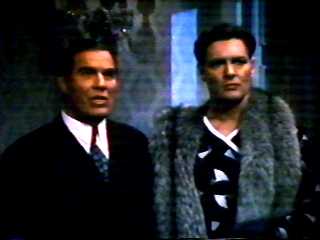 |
| While Leonide checks on the doctor's supply of morphine... | Bill describes his daring capture of Ed Wood, Jr. |
Epilogue. Terry goes to the morgue. He asks Jane, who thought this was the place where you get a marriage license, to wait outside.
After the reporter proudly tells the examiner about his story (and recapping the plot really, really fast), he asks about the cause of death. The coroner proclaims that she was literally (ready?) scared to death. Cut to a close-up of Laura. Two hands lift the edge of the sheet to cover her face while the musical cue plays. Go to a card with the words THE END superimposed over a blue, er, green mask, plus the dramatic chord. No end credits. (A good cast is worth repeating; a wasted cast is not.)
The Good Stuff
Hey, It Is in Color
Unlike most B features from the '40's, this one had the rare fortune of being shot in color. You get the novelty of seeing actors like Bela Lugosi and George Zucco with natural (for a studio) flesh tones as opposed to gray. And to the best of my knowledge, this is the only original color feature with Lugosi.
Not that color elevates this thing to any kind of lofty plateau. There's very little here that couldn't have been shot in black and white because there's not really anything here taking advantage of being in color. (Cf. Robot Monster (1953), which was originally presented in 3-D, but that filmmaker didn't use that novelty to its fullest, either.)
Although
the color of a mask is an important plot point, there's only one mask so
we needn't worry about confusing it with another one. As noted above
in the plot description, the color of the mask (blue) doesn't match the
color it's called (green). We can't tell if this is the fault of
very poor attention to detail on the set, something not working right in
the color process, or time fading a component of the color in print we have
today. However, we'd still like to give them points for trying
something different that almost worked..
Some Agreeable Comic Relief
Nat Pendleton is likable as Bill "Bull" Raymond: Dim Detective. Unlike other features with odious comic relief, his big dumb lug act is low key, and his dialogue isn't intrusively annoying. Likewise, Gladys Blake is fun to watch as Lily Beth because she's got a lot of spirit and doesn't do anything irritating with it. We could wish the movie had been more about them instead of the other characters, but given what happened to the other characters who were supposed to be more important, maybe it's a good thing Pendleton and Blake escaped the full attention of this production's creative process.
Also, there's Angelo Rossito. He doesn't do anything annoying either. Plus it's fun watching his character take down Bill for insulting him.
The Bad Stuff
And Some Disagreeable Comedy
Important note. Douglas Fowley and Joyce Compton are not George Burns and Gracie Allen. Although Compton can play the dizzy dame type, and Fowley can play the guy who likes to have his facts straight, it is zero fun watching these two in action with the characters they're given. Instead of a guy with a light touch giving set-up lines to a woman, we get an aggressive man roughly badgering his girlfriend for her lack of focused intellect. And then he roughly badgers everyone else, too. He's supposed to be the hero of this story.
Rather
than the regular approach for features of this type, like The Mad Ghoul
(1943) and Voodoo Man (1944), the writers attempted to inject some screwball comedy into the story. Unfortunately, the comedy is too
unsophisticated, low key, and just plain inept for this to work as
screwball.
Unbearable Lightness
With people like George Zucco and Bela Lugosi in the cast, you'd expect some menace. But you don't get it. Their parts are too wimpy to be effectively threatening. Lugosi is relegated to mere hollow threats; Zucco, a bland echo of mad science.
Rather than going with their talented headliners,
the production relies on an unusual narrative technique to give this movie
a sense
of weirdness. That is, they stop the movie every so often to let
Molly Lamount deliver one line from the slab in the morgue. Net
effect: The story's momentum (such as it was) suddenly grinds to a halt
for an overly predictable "fade to slab, here's the line, fade back
to story" sequence. If it was meant to be funny, it'd be a
running gag. It's not; therefore, the audience runs gagging..
A Solution With No Mystery
A good mystery withholds each clue until the proper moment. "Proper," of course, is a matter of debate. For example, the first Sherlock Holmes story, "A Study in Scarlet," may get points for introducing one of the best known detectives in fiction, but it loses points for violating (by modern standards) the idea of giving the right clue at the right time; too much is revealed at the end.
In this movie, we are given hints about characters' secrets, but most of them are red herrings. The final solution is not foreshadowed enough. In other words, it doesn't play fair.
Characters hold back on details. This is a good narrative technique for holding the audience's attention, but it waits too long to give the details, so the audience loses interest in the details. Therefore, when we finally know whodunnit and whydunnit, we don't get a sense of discovery but one of relief that this poorly played red herring game is over and the far-fetched solution is beneath us.
There are also several inconsistencies in the story which are fatal
to the mystery's sense of credibility. Rather than catalogue them
here, we leave this as an exercise for the alert viewer. Make it a
drinking game if you like, but keep a bucket handy.
Hypno-Myths
This movie propagates many of the early myths of hypnosis despite the
fact the technique had been in clinical use for some time. See
"Roots, Shoots, and Other Compares" below.
The Who Cares Stuff
Notes on the Cast and Crew
William Christy Cabanne (director) started cranking them out in the early 1910's and continued to do so until the late '40's. In terms of production he was extremely competent. However, he's not what you'd call a cinematic artist, and his huge collection of completed movies aren't memorable nor distinguishable for any particular styling, good or bad. In other words, his work was typical of Iron Age B movies.
Bela Lugosi (Prof. Leonide) needs no introduction here. Period.
George Zucco (Dr. Josef Van Ee) was a B movie regular during the '40's. His most positive roles were probably as the viceroy in The Pirate (1948) and as Professor Moriarty in The Adventures of Sherlock Holmes (1939). Those who love their classic monsters are more likely to remember him as Andoheb the high priest in various Universal mummy movies, like The Mummy's Hand (1940) et. al. Discriminating B movie fans will remember him as a mad doctor in things like The Mad Monster (1942) and The Mad Ghoul (1943).
Molly Lamont (Laura Van Ee) was born in South Africa. She appeared in various movies, never really capturing the top bill but often getting good supporting roles in things like The Awful Truth (1937), The Suspect (1944), and The Dark Corner (1946). She also appeared in various B pictures, but never really caught on in those, either.
Douglas Fowley (Terry Lee) had a solid working career with various roles that defy one single categorization. This was Roscoe in Singing in the Rain (1952). And this was Kipp in Battleground (1949) and Jones in Mighty Joe Young (1949). And this was Walt in Cat-Women of the Moon (1953). He had various other parts in a wide variety of movies spanning a four decade career. In Scared to Death, he gets a nice big role as the hero, but, my God, what a poorly realized character. You kind of picture this guy going home at the end of a day's shoot mumbling, "Are these people sure this is working?"
Big Nat Pendleton (Bill Raymond) won the silver for wrestling at the 1920 Olympics and turned to acting shortly thereafter, usually playing athletes and policemen. He was a regular in the early Dr. Kildare movies as Joe Wayman, the Thin Man series as Lt. Guild, and Abbott and Costello's Buck Privates movies as Sgt. Collins.
On the other end of the size spectrum, Angelo Rossitto (Indigo) appeared in various films from the late '20's onward, with quality ranging from Freaks (1932) to Al Adamson's Dracula vs. Frankenstein (1971). He wasn't in as many movies as he could've been, and he wasn't paid much for those he took. (Paid by scale? Be nice, now.) He was often the man under the costume in things like Invasion of the Saucermen (1957) and H. R. Pufnstuf (1969-1970). People who know Hollywood landmarks are most likely to have heard of him as the newsstand midget. People who watch movies are most likely to remember him as the brains of the Master-Blaster combination in Mad Max Beyond Thunderdome (1985).
Stanley Andrews (Pathologist) and Stanley Price (Intern) were in about a jillion movies, serials, and TV shows, almost always playing bit parts. Dorothy Christy (Mrs. Williams) also did various bit parts, but was also a playwright/screenwriter with Campbell Christie.
William B. David (producer) mostly worked with Golden Gate Pictures, which mostly did westerns in color for a couple of years during the mid '40's.
Carl Hoefle (original music) did most of his compositions for David's Golden Gate westerns.
Marcel Le Picard (cinematographer) started out in the mid 1910's and kept going until the early '50's. He lensed several westerns, including the Golden Gate westerns and various B westerns, many with Johnny Mack Brown. During the '40's, he moved his camera indoors for a few Bowery Boys movies and some memorably bad things like Voodoo Man and Return of the Apeman (both 1944).
George McGuire (film editor) invented the Moviola and was the editor on The Lost World (1929) and Detour (1945). Needless to say, Scared to Death was not his finest moment.
Harry Reif (art director) was putting together sets for various B westerns and mysteries in the mid thirties and continued on until the end of the Iron Age of B movies -- round about 1950. His work you've most likely seen was during the Golden Age of B movies, when he started working with Richard Cunha, Roger Corman (plus various AIP beach productions), and a soon to be famous Stanley Kubrick in The KIlling (1956).
Robert Farfan (assistant director) was also the assistant
director on various TV shows, like Rebel Without a Cause (1955), Gunsmoke
(1955-1975) and Get Smart (1965-1970). Oh, yeah, and he also assisted
Edward D. Wood, Jr. on Bride of the Monster (1956).
Roots, Shoots, and Other Compares
"Now cluck like a chicken!" As noted in the plot description, it was possible for a hypnotist to issue commands telepathically because that's the way it worked back then.
Below is a very selective list of examples which shows the changing popular image of hypnotism. (For clarity, stories about zombies, supernatural/alien creatures with innate hypnotic abilities, and general brainwashing have been omitted.)
Franz Anton Mesmer (1734-1815) - Physician who proclaimed hypnotism (or Mesmerism, if you prefer) as a method of curing illness. However, his theories were based on a magnetic variation of the bodily humors concept, so he didn't get very far scientifically. He went into showbiz and became something like a faith healer.
By our standards today, Mesmer's medical notions would make him a mystic, so it's by no coincidence that hypnotism would later be associated in Western thought with mysticism. (Cf. the Western perception of Asian and African mysticism and trances.) And since we're also talking about subverting someone's will, Mesmerism was often portrayed as an evil form of manipulation.
"The Facts of M. Valdemar's Case" (1845), a.k.a. "The Facts in the Case of M. Valdemar" (1850), by Edgar Allan Poe - Man dies while in a "mesmeric trance" but continues to live, physically suspended in time at the point of his death. He instantly putrefies when awakened. Added to the notion that the supernatural was possible during a hypnotic trance.
Grigory Yefimovich Novykh (1872-1916) - You might know him better as Rasputin. There are few trustworthy accounts of what happened when the royal family of Russia took him in, but it is often maintained that he used hypnosis and some forms of mysticism to achieve his goals. Since the sensationalized versions of events "really happened," his notoriety further added to hypnotism's reputation for evil manipulation.
The Basilisk (1914) - Short about a hypnotist doing his thing on a young woman to get her to kill her husband. The concept of "hypnotist uses a cat's paw to commit crimes" will appear in many other stories; cf. brainwashing.
Dr. Mabuse, der Spieler (1922) - Master criminal uses hypnosis as part of an elaborate scheme to gain power. Various other master criminals will also use hypnotic abilities in other tales; see also, Sax Rohmer's Fu Manchu stories.
Svengali (1931) - Based on the book Trilby (1894) by George du Maurier and filmed various times before and since, but this is the best known version of the story. Malevolent mystical music maestro hypnotizes a woman and turns her into a singing sensation. It also popularized the notion that hypnotic suggestion could be done via telepathy. Cf. Dracula (1931); both made in the same year, both based on source materials from about the same time, both being the most popular version of the story, and both featuring a mystic form of mind control via telepathy.
Carefree (1936) - Girl begins falling for her psychologist, so the self-sacrificing psychologist hypnotizes her into hating him and loving someone else. Then he has second thoughts and tries to change her mind back to, uh, normal. Will he succeed? C'mon, it's Astaire and Rogers.
The Search for Bridey Murphy by Morey Bernstein (1956) - Presented-as-fact account of a hypnotist documenting a woman's past life regression. Made into a movie by the same name. Presented with some wild supernatural variation in Roger Corman's The Undead (1957). Theme also appears in The She Creature (1956) and many other "past life" stories.
I Was a Teenage Werewolf (1957) - Hypnotist sets up Michael Landon's character to become a murderous beast whenever he hears a bell. (Heh, every time a bell rings, an angel gets its wings....) See also Blood of Dracula (1957) wherein the same trick turns a schoolgirl toothy whenever she sees a particular piece of jewelry.
The Hypnotic Eye (1960) - A series of women begin accidentally mutilating themselves, and the common thread is a stage hypnotist.
Devil Doll (1964) - Stage hypnotist (cripes, what is it with these guys!) has a disturbingly active ventriloquism dummy and an equally disturbing interest in a young woman. Combines ye olde Svengali theme with soul migration into inanimate humanoid objects (cf. The Puppet Master (1989)).
On a Clear Day You Can See Forever (1970) - Hypnosis, past life regression, and big musical production numbers. The horror. The...horror....
Acknowledgement - Special thanks to Terry O' Brian of Hypnosis in Media for devoting a website to the popular image of hypnotism throughout the years. His work made the research for this section easy. Give his site a visit, won't you. Hey, on second thought (putting on special hypno-glasses), you will visit his site...
The Bottom Line
Dead woman occasionally interrupts the story of her own death. Novel appearances of cult movie icons Bela Lugosi and George Zucco in a color feature. Very poorly constructed mystery with an abysmally realized narrative gimmick. Some agreeable comic relief, but the eventual hero of this piece is profoundly annoying. Would be an instantly disposable movie were it not for some classic badness. Recommended for B movie enthusiasts, insomniacs, and psychologists looking for a few unintentional laughs. Also recommended for people who don't like old movies because they're in black and white. (There. That'll learn 'em.)
Originally published 16 October 2000
 |
   |
A
Proud Annex of....
|
|