Another feature of... |
|
Another feature of... |
|
My friend Andrew once had one of those lunatic streaks of luck. You know, when you’re "on", or "hot", and can do no wrong. Over the space of a couple of months, Andrew and I would occasionally drop by our local Thumbs Up video store. This emporium has a cavernous collection of over 12,000 videos. It’s a treasure trove of obscure and awful oddities. During this particular period, Andrew three times picked a movie completely at random. Each one proved to rank with the very worst of the hundreds of Bad Movies we’d seen before. These stellar flicks included The Sea Serpent (a film also due to make an appearance here one of these days). This Ray Milland starrer features what is without doubt the funniest giant monster the silver screen has provided since The Giant Claw. Next up was The Rogue, a European pic featuring the incoherent adventures of a Continental Gigolo. But his favorite of the three was undoubtedly this short (54 minutes) little item: Abe Lincoln - Freedom Fighter. This is one of those films where the video box gives it all away. The front of the box features two guys in rural dress, one black and one white, laughing it up together. The first thing that might be noticed is that the, uh, actor playing Lincoln is surprisingly hunky (for Lincoln, anyway). But the back of the box provides the film’s first real payoff. First up is a corner shot of Abe and some woman standing close and exchanging heated glances. Apparently, this is a scene from the sequel: Abe Lincoln - Chick Magnet. Then the standard "hilarious plot description" all strange little videos come equipped with:
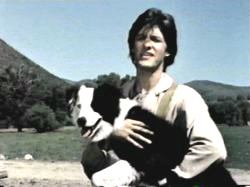
Uh, yeah. Does anyone else get the idea that this wasn’t "based on a true story"? Our grainy little epic begins with a couple of guys chasing a lovable pooch through a scenic plain. This is probably to establish them as "jerks". Still, can any injustice prevail when Abe Lincoln, F.F., is in the area? The dog chasing goes on for a while, giving the audience the chance to savor the "excitement". Our black protagonist, Henry Young, makes his appearance. We notice that the costuming department has helpfully cut neat rents in the bottoms of his pant legs, so that they look "ragged". Figuring that anybody venal enough to chase a cute dog is also likely to spell trouble for a member of the region’s, uh, limited black population, Henry hides behind a rock until the chase has passed him by. Then he skedaddles (wow, how often do you get to use the word "skedaddles" in a sentence?). Next we see our hero, Abe Lincoln, a’walkin’ down a country lane. Lincoln proves to be a lot more attractive in "real" life than his portrait on the fiver would have us believe. The feathered haircut, in particular, is a nice touch. The chased mutt breaks from the surrounding trees, proving to be Abe’s dog, "Homer." This, I think, is a clever ploy by the screenwriter to show how ol’ Abe loves readin’ those books ‘a his. Homer’s pursuers appear. The disagreeable Luke yells about Homer running by his house, and settin’ all a’ his hounds a’barkin’. The peacelovin’ Abe joshes that Luke could pull ol’ Homer into court and sue, but that then he’d have to prove damages (ah, the legendary wit of America’s greatest President). Luke’s sidekick, teenager Gibb, shows up. Gibb is shocked when Luke orders him to shoot ol’ Homer, now nestled in Abe’s arms. "You’d rather pet Homer than shoot him," the intuitive Abe points out. This sets Luke to fumin’, and he starts a’fightin’ with Abe. Abe suspects that ol’ Luke is just a’tryin’ to dirty up Abe’s only clean shirt, soin’ he can’t go to the dance that afternoon. Luke also starts a’yellin’ that Abe’s book readin’ doesn’t make him better than anybody else. Hmm, it appears that ol’ Luke is a’sufferin’ from one of them "inferiority complexes" that the city folks talk about. Lincoln is famously regarded as America’s greatest President. Still, I’ll bet you were a’wonderin’ whether he could carry himself in a fistfight. No? Well, they throw one in anyway. Luke gets Abe’s hand behind him, but the powerful Lincoln breaks frees and…Well, I’d say he uses Judo on ol’ Luke to toss him to the ground, if’en it wasn’t so ridiculous to think that Abe would know Judo. Maybe he picked it up readin’ one of those there Judo manuals that were a’floatin’ ‘round the countryside in the 1830’s. Anyways, their fightin’ gets interrupted by the arrival of Judge Clark’s carriage. Abe and Luke start spiffin’ up, as Nancy, the object of their mutual affection, is in the cart too. The Judge breaks up the fight, and points out that Abe should be a’buildin’ the Judge’s hog pen, as he had contracted to do. Chagrined, Abe jumps into the Judge’s wagon and they head out. Luke asks young Gibb if he thinks it’s possible that Nancy likes "that ugly clodhopper"? "You mean Homer, or Abe?", Gibb replies, settin’ ol’ Luke off a’laughin. But as they ride off, Luke states (in a line obviously looped in later) that he still has a score to settle with ol’ Abe.
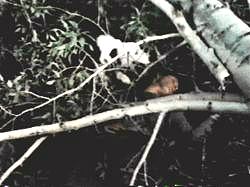
Luke and Gibb soon spot that there black fella, who runs off. Luke and Gibb begin to chasin’ ‘im. They reckon he might could be a runaway slave, and want that ol’ re-ward for his capture. Henry starts across a narrow stream, but stumbles (for no reason we can see, but, you know, it was in the script). His meager possessions, including a piece of paper highlighted with a camera close-up, tumble into the water. With Luke on his tail, he has to run off. Later, hiding in a tree, he eludes Luke and Gibb, then heads back to the river. He finds his bag, but his "papers" are missing. Meanwhile, in a comic interlude, ol’ Abe is a’cuttin’ down a tree to make rails for the Judge’s hog pen. Homer pops up, wanting to play. As Abe is busy, Homer starts playing with a fawn standing about ten feet away (awww!). Frankly, I wouldn’t think a deer that stands right by men and plays with their dogs would have much of a life expectancy. Given how, you know, guys tended to hunt deer for food at the time, given the lack of supermarkets. After giving the audience their fill (and more!) of this "cute" scene, the fawn runs off, allowing the "plot" to recommence. Abe gets that tree a’fallin’, but ol’ Homer, who’s apparently none too bright, is a’standin’ right in it’s path. Abe chases Homer away, but the tree falls on him, instead (this is accompanied by a musical "waa-waa" note, so that we know that a tree falling on Abe Lincoln isn’t, you know, a good thing). We cut to Henry a’combin’ the river, looking for his papers. Homer pops up, and using that TV dog language thing, gets the guy to follow him. Finding Abe unconscious under the tree, Henry pulls him out. After moving his head around a lot (to make sure his spine isn’t damaged, I guess), Henry runs off to find help. The Judge and Nancy hear his cries, and come in their wagon. Henry then runs off, as he’s still kind of screwed without his papers. Nancy and the Judge find Abe and load him into the wagon. Can we pause here a moment? I was just wondering. Does anyone else find the idea that Lincoln’s lifelong loathing of Slavery was rooted in the fact that a black guy saved his life completely puerile? Isn’t this over-simplistic, to say the least? Maybe he just philosophically found it abhorrent. Isn’t this kind of "1 + 1 = 2" characterization insulting, both to one of History’s greatest and most complex figures, as well as to the audience? Proving that no good deed goes unpunished, Henry gets captured by Luke. He maintains that he’s been freed, but without his papers he’s up a creek. Meanwhile, Abe is in the local doctor’s office. "It’s just a concussion," he’s informed. Wow, glad it’s nothing serious. Abe asks about his helper, but the doctor only knows what the Judge and Nancy told him. The Judge enters and informs Abe about Henry being captured. Abe immediately offers his help, but the doctor warns him that everyone in town will be against him. Only Abe is enlightened enough to see past Henry’s black skin (OK, everybody "got" it, yet?). Abe goes to see Henry in the shed where he’s being kept. Henry proves to be surprisingly articulate for a recently freed slave. Abe notices that two fingers on Henry’s right hand are cut off at the middle knuckles (plot point!). This happened when Henry lifted a plow off his former owner, which act got him freed. Abe tells Henry to sit it out, and wait for verification of his freeman status to come through. In the meantime, Abe will try to get him released into Abe’s custody. In the town’s general store, Abe makes his case for Henry’s parole (with Luke, of course, arguing against). After a not extraordinarily eloquent debate, the Judge agrees to put Henry into Abe’s care. A glowering Luke rides off with Gibb after seeing Henry go off with Abe. Stopping at the river for a drink (gee, what’ll happen now?), Luke finds a sodden coat. It’s Henry’s lost coat (duh) and happens to contain his papers (double duh). (Let’s just pretend that we didn’t earlier see the papers floating down the river by themselves) Luke realizes that Henry is a freedman, and even without his papers will be able to prove his status within a couple of weeks. Therefore, Luke must think up something quick if he’s to profit from the situation. Luke comes up with some evil scheme to get his money, and to get back at Abe at the same time. He then tears up Henry’s papers, proving himself a colossal jerkweed. We cut to Abe’s cabin, where he lives alone with Homer. Uh, I’m no history major, but I believe that in fact Lincoln lived with family pretty much all his life. Exactly what part of Lincoln’s life was spent living alone in a log cabin in some unidentified little town? Henry is whittling what is supposed to be a well done reproduction of Homer, although you couldn’t prove it by me. Maybe people had a lower expectation level for carved goods back then. Henry tells of how he was sold off from his family at the age of ten, so that we’ll understand that slavery was "bad". "If I had my way," a frustrated Abe sagely muses, "we’d all be thinkin’ more about human rights than we do about property rights!" Hey, nice 1970’s era agitprop, dudes. Unfortunately, it’s pretty unlikely that Abraham Lincoln would ever have made this statement. First of all, the phrase "human rights" seems a little jarring coming from someone speaking in 1840-something (or whenever this was supposed to take place). What’s next, "Hey, hey, ho, ho, Western Civ has got to go!"? More importantly, however, American political theory is largely based on the concept that "property rights" are, in fact, the realistic foundation of all political rights. When a government can deny a man his house or his food, all other "rights" remain abstract. The Revolution was mainly fought over the idea that no government has the right to tax the people without their having a direct say in the process. In other words, the government only has the "right" to take the property of the citizenry when they agree to give it up. Lincoln concurred with this, and would of been the last to sneer at the concept of "property rights", which he eloquently supported in both his writings and speeches. He certainly disagreed with the idea that humans should be able to own one another. But this in no compromised his belief in the essential right of the citizen to be able to lay claim to his or her own property.
Abe goes on to describe a slave auction he once saw. Which, to me, doesn’t seem likely to be "number one" on a list of topics an ex-slave would enjoy talking over with a white guy. Abe’s anger over this obvious injustice is fully, if robotically, scripted out, so that we can all understand that he doesn’t like slavery. He ends by noting his personal amazement that they didn’t even seem to know it was wrong. Henry replies that maybe it might have been different if "they were the ones in chains." (wow!) OK, now that we’ve made all the arguments against slavery as might be formulated by your average seven-year-old, we can go back to the "plot". Abe heads off for the dance, leaving Henry alone at the cabin (which, since he took legal responsibility for Henry, seems a little trusting. But, you know, both Abe and Henry are "good guys"). Luke and Gibb are lurking outside, scoping out the situation. Luke and Gibb expository their heinous plan: Gibb will go to the general store. If no one is there, Gibb will grab the cash box and bring it to Luke. Luke then plans to implicate Henry in the crime. Henry will either be sent to jail or strung up, leaving Luke both with the cash and the satisfaction of causing Abe grief. Luke arrives at the big dance, an outdoor affair. This not only establishes his alibi, but gives him the chance to rile up the townsfolk. He proceeds to inform a group of the town’s men about Abe leaving Henry unguarded. An impromptu delegation then confronts Abe over the matter. The Judge breaks up the argument, but Luke has now begun to turn the town against Abe. His evil plan is working to perfection. He even gets Nancy away from Abe and dances with her. Meanwhile, young Gibb breaks into the store, and begins searching for the cash box. Behind the counter, he stumbles, leaving a hand print in the freshly painted surface of a cabinet (plot point!). In case you’ve never seen a movie before, let me explain: This will be a "clue". In fact, it’s such an obvious clue that I kept waiting for Velma from Scooby Doo to appear, so that she could explain its significance. Gibb locates the cash box and vamooses. Outside, Abe worriedly watches the townsmen haranguing the Judge over the whole Henry situation. After Abe finishes his dance with Nancy, the Judge comes over and advises Abe to keep an eye on Henry, in order to placate the townsfolk. Abe reluctantly agrees, and he and the Judge head back to Abe’s cabin. But that ol’ devil Luke has gotten there first, cash box and rifle in hand. First he fires a shot into the air right outside Abe’s door. Then, as Gibb runs the horses back and forth in front of the cabin, Luke hurls threats inside. Henry, afraid that a lynch mob’s after him, takes off out the back door. Now that Henry has fled, Luke leaves the busted remains of the cash box on Abe’s front porch. We cut to Abe and the Judge as they approach the cabin. Abe’s planning to leave Henry in the Judge’s care while he personally rides to collect the verification that Henry’s a freedman. Abe then mulls over the way he’s had to bend his principals to deal with the town folk’s prejudices. It’s made him reconsider whether he wants to enter politics. This leads to one of the most astounding and unintentionally hilarious lines I’ve ever heard. I repeat: This is not supposed to be funny: Abe: "I don’t know about
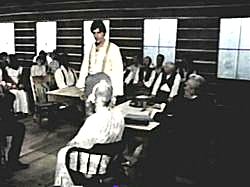
this politician business." Abe and the Judge arrive at the cabin, and the planted "evidence" tells an obvious tale (actually, it’s a pretty good frame-up). Soon the townspeople are out searching the woods. Abe, suspecting that Henry will still be searching the creek for his papers, finds Henry just as he locates his coat. However, Homer’s barking has alerted Luke that something’s up. Henry is crushed to find his papers missing. As he and Abe search around, Luke arrives with the mob. He almost succeeds in getting them to shoot Henry down when the Judge appears, and takes Henry prisoner pursuant to a trial. Although Abe’s not a lawyer yet, he takes Henry’s side as the defense council. The Judge warns Abe that his unpopular stand could ruin his prospective political career. This allows Abe a few more self-righteous lines about integrity and such. The town convenes inside the courthouse. Did I mention that the inside walls of the courthouse look exactly like the interior walls of the general store, and in Abe’s Cabin, and even in the shed where Henry’s kept? Yep, they had one big budget to work with here. The prosecutor proves to be a big bearded ham played by an actor I’m sure they got from Summer Stock. He makes his opening statement, to the applause of the assembled citizens. Then Abe stands up, and makes the first opening speech in his noted career as a brilliant orator. For the historically minded, here’s the text of young Abe’s first statement in a Court of Law: Abe: "Your Honor. Gentlemen of the Jury. Sir [to prosecutor]. Law says that a man can not found guilty if there’s a reasonable doubt in the minds of the Jury. I aim to raise that doubt in your minds, friends. Thank you." OK, I’m not a lawyer, so I can’t decipher all that legal mumbo-jumbo. If anyone out there can help us out, please contact me. The trial proceeds. And I must say, Abe gives about the single worst defense I can possibly imagine. He keeps asking questions that result in answers that dig Henry deeper into trouble. Luckily, there’s that hand print in the paint that Gibb left behind. When the store owner mentions that the thief ruined their new paint job, Abe immediately replies, "You’re not saying there’s a handprint in the paint?" Actually, she didn’t. Considering her exact words, Abe’s question represents an amazing intuitive leap, but then, he read the script and all. When Abe mentions that they’d like to see this handprint, she mentions that her son is repainting the cabinet. Abe and the court members run over to the store. In a hilarious moment, we see the actor standing over the print with a paintbrush. You can actually see that he’s waiting for the cue to pretend to be "just about" to paint over the clue. Then Abe bursts in, and the previously frozen actor moves as if to imply that he’d been "only seconds" away from painting over the evidence. Wow, what a stroke of luck. Another couple of hours and the kid’s arm might have gotten tired, and perhaps he’d have accidentally painted over the clue before Abe got there to stop him. "Luckily", though, Abe appears in time to stop this from occurring.
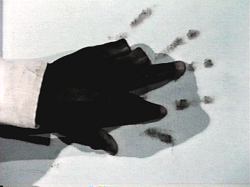
Henry, as previously established, is missing parts of his fingers, and so the handprint proves his innocence (by the way, the whole "damaged hand" deal is ripped off from Atticus Finch’s defense of a Black man in the classic To Kill a Mockingbird. Of course, in that more realistic work, the jury convicts the guy anyway, since they don’t want to admit that a white woman’s word could be less worthwhile than a black guy’s). By the way, when Henry holds his hand against the print, it’s doesn’t lie flat against the cabinet. That’s because the actor has his two "missing" fingers bent into his palm. Abe somehow figures out that it was Gibb that stole the box (?). Confronted with the print, Gibb breaks down and spills the beans. Luke makes a break for it, allowing Abe a short and boring "action" scene as he pulls the escaping Luke from his horse. Now comes one of the most ridiculous (and offensive) endings in film history: Abe offers to act as Luke’s counsel. Since Luke’s apparently learned his lesson (I guess) about trying to arrange murders so as to escape with fourteen bucks in illicit gains (that’s how much was in the cash box), Abe figures he deserves all the help he can offer. Or maybe Abe figured out quicker than most that defending the guilty is where the money is. In a bizarre coda, we cut to an actor in the absolute worst "Mark Twain" (!) get-up I’ve ever seen. He tells us that Abe was so eloquent in Luke’s behalf that the Judge suspended his sentence. Hell, what’s a little theft, attempted murder, fraud and attempting to sell a freedman into slavery between neighbors. I notice that no one’s asked ol’ Henry his opinion on all this. Then the camera pulls back and we say so long to Mark Twain, as he oars the rowboat he’s sitting in (?) away from the camera. His appearance as narrator is the final bit of evidence that this whole schlocky deal was an episode from some retarded, "educational" TV series. If anyone knows what this show was, please let me know. And so we also say good-bye to one of the most simplistic and insulting portrayals of a major historical figure yet produced. In fact, it might well represent the second most successful assassination of Abe Lincoln. Rest in Peace, Mr. President. Review by Ken Begg |