Another feature of... |
|
Another feature of... |
|
|
|
Billy Jack Goes to Washington Page 2 -
Jabootu's Bad Movie Dimension The next morning, Bailey is in his hilariously huge and palatial home, which with its array of fine old oil paintings and wall tapestries, seriously looks like something out of a King Arthur movie. He is eating his breakfast while surrounded by his Affluent Middle-Aged White Guy henchmen (including Payne), all of who are in a panic about how the crusading Billy Jack is on their case. “Now he wants to talk to every one of the congressmen,” one gulps, “including Bill from the Willet Creek district!” So Billy wants to have discussions with all 535 Representative and Senators? And also, where are we in Billy’s “two months” in the Senate? Seems like the clock should be ticking here. “He’s got all their names, their voting records…” One Worried Henchman continues. Wow, that’s amazing! How the hell did Billy dig up that sort of highly classified info? I’ll bet he even knows all their party affiliations!! “In one month [which would seem to indicate that Billy’s term is nearly at an end] he’s got more groups out to destroy him than any man in the history of the Senate,” McGhan notes. Payne counters that their fears are exaggerated, whereupon McGhan snaps, “If it’s so ridiculous, why does the White House have a whole unit investigating it?” Hmm, that does raise some questions. Like, a “whole unit” of what? And, er, what exactly is the ‘it’ are the unit is investigating? (And weren’t we informed just a minute ago that the White House was in on ‘it’? So…oh, never mind.) The Sauron-like Bailey
himself sits calmly through all this, still falsely secure in his eeee-vil
power. “I don’t see the problem,” he says. “Let the White House take care
of it.” But…but…the White House is the one having a ‘whole unit’
investigating ‘it,’ so… Oops, my head just exploded. Sorry. Give me a
minute, would you?
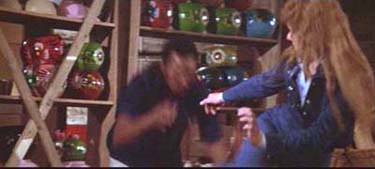
The point being, I think, that Bailey can count Payne out. McGhan lets Billy in, and Bailey introduces him to all the henchmen, who prove to be a variety of congressmen and, members of “the Interior,” “the utilities commission” and “the Nuclear Regulatory Commission,” etc. Meanwhile, Payne has exited via a side door to avoid being seen. Bailey follows after him. Payne warns that Billy is unlike anyone Bailey has ever known. “This boy is different, honest,” Payne attests, “He’s a decent man.” Being in the presence of a non-corrupt individual, Payne’s Social Conscious is slowly being roused from its long slumber. Bailey replies that it’s too late to stop things now. When Payne responds that he’ll have nothing to do with “crucifying that boy,” [nice, subtle reference there, Mr. Modest Laughlin], Bailey smirks. He mentions the possibility that Payne might find his way out of office too, while conversely proffering (I think) the carrot of their party’s Presidential nomination. Under this enticement, Payne’s brief rebellion flounders. Having put that particular fire out, Bailey sends Payne along and returns to the office. He offers Billy some coffee, but Our Hero declines, because, you know, it must be evil coffee. Bailey, being a Rich White Guy, naturally patronizes Billy—throughout the movie, he continues in calling Our Hero a “half breed,” just so we don’t forget that guys are like are racist amongst all their other sins—and tries to “explain” things to him. Billy asks what interest Bailey personally has in the proposed Willet Creek reactor, and Bailey references his role as the state’s “chairman of the political party.” That’s kind of an awkward phrasing, but to be fair, Laughlin is presumably attempting to damn both houses and not pin the eee-vilness exclusively on the Republicans. (Unsurprisingly, though, this philosophical loftiness generally failed to manifest itself in real life, as when Laughlin threw his weight, such as it was, behind John Kerry in the last election. This is akin, I suppose, to the recent riots in France by self-proclaimed student “anarchists,” who agitated in support of continued restrictive government job regulations.) Bailey goes on to attempt his normal role of Mephistopheles, having failed to heed Payne’s warnings about Billy’s pristine morality. He notes that with a little help, Billy could retain his senatorial seat, etc, pointing to his collection of toadies as an example of his power. “Are you trying to tell me,” a shocked Billy inquires, “that you tell all these gentlemen here, and that you tell Joe Payne, what to do?” Bailey confirms this. “Joe Payne has been taking my ‘advice’ since he started running for office over thirty years ago.” Billy can’t believe this of his hero. “You’re a liar,” he bristles. Bailey orders him to keep his mouth shut when the bill is read the next day, and an infuriated Billy responds by karate chopping the glass table in front of him. Which—and again, this is a Billy Jack movie—is the first burst of ‘action’ in the film’s first 50 minutes. “Now that,” Billy replies, pointing to the shattered table, “is exactly what I think of your threat, Mr. Bailey.” Uhm…it’s like a broken sheet of glass? Is that it? Because I’m not really sure what you’re going for here. Late that night, Carol is in a small deli buying some stuff so that she has a reason to be out in the dark and can be attacked so that we understand how eeee-vil Billy’s opponents are. (Oops, sorry.) On the other hand, this is the young lady who recently was shot nearly to death by rampaging National Guard troops as she threw herself over a murdered young boy with hooks for hands who had been shot down whilst cradling his bunny rabbit and trying to protect his cute little pet burro. So, you know, she’s probably already kind of cynical about that sort of thing. So anyhoo, she leaves the shop, and walks down the darkened, deserted sidewalk, when to our complete and utter shock she is jumped by…. What? Well, no, that hasn’t actually happened yet, but… Ah, there we go. A big black dude (gee, nice touch) in a pink wife-beater T-shirt (?) gets out of a parked car and begins to stalk her. Jaws-type music plays as the man and the car, presumably driven by a compatriot, follow along behind her. Soon she is boxed in by another pair of cars. (This all seems kind of elaborate, but what do I know?) She throws down her groceries and runs into an alley. This is all part of the plan, though, and Carol finds herself trapped due to the sort of preplanning, manpower and logistical support that went into the D-Day invasion. A kindly old black security guard appears (presumably to offset the party of black men hired to attack Our Heroine), but he quickly falls to the tuffs. Luckily, Jean has arrived on the scene (she came searching when she learned that Carol went out alone), and exhibits some new martial arts chops, courtesy of an obvious stunt woman. Even so, the pair quickly are cornered in a warehouse by what seems to be at least ten black hoodlums. Jean asks who they are, and they reply by—what else?—opening their apparently standard issue switchblade knives. A weeping Carol asks what they want, and one cat, wearing a huge Rudy-from-the-Fat-Albert-Gang denim cap, replies that “We need your clothes…off.” Maybe they’re a platoon of Affirmative Action Terminators. Meanwhile, back at the mouth of the alley, Billy Jack slowly moves into a TOTALLY KICKASS AND COOL silhouetted position in front of some lit headlights. Since he wrote the script, I guess, he knows he can afford to take his sweet time in stopping to pose and then slowly ambling down the alley so as to make this all the more dramatic and such. At the same time, the toughs somehow sense his presence. (I guess; I mean, they’re inside a building now, so they wouldn’t be able to see him.) Perhaps it’s like how you can sense a storm just before a cloudburst occurs. Billy enters, and the hoods part before him, and all is exaggeratedly silent, because that’s all cool and stuff. Billy does his shtick where he remains all unconcerned and gets all talkative and such, which he always does when he’s about to lay the whoop-ass on some group of dudes. Meanwhile, the toughs take a hell of a lot of time to circle around him and prepare to launch what I think we can safely assume will be a spectacularly failed assault, much of which will portrayed in slow-motion. During all this, Billy asks who hired them, and proffers various theories. He also asks if hiring black guys was meant to make the attack on Carol look like “a racial incident.” This, of course, is so we ‘get’ that the unpleasant racial notes struck here are courtesy of the Bad Guys who hired these dudes, and not the filmmakers themselves. “You guys ought to be ashamed of yourselves,” Billy lectures. Not, presumably, because they are violent criminals so much as that they are violent black criminals who have put themselves at the service of Their Oppressor, The Man. Yep, apparently that is what Billy means, since his next line is, “I mean, Kunta Kinte would roll over in his grave if he saw you hire out to The Man like this.” (!!!) And so the futility of attempting to exaggerate Laughlin’s political blind spots is once more exposed. Meanwhile, in a hilarious bit that would seem downright satirical had the Laughlins even one once of irony between them, the tightly denim-clad Jean now pauses to remove her own cowboy boots as Billy does the same. And so Pacifist Jean, Billy’s partner in all things (as her portrayer is Laughlin’s), now casts aside all her previously established bedrock philosophical beliefs, so that she may get in on the ass-kicking too. The family that kicks together sticks together. All this goes on at ridiculous length, so that Billy can keep up his endless monologue about policemen breaking the law and blah blah blah. “But rape!” Billy tuts. I don’t want to be pedantic, but, uh, well, you know, I don’t think these guys are policemen. But anyway. (He calls them policemen again later on, so…are they supposed to be? How would we know that?) Eventually, though, even Billy gets tired of hearing himself speak…. Well, OK, perhaps not. Yet he probably recognizes that the audience is getting impatient for some awesome, Establishment-defying hippy-happy violence.
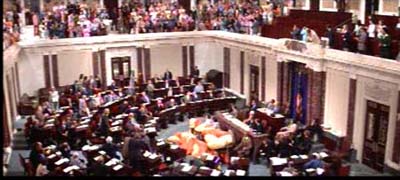
Luckily, the warehouse is full of large, free-standing sheets of candy glass, along with balsa wood shelving units, for obvious reasons. Sure enough, Jean is allowed to kick some ass, although with less authority than Hapkido black belt Billy. Moreover, there’s a somewhat suspicious tendency to shoot her from behind when she’s executing high kicks and such. Meanwhile, in a truly shocking twist, one of the bad guys has actually brought a gun. However, just one of them, and he’s dispatched with a handy vase wielded by Carol. And so the whole Laughlin family (and a stunt woman) got to enjoy beating up a dozen black guys together. Awwww! The vase sends the guy for a loop, but leaves him conscious. “I’ll tell you, my friend, you’re one hard man to purify,” Billy notes. Whatever that means. Then, using some obvious wire-fu, the compact Billy literally throws the much larger man through the air and into a standing wall-sized mirror; the first of a series of them, which then fall and shatter in sequence like dominoes. If Buster Keaton had been a talentless hack, this is the sort of gag you might have seen in one of his movies. On the other hand, it must be admitted that Laughlin successfully emulates the Great Stone Face in other ways. An irate Billy is next seen bursting into Payne’s senatorial office, where he confronts his mentor with Bailey’s accusation. “I called him a liar,” Billy reports. Payne attempts to explain the world to his disbelieving protégé, before suggesting that Billy go home and leave the cesspool that is Washington behind. “The idealist,” Payne muses, “sees everything as black and white, angel and devil.” Actually, it’s not necessarily idealists who do that, it’s a rather a wide assortment of nuts. But anyway. Billy is just too pure for this world, Payne argues. “I know it’s tough to run head-on into the world of facts,” Payne admits. And I must concur, dealing with facts is not Billy’s, or his portrayer’s, strong suit. Needless to say, however, this sort of thinking is anathema to Billy. Also needless to say, Payne presents his case for politicking and political compromise in about the most ham-fisted, grubby fashion possible, approvingly putting forth as an example how Jefferson made a compromise on slavery. This guy has been in elected office for thirty years, and this is a demonstration of rhetorical prowess? Then, lest we fail to pick up on such a subtle idea, Payne tells Billy that thirty years ago, “I was you!” In other words, he was then the idealist that Billy is today. See, he’s what Billy could become should he embark down the Eee-Vil Road of Compromise. (Actually, unlike Jefferson Smith, Laughlin has too much pride in his doppelganger to even allow for this possibility, which is why Payne exhorts Billy to leave town, rather than imploring him to join him in Washington permanently.) Humorously, despite writing Payne’s speech so that he presents the case for business-as-usual in the rawest of terms, Marshall is so much an actor that he is still nearly persuasive. If someone who was actually a supporter of compromise governance, American style, had been allowed to write his lines, instead of Laughlin, he’s undoubtedly make Billy look like a stiff-necked nutcase. Imagine the Alan Alda of The West Wing lecturing an unbending pro-life ‘idealist’ (assuming the show’s writers could ever conceive of attaching that term to such a person) on the realities of compromise and you’ll have a sense of what I mean. In any case, Payne admits to feeling a paternal fondness and respect for Billy, and warns him to leave before his ruthless opponents do him in. Bewildered and saddened at the confirmation of his mentor’s foibles; well, not foibles, rather that his mentor is an outright Agent of Evil, Billy turns and leaves. The next day, the Evil Bill is brought up in the Senate. To Payne’s dismay, Billy is in attendance, wearing his one, ill-fitting brown suit and tie. As soon as the Bill is raised, Billy jumps up and asks for permission to address Section 40, the part where the whole thing about the nuclear plant is hidden. With his phony-baloney job on the line, Payne rears up and asks to make a statement. Billy could, of course, refuse to yield the floor now that he’s been recognized by the Chair. However, he’s all, you know, straight shooter-ish and stuff, and so he politely agrees to let Payne speak. Thus Billy finds himself sandbagged, as Payne declares that evidence has been brought to his attention, such that he claims to find “Senator Jack unworthy to address this body.” Given the history of the Senate, that’s a bold claim. Maybe he has documents proving that Billy is Stalin. No, that wouldn’t do it…. In any case, this accusation provokes a huge burble of shocked watermelon, watermelon noises from the assembled attendees. Promising “a charge as grave as has ever been made from this floor against a fellow member,” Payne asserts that he has evidence that Billy owns the land he suggested be used for his National Youth Camp. “Using,” Payne accuses, “his privileged position for his own personal profit.” Really? That’s the “gravest charge” ever laid by one Senator against another? Seems like pretty run of the mill financial shenanigans to me. Especially given the more freewheeling and rambunctious early days of the Union, I would have assumed that charges of actual treason and the like have been tossed around the Senate floor with some regularity. In any case, Payne proposes an investigation to see if Billy should be stripped of his seat. Since Billy (as far as I can figure) only has a few days left in his term, presumably this investigation would accomplish its job no matter how it turns out. Flummoxed at being betrayed by his hero, Billy silently sits down.
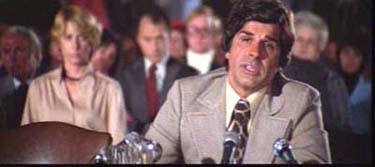
The investigation is commissioned, and soon Governor Hopper is testifying. (Billy, back in his traditional denim threads, is seated alone at a table directly to the side of the committee table. This doesn’t make much sense, but it does allow us to see him and the line of committee members in the same shot.) There follows the traditional montage of witnesses testifying falsely against Billy. (By the way, and it’s a little late to think of it now, but whatever happened to those ten or twelve black guys Billy and Jean and Carol captured? I mean, he did call the cops and have them arrested, right? Were they in fact policemen? Wouldn’t one of them have likely cracked and turned state’s evidence? I don’t know, that seems like a pretty big loose end to just leave dangling.) Next one hand-writing expert testifies to his belief that Billy’s authentic signature is on the lease in question. However, another testifies that this signature is a forgery. And the second guy is black, and thus obviously the honest one. However, then another white guy comes in and backs up the first white guy, as we white guys are prone to do. I have to admit, I was kind of reeling at this point. Though an hour shorter than his previous opus—although it wasn’t originally meant to be—this movie is still two unwieldy hours long, and narratively lean it ain’t. Good grief, sitting through these movies is like participating in of those 150 round bare-knuckle boxing matches they used to hold. (Still, and proving that my karma is good, as I unpaused the DVD to continue watching the movie after writing those exact sentences above, it was to find Payne seated at the witness table and testifying…despite the fact that a few seconds ago he was sitting at the committee table, but never mind. He starts his statement by averring, “This is an excruciatingly painful duty before me.” Brother, tell me about it!) For what it’s worth, though, this is probably the best scene in the movie, even if that’s a classic example of damning something with faint praise. Still, Marshall’s restrained acting and one of the script’s better passages really sells the idea of how thoroughly corrupt Payne has become; more corrupt, presumably, then even he understood. As lame as the movie is, hearing Payne publicly trading on the memory of Billy’s uncle, in order to frame Billy while at the same time betraying everything Billy’s uncle died for, is legitimately appalling. (On the other hand, we do get kind of a plot problem here. To help bury Billy, Payne testifies that when Billy first mentioned to him the idea for the National Youth Camp bill, Payne informed him of the plan to build a nuclear plant at the same site. The idea, of course, is to establish that Billy knew about the plant all along. The problem there is, wouldn’t Billy have made as much money selling the land to the power plant people as he would if they had built a youth camp there? You’d think.) Anyway, the scene goes on too long, as you’d expect it would. Still, even as someone who has always been an E.G. Marshall fan, I have to say that he’s simply terrific here. Claude Rains played Payne (‘Paine’, actually) in the original movie, and there are few actors I like more than Rains, but Marshall really holds his own. Which, considering how much less he had to work with—he’s working with and under Tom Laughlin, not Jimmy Stewart and Frank Capra—is really something. Conversely, the cutaways to the supposedly pole axed Billy, ‘realized’ by Laughlin via the technique of scrunching up his forehead and hanging his mouth open a bit, probably didn’t cast much of a shadow on the memory of Stewart’s performance. The committee next calls Billy to the witness table. (Here we see that Payne has returned to the investigating committee table. Is that possible? Could he really stand as a member of the committee while also appearing as a witness before it? That doesn’t seem likely.) Billy leaves the defendant’s table and walks across the room, accompanied by a burst of peas & carrots peas & carrots mumbling from the extras. He pauses to glare in righteous fury at Payne, and then turns and, instead of sitting at the witness table, strides out of the committee room. In response, Jean hangs her head, and various bit actors are given lines to make sure we in the audience ‘get’ that this retreat makes Billy look guilty. A last shot shows Payne sitting alone, presumably appalled at his role in all this. We cut to a big party
at Bailey’s house, attended by Rich Old White Guys and a bunch of what are
evidently—especially if you are familiar with Laughlin’s canon—a gaggle of
high priced hookers. Payne is still sitting in stony silence, as we hear
Bailey give the order to give Payne “a big build up” over the scandal,
presumably in furtherance of securing Payne his promised presidential
nomination.
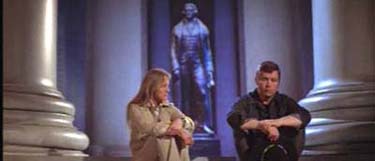
Ah, now I get it. They couldn’t get permission to shoot the scene at the actual memorial, so the high shots are used to disguise the fact that the person we see isn’t Jean. However, the truth is sort of revealed via some patently obvious projection shots, with Jean and Billy standing before what is obviously footage of the Memorial rather than the Memorial itself. In case you’re unfamiliar with the original film, this is the analogue to a scene at that also takes place at the Jefferson Memorial, although Capra and his cast were actually allowed to film on the location. In the original, Jean Arthur (who basically played the Saunders role, and eventually becomes Stewart’s love interest) follows the similarly betrayed and dispirited Jimmy Stewart, and gives a speech that convinces him to resume the fight. Here, of course, the Arthur role has been split in two, since Billy already has a romantic partner. Thus it’s Jean who joins him in the remake. She sits on the steps beside Billy and reveals that she’s seen Saunders, who just in time has found the MacGuffin File in her and McArthur’s safety deposit box. This just gets back to one of my points earlier. The Bad Guys kill McArthur after he tells them he didn’t keep a copy of the file, taking his word for this when he was blackmailing them in the first place. In return for keeping quiet, all he wanted was a patronage job, which again seems an easier thing to do than committing murder. However, if they had done that, then we wouldn’t have such a neat, convenient, tied-with-a-bow solution to everything. Jean reports that
Saunders is willing to help if Billy should decide to fight back. However, a
depressed Billy admits that he doesn’t even know who he’s supposed to be
fighting. (Really? It seems pretty obvious to me.) “Who better than you,”
Jean asks, “knows that you can’t reform Congress from within?” Which…exactly!
It’s hard to get past the idea that Billy would never have accepted the seat
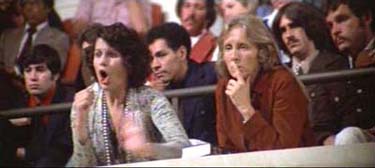
in the first place. Anyway, we take another quick swirling aerial tour of the nation’s landmarks, accompanied by some lovely music courtesy of Elmer Bernstein. This is followed by another laughably bad rear projection shot of Billy standing before the Jefferson Memorial statue, and reading aloud the inscription hewn into the marble wall. Then Billy looks up in awe at Jefferson’s visage. Properly inspired, with purposeful music blaring, Billy is next…sitting himself in the little open air tourist tram. I don’t know, the image just doesn’t seem to match the moment. And so we take in the sights (again) with Billy, from the eternal flame at Arlington Cemetery to the Washington Memorial to the Lincoln Memorial and so on. During this, we ponder both the very real majesty of our nation’s capitol (despite the fact that Billy’s tour plays exactly like a bad Disney patriotic short from the ‘50s, including the obligatory rendition of “Glory, Glory Hallelujah” [!!] as Billy gazes upon the statue of Lincoln), while also musing as to what exactly made up the 40 plus minutes Laughlin cut from the original, longer version of this film. Anyone who’s seen The Trial of Billy Jack and lived can testify to its otherworldly bloatedness, but damnation, sir, if this stuff all made it in, what didn’t? By the way, I’m the last person to scoff at scenes of someone getting choked up while contemplating the likes of Jefferson and Lincoln, not to mention our war dead. I realize also that one can legitimately separate the country from the government. Still, it’s hard for me to reconcile Billy’s apparent worship of Lincoln and (especially) Jefferson, given the contempt displayed towards pretty much all of Western Civilization and the Dead White Guys behind it in the series’ previous entries. Bringing the America of today more into line with the vision of the Founders just doesn’t seem consistent with the attitudes displayed in the earlier films. Back to the Senate chamber, where once again the reporters in the peanut gallery are used as a not very in tune Greek Chorus. One wag refers to the full house by noting “everyone comes to see an execution,” leading another to ask, “Where are the drums and the guillotine?” Oh, my sides. Oscar Wilde had nothing on you guys, that’s for sure. They remark as well upon Billy’s seeming absence. However, when the roll is called, and “Jack” is sounded, Billy throws the door open, shouts “Here!” and enters. Needless to say, this occasions much pronounced buzzing from the extras, as well as a shocked look from Payne. At the same time, Jean and Saunders enter the gallery and take two seats saved for them. Lest the sight of Saunders entering the gallery confuse us, they have a reporter blurt, “What’s Saunders doing here?” I’m not sure why this is considered so remarkable, since she’s a former senatorial aide, but there you go. Billy’s appearance triggers a motion from the floor to have him expelled, pursuant to the findings of the ethics committee, or whatever the hell that was. Said resolution is read as Billy stands looking on stoically. At least I think he’s looking on stoically. It’s hard to tell, since that’s really his only expression. Before the resolution can be voted on, however, Billy asks for the floor. Other Senators object, although the Chair notes that “Senator Jack is still a member of this body,” albeit without yet recognizing him. To move things along, Jean shouts “Let him speak!” In response, the assembled onlookers burst into raucous applause. Yeah, I’m sure the Senate likes that sort of thing from the visitor’s gallery. Indeed, if I wanted to make sure Billy wasn’t given a chance to speak, I’d do exactly what Jean just did. Being a movie, of course, the Chair doesn’t even order Jean removed from the chamber. He does pause to lecture the gallery against such outbursts, however, and notes that such will not influence his actions. Then he says, “The Chair recognizes…” and dramatically pauses—well, ‘dramatically’ pauses, anyway—as the camera cuts around to various faces that have assumed suspenseful expressions, “….Senator Jack!” You stupid old fart! Now we’ve got another 36 minutes of movie to sit through! Thanks a lot, jerk. The onlookers respond with another round of applause, and really, it seems quite unlikely at this point that the Chair wouldn’t clear the gallery. Billy begins giving a speech, whereupon Payne stands up and asks if Billy will yield the floor. We cut to Saunders and Jean frantically—and I mean mime frantically—signaling ‘no.’ Again, this is highly insulting, since the intent is clearly to make sure that we simpletons in the audience get that giving up the floor would be a bad idea. Well, gee, we previously saw Billy turn the floor over to Payne and get bit in the ass less than twenty frickin’ minutes ago. So I think we might have figured this out on our own, thank you very much. Proving himself a political mastermind entirely too savvy to make the same boneheaded mistake twice, Billy refuses. “I yielded once before,” Billy notes (why, yes, now that you mention it, we do recall that, because again, we saw that scene less than twenty frickin’ minutes ago), “and if you’ll recall, I ended up being splattered across the headline of every newspaper in this country and was practically never heard of again!” Everyone in the gallery chuckles at this droll observation, although I must admit, I can’t make head or tail of it. Billy explains the results of his “coaching,” (presumably from Saunders), as to the ways he can temporarily yield the floor without surrendering it entirely. This is actually extremely arcane stuff, so I’ll forgive the obvious exposition here. For instance, he may yield for questions or points of order and still retain the floor. Payne again asks him to yield, and Billy agrees only after Payne stipulates that he wishes to ask a question. Man, the Robert’s Rules of Order buffs must be on the edge of their seats right now. In response to Payne’s query, Billy admits that he intends to discuss Section 40 of the Evil Bill. Payne objects that this topic was entirely covered by the ethics committee investigation. This leads to a shouting match wherein Billy replies that he wasn’t “guilty as charged,” but rather, “guilty as framed.” I didn’t think that was a particularly clever line (and he uses it twice), but it’s actually cribbed from Mr. Smith. Maybe it sounded wittier when Jimmy Stewart said it. More shouting ensues, of the sort that makes you think Al Pacino saw it before filming the climatic scene of And Justice for All… (and believe me, that’s no compliment), and there are gasps of shock from the gallery, and so on. However, I’m too tired to examine all this in detail, especially as we’ve still half an hour of movie left. In the end, Payne, knowing he can’t seize the floor, leaves the chamber and implores his fellow senators to do the same. A large number of them do so. Other senators pause first and do some speechifying, because this is a Billy Jack movie, and that means we’ve got nothing but time. In the end, Billy is left alone on the floor, whereupon he vows to present his evidence to the viewers and reporters up in the gallery. “Filibuster!” an excited reporter shouts, and triumphant horns bray on the soundtrack. Sure enough, we get a Reporters-Running-To-Phone-In-The-Story scene right out of Airplane! And actually, it’s just as funny. Meanwhile, Saunders enters the Press Room to exhort the reporters to take Billy’s side in their coverage. Giving my jaundiced view of the press in this country, that’s exactly what I’d expect them to do. Still, seeing a professional political hack beseeching the Washington press corps to shill for one side on a political issue is not what I’d call ‘inspirational,’ no matter what the music tries to imply. Sure enough, after but
a few seconds of this, one reporter calling in his article merrily throws
off his initial stab at impartiality (which Saunders herself calls “the
straight story”) and recasts the lead of his article in a purely partisan
manner: “Scratch all that and take this: The most titanic battle of modern
times has broken out in Washington. A new young David, without a slingshot,
has risen to do battle on the Senate floor…” Well, you can take it from
there.
Back on the Floor,
Billy is now reading aloud the Declaration of Independence. Wow, with hard
evidence like that, Bailey is doomed. Saunders returns and she and Jean
mime directions for what Billy should do next, which isn’t exactly
burnishing his Action Hero credentials any. Their instructions are that
Billy shouldn’t present his evidence until the reporters return (which, in
fact, he wasn’t). [*This scene is also taken from Mr. Smith.] At the same time, Bailey is ordering Payne to get back in there and stop Billy, no matter what it takes. “I don’t have the stomach for it anymore,” Payne protests. Bailey wants none of that. “If he starts to convince those Senators,” Bailey warns, “you might just as well blow your brains out.” Oh, yeah. We’ve seen that. One whiff of scandal in Washington and major players all over town start falling on their swords by the bushel basket. In any case, a zombie-like Payne shuffles from the room. We cut to a bunch of Senators, including Payne, assembled in a side room, presumably while the Sergeant at Arms gathers up enough of them to get the necessary quorum. They are understandably annoyed at the whole situation. One fellow suggests not only tossing out Billy, but Section 40 of the Evil Bill too, if that will help to make the whole thing go away. Payne manages to nix this idea, long enough anyway to whip up support amongst his fellow to simply wait Billy out. He can only hold the floor as long as he can stand, we’re told, and they figure they can wait him out in shifts until he gives up or just literally collapses. And so the filibuster proceeds, with Billy yakking on. Meanwhile, while Bailey works the phone, pulling strings so as to do everything he can to take Our Hero down. He also orders a flunky to arrange for the tons of fake telegrams that we all remember from the original Mr. Smith. We cut to that night, as Billy rambles on. He’s now talking about the MacGuffin File. This is actually a bad idea. By reminding us of the file, we now remember that the entire filibuster is pointless. Billy’s got a whole file detailing at length the dirt on Bailey, the Willet Creek project, government officials taking kickbacks. As well, we’re told, the file details “the astonishing fact that over a ten year period, at fifty eight different nuclear plants, there were at least 141 technical mishaps that came dangerously close to a complete meltdown.” And that doesn’t even cover that time a bunch of killer bees invaded a nuclear reactor and it exploded, killing tens of thousands of civilians and Richard Chamberlain. (By the way, the folder we saw looked pretty slim to contain this vast array of information. It must have all been on microfilm or something.) Anyway, Billy, since you’ve got this file and all, instead of spending days filibustering on the Senate floor, why not just copy it and send the information to the press you moron?! I mean, wouldn’t that pretty much get the same result, easier and quicker, and save everyone a whole lot of time? (Especially me.) This is why there wasn’t a MacGuffin File in the original movie, because, you know, the people who made it weren’t idiots. OK, let’s raise another point. As is the series’ wont, now that Laughlin has introduced some totally made up information, he runs with it as the basis of a scathing indictment of the Establishment. Here he heaps scorn on the testimony of the nuclear industry following the Three Mile Island incident, for their assertion that the event was a freak one. OH, YEAH?! THEN HOW DO YOU BASTARDS SQUARE YOUR ‘FREAK INCIDENT’ RHETORIC WITH THIS MOVIE’S IMAGINARY STATISTIC OF 141 NEAR QUITE ALMOST COMPLETE MELTDOWNS?! HUH?? HUH??!! This is, however, probably the most intuitively believable scene in the movie, in that it finds Billy hoarsely blabbing endless hours of nonsense while his sparse audience, occupying a mere fraction of the available seats, slumbers on soundly all around him. Dawn breaks the next morning, whereupon we find Jean and Saunders sleeping in the pressroom. Again, I think it says something about the Laughlins’ political blind spots that they assumed the audience would cheerfully admire the idea of reporters so blatantly taking sides in this. One of the friendly reporters enters the room with a dire update. “You better wake up!” he calls to Our Heroines. “You guys are in trouble!” (Hmm, perhaps he’s not a reporter, but a film critic.) “You better call your boy off, Jean,” he continues morosely. “Almost nothing he’s saying is being printed or heard back in your home state.” The idea is that Bailey, who is also the state’s primary media baron, has choked off any coverage of what is happening in the carefully unnamed “home state.” Two problems. First, that’s ridiculous. No one man could own all the newspapers, radio and TV stations in an entire state, even one with a low population and scattered communities. I’ll admit the idea was somewhat less suspect back then than it would be now, what with the Internet and cable and all, but it’s still a lot to swallow. But let’s say he has put pressure on all the other media outlet owners and succeeded at this. The larger problem is that the natural answer to this devastating setback is, “So what?” Billy’s filibuster is clearly a huge national story (especially following the previous accusations of corruption against him), and we’ve seen—yay!—that the national press corps is totally in his pocket and willfully slanting coverage his way to a grotesque extent. Aside from those juicy angles, however, the fact is that Billy has in his possession a file detailing governmental corruption and a history of myriad hidden “near melt downs” over the last decade. Good grief, this is just a few years after Watergate. The national coverage on this would be explosively huge, as a legion of starry-eyed reporters dreamed of becoming the next Woodward and Bernstein. In Mr. Smith, the battle between a National Youth Camp and the construction of a dam—not a nuclear plant, obviously—was in fact mostly a local concern. (And, of course, there was a lot fewer media outlets back in the ‘30s, so the control by one man of the state’s newspapers and radio stations was a lot more believable.) In contrast, the issues and stakes here, per the tradition of the Billy Jack series, have been dramatically scaled up and are clearly national in nature. Hell, there’s even a murder involved in all this. Even if we stipulate that Bailey could engineer a complete media blackout in Billy’s home state (regarding a gigantic national story revolving around one of their own Senators, who himself is a hugely popular local folk hero), it wouldn’t really matter. Such evidence of nationwide corruption and nuclear malfeasance would be evoking pressure on the Senate, as well as all the other political institutions, from every corner of the country. [*Meanwhile, fans of the previous Billy Jack might be wondering, “Well, what about the TV station at the Freedom School?” In The Trial of Billy Jack, this facility was established as having huge national impact via their fearless political exposés. So much impact, in fact, that ultimately the Man had the station blown up, and then sent in the National Guard to massacre the students, lest he be destroyed by this Shining Instrument of Justice. Anyhoo, they cover this by briefly noting, “They busted up your TV station, and cut your transmitting cable.”] Jean is infuriated by this manifestation of the Man’s stranglehold on, well, pretty much everything. She sneers, “So that’s your ‘freedom of the press?’“ and then runs around kicking and overturning furniture in her righteous wrath. I had to laugh, however, when her rampage ends with her petulantly moaning, “It’s just not fair!” This is a woman who understands what the theme song of Malcolm in the Middle is telling us. Now we get to the section of the movie where Billy nobly staggers around on his last fumes of energy, declaiming raggedly through a ravaged throat. It’s at this juncture, moreover, that we find him pushing the National Referendum idea. (Hilariously, he refers to this massive rewiring of our entire governmental system as “one little tool.” That’s like calling World War II ‘one little spat.’) I found his pushing the Referendum at this exact moment kind of funny, because at this point most of the people in the chamber wouldn’t even be able to make out what he was saying. This situation is in fact emphasized by their attempts to compensate for Loughlin’s stagy whisper, which they do by cranking up the volume on his voice. As always when dubbed dialogue sounds overly loud, this merely calls attention to itself. In sum, Billy pushes the Referendum as a mechanism for guaranteeing that the Will of the People isn’t impeded by our constitutionally ordained branches of government. I’ve already spent a lot of time on why I think the referendum / initiative idea is bad, not to mention illegal on the face of it. However, I’ll again note my belief that Billy and his pals would not in the real world necessarily find themselves cheering the results of “turning this government back into a government of the people.” I swear, when are these people going to learn the lesson of unintended consequences? This is supposed to be Our Heroes lowest ebb, by the way, with Billy barely retaining consciousness and Jean just now learning about the sabotage of the Freedom School TV station. With this mighty weapon taken from them, even Saunders tells Jean that they’ve lost, and that she should call Billy off. Cut back to Billy, who is in full Jimmy Stewart mode…. Well, you know what I mean. Obviously he’s nowhere near ‘full Jimmy Stewart mode.’ I meant more his incredibly inadequate stab at such. Still, this raises the rather obvious question of why the hell he’d try to fill such shoes in the first place. Not just Stewart’s—although that’s more patently embarrassing, since the contrast is easier to make—but Frank Capra’s to boot. Anyway, he’s painfully orating with his last ounces of energy and will power on human greed and such. This is where Payne signals to bring in the trumped up flood of telegrams and letters—laughably, as the pages bring in mailbag after mailbag, the scene calls as mind as much the climax of Miracle on 34th Street as that of Mr. Smith—supposedly from a common citizenry vilifying Billy. Here I sort of hunched into a pre-wincing stance. This proved wise, as they actually do have the balls to let Billy paraphrase Stewart’s famous lines about “you all think I’m licked,” and his determination to continue standing, even if “all the Baileys come marching in here with all their armies and all the National Guards*, and you fill this chamber with lies!” as he tosses around fistfuls of the phony missives. [*The reference to “National Guards” is, needless to say, not found in Mr. Smith. Since Laughlin spent much time portraying the National Guard as a murderous instrument of evil in the previous film, this remark indicates that he has some sort of weird fixation on it. And speaking of weird personal bugaboos, one other alteration to Stewart’s monologue is to again interject a reference to the National Referendum idea. The guy just can’t help himself.]
And so he talks on, and on, and on. And, of course, he draws out a lot that Stewart said concisely, perhaps attempting to paper over their respective and monumental gap in acting ability by juicing up his lines. Finally, though, the script calls for him to collapse dramatically to the floor, and to my eternal thanks, he eventually does. Everyone looks on in shock and horror at Billy’s still, silent form. (Well, except for me, I suspect. I expect my expression was quite gleeful, in fact). A stretcher is brought in and Billy removed. With that accomplished, the Senators immediately get back to the motion to strip Billy of his Senate seat. This triggers, needless to say, a thunderous rounds of ‘boos’ and shouting from the Common Folk in the gallery, which again the Chair doesn’t bother to clear. The noise continues unabated, and being unable to continue, the Senators begin to leave the floor. In the end, only Payne, obviously troubled, is left in his seat. (By this time I had lost count of how many scenes feature a troubled-looking Payne sitting alone. It’s more than a couple, anyway.) We cut to an ambulance (just like in the beginning of the film—Wow!) speeding Billy to the hospital. He rouses and he and Jean have a final tender little scene. This is weird, in that, at least in this ‘short’ version of the film, the plot stuff all gets resolved without us seeing either Billy or Jean again. Said resolution occurs after this scene, and you’d think they’d have left in one shot of Billy and Jean’s reacting to it, but they don’t. Moreover, this makes Jean’s final lines (ever, after three movies), of “You did it! And you didn’t even once have to take off your boots!” (!!!), sort of weird. Since the events that wrap up the story haven’t occurred yet, these lines are premature. As of this point, in fact, Billy hasn’t “done it.” I can only assume when they re-edited the movie, they slipped back this scene in the wrong order. Or something. In any case, it’s a bit strange that we never see the series’ main characters again following the film’s halfhearted climax. Anyway, we cut back to the Senate, and again they introduce the ‘expel Billy’ motion, and because this is the climax, the gallery stays quiet this time. Why? It’s the old It’s In the Script trick. Anyhoo, as our hearts beat in suspense over whether Good or Evil shall triumph, and just when all looks darkest, the day is saved. Payne, inspired by Billy’s brave example, jumps up and provides the plot’s deus ex machina by confirming everything Billy said about Bailey and the Willet Creek plant. (This should be Marshall’s best scene, but it’s…too big. He’s better in the smaller moments, when the script and Laughlin’s direction don’t force him into histrionics.) Again, I can only assume some material got cut here. As things stand, the immediate reaction to Payne’s tearful and wrenching confession of corruption is to show those in the gallery jumping up, shouting and applauding in frenzied celebration. (!!) Presumably in the original version this festivity actually followed Billy’s public vindication, or the voting down of the nuclear power plant, or something. In any case, the re-editing here is quite misjudged, as Payne’s confession doesn’t seem like something that should be triggering shouts of joy from onlookers. And…wrap. [By the way, if I remember correctly, Paine (the senator in the first movie) actually did shoot himself after confessing his sins*, since being ruined was a much bigger deal in those days. In the remake, though, Payne doesn’t kill himself. Did he do so originally, and this was amongst the material cut out? Did they never plan to have him do himself in? In any case, it makes Bailey’s remark to Paine that if Billy wins, “you might was well blow your brains out,” sort of weird.] (*As it turns out, I didn't remember correctly. Thanks to proofreader William Leary for explaining, "[Paine] tried to [shoot himself], but someone stopped him. It was after being stopped that he ran onto the floor and announced that Smith's accusations were entirely accurate.) Let’s get back to Payne’s climatic confession for a moment. That provided the deus ex machina of Mr. Smith Goes to Washington, too, with Paine conveniently having a crisis of conscious and handily confirming all of Jefferson Smith’s charges. The difference is that the remake moronically introduces another deus ex machina in the MacGuffin File. Hilariously, after going to all the trouble of establishing the thing and continuing to work it into the script, they then pretty much have to ignore the implications of the thing. If Billy has the file, then he has more than enough concrete evidence to blow the lid off the whole scandal without having to go the whole filibuster route. However, the filibuster remains easily the most remembered part of Mr. Smith, and you just could not remake the film sans it. Thus, the MacGuffin File is not only a pointless and time-wasting plot device*, but they actually have to work around the damn thing. [*Although if the Billy Jack series proves anything, it’s that whether stuff is pointless and time-wasting was not one of Laughlin’s major concerns.] All that’s left is the closing credits, and sure enough, even those prove entertaining. (No one can say that Laughlin isn’t a total filmmaker.) For instance, as the character names scroll past, we see that although they are generally the same names used in Mr. Smith Goes to Washington, several of them are spelled differently. (?!) Thus ‘Paine’ becomes ‘Payne,’ and ‘McGann’ becomes ‘McGhan.” The second funny thing is that, presumably in hopes of reminding people that despite this most un-Billy Jack-esque movie, this is still a Billy Jack movie (which, given the dearth of action scenes, was perhaps wise), the credits are accompanied by a new version of “One Tin Soldier,” the famous theme song from Billy Jack. Frankly, the redo is not very good. Imagine a typically awful production number on The Brady Bunch Variety Hour featuring a silk-swathed ‘Jan’ or ‘Marsha’ inadequately warbling “One Tin Soldier,” and you’re pretty much on the mark. After a few bar of this, I formed a cynical suspicion that was confirmed by a later credit: “One Tin Soldier Performed by Teresa Laughlin.” Teresa, of course, played Carol in the series, and had been afforded the opportunity to assault the audiences’ eardrums on more than one occasion. Not since Arch Hall Sr. has a man done more to showcase a child who couldn’t sing nor act. Jabootu fans will also be pleased to learn that MegaForce director Hal Needham is credited as the film’s stunt coordinator. Assuming a huge number of martial arts scenes weren’t amongst the material cut, then Mr. Needham must not have labored overmuch on this one.
Afterword :Following the success of 1977’s Oh, God!, popular country singer/composer John Denver seemed on the brink of a fruitful movie career. One of his dream projects was to remake Mr. Smith Goes to Washington. The rights, however, were held by film producer Frank Capra Jr., the son of Mr. Smith director Frank Capra. Interest in the project was high—it was thought a feel-good romantic comedy about cleaning up corruption in Washington would play well in post-Watergate America—and Mr. Denver was outbid by Tom Laughlin. One can only imagine that Denver’s version would have been a more orthodox retelling (certainly he was more of a Jimmy Stewart type), and almost by default a better movie, even if it weren’t that good. Laughlin, however, was still riding high on the monumental financial success of both Billy Jack and the elephantine artistic disaster that was The Trial of Billy Jack. Astoundingly, the latter was 1974’s fifth most successful film, drawing a then monstrous $31 million plus at the box office. The only films to do better than year were Earthquake ($36 million), Young Frankenstein ($38 million), Blazing Saddles ($48 million) and The Towering Inferno ($49 million). Viewing himself as a perfectionist and a bit of a cinematic genius, Laughlin was well known for run-ins with the Hollywood establishment, as well as the critics. (Following the critical lambasting of Trial of Billy Jack, Laughlin sponsored a well-funded national essay contest on why critics were out of touch with the Common Man, i.e., those who made Trial a gigantic success.) Laughlin always spent money freely, which didn’t endear him to the studios. Perhaps seeing that his moment in the political landscape was passing (or perhaps just wanting to be all things at the same time, and screw consistency), Billy Jack Goes to Washington appears an obvious bid to reach past the youth audience that had flocked to his previous films, at least until the failure of his then recent The Master Gunfighter. Thus he chose to remake a venerable Hollywood classic, instead of making an original film, and hired for the first time a cast of familiar faces. Admittedly, these actors were primarily known for their television work (including neophyte screen actress Arnaz, who’s was then most recognizable from appearances on her mom’s TV series The Lucy Show), save only for the elderly screen star Pat O’Brien. Still and all, it was the sort of veteran professional cast you might expect to see in a real movie. To be fair, if it is fair, Billy Jack Goes to Washington does take quite a lot directly from the original film. Much of the dialogue heard during the Senate scenes reflects that heard in Mr. Smith, and many scenes, like the one at the Jefferson Memorial, are similarly mirrored. On the other hand, Mr. Laughlin’s political paranoia is about as far from Frank Capra and Jimmy Stewart as you can imagine. A bigger problem is that trying to brundlefly Jefferson Smith and Billy Jack into the same character is so inherently illogical that a Star Trek robot’s head would explode after watching but a few moments of the movie. Also, Jimmy Stewart didn’t kick as many people. The above probably as much as anything else encapsulates why the film bombed. The Trial of Billy Jack might well be the worst hit movie in cinema history, but it played cannily to the yens of its (presumably stoned) target audience. Billy Jack Goes to Washington takes that audience for granted—and with the end of the draft and the Viet Nam war, the ‘youth movement’ itself was already dissipating—while trying to sell the character to an entirely alien demographic. To wit, older and Middle American viewers (such few as there were, anyway) were most likely turned off by assertions that the government went around assassinating people on a weekly basis. Once assumes the obligatory bad mouthing of the average American didn’t go over that well either. At the same time, Billy’s core audience of left-leaning teens and college students—no longer quite as stoned, perhaps—no doubt wondered why he was spending so much time staring dewy eyed at statues of fascistic Dead White Men like Jefferson and Lincoln, and so little time applying his foot to some redneck’s face. Presumably everyone, meanwhile, was turned off by the fact that Billy Jack Goes to Washington is an awful movie. In any case, after spending a then sizable $7 million on the film, including $750,000 to meticulously recreate the Senate Chamber after being denied permission to film there (for obvious reasons), the movie was judged such a fiasco it was barely released. It hit a few screens, did as badly as had been predicted, and closed up shop. Laughlin was ruined as a filmmaker. Bad Movie pioneers the Medved Brothers* nominated Billy Jack Goes to Washington as The Worst Film You Never Saw in their seminal tome The Golden Turkey Awards. The category referred to films that were so evidently bad that they never got released, or, as in the case of Billy Jack Goes to Washington, got the merest token release. (The book was written in 1980, it should be noted, before there was a home video market. If you didn’t see a movie in the theater or on the few TV channels back then, it had basically disappeared off the face of the earth.) [*The Medveds largely agree with some of my analysis of why the film failed: “Billy Jack does manage to deliver several long, preachy speeches on the Senate floor,” they write, “but disappoints his fans by gesturing only with his hands and not with his bare feet.”] The competition was impressive, including the legendary Jerry Lewis Holocaust epic The Day the Clown Cried and a truly dreadful sounding Alan Alda war comedy called The Extraordinary Seaman. (Really making my mouth water is that the latter was helmed by one of Jabootu’s favorite directors, John Frankenheimer.) Billy Jack Goes to Washington won, but the Medveds noted that this was partly because of Laughlin’s shenanigans after it was pulled from release. What they are referring to was Laughlin’s oft-stated and continuing contention that the film was torpedoed not by the movie going public, but by the government. (It should be noted that the ‘70s saw slews of paranoid political dramas, including several near-classics like Three Days of the Condor and Winter Kills. I guess only Laughlin’s films were considered so dangerous as to force into action the Shadowy Forces that blocked Billy Jack Goes to Washington’s release, though.) Laughlin ‘documents’ this in his book
The Legend of Billy Jack: The screening seemed to go well. Generous comments were exchanged, and the small, but influential, crowd appeared to be gripped by the action on the screen. But when the final credits rolled through the projector and the lights came back up, Laughlin was greeted by an unexpected scene. The Senator from Indiana got up and started screaming at him -- “You communist son of a bitch! I absolutely guarantee you, you will never get this picture released. Everything you have, this house, everything, in one year -- gone! You're dead.” Then, kicking over chairs he charged at Laughlin, but those around him were able to restrain the enraged Senator who was now storming out of the house and violently pushing the gate open with such furious force that he broke the electric motor. Hartke's wife was in tears, embarrassed, and Delores and Lucy were trying to comfort her, as she apologized for an outburst that had surprised and hurt her more than anyone in that room. It was an awkward moment, and it lingered until the celebrities and politicians said their goodnights and filed out of the house. As it would turn out, the small group gathered at Rockingham that night had attended one of the only screenings Billy Jack Goes to Washington would ever have. The picture would never be released, just as Hartke* promised.” [*For the record, Hartke was a lifetime liberal Democrat well known for his opposition to the Viet Nam war.] Personally, I find a spontaneous reaction of death threats a more believable reaction to being forced to watch this movie—and remember, the version seen in this anecdote would the one running a full 155 minutes—than Laughlin’s assertion that the rest of the viewers were “gripped by the action on the screen,” or that “generous compliments” were issued on the film’s behalf. On the other hand, any compliment about the movie would, by default, be ‘generous.’ Laughlin continued to peddle this unlikely tale for years, such as during a 2005 CNN interview for the show Showbiz Tonight. During this, Laughlin asserted, “three years later, [Hartke] gets indicted for the exact crime that we showed in the movie.” That’s mendacious. In fact, a retired Hartke (he left the Senate in 1976) was indicted in 1994—nearly 20 years later, not ‘three’—by an Indiana grand jury on charges of polling violations. He served a six-month suspended sentence. Hardly a badge of honor, but neither was he indicted “for the exact crime” shown in the film—whatever it is that Laughlin is even referring to. Veteran schlock producer Sam Arkoff produced the first Billy Jack movie, The Born Losers. He had been sued by the contentious Laughlin (as were many others), but remained an admirer. In biography, Flying Through Hollywood By The Seat of My Pants, Arkoff writes that Laughlin invited him to take a look at the just finished Billy Jack Goes to Washington, presumably in its three hour form. Tactfully, Arkoff notes that the film “just didn’t recapture the charming and disarming character Tom had played in Billy Jack.” That might be the kindest thing anyone has ever said about it.
A Good Cast is Worth Repeating :As with the rest of the family, Teresa Laughlin basically retired from films following the disastrous failure of Billy Jack Goes to Washington, her sole later credit being a small role in 1984’s Breakin’. (!!) Delores Taylor, the portrayer of Jean and Tom Laughlin’s wife, apparently never took on another show biz job of any sort. Producer Frank Capra Jr. amazingly didn’t go the route of Senator Paine after realizing what he had done to the memory of one of his father’s greatest films. Instead, he continued shepherding such fine cinematic fare as Firestarter, Morgan Fairchild’s The Seduction, Fred Dryer’s Death Before Dishonor and Chuck Norris’ An Eye for An Eye. Truly the apple does not fall far from the tree. Lucie Arnaz went on to appear in 1980’s similarly appalling and hilarious The Jazz Singer, opposite Neil Diamond and Laurence Olivier. Free of the direction of Mr. Laughlin, she remained the only major cast member in that film not to horribly embarrass herself. 1985 saw The Lucie Arnaz Show, but Ms. Arnaz failed to achieve the success of her mother and the series was short lived. She continues to act, mostly via an occasional TV guest appearance. Dick Gautier continued to work steadily, mostly in TV guest roles, through the late ‘90s. He again played his signature role of Hymie the Robot in the 1989 TV reunion movie Get Smart, Again! Actor Peter Donat has a role as one of the sympathetic reporters in Billy Jack Goes to Washington. He is, coincidentally, the nephew of Robert Donat, who beat out Jimmy Stewart for the Best Actor Oscar when Stewart was nominated for Mr. Smith Goes to Washington. A busy TV actor, Peter Donat remains best known for having played Fox Muldar’s father on The X-Files. ‘30s film star Pat O’Brien, who played the President of the Senate / Senate Chair in the movie, only took on a few more acting gigs before passing away in 1983. He did appear in 1981’s Ragtime, which marked the return of his one-time frequent costar Jimmy Cagney after a screen absence of twenty years. Sam Wanamaker continued to have a successful character acting career, mostly assaying heavies. Notably for the Jabootu buff, he played the oily Rupert Murdoch-analogue in Superman IV: The Quest for Peace. In real life, Mr. Wanamaker was the founder of the International Shakespeare Globe Centre, and spent decades tirelessly raising funds to rebuild the Globe, the venue where Shakespeare premiered his works. Mr. Wanamaker was also the father of actress Zoe Wanamaker. He died in 1993. E. G. Marshall remained one of the most familiar and respected American character actors, working steadily up until his death in 1998. Younger audiences probably remember him best as Beverly D’Angelo’s dad in Christmas Vacation. Horror buffs, meanwhile, might recall his turn as a germophobic millionaire besieged by cockroaches in Creepshow. His signature parts, however, were as one of Henry Fonda’s 12 Angry Men, and his starring role in the ‘60s TV series The Defenders, a legal series in which he played opposite The Brady Bunch’s Robert Reed. The program is still considered one of television’s finest dramas. Those are just a few roles among the hundreds Mr. Marshall assayed, however. Among those cut from the film was a young Suzanne Sommers as “Party Girl.” As far as I could tell, all her scene ended up on the editing floor when the film was edited down to two hours. Still, she’ll always have Ants!
As for Tom Laughlin, the actor, screenwriter and director behind the Billy Jack series, he had but three small acting gigs in his future. He played ‘Lou’ the following year in Michael Winner’s Farewell, My Lovely, a part so small that you have to click the (more) button on the film’s IMDB cast listing to see his name. He also appeared in a similarly minute role as one of the Cavendish gang in the legendary 1981 bomb The Legend of the Lone Ranger. Then, ten years later, he assayed Socrates (!) in a British TV special called The War that Never Ends. Andrew Kier and Ben Kingsley also appeared in the project. His movie career behind him, Laughlin basically retired from the limelight, reappearing mostly in periodic news stories covering his quixotic quadrennial runs for the Democratic Party’s presidential nomination. He has not, as of yet, achieved that goal. In recent years he’s started a website, www.billyjack.com, through which he provides his fans further access to his political musings. Unsurprisingly, President Bush is a regular target, and anyone who misses the Billy Jack series will find sustenance in such essays as “3 Fanatic Groups,” which details how The Corporate Oligarchy, the Neo-Cons and The False Evangelicals threaten the very existence of mankind: “All 3 groups passionately support the most extremist, un-American document in American history: The Bush Doctrine of World Domination and Control through Preemptive Strikes.* This Bush Doctrine is the core principle of Bush Jr.’s Presidency, and was first exercised with our illegal invasion of Iraq for oil. Almost all the men involved in creating it and implementing it are now the core of Bush’s Administration.” [*I’ll bet you didn’t even know that was an actual document, did you?] Via the site, Mr. Laughlin also hawks his movies, autographed pictures, various books he has self-published (including The Legend of Billy Jack, a copy of which I must hunt down one of these days), a CD called “The Music of Billy Jack”, and T-shirts. Moreover, especially whenever there’s a Republican in the White House, Laughlin announces that “Billy Jack is needed now more than ever,” and attempts to raise funding for another movie. This includes the present, as Laughlin is predictably a critic of the Iraq war and wishes to comment on it. Believe me, nobody hopes more than I that Mr. Laughlin will get a chance to make that movie. However, since he is well into his seventies by now, I sincerely doubt our mutual dream project will ever come about. Still, back in a 2005
CNN interview promoting the DVD release of the Billy Jack series, Laughlin
dropped these tantalizing remarks:
Many thanks to correspondent Kellie Sharp for this missive: "Mr. Begg; I recently read your newest review and, as always, found it hilarious and enjoyable. For once, I didn't even take much issue with your political stance, because I agree that nuclear power and nuclear weapons are completely separate issues. However, I did notice that you made some rather dubious claims about the Chernobyl incident (that it claimed less than 100 lives). You make it sound like it wasn't a "big deal." As far as short-term effects, Chernobyl claimed 28 lives within the first three months of the incident. 106 emergency workers on the scene were also diagnosed with acute radiation syndrome. Given the Soviet tendency to downplay the effects of their disasters, we can probably safely assume that these numbers should be slightly higher. However, it is the long term effects that are the most disturbing and should not be ignored. Over 500,000 thousand workers sent to clean up the area and seal it off have been exposed. Literally thousands of people in the Chernobyl area have suffered from radiation in the form of leukemia, other cancers, and birth defects. It has been estimated (conservatively, I should add) that 40-60,000 people will experience some sort of health problem related to radiation from Chernobyl. [This information came from several
sources, including the Associated Press and Dr. Michael Stefany, who has an
MA in History, specifically Russian and Central Asian Studies, at my
university, Indiana University of Pennsylvania.] So, thanks for listening to me! I love your site and continue to look forward to your reviews. All the best! ~Kellie Sharp"
First of all, it was certainly never my
intention to make light of the catastrophic events that occurred at
Chernobyl. If my remarks in any way suggested this to be the case,
then I am more than a little embarrassed. I clearly should have taken
more time in composing this section of the review. I should have been far clearer. What I meant to say, and obviously said poorly, was that Chernobyl was an all out disaster, of a sort that frankly I can't even imagine happening here, and that even using that event as a yardstick, director Tom Laughlin’s rhetoric on civilian nuclear power plants (including the fact that he conflates this issue with nuclear weapons) seems exaggerated. I meant to point to Chernobyl as an accident of the sort that I don’t believe could happen here, or in any non-totalitarian country for that matter. Chernobyl occurred because the Soviets, as ever, relied on appallingly primitive technology and design (there was no containment building, for instance), which was moreover appallingly maintained and appallingly staffed and supervised. Furthermore, when the incident occurred, the first instinct of the Soviet government was to cover up the incident. Only when radioactive particles in Sweden were discovered did the Soviets admit what had happened. Another point I inadequately tried to make was that the nuclear power industry, and I’ll extend this to all the nuclear systems in the free world, has a far better safety record than any other industries involved in energy generation,including electrical plants, coal mining and the manufacture of hydro-electric dams. To date, I’ve found mention of only two industry-related deaths. Bothoccurred following a 1999 accident in a Tokaimura nuclear plant in Japan. Two deaths obviously remains a horrible thing, but certainly the number pales in comparison to work-related deaths in other industries. Even in terms of Chernobyl, the actual death rate, including most probably all those who will eventually die earlier than their time from cancer, is probably less than, say, those caused by the release of deadly chemicals during the Bhopal disaster. In saying this, though, it should be stipulated that Ms. Sharp is entirely correct in noting that the number of immediate deaths does not begin to cover the horrific effects of the disaster. Meanwhile, others have questioned the figure of ‘under 100’ deaths I alluded to from the Chernobyl incident. Admittedly, estimates of fatalities vary wildly, as this Wikipedia quotation indicates: "Greenpeace quoted a 1998 WHO study, which counted 212 dead from only 72,000 “liquidators” those who cleaned-up the accident). This contradicts the number of 47 dead liquidators on a total amount of 600 000 people. Greenpeace Russia considers that 67,000 people died in Russia because of Chernobyl's consequences. According to the Union Chernobyl, the main organization
of "liquidators", 10% of the 600,000 liquidators are dead, and 165,000
disabled. According to a April 2006 report by the International Physicians
for Prevention of Nuclear Warfare (IPPNW), entitled "Chernobyl's
consequences on health", more than 10,000 people are affected by a thyroid
cancer and 50.000 cases are expected. In Europe, 10,000 deformations have
been observed on newly-borns because of Chernobyl's radioactive cloud, and
5,000 deaths among recently-born babies. Several hundreds of thousands of
the people who worked on the site after the accident are nowadays sick
because of radiations, and tens of thousands are dead, according to the
IPPNW, 1985 winner of the Nobel peace prize.” Key paragraph from the BBC story: The report also says there is "no convincing evidence" that there has been a rise in other cancers because of Chernobyl. This claim is more controversial, and I don’t possess the time, inclination, or, frankly, the smarts to sort through the evidence and compare all the evidence. In any case, the 2005 Chernobyl Forum report references a number of actual fatalities referenced of about 60. The estimates of an additional near 4,000 people eventually having shortened lives due to the accident are ultimately unprovable, but I'm willing to accept it.
-Review by Ken Begg |
||||||||||||||||
|
|