Another feature of... |
|
Another feature of... |
|
(1957) Warning: While I’ve tried not to pursue my youthful love of puns in these reviews, I couldn’t ignore all the obvious ‘tree’ jokes. You’ve been warned. If you pursue the Bad Movie hobby long enough, your tastes become more refined. I started out with obvious schlock-fests like The Curse of Bigfoot and the Larry Buchanan ‘dinosaur’-in-a-cave epic It’s Alive. (Said dinosaur being a guy in a wetsuit adorned with Ping-Pong ball eyes.) However, decades of experience have sharpened my cinematic palate. I can now fully appreciate the (somewhat) less manifest flaws of well-produced yet equally inane flicks like On Deadly Ground, A Stranger Among Us or Star Trek V: The Final Frontier. Still, sometimes it’s a treat to go back to the really brainlessy goofy stuff. Your Giant Claws, your Jungle Hells, and, yes, your From Hell It Cames. The richest epoch for laughable sci-fi was definitely the 1950s. Traditional horror pictures really didn’t come back until about ‘58, with the appearance of the comparatively opulent Hammer gothics. Monsters were huge business in the ‘50s. Yet they were almost always given a (purportedly) scientific rationale as opposed to a supernatural one. The decade’s great profusion of cheeseball genre flicks was due to converging sociological and economic trends. Jobs were plentiful. Cars were cheap enough that many teens could afford to own one. That era’s youth, the first wave of the baby boomer generation, enjoyed an unprecedented level of disposable income. This was coupled with a level of freedom from parental oversight that would have been unthinkable even ten years earlier (largely the result of the influential child rearing theories of Dr. Spock). Teens with money and freedom of movement chaffed at hanging out with their families. Increasingly, they sought entertainment that not only spoke to them, but which also remained actively unintelligible to their parents. This appetite for media aimed directly at them coupled with cash to burn created the first mass youth markets. In music, these trends fueled the explosive growth of Rock ‘n’ Roll. They also helped create a culture of drive-in theaters and cheesy genre films. These movies tended to be crude and sensational tales featuring then unprecedented levels of horror, violence, sex and loud music. Monsters, Space Men, JDs (juvenile delinquents) and Rock ‘n’ Roll music were all the rage. As well, while some of the films still ended with moralistic ‘daddy knows best’ messages, at least as many featured apathetic and stupid adults. These pigheaded grown-ups would ignore or downright blame teenagers for whatever shenanigans were occurring. This would force the youthful protagonists to take matters into their own hands. Teens would end up saving the world in films ranging from The Blob (starring Steve McQueen!) to Invasion of the Saucer Men. Parents not only disdained the subject matter of these films, but also their poor production values. This, however, made them all the more attractive to their base audience. And because no one from the adult world was monitoring them, such pictures could feature more gratuitous violence and sex then did the major studio offerings of the period. These were the conditions that resulted in the great Schlock Sci-Fi boom of the ‘50s. For here was a guaranteed audience for any junky flick that had a monster or a space man in it. Quality was truly beside the point, and films were often created around exploitable titles and poster art. A producer like Sam Katzman would come up with a surefire title like I Was a Teenaged Werewolf and then commission a script to be written around that title. Provide the elements that this audience demanded, and you were pretty much assured a certain return on your investment. Say that each giant bug or alien invasion flick of the period made at least $50,000 at the box office. If you had stayed under $25,000 in producing your movie, a profit was guaranteed. This is simplistic, of course, but roughly correct. Yet the inference is obvious: Why spend more money to make a good sci-fi film which might not then break even? Maybe if you spend $100,000 to make a decent flick, more kids will go to see it and you’ll make bigger bucks. But if they don’t, you could be ruined. Schlock producers like the ubiquitous American Independent Pictures (AIP) would take the profits from their last film and plow them into the budget of their next movie. One film that lost money could put a shoestring business like that out of business. Besides, they couldn’t compete spectacle-wise with the major studios anyway. How could AIP possibly raise enough dough to make a special effects extravaganza like War of the Worlds or Forbidden Planet? Obviously, they couldn’t. However, they could steadily churn out dozens and dozens of crappy little flicks to feed the seemingly insatiable appetite of their core audiences. So for every Day the Earth Stood Still you got a dozen films like The She Creature, The Beginning of the End, The Attack of the 50 Foot Woman, Cat-Women of the Moon, The Neanderthal Man, The Beast of Hollow Mountain, Teenage Caveman, Blood of Dracula, Monster on the Campus, The Brain from Planet Arous, Teenagers from Outer Space and The Leech Woman. And one film like From Hell It Came. We open with two men and a woman entering a jungle clinic/laboratory, much like the one in Jungle Hell. Only this is a South Pacific island jungle, rather than that film’s East Indian jungle. Our protagonists include Prof. Clark, Dr. William Arnold and Dr. Terry Mason. Mason is the female, and like all ‘50s sci-fi women scientists, sports a masculine sounding first name. This was generally used to ‘comic’ effect. The males would be waiting for some expert named Pat or Chris or something, only to find to their surprise that ‘he’ is a girl. Much merriment ensues. Here, though, we meet ‘Terry’ right off, meaning that the above scenario won’t be played out. So why did they even bother? Force of habit, I guess. Their assistant, Eddie, who’s been shaving (verisimilitude!), emerges from the back room. "Professor," he exclaims, "this is the reply from your message to Washington." Obviously, these are important scientists, or they wouldn’t be corresponding with Washington. (The government was still pretty much Our Omnipotent Pal in the cinema of the 1950s.) Prof. Clark reads a list of instructions. Among other things, they’re to exhume the "growth" and check it for radioactivity. Given that this is a ‘50s sci-fi flick, I think we can safely assume a ‘yes’ on that issue. Then Terry refers to the growth as a ‘monster.’ See, all these vague references are creating an air of mystery. Meanwhile, the film teases us by only slowly revealing the plot. Clever, eh? Clark worries about how this will effect their relationship with the natives. They’re already in an uproar, he notes. After all, he continues, they consider this thing to be another "Tabonger." (Actually, it’s supposed to be Tabanga, but that’s how he pronounces it.) Ah, the Jungle Movie clichés are already starting to kick in. Wise western scientists. Unruly, superstitious native. Watch out for a witch doctor and a rebellious native guy who’ll side with the Scientists. All these flicks have them. In fact, they’ve been warned by ‘Norgu,’ one of the villagers, to stay away from the Tabanga. (Ah, Norgu, you’ve done it again!) Dr. Arnold, who’s obviously Terry’s perspective love interest, is all for that idea. He doesn’t want any more problems with the natives. Terry, however, is your spunky female scientist type. This means that she’ll ignore the men’s advice, get into trouble and the men will have to save her ass. So Terry, naturally, wants to get out there and start digging. "Now, Bill," she soothingly reminds Arnold, "I can handle a gun if the situation arises." Perhaps she’s from Montana. (Note: If you don’t get that last reference, here’s your chance to try that search engine that Paul installed on the Home page.) In other words, if those uppity natives give them any lip, blamm-o! That’ll teach those savages to stand in the way of Western Science! Arnold gives in. Meanwhile, his halting delivery indicates that either the actor is having trouble with his lines or is trying to read cue cards from too great a distance. At this we cut to the credits, superimposed over a notably hokey ‘jungle village’ painting and accompanied by cheesily bombastic music. (If you were thinking theramin, give yourself two points. If you were also thinking jungle drums, take three more.) The working title of the film was It Came From Hell, but they must have thought that the final moniker sounded more dramatic or classy or something. Now we get a crawl, like (sort of) the ones that the Star Wars movies start with: "In Haiti, a corpse walks as a Zombi! [Sic] In primitive India, the dead return as animals! On certain Pacific Atolls, a warrior treacherously murdered [does this happen a lot?] may turn into a tree! Or so it is said by the Shamans…" "Our story occurs on a savage island where a Prince is killed unjustly. The victim was buried upright in a hollow tree trunk. The legend say that "the tree walked to avenge its wrongs."" As you can see, the anthropology in this film has been meticulously researched. We cut to maybe two dozen [*ahem*] natives standing around with torches and such. Tano, the village witch doctor (told ya!), is seated on a reed mat before a fire. Soon he holds up a voodoo doll (in the South Pacific?) and pokes it with a knife. To make sure that we get that this is ominous, the act is accompanied by a big blare of music.
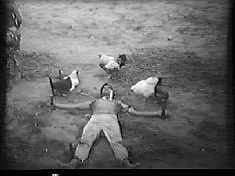
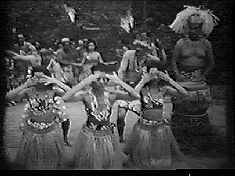
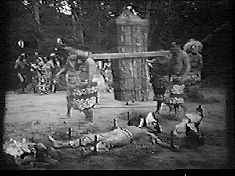
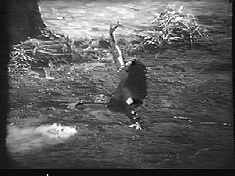
"Kimo," he begins, (and no, I’m not doing any ‘therapy’ jokes) "you have committed the greatest crime of all. You have betrayed your own people!" Meanwhile, we cut to Kimo, tied prone on the ground with stakes. Two guards with clubs (!) flank him. This might have proven more dramatic were it not for the half dozen chickens calmly pecking the dirt around by Kimo’s head. This last bit seemed rather an odd directorial flourish. Kimo is accused of causing the death of his father, who was leader of the tribe. Tano pronounces a death sentence. Then, to the shock of no Jungle Movie fan, he tosses a handful of whooshing powder into the fire. Which, unsurprisingly, whooshes. Kimo, who like all the villagers appears oddly Caucasoid in the facial region, declares his innocence. He claims that his father died from "the Black Plague!" (Yow! These guys definitely have more than walking tree monsters to worry about!) He then accuses Tano of (here it comes) hating the Americans because "you fear that their medicine is stronger than yours!" Man, if I had a buck for every time I’ve heard that line… Hmm, maybe Tano should move to Southern California. After all, the locals there would surely assume that his native medicine was better than that Western ‘science’ stuff. I mean, when was the last time your GP tossed some whooshing powder into an open flame? X-Rays, my ass. The two continue to lob accusations at each other for a while. This is all standard Jungle Movie stuff. See, Kimo tried to convince his father to buddy up to the Wise and Powerful Americans. Tano, knowing that his jig was up, made a deal with another dude, Maranka. They killed Kimo’s father and framed him for it. The Americans get their share of the blame, too. This way, Maranka becomes the new chief, while Tano gets rid of the competition and remains a great power in the village. Kimo tries to expose this conspiracy, now accusing Maranka. "The Evil Spirits [oh, brother!] have seized Kimo’s mind! His tongue has become a serpent!" Maranka cries, sporting a rather incongruous Midwestern twang. Kimo notes that his wife, Korey, was there when Tano poisoned his father. She’s standing nearby in an exaggerated cheesecake sort of stance, like a contest in a beauty pageant. This and the fact that she fails to back up her noble husband’s account informs us that she’s a hussy who’s in on the frame. Lenmana Guerin, the [*cough*] actress playing Korey, easily gives the worst performance in the film. Which is saying something. In fact, she might be giving the worst performance of any film. She’s so obviously phony here that you expect the villagers to instantly buy Kimo’s account and kill her and the other conspirators out of hand. Instead, Korey announces that it was Kimo who brought the poison, having gotten it from the Americans. This seals Kimo’s fate. Tano continues. "You broke the law of our tribe when you brought your father to the Americans," he sneers, continuing the longest legal proceeding since the opening of The Brainiac. "It was their fiendish, unholy Devil Dust that made him sick, their medicine that killed him!" Kimo is clearly unhappy with his wife selling him out. "I will return from the grave to revenge myself," he announces. "Tano!" he continues. "You can kill my spirit but my body will never die! In death I will be stronger than you in life!" (Hmm, methinks perhaps a certain George Lucas once saw this movie?) "Maranka! Your days are numbered," Kimo notes, in what is apparently a popular South Pacific idiom. "I shall come back from Hell and make you pay for your crimes!" Unfortunately, his dramatic spiel is undercut by the chickens we still see pecking at the ground directly above his head. The trial is concluded. One guard kneels and holds a ceremonial knife over Kimo’s heart. The other takes his club and (offscreen, natch) drives the blade into Kimo’s chest. The music blares. The villagers gasp. The chickens look on in stony silence. At a signal from Maranka, the villagers begin to engage in an extremely awkward and embarrassingly bogus ‘native’ dance. Three ladies in hula skirts dance in the foreground. They hold their hands in front of their eyes and wiggle their fingers. This is apparently their tribal "Don’t look at the Bad Movie" dance.
Meanwhile, a middle aged woman who looks quite a bit like Vivian Vance is seen watching from some bushes. This is Mrs. Kilgore, and the savvy movie vet will immediately pick up the fetid aroma of a lame Comic Relief character. She watches as an upright wooden coffin is brought in, carried on horizontal poles.
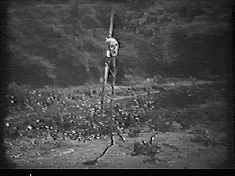
Cut back to the lab. Aware that we have over an hour left to kill, the actors obligingly take long pauses between lines. (See IMMORTAL DIALOG.) This is a ‘character’ scene, meant to eat up some time at minimum expense. It’s also to show us that our heroes are Regular Joes, not some damn effete eggheads. So they smoke and drink and crack jokes. To keep the scene from becoming static, the director borrows a page from John Frankenheimer’s book and continuously has the actors pace around the lab. This technique works here fully as well as it did for Frankenheimer in The Prophesy and The Holcroft Covenant. It also (duh) provides an opportunity for a particularly labored bout of expository dialog. For no seeming reason, Clark and Arnold trade fact after fact that they both already know. They note how they tried to save the Chief (Kimo’s dad), but that he was too sick. Clark says not to worry, that the natives are peaceful. Arnold, however, notes that that was "before they dropped the Atom Bomb on Nagassa [sp?] Atoll." Some might find it hard to believe that Americans would test a bomb where people might be affected. Therefore, we’re informed that a "freak typhoon" blew fall-out here, "1,500 miles" from where the bomb was detonated. Still, we’re a caring folk. So these scientists from the "International Foundation" were dispatched to investigate the remote possibility that atomic fall-out might adversely affect the locals. Luckily, though, that unlikely possibility has been officially ruled out. It’s the Black Plague that’s causing all the trouble, all right. "We’ve checked the radiation on this island," Clark notes. "Hardly any more than an ordinary dental x-ray." Yes, a dental x-ray that keeps going, and going, and going…. But the natives, ignorant savages that they are, aren’t buying it. "I’ll tell you who poisons their simple minds," Clark explains in wince-inducing fashion. "It’s Tano, their Witch Doctor." Hmm. That seems to confirm my earlier intuitive theory that Tano is the villain of the piece. Out of nowhere, Clark opines about what’s ‘bothering’ Arnold. This, despite that fact that he doesn’t seem particularly bothered. "It’s written all over you. You’d like to go back home, don’t you?" Next we learn (this is really one of the most shameless expository displays I can ever remember - the scene just goes on and on) that Arnold is only hanging around because he wants Dr. Terry Mason to marry him. Unfortunately, she keeps turning him down. "Why did I have to fall in love with a dedicated female scientist?" he laments, as has Man through the ages. Eddie comes in for a cup of coffee, just in time to hear a scream. Outside, Mrs. Kilgore is grappling with a native. Fetching some firearms from their rather plentiful supply, the men run outside. Finding Mrs. K unconscious, they move her into the lab. We cut back to the village, where Kimo’s been loaded into that stand-up coffin. (It seems to me that it’d be quite a bit harder to dig a grave for a vertical coffin than a horizontal one, but what do I know?) Bearing the casket, the crowd, such as it is, begins a procession. Back to the lab. Mrs. Kilgore, much to our regret, awakens. Being a comic relief character, she’s been assigned a broad, if none too convincing, Piccadilly accent. She soon conveys her news. "I saw them kill Kimo. The bloomin’ cannibals! They stuck a knife right in ‘is ‘eart! It was ‘orrible." But not as ‘orrible as her haccent, what? We soon learn that Mrs. K possesses further ‘humorous’ traits. For instance, she’s apparently of ‘amusingly’ low moral character. This is revealed when Arnold gives her a sip of whiskey from a glass. "Don’t be stingy at a time like this, deary!" she replies, grabbing the tumbler and gulping down the booze. Then she gets all flirty. (Hmm, they’ve already established that Prof. Clark has a penchant for the sauce. Perhaps he and Mrs. K will end up together in a second banana relationship.) Meanwhile, the villagers are lowering Kimo’s coffin into its rather un-ergonomic looking two by six foot hole. Tano drops the punctured voodoo doll into the grave. Next he tosses in a large bone [??] of some sort. He then speaks a ‘native’ incantation is what sounds like a moron’s version of Latin. "Summa Clova Nega-toro!" he chants (approximately, anyway). Dr. Arnold is then seen reminding Mrs. K that she shouldn’t go nosing around the locals’ ceremonies. (I should note that, despite the fact that Kimo supposedly had this big relationship with the medical team, none of them have reacted in the slightest to the news of his death.) She makes some lame excuse, then unpleasantly (for us, anyway) begins vamping him. Like many man-hungry middle-aged comic relief women, she proves to be a widow, twice over. "If we hadn’t heard you scream, Mrs. Kilgore," Clark interposes, "we might be burying you beside your latest lamented husband!" Yep, nobody can reassure the ladies like Prof. Clark. Next comes the most frightening (and certainly most distasteful) moment of the film. Mrs. K asks Arnold if he shouldn’t "examine" her for injuries, if you know what I mean and I think you do. He, thankfully, refuses, sparing us all a nightmare that would haunt us for decades to come. Mrs. K then talks about going back to Australia. I guess I was wrong. She doesn’t have a really bad English accent. She had a truly horrible Australian accent. She gets back around to Kimo. This allows our Heroes to finally express some extremely tenuous regrets about his death. Their responses seem especially slight given that Kim was largely killed for hanging out with them. Instead, they mostly seem sorry that their one link to the villagers is gone, rather than mourning him as an individual. The scene ends with Clark noting that he’ll request more help in his next report to Washington. Apparently, he requested the assistance of a stock footage ship, since that’s what we see next. Hmm, perhaps not, given the stock footage helicopter that takes off from it. The copter lands and Terry Mason (no, not the lawyer) disembarks. I know what you’re thinking. Hey, what the heck, she was already in the movie. Well, the experienced Bad Movie buff knows that producers on a shoestring will often begin a film with a scene from the middle, and then repeat it again later. So that prolog bit before the opening titles should more or less be ignored for now, as it hasn’t ‘happened’ yet. Eddie and Dr. Arnold hop in their jeep and drive over to pick up their new associate. On the way, they pass a skull mounted on a stick. An ominous music cues lets us know that this isn’t one of those good skulls on a stick. It turns out that this totem marks the spot where the villagers buried Kimo’s coffin. Mere seconds after the car passes by, we see the dirt start to heave… You know, I have to wonder where they got the skull, the one propped on the stick. It’s not Kimo’s. This arrangement doesn’t seem very practical. I mean, if they mark every grave with a skull, then you need two dead people for every, uh, dead person. Perhaps they order them from a medical supply house.
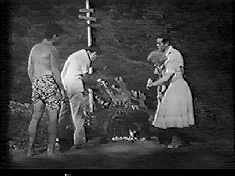
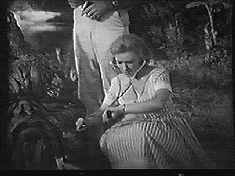
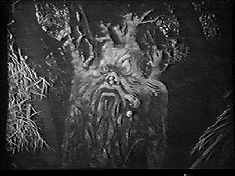
Arriving at the landing field, Arnold hops out and kisses Terry. When she laughs at his fervor, he notes that "At times a violent chemical reaction sets in." "May I prescribe a cold shower?" she laughingly replies. This, apparently, is ‘doctor’ humor. Terry is surprised to learn that Arnold didn’t specifically request her. (No, it’s all just your typical movie coincidence.) To the contrary, he’s worried about her being sent to such a potentially dangerous spot. To illustrate his concerns, he points to four glowering natives, whom Terry hasn’t noticed. Given the camera angle, these must be standing all of about ten or twelve feet away. I hope Terry isn’t the kind of scientist who’s required to ‘observe’ stuff. Despite Arnold’s concerns, Terry refuses to leave. I don’t know why he’s complaining. After saving her from a monster, she’ll almost have to marry him. (Oops, hope I didn’t blow anything there.) They drive back to the lab, failing to notice the still heaving, cracked dirt in the road. (Apparently, they’re both the non-observing kind of scientists.) Clark comes out to greet their new arrival. "Welcome to the Island of Forgotten Scientists," he joshes. Admittedly, though, the phrase ‘Movie of forgotten actors’ more readily comes to mind. Mrs. Kilgore, still hanging about, takes Terry over to her surprising large quarters. There they meet Orchid, a half-Dutch outcast native girl. Mrs. K takes her leave. We next see Terry using the camp’s outdoor shower stall. In the ‘50s, this is what passed for ‘sex.’ I mean, if she’s in the shower, she’s probably naked and all. Hubba hubba! As we cut up to Terry’s head, we see that she’s wearing a towel wrapped around her hair. I don’t know why I mentioned that. It just seemed odd, seeing how she’s showering and everything. Meanwhile, she wastes our time gleaning some useless expository dialog from Orchid. As Terry finishes, she moves is such a way that I think we get a quick flash of her nipple. It’s hard to tell, but if so, it’s hot stuff for a ‘50s flick. (Perhaps this was intentional. The producers might have hoped that hot-blooded teenaged boys would pay to watch the film over and over trying to ascertain that very thing.) Arnold comes by and catches Terry in her towel. Fans of Fiend Without a Face may recall the hero of that film catching that movie’s heroine in a similarly ‘compromising’ situation. Terry tells him that she’ll be over once she’s dressed and he departs. Arnold’s in the lab when villager Norgu appears with a native girl at his side. Norgu notes that he was Kimo’s best friend, and that he shares Kimo’s respect for Our Heroes. (Yeah, and look where it got Kimo!) The woman is Dori, Norgu’s wife. She’s supposedly suffering from the plague, although you couldn’t tell it from me. Arnold examines her and notes that her appearance is improved. (I’ll say!) Clark, meanwhile, urges Norgu to get as many of the sick villagers as possible to come see them. All of which raises the questions, when did we develop a cure for the Black Plague? Did I miss this? Terry enters and at Arnold’s request examines Dori. "From the look of her scar tissue, it seems to be responding to your treatment," she declares. (Does scar tissue really ‘respond’ to treatment?) I guess she’d know, for, as Arnold notes, "Terry, you specialize in dermatology and the removal of excessive scar tissue." Frankly, I would have thought that Terry already knew that. "Have you any ideas?" he continues. "It would help our situation with the natives if we could speed up her recovery." Uh, let me get this straight. Because it seems like Arnold is asking for Terry’s help in ‘clearing up’ the scar tissue. Now, I’m no medico, but if I were treating victims of the Black Plague, this wouldn’t be my first priority. Terry, however, does have a suggestion. "Let’s try Formula X-47," she replies. She used this at her last posting to "rebuild human tissue destroyed by jungle rot." (Uh, ye-aah.) She has some of this stuff in her effects, waiting to be unpacked. Arnold asks Norgu to bring Dori by the next day. Norgu and Dori, who’s yet to utter a single word during all this (presumably they’d have had to pay her more if she had a speaking role), take their leave. Next comes the funniest line in the movie. Clark notes that progress with the natives is slow in coming. "Their superstitions are so deep rooted," he notes. Given the premise of this film, I think that’s pretty wry. I suppose it might have been an intentional gag on the part of the screenwriter. Yet nothing else here suggests that he’s capable of such drollery. We cut over to the village. Korey, Kimo’s ex, walks over to Maranka and tries to embrace him. He responds by shrugging her off. "It was for you," she stiltedly expositories, "that I helped kill Kimo, my husband." It last bit is presumably to remind confused (or freshly awakening) viewers of who Korey is. She tells Maranka that since they got rid of Kimo, "the fire of your love has grown cold." We learn again that it never pays to love a double-crosser, as Maranka blows her off. After all, she already betrayed one husband. So why should Maranka trust her? Korey tries the obligatory "remember, I know you’re a killer" blackmail deal that morons in these things inevitably try. When are these people going to learn that reminding a killer that you could expose them isn’t the brightest thing in the world? Korey is pissed because Maranka has been shacking up with Naomi. Do we really need to introduce yet another extraneous character at this point? Other than providing another potential victim for Tabanga (should it ever elect to show up), what’s the point? Speak of the hussy, Naomi is no sooner mentioned than she appears and begins cozying up to Maranka. "I picked the poison berries for you," she blares in a harsh and blatantly American accent. We catch up with Arnold and Terry (wearing a dress!) taking a romantic stroll through the jungle. He gives her a flower, which he notes is "almost as lovely as you are." Unfortunately, he fails to quit while he’s ahead. Instead, he follows up with the rather inscrutable statement that "I want to fill your head every morning with jungle flowers." He then attempts to kiss her. Terry, knowing that if he does they’ll have to get married (this being the ‘50s and all), turns her head and walks away. They end up sitting by a log. (Freud!) Bill asks her if she doesn’t want a husband and children, "like other women?" Cornered by his inescapable logic, she allows him to kiss her. She then tries to weasel by claiming that her kissing him back was "unconscious, involuntary." Much like watching this movie. This leads Arnold to utter the classic line, "Terry, will you stop being a doctor first, and a woman second?!" Just in case this doesn’t get him in enough trouble with modern audiences, he urges her to "Let your emotions rule you, not your intellect!" Terry replies that she lives by her intellect, proving that she still needs someone to remind her what being a woman is all about. She suddenly pauses, staring off into the distance. (I know the feeling.) We cut to a skull on a stick, which is quivering and then topples over. "Isn’t that the native cemetery that Orchid was telling me about?" Terry asks. "That’s where they buried Kimo," Arnold confirms. OK, where to start. First of all, why, within her first couple of days on the island, would Orchid and Terry have been yakking about the native cemetery? ("Oh, and another great place to meet cute guys is the graveyard! Giggle, giggle.") Second, it’s quite obvious that this clearing in no way matches the road in which we previously saw Kimo’s coffin as being located. And in case you were wondering, yes, the graves all seem to be marked with skulls on sticks. Still, I think I have an answer for the whole skull conundrum. Remember Night of the Living Dead? The film starts with Barbara and her brother Johnny driving to a cemetery to visit their father’s grave. As the cynical Johnny lays a Styrofoam cross down near the headstone, he notes that all the crosses they brought on earlier visits are missing. He muses that the store that sells them must come and collect the old ones at night. Then, after a bit of cleaning up, they re-sell them. He posits that they might well have laid this exact same Styrofoam cross here over and over again. Well, Terry’s attention was grabbed by one of the old skull-on-a-stick units keeling over. Obviously, Johnny’s theory applies here was well. As soon as an old skull-stick falls down, the village undertaker reclaims it and sells it to the next bereaved party. This way, everybody gets ahead. (Sorry.) Terry says that she’d like to see Kimo’s grave. Gee, that’s romantic. Arnold, however, confirms that the cemetery is "taboo territory." Now, if the graveyard is taboo, why does it have a road running through it? (Which now it clearly doesn’t, anyway.) "Who’s afraid of the local Medicine Man?" she asks, and off they go. Considering Arnold’s constant moaning about their bad relationship with the natives, this seems somewhat odd. At the gravesite we see a largish branch stuck into the ground. This is identified as a "stump," which is "breaking the ground around the grave." By the way, you can now see the grave from the angle we saw it during the earlier ‘drive by’ scene. I can definitely confirm that its current location is completely different. In the earlier shot the scenery beyond the grave was forested. Here there’s a stony formation in the background. Also, whereas before the skull stick was solitary, Kimo’s grave is now surrounded by them. I have to admit, they find the whole ‘stump’ thing a lot more intriguing than I would. In fact, they immediately head back and show a sketch of this ‘mysterious’ growth to Clark. He is, we’re told, "an expert on jungle trees and plants." Never leave home without one. Pondering how it’s possible for a tree to sprout from a grave (don’t they have anything better to do?), Clark sagely notes that "Science doesn’t have all the answers yet." This scintillating conversation is cut short by the arrival of Norgu and Dori. Norgu already knows about the stump. Flustered, he explains that "Kimo’s curse is coming true." Which is odd, because I don’t remember him cursing an audience to watch an extremely silly movie. Perhaps he means the "I’ll get revenge from the grave" curse. Norgu sees the sketch and exclaims that the stump is what he’s talking about. Despite being ridiculed, Norgu goes on to relate how a great chief was once treacherously murdered. Legend has it that he came back as a tree-monster, and demanded that Dorothy stop stealing his apples. Oops, sorry. Wrong tree-monster. This tree-monster, called a Tabanga by the villagers, roamed the island committing various acts of mayhem and such. Arnold asks what ‘Tabanga’ means. I waited for Norgu to roll his eyes and answer "tree-monster - duh!" Instead, it translates as "Creature of Revenge." (Ooh, spooky!) Just then Orchid bursts in. She’s been by the graveyard, which seems to get a lot of traffic for a taboo spot. There she saw a large stump with a ceremonial dagger sticking out of it growing from Kimo’s grave. She maintains that the stump had "green stuff coming from it, like green blood from a dying man." Which makes me wonder exactly how many dying men she’s seen. [Editorial note to Star Trek Geeks: Insert your own ‘Vulcan’ joke here.] At this point, our heroic scientific team finally decides to get off their duffs. Here the film’s Goof-o-meter™ reading goes off the chart. Buried above the grave we see a rather silly looking tree-man buried about chest high in the dirt. He sports an exaggeratedly horrid visage and, sure enough, the knife that killed Kimo is sticking out of its chest. Terry, listening to it with a stethoscope (!!) confirms that it has a heartbeat (!!!). Arnold, meanwhile, notes that it’s getting a high reading off his Geiger counter. (I guess that stethoscopes and Geiger counters are standard equipment when investigating bizarre tree stumps.)
Terry confirms that the tree’s heartbeat "tallies with the lateral pulse!" As if we doubted it! Meanwhile, no one sees fit to mention that they’re all squatting around a highly radioactive object. Perhaps Terry hopes that if Arnold is rendered sterile he’ll stop bugging her about the whole marriage thing. "It’s a human heartbeat!" Terry continues, which, obviously, it isn’t. In any case, do ‘human’ heartbeats really sound that different from, say, animal heartbeats? They then attempt to procure a sample of the green ooze around the knife. ("It’s probably the equivalent of blood, the stuff that keeps it alive," Clark notes, making perhaps a few more assumptions then I would in his place.) The ‘blood’ causes the Geiger Counter to go nuts. "Stand back!" Clark warns, moving all of maybe six inches further away. Norgu warns that the Tabanga will soon free itself from the ground. Clark scoffs at the patently ridiculous notion that this half-buried radioactive Tree-monster with a human heartbeat growing from Kimo’s grave is just going to heave up and start walking around. Where do these silly natives get their ideas, anyway? Norgu pleads for them to destroy the Tabanga while they still can. However, if scientists ever acted like that, then about 40% of all sci-fi movies would cease to exist. Instead, needless to say, they decide that this thing must be studied for the good of Science. However, being a woman, Terry does mention an intuitive "eerie feeling" about the whole (weird radioactive Tree-monster with a human heartbeat) thing. The scientist heads back to the lab, and we now replay the scene from the beginning of the movie. (Told you!) So presumably it’s been a while since the last scene, given that Clark gets that wire about the Tabanga from Washington. Just in case you forgot:
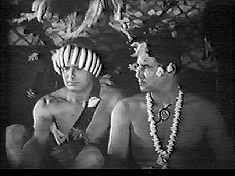
We cut to the village, where Maranka and Tano are hatching further evil plots. Maranka feels that Norgu should die along with the Americans. Tano agrees, but urges caution. He then reveals a plan that is surprisingly sophisticated for this sort of film. He has some potion or other that when applied to the still growing Tabanga will ensure that it becomes his slave. Killing at his command, the creature will secure Tano’s power. Norgu will be the Tabanga’s first victim. (In case you’re wondering where he got the recipe, Tano notes that it’s from a ‘spirit.’) Maranka reminds him that Korey must also die. You’d think that Maranka would be a bit wary of Tano having control over an indestructible monster. If so, he’s not mentioning it. Meanwhile, it turns out that Korey is eavesdropping on their conversation. Hearing her death sentence, she runs off. Korey appears at the door of the lab. Seeing her, Arnold calls Norgu out. Korey, frightened for her life (and still choleric over that ‘Naomi’ thing) has decided to rat Maranka and Tano out. If she thinks that this will keep her from reaping her just desserts at the hands, er, branches of the Tabanga, well, she must not have seen many cheesy sci-fi/horror flicks. Clark gives Korey permission to stay at the compound, and suggests that Norgu and Dori stay also. Meanwhile, the Tabanga is to be dug out and brought to the lab that evening. That night (you can tell it’s night, because they’ve dubbed in cricket sounds), our heroes congregate around the Tabanga. While still partially buried, it has now sprouted up enough so that the dirt is down around its, uh, ankles. Oddly, no one remarks on this, despite the fact that it seems somewhat curious. Nonchalantly, they begin to dig. Now, there’s no way that they can realistically show this thing being removed and transported. So it’s no surprise when we just cut away to it lying on the lab’s examining table. The scientists crowd near, sort of ignoring the whole ‘radioactivity’ issue. Terry notes that Clark brushed the knife still imbedded in it during the "operation." The Tabanga almost seemed to move, she continues, as if it were in pain. (Plot point!)
Terry suddenly notes that its pulse is slowing down. "It’s dying!" she exclaims. (There’s a little rubber bit on the monster’s chest that pulsates. This has been used to clue us in on the fact that the Tabanga’s alive, although none of the characters have mentioned it. In any case, as Terry announces that it’s dying, we see that the pulsations become weaker.) Terry posits that its fragile condition may be due to "a clog in the aorta." [?!] The guys both immediately appear ready to toss in the towel. Terry, though, like all ‘50s female scientists, is spunky. She continues the fight to keep it alive. "Couldn’t we try to energize the adrenal gland with an electro-resister?!" she queries. Well, duh. How did Clark and Arnold miss that one? Boy, should they be embarrassed! Arnold replies that he finds Terry’s interest in this thing morbid. Terry retorts that he should start thinking like a scientist instead of worrying about the native’s silly superstitious taboos. (Uh, would those be their silly taboos regarding inexplicable quick-grow radioactive Tree-man monsters that sprout up out of murdered people’s graves?) I think she’s trying to say "Stop acting like a villager-taboo-loving guy first, and a scientist second." Despite this plea, Clark and Arnold crack wise and decide to give up. (Their generators, we’ve been told, won’t produce enough juice for the electro-resister idea.) Terry remains quite spunky, however, and goes over to the lab’s refrigerator. She removes a serum box and returns to the table. Clark examines the bottle she’s retrieved. "Formula 447," he notes. You know that it must be powerful, because that’s almost forty formulas higher than the one you scrub counter tops with. (OK, why is one formula designated ‘X-47’ and the other ‘447’? What does the ‘x’ stand for? And what mysterious power does the number ‘47’ hold for the screenwriter?) Clark asks about this new formula. "I’ve experimented with monkeys and parrots who’ve been exposed to a dangerous amount of radiation," she helpfully explains. "This formula’s achieved miraculous results in recreating heart action." Well, I can’t argue with that. It probably cures the ague, too. It’s lucky, though, that Tree-monsters are so similar to monkeys and parrots when it comes to recreating heart action. She notes that they’ve yet to try it on humans (like that’s applicable to this situation). Furthermore, "It works very slowly. It takes several hours to show any effect." At least, it did when it was tested on parrots and monkeys. Therefore, she seems to be implying, it’d be the same with Tabangas. Does anyone not see where this is going? You know how in James Bond movies the villain always has to leave before personally seeing to Bond’s demise (usually because he’s wasted so much time explaining his entire plan to him)? Then Bond takes advantage of his absence to escape from his inept henchmen? Well, who wants to bet that they shoot up the Tabanga with 447 and then leave while waiting for any effects to show. And then when they return…*gasp!* They hook up an I.V. bottle. (Because a hypodermic needle wouldn’t penetrate its bark, see?) Yet even with the contents nearly emptied into the creature, its heartbeat continues to fade. At this, even Terry gives in. Besides, her calculations indicate that even were the formula to work, there’d be no visible results for another eight hours. They all head to bed after agreeing to meet back here in the morning. In an extravagantly arty shot (for this kind of thing, anyway), the camera slowly pans around the empty lab until it lands upon a clock, showing it to be ten at night. There’s then a fade to the clock registering ten to six the next morning. Then the pan reverses itself, to reveal that the lab’s been trashed and the examining table is empty. For some reason, a snake (presumably a lab subject) is seen hanging from a light fixture. Ooh. Eerie. In perhaps the film’s comic highlight, we now cut to a meadow. Here, for the first time we see the Tabanga lumber around. (Sorry, I couldn’t help myself. Hey, maybe he’s board! OK, I’ll stop that now. But, hey, really, that Tabanga’s a superior monster, isn’t he? What? How can you tell? Why, because he’s out standing in his field! Out-standing in his field! That’s all for me. Good night, ladies and gentlemen!)
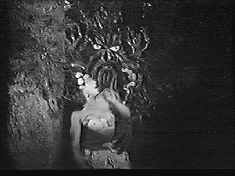
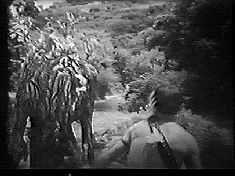
The monster suit looks quite a bit goofier when ambulatory, not least because they rigged the mouth to continuously open and close when it’s in motion. The ‘lip’ movements, surrounded by otherwise static features, inevitably call to mind those old Clutch Cargo cartoons. Presumably, the filmmakers thought that some ‘facial’ movement would add verisimilitude. If so, this aren’t the facial movements they needed. Back at the lab, Our Threesome arrives simultaneously at the smashed-up lab. Given the size of the compound, and the fact that at least eight people are staying there, you have to wonder how the Tabanga managed to create such havoc without awakening anyone. Terry’s aghast, because she was sure that her calculations were correct. As hard as it is to believe, one of the variables she used to calculate the effects of an experimental formula on a radioactive plant monster must have been off. To make the scene even sillier, Clark pipes up with a theory. Terry confirms that the monkeys treated with the formula took much longer than one night to fully recuperate. Clark posits that it must work the same way with a Tabanga. (It was on this basis, of course, that monkeys were used in clinical tests to assess the carcinogenic potential of red dyed M&M’s to Tabangas.) He believes that Tano and his bunch wrecked the lab and stole the Tabanga. Which isn’t a totally inane hypothesis, actually. Oh, we have one more de rigour scene to get out of the way. Just on the chance that the Tabanga’s for real, Arnold notes that they’d better radio for help. Anyone who guessed that they then found their one and only radio all smashed up gets two points. We cut to Naomi partaking of an idyllic swim in a local lake. She emerges from the water and begins dressing. Meanwhile, Korey appears, lurking nearby. (Actually, I couldn’t initially tell which of these characters were Korey, Naomi or perhaps even Orchid. I started this paragraph about three times before figuring out who was who.) Naomi is heading back to the village when she’s intercepted by Korey, who’s seeking revenge. Korey pulls a knife on Naomi and we are soon treated to what has to be one of the three worst fight sequences I’ve ever seen in my life. These two grapple with exaggerated caution, as if the other was covered with quills and they didn’t want to get scratched. Meanwhile, we wait for someone to fall into the conveniently placed quicksand patch in the foreground of the shot. (In one of the weirder cheesy movie conventions, the ‘quicksand’ is in spots bubbling and giving off dry ice vapors.) In the fight’s best bit, Korey is chasing Naomi with her knife. Naomi ends up blocked by a tree, and we think that this is it. However, at last second, she ducks and Korey runs into the tree. The problem here is that both of them are ‘running’ at about quarter speed. It’s like they filmed the actors blocking the scene rather than acting it out. Perhaps the film is trying to imply that the natives of this island just run very poorly. This would help to explain how anyone could be caught by the less than fleet Tabanga, who joins the ranks of monsters that you could escape by utilizing a brisk walk. Despite having hit the tree at a speed of twenty yards an hour, Korey finds her knife imbedded deep into the tree trunk. I’m sure this ‘means’ something, since the Tabanga has a knife stuck in his chest, but I can’t figure out what. Perhaps it’s meant to be ironic. Naomi, meanwhile, runs off to collect a fairly unimpressive dead branch to use as a weapon. It’s the kind of thing you’d use as a switch if your kid got into Old Man Meyers’ watermelon patch again. Naomi lightly smacks her tormentor with the stick, apparently [*ahem*] knocking her unconscious. This, conveniently, occurs just as Tabanga appears from around the tree. This sets up The Tabanga Maneuver™. This is the procedure by which awkwardly constructed monsters capture women. Since many of them aren’t very bendable, they tend to sneak up on women. Said woman then providently faints directly into their arms, or tentacles, or branches or whatever. Here Korey has been knocked unconscious rather than fainting, but it’s roughly the same thing. You know, it’s hard to ascertain expressions when a monster’s face is immobile. Still, I can’t help feeling that along with the hatred and the anger and the blind thirst for vengeance, that perhaps the Tabanga’s also feeling some sad affection for his ex. Perhaps he’s begun to pine for her. (OK, that’s a long way to go for such a lame punchline, but what can I say?) Anyway, the exact rules of The Tabanga Maneuver must be observed, I guess. So Korey awakens to find herself trapped in Tabanga’s embrace, upon which realization she, that’s right, faints. The poor guy stuck in the Tabanga suit then laboriously hauls her over to that ‘quicksand’ patch I was talking about, which is still merrily bubbling away. He drops her in. Korey awakens, starts screaming, and obligingly swims further out into the quicksand. Otherwise, we’d wonder why she doesn’t climb out onto the solid ground that lies perhaps an inch from where she landed. (Encumbered by the suit, the Tabanga guy could only drop her straight down, as opposed to actually tossing her. This results in her landing right by the edge of the pit.)
A terrified Naomi, meanwhile, has made it to the village. She warns Maranka that the Tabanga has made an appearance. (There’s a sentence I never thought I’d write.) "Well, how do you know it was Tabanga?" he asks. An astute question, my friend. Perhaps it’s a confused Ent who’s lost his way. "Because it…it looked like a tree, and it had eyes, and hands," she answers, "and a knife was still in its heart, like Kimo’s!" Hmm, yeah, that last part does narrow it down a tad. Tano comes sauntering over. Maranka informs him of the news. Tano stares steely-eyed at Naomi. "Are you sure it was the Tabanga?" he inquires. (OK, unless false Tabanga sightings are rife in this village, this line of questioning is becoming rather silly.) Tano figures that the only way to be sure is to go to the cemetery.
Tano views the grave and quickly affixes the blame for Tabanga’s premature removal on our heroes. "This is dangerous," he discerningly notes. Now that control of the Tabanga is out of the question, Tano decrees that it must be killed. The village’s bravest hunter (out of what, twenty people?) must be put to the task. After that, it’ll be the scientists’ turn. Tabanga, meanwhile, is making an appearance at the village. Perhaps it’s just seeking out its roots. Or maybe knot. It ‘stealthily’ (you can image how realistic this looks) begins to sneak up on Maranka, who’s occupied honing his spear. (And no, that’s not a euphemism, you perverts.) Maranka somehow becomes aware of his silent stalker and spins around, spear at the ready. Proving to be a strategic genius, he backs up into a tree. Then he proceeds to chuck his spear over the head of the Tabanga (!!), which is standing all of maybe three feet in front of him. Veteran Jabootuists will be reminded of an even more remarkable such display, which occurred in the seminal The Last Dinosaur. There, Bunta, the "world’s greatest tracker," similarly managed from extremely close range to toss his spear over the head of that movie’s T-Rex. Of course, now that Maranka’s wasted his spear, that ‘backing into the tree’ idea looks even more inefficient. Especially since, as noted, a brisk saunter would have guaranteed escape. Exit Maranka. (How the heck did this loser ever get to be Chief? In a village this size, there must have been two or even three other guys who could have taken the job.) Tano and Naomi return to find the village council (so I assume; there must be ten people and at least five chickens in attendance) having a panicked meeting. One guy asks Tano why he didn’t destroy the ‘Tabango’ when he had the chance. Tano blames everything on the Americans, and not entirely without cause. (Not that he ever intended to destroy it in any case.) Orchid, who ‘happened’ to be at the village, despite the fact that we were earlier told that she was an ‘outcast’, returns to the labs. There she informs Clark of the Tabanga’s rampage, such as it is. Terry’s first reaction upon hearing that the Tabanga lives is a delighted "I knew my formula would work!" (Again, these guys seem to take an awful lot about Radioactive Tree-Man-Monster biology for granted.) She’s somewhat brought down by the news that it’s killing folks. "I just wanted it to live, not to destroy," she replies. Man, there it is. The same, tired old excuse that scientists trot out whenever their creations go awry. Boo hoo, lady. But if you think that’s going to get you off the hook when the villagers launch a class action suit on your ass, well, you’ve got another thing coming. Arnold lamely tries to console her. "Don’t blame yourself, Terry. The radiation dormant in the monster must have set off a chain reaction." Uh, yeah. Sure. OK, even assuming that Arnold’s theory is true (or made any sense), that would relieve Terry of responsibility…how exactly? Meanwhile, the natives are creating a Malaysian Tiger Trap. This is your standard pit covered over with foliage. Sharpened spikes at the bottom are optional. Tano, surprisingly, is brave enough to use himself as bait for the trap, knowing that he’s to be the Tabanga’s next victim. B Movie villains usually don’t have any positive traits, so his willingness to put his neck on the line is somewhat remarkable. The others hide. Tano strolls around in the open, inviting Tabanga’s attentions. Sure enough, the beastie soon makes an appearance. Tano allows him to draw close, and then lures him over to the pit. The Tabanga continues forward and stumbles into the trap. Seen from the inside, the pit appears to be at least ten or twelve feet deep. Therefore, it seems almost certain that it’s a natural crevice of some sort. This makes me wonder to what extent, if any, the Tabanga retains Kimo’s memories. Wouldn’t he know the island pretty well? The Tabanga tries to get out, but can’t figure out how. He’s stumped. Actually, as soon as he’s in the pit, the other villagers run over and toss torches in with him. Soon a pretty massive blaze is roaring. Tano declares the Tabanga doomed and the villagers leave. Needless to say, the next shot, after the fire is out, shows the Tabanga emerging unscathed from the hole. Unexplained is exactly how this awkward creature managed its escape, or why it didn’t burn. The Tabanga pretty much just rises straight up from the pit, almost as if it were being raised on a platform or something. Two villagers are walking through the woods and spot the Tabanga (although not until they’re almost right on top of it). They run off and head for the lab. One villager, one an extraordinarily bad actor who attempts to speak with a ‘native’ cadence, explains how the fire idea didn’t pan out. They ask the scientists for their help. Mrs. Kilgore shows up, looking for protection. Clark condescendingly speaks the classic line, "You two girls stay here." Mrs. K is having none of that though, nor is Terry. And, duh, they’re right. Everyone’s safer staying together, you’d have to think. On the other hand, Mrs. K also asks for a gun. She doesn’t know how to use one, she says, but would feel better having one. This, unlike staying together, is not a good idea. As a sop to the men’s egos, apparently, they take rifles while the women just get pistols. Out in the woods, a surprised Tano has met up with the Tabanga. Rather than turn and safely walk away, he moves slowly backward. Whereupon he trips over a log and smacks his head on a rock. At this point even the Tabanga can catch up with him. Actually, with Tano lying on the ground, the Tabanga wouldn’t really be able to reach him. So we see the creature bend over as far as the suit will allow, and they dub in Tano’s scream. I personally think it would have been easier to have the Tabanga step on him and crush him, but what do I know?
The Tabanga takes Tano (I guess he’s still supposed to be alive, although there aren’t any signs of that) to the top of a hill. He then drops Tano, whose body rolls to the bottom of the incline. There it somehow ends up being impaled on a big root or extremely low tree limb or something. Exit Tano. You know, I just noticed (while doing a final edit of this piece) that trees are involved in the deaths of each of the Tabanga’s victims. Korey ran into a tree and was knocked out. Maranka backed into a tree and was trapped. Tano trips on a log. I’m assuming that this is supposed to ‘mean’ something, but what? Soon Our White Heroes are hunting for the Tabanga, with the two villagers at the lead. I know that this is a movie and all, but were there really South Pacific tribes that were still using spears in 1957? (Or lived in wicker huts, for that matter?) It seems like they could have procured themselves some firearms by then. Unbelievably, the group manages to leave behind Terry, who’s stopped to remove a stone from her shoe. (She was in the back with Mrs. Kilgore, who’s so busy yammering that she doesn’t notice Terry’s absence.) In the few seconds it takes to remove and shake her shoe, the group has left her field of vision. Needless to say, once she stands up we see that the Tabanga is right behind her. In a prime example of the Stealth Monster Rule™, Terry stands next to the Tabanga for a ludicrously long time before noticing it. Only when it grabs her does it earn her attention. Then she screams and, naturally, faints.
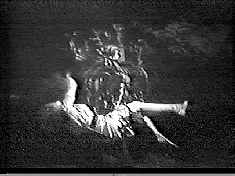
I suppose the fact that it’s tree-like was supposed to have camouflaged it somehow. However, there wasn’t a tree there five seconds ago when Terry reached down for her shoe. Besides, the skull-headed knife sticking out of its chest is all of perhaps six inches away and directly in her line of sight. Earlier, it was implied that the older Tabanga of legend slipped away into the quicksand once its mission of vengeance was completed. This one, of course, decides to grab and carry off our heroine. It’s just that way things are done, old boy. At this, the other scientists, trained observers after all, finally notice Terry’s absence. They retrace their steps as the Tabanga inevitable carries Terry off in its, er, arms. However, a shoe is conveniently dropped. Presumably, this is so that when Terry disappears at midnight, the Tabanga will be able to find her again by seeing who can wear it. (Hey, that would make it a ‘shoe tree’! Sorry.) Actually, I’m wrong. It’s the group who finds the shoe, and uses it to follow the Tabanga and Terry. Although by the time they’ve found it, the Tabanga’s had about five minutes to head off into the heavy brush. So I don’t know how it can really help them in their pursuit. It turns out that they hear Terry scream, and locate her that way. So much for the carefully set up ‘shoe’ thing. It also proves that Terry must have unusually powerful lungs. Terry continues screaming while raining the Tabanga with those little blows that girls hit monsters who are carrying them with. The group hunts down the Tabanga right near (that’s right) the quicksand patch. I expected the obligatory "don’t shoot - you’ll hit the girl!" bit here, but was surprised. Instead, Arnold tells Eddie that he’s got the best shot, and only asks if he thinks he has enough light. Oddly, though, Eddie kneels to take his shot from about must be twenty or thirty yards off. Of course, Eddie might be a crack shot, and he is sporting a rifle (although it’s an M-1 military rifle, rather than a scoped hunting rifle). But my point is, look, the Tabanga’s an extremely slow creature. And it’s ability to counterattack is stifled by having its arms full. So why not walk right up behind it, angle your gun so that the bullets can’t possible hit Terry, and just unload. They could even walk up and use gunfire to blow its legs to shreds. Except, of course, that this would violate The Avoid the Limbs Rule™. (No character can ever deliberately aim for a monster’s legs in an attempt to disable it, even if gunfire is otherwise incapable of stopping it). Arnold has a silly idea, telling Eddie to shoot for the knife head (man, he must be a very good shot). Maybe driving the knife in deeper will harm the creature. Why a knife that’s already sticking into it would kill it were it driven deeper isn’t explicated. Also, cliché or not, I’d be very worried about the possibility of blowing a sizable hole in Terry if he misses. Especially from this range. It appears that the Tabanga is planning to chuck Terry into the (still smoking) quicksand patch. Eddie notes that it’ll have to turn around if he’s to get a shot at the knife. They try to get its attention by firing a couple of round into it. This fails to get the creature’s attention, however. "Doc, I never saw anything like it," Eddie exclaims. (No duh.) "These bullets bounce off like BB shot on a stone wall!" Now I know that the Tabanga’s a supernatural creature of sorts. But why is it fireproof, and why is it bulletproof? I mean, I could see if the shots did minimum damage, like they would to a real tree. But ‘bouncing off’ is a completely other matter. Still, it’s about time to end the movie. Also, they can’t let movie’s heroine get killed. That kind of stuff didn’t happen until the ‘60s. So the Tabanga just drops Terry for little apparent reason and turns around. The team unleashes a fusillade of shots, finally managing to hit the knife. This indeed apparently has a fatal effect on the Tabanga. (You know, it’s nice when monsters come equipped with their own off switches.) It tumbles back, naturally, into the quicksand and sinks. Exit Tabanga. Arnold runs forward and embraces Terry. I guess we’re to assume that she’s going to marry him now, although nothing has really changed. Meanwhile, one of the villagers turns to Clark and admits his inferiority. "We know now that American magic is better." Yeah, the American Indian tribes learned the same thing. Only they decided that meant fighting the Whites with rifles rather than bows and arrows. These guys are a lot more docile, though. So they ask Clark to replace their dead medicine man ‘Tonto’ [sic]. After that, Mrs. Kilgore makes her own comical advances to Clark, under the ‘second male/female lead’ rule. On this jovial note, our feature ends. Alas, this proved to be the only cinematic appearance of our friend, the Tabanga. And so we bid adieu to one of Sci-fi’s greatest creations. Too bad it’s not around to take a bough. TABANGA JOKES I DIDN’T GET TO USE: Q: Why did the Tabanga open a second business? A: He wanted to branch out. Q: How can you tell that a Tabanga’s constantly ready to travel? A: He’s always got his trunk with him. Q: Why did the gold-digger cozen up to the coniferous Tabanga? A: She was hoping for a fir coat. Q: What do you say about a Tabanga who acts tough but refuses to fight? A: His bark’s worse than his bite. Q: What did the car-pooler say to the deciduous Tabanga? A: Drop me off here. Q: What’s the coniferous Tabanga’s favorite Barbra Streisand song? A: "Memories," from Cats. But if it was "Evergreen," that’d be kind of funny. IMMORTAL DIALOG Dr. Arnold and Professor Clark enjoy a drink and have a little fun at the expense of the Fuzzy-Wuzzies. Arnold: "You better lay off that stuff, Professor. You’ll wake up in the morning with a hangover, but the drums will still be here." Clark: "The drums don’t bother me, Doc. As a matter of fact, they have a nice anthropological beat." Arnold, master of the wry observation: "Well, maybe we ought to record it, get it on the hit parade!" The Dry Wit of Dr. William Arnold, the Oscar Wilde of the 20th Century: Clark, bitching about Tano: "He’s afraid of losing his patients to modern medicine. He wants to keep them steeped in their centuries-old superstitions. They worship him like some kind of high priest!" Arnold, Doctor of Bon Mot-ology: "Back in the States they don’t regard doctors that way. Sometimes they don’t even pay their bills!" ‘50s White Guy Arnold is annoyed that chickadee Terry keeps refusing to marry
him: Clark: "What do you expect from a pretty girl a few years out of med
college? [There’s a good line.] She wants excitement, adventure. She thinks
that routine is a middle age thing." Clark: "…and she prefers test tubes and a tiny Pacific atoll. Give it up! Find somebody else!" Arnold, whose name is Constancy: "I’ve tried, dozens of times." Review by Ken Begg
|