Another feature of... |
|
Another feature of... |
|
|
|
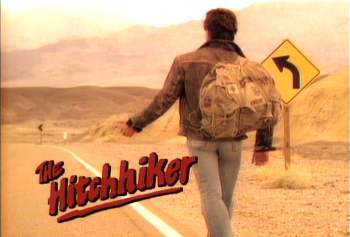
The Hitchhiker
-
Jabootu's Bad TV Dimension
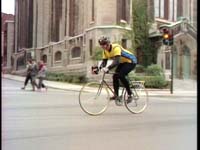
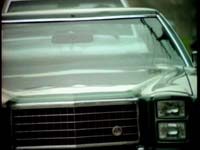
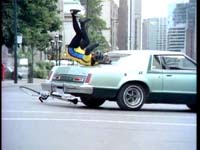
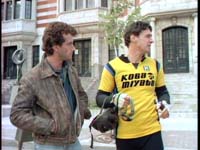
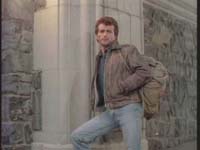
Episode: "Remembering Melody" Names : Actors David Dukes, Alberta Watson, "and SUSAN BLAKELY as MELODY". Adapted from a story by George R. R. Martin, teleplay by Alvin Sapinsley. Directed by Christopher Leitch.Set up: We open on a bustling—well, bustling for Canada—metropolis. A yuppie-ish (uh, oh) bicycle enthusiast (this was, after all, the decade of Breaking Away and Quicksilver), arrayed in yellow spandex jersey and helmet, is peddling merrily down a thoroughfare. Suddenly, a cramped camera angle inside a car shows the vehicle being put into gear, without revealing any detail about its operator. A music sting, along with the weird camera work, suggests that something sinister is afoot. Or awheel, as the case may be. Soon an outside angle confirms that the car is in fact driverless as it proceeds down the street. Oddly, despite cruising down a fairly busy roadway, no one comments or even directs any attention towards this somewhat unusual sight. Soon the automotive automaton intercepts the aforementioned peddler, resulting in the latter flipping painfully over the former. (Thus allowing a practical demonstration of the principle, to paraphrase Sean Connery, that one should never bring a bicycle to a car fight.) Looking up dazed from the tarmac, the unseated bicyclist espies amongst the crowd gathering around him…The Hitchhiker! The Hitchhiker helps the shaken but mostly uninjured man to his feet, while I ponder how weird it always is when our Host actually intrudes himself into the narrative. The Roadmaster of the Rococo explains to the man that there was no driver in the car. The angry victim unsurprisingly finds this assertion somewhat difficult to swallow, and drops the fact that he is an attorney. The latter makes his exit, thus allowing Our Presenter of Pedestrian (in more ways than one) Peculiarities to turn to the camera and deliver his traditional opening remarks.
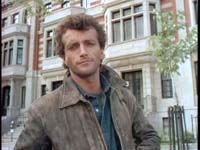
Ted returns to his apartment, helpfully leaving the front door open behind him so that the mini-cam employing cameraman can follow in his wake. Ted makes a beeline for the refrigerator, which, as he is a yuppie health enthusiast, proves to contain little other than a quart of orange juice. Indeed, a quick tour of his apartment reveals it to be similarly impersonal, sterile and unlived-in, because he’s a yuppie attorney and this is a program that isn’t known for its artfully shaded characterizations. He calls his office to explain that he won’t be in on time. Amusingly, as he paces around, the rather obvious shadow of the cameraman falls directly across his body. Ted ends up looking into his bathroom mirror, and we see that he is shaken by the incident. We cut outside, where a pretty blond woman is, I guess, standing outside Ted’s building and looking up at, presumably, his apartment. This is accompanied by mystical wind-chime music, so that we get that she’s…well, some damn thing. Meanwhile, Ted is taking a shower, as shot from above at an artful angle so that we don’t see his weiner. He does turn around, though, to give a little something for the ladies to look at. Let’s just say that Ted apparently spends a lot of time in the sun wearing only shorts. To his further annoyance, Ted’s shower is
interrupted by the buzzing of the apartment intercom. Then, when he emerges
to answer it, no one answers. Worse, his apartment doorbell rings,
indicating that someone has been allowed up without his permission. Ted
stalks to the door (where the director chooses to shoot him in close-up with
a fish-eye lens, presumably because it’s all artistic and stuff) and peers
through the peephole. The view reveals that there is no one in the hall. He
immediately throws the door open, only to find standing directly before him
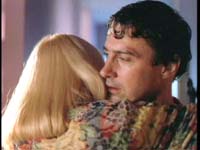
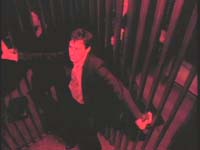
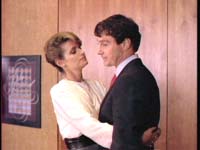
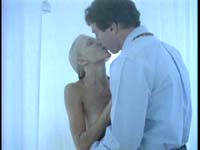
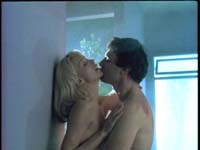
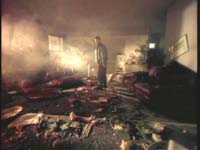
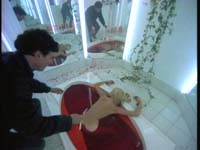
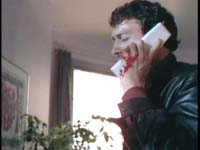
the blond woman we saw a minute ago. At this point we must sincerely hope that the woman proves to be something other than a ghost, given that we’re barely 20% into things and the show has already gone out of its way to confirm that supernatural things are afoot. Certainly such a revelation would be less than a Shock Twist at this point. A stunned looking Ted confirms the woman’s titular identify by calling her Melody. The latter, for her part, proves a chatty, burbly type with a wince-inducing Kim Carnes-meets-Betty Boop giggle. Obviously (and anyone conversant with this program will know I mean obviously) Melody represents the Chaotic Life Force Yin to Ted’s Repressed Materialistic Yang. Think Dharma & Greg, only with even fewer laughs. In any case, Melody’s characterization is quickly confirmed, in case the viewer should be a trifle slow, when she walks uninvited into the apartment and exclaims, "Far out! What a groovy pad!" No, I am not making that up. Ted is confused when Melody mentions his accident, wondering how she would know about it. Meanwhile, she removes her coat—flinging it carelessly across his leather couch—to reveal faded acid-washed jeans and a peasant blouse. She’s a hippy…get it?! In answer to his query, she explains she just deduced from his injuries that he had fallen off the bike he always used to ride around on. In reply, he notes wryly that she still dresses like a hippy, a charge she reacts to with umbrage. (??) Blah, blah. They haven’t seen each other for two or three years, etc. Ted goes to dry his hair, while we see Melody begin to collapse to the floor in some sort of distress, albeit I’m not sure whether this is meant to be emotional or physical in nature. Ted notices, and runs to her aid. Despite his evident concern, he’s also quite obviously wary of getting involved with her problems, which apparently has happened before. Melody, sure enough, explains that she is currently jobless and homeless. She relates a tale of woe, and Ted is clearly (and again, I mean clearly) seen struggling against getting entangled into her affairs. In the end, she asks if she can stay with him for a while. Having steeled himself, however, he refuses. She attempts to draw on their history together, but he notes that it was upwards of fifteen years ago that they were close. Also mentioned are a Michael and Annie, who they apparently shared a house with, presumably in their college days. He relents to the point of letting her stay the night, though, and then he leaves for work. Arriving at work in a lawyerly suit, Ted enters an elevator that features mirrored walls and blood red lighting [??]. (Man, if it turns out that he died in the bike accident, and doesn’t know he’s in Hell…) The elevator rises and then seems to be plummeting down, and Ted shrinks to the floor—like Melody—earlier and screams. However, the car arrives safely at his floor. He rights himself and disembarks, albeit in some emotional distress. He walks down the hallway of his office, as the soundtrack rings and while others address him in muted tones. Clearing his head, he makes his way to the office of Jill, another attorney with who he proves to be romantically involved. He spills to her (and us) his backstory. He and Michael and Annie and Melody indeed shared a house in college, and "were like family." Melody was the one with a steady job, and they all relied on her. "She was only a waitress, but she supported us all," he explains. That must have been a good waitressing job. Blah, blah, they made a pact, they’d always be there for each other, etc. Frankly, that sounds like an oral contract to me, and as a lawyer he should probably be ready to fulfill its terms. Jill, for her part, sees Melody mostly in terms of a romantic threat, and naturally is hostile to Ted getting re-involved with her. Here Ted starts ranting about how the younger Jill doesn’t know "how special the times," i.e., the ‘60s, were, and how they "stopped a war" (yes, and the people of Cambodia thank you), and so on. And then it’s on to how he’s now whoring himself for "mega-corporations" and yada yada. Gaak. OK, now I can’t wait to see this guy get his. Freakin’ baby boomers. Jill, for her part, has no sympathy for his guff, which I guess is meant to make her look hard-hearted, but instead pretty quickly got me on her side. We next see Ted walking down the street, and his turmoil seems even more pronounced. Then he arrives home, where soft music is playing on the stereo, and place settings for a romantic dinner are laid out on the carpeted floor. Also in evidence are various artifacts of Ted’s oh-so-groovy past, including photos and a necklace of what I can only assume, with genuine horror, to be ‘love beads.’ He dazedly dons this gruesome article, and meanders into the bedroom, where a reclining Melody is wating to provide the episode’s Obligatory Nude Scene… Actually, that hadn’t happened yet when I wrote the above sentences (I had paused the DVD as I recorded my comments), but I was just assuming. So here I must man up and admit that I was completely and utterly wrong. For Ted instead meanders into the bathroom, where a showering Melody is waiting to provide the episode’s Obligatory Nude Scene. Guess I’m not looking too smart right now, am I? In fact, for a second, I foolishly thought from the above-the-boobs camera angle that Ms. Blakely was going to escape flashing her talents for our edification. However, this instead leads to a rather tactless bit where she reaches for Ted, they kiss, and in the middle of this the camera angle visibly wanders down from their bussing faces to focus on her ya-yas. Seriously, it’s like the cameraman was like, ‘Oh, yeah, her breasts. Sorry. There you go." Still, they make up for it by providing a good, long gratuitous shot of her melons. Then, with rapturous music playing, Ted and Melody have Beautiful Movie Sex all over his apartment; on the floor, the de rigueur standing-up-against-a-wall humping, the inevitable fooling around in the bathtub, etc. Thus, having fulfilled their Nudity Obligation to HBO, the show can now unfortunately return to the ‘narrative,’ such as it is. Melody, sated, of course wants to talk, and inquires as to why Ted left her behind all those years ago. They go over the whole ‘60s thing again, and How Awesome it was When All They Cared About Was Loving One Another and Being Free and Sticking It To The Man, and then I had to pause my reportage while I cleaned the vomit off my computer screen. Anyway, he’s all "Hey, I live in the present, now," and she’s all "No, you made a promise to me, and a promise to yourself," and I’m all, "Where’s that bucket…blrughhh?" And there’s a mention of a telegram she sent him two years ago reading "It will never be any other way." Wow, man, groovy. She also says, "You could have saved me." So, you know, she’s clearly dead and everything and is here to haunt him or bore us (mission accomplished!) or something. In any case, he wisely walks out on her, and we next see him in bed next to Jill, presumably at her place. But he wakes up hearing Melody’s voice, and we cut back to his place, where she is crouching on the floor while a big offscreen fan blows wind at her. Stuff blows around, and the front door bursts open and brightly backlit fog comes rolling in, and I feared for a minute that Whitesnake was going to jump inside and start playing a power ballad. To Jill’s chagrin, Ted announces that Melody’s in trouble and that he must go to her. Meanwhile, Melody steps into the blazingly lit and befogged hallway, drops her robe (while being too far from the camera to provide much of a butt shot) and…oooh!...fades away. Ted returns to the normally lit but entirely wrecked (from the industrial fan) apartment, and finds Melody nowhere to be seen. Finding his (I guess) bloody straight razor on the floor—who owns a straight razor anymore?—he picks it up and stalks into the bathroom. There he casts aside the shower curtain and finds Melody floating in a literal pool of blood in the bathtub, with "Something to Remember Me by" scrawled in crimson on the walls. (Uhm, so how did the razor end up in the living room if she…oh, never mind.) Perhaps because this is hard to read, we hear her voice repeating the phrase for audience edification. He screams and runs, and Jill arrives to meet him at the door. He tells her about Melody, and then suddenly notices that the apartment is now un-trashed. Jill goes to check and see if Melody is still alive, but when she throws the shower curtains open, the bathtub is clean and empty. Turning in confusion, Jill finds a newspaper clipping on the bathroom mirror, reporting that Melody committed suicide. "She was already dead!" Ted gasps, and for two years, at that (the time of the telegram, natch). I must admit, I would have been pretty amazed and stunned by this revelation myself, if I hadn’t figured out she was dead like twenty five minutes ago. Horrified by this Unforeseeable Shock Twist revelation, Ted runs into the living room to phone Annie and Michael and warn them that, I guess, Melody’s spirit is for no real reason showing up two years after her death to have ghostly sex, pretend to but not really wreck her host’s home, commit fake suicide and then leave a newspaper clipping behind her. However, when he reaches Annie’s number…
Don’t read further if you wish to avoid learning the Extra Special Bonus Shock Suspense Finale….
…it’s Melody who answers the phone!!!! (Oh, like you hadn’t figured that out.) "I’m going to leave [Annie] something, too," Melody tells him. "Something to remember me by." The light outside Ted’s window blazes white, and we cut outside the apartment building to see…The Hitchhiker! The Hitchhiker Wraps Things Up: "Ted Miller made promises out of convenience. He made promises out of guilt. But when he broke the Promise of Innocence, he betrayed not only another, but himself as well." (Wow!)
Afterthoughts:
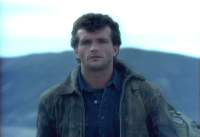
Loads of ‘Adult’ Language? A little. Whatever Happened To…: Christopher Leitch. Mr. Leitch started as a prolific episodic TV director in the early ‘80s, working on such series as Moonlighting, the remake Alfred Hitchcock Presents, Misfits of Science, The Flash, Beauty and the Beast, China Beach and others. Eventually he graduated to TV movies, including the 2000 cable remake of Satan’s School for Girls. David Dukes (Ted Miller) has been a busy character actor since the ‘70s, and has appeared in over sixty theatrical and (most often) television movies, along with assaying numerous TV series guest roles. His most famous performance, probably, was as a man who attempted to rape Edith Bunker on a Very Special episode of All in the Family (really), back when hit shows had much huger audiences than they do now. He supposedly received death threats following this appearance. Mr. Dukes died in 2000, while working on the Stephen King mini-series Rose Red. Susan Blakely (Melody) has appeared in nearly sixty movies and countless guest TV roles. In the ‘70s she was an ingénue, and had supporting roles in such films as The Towering Inferno, although she gained real (albeit temporary) stardom after playing the female lead in the tremendously popular Rich Man, Poor Man, the first network TV mini-series, which also launched the career of Nick Nolte. Things went down hill quickly, however, and a career slide was inevitable when three years later she was playing the lead in the notorious dog The Concorde: Airport ’79. Other notable works include the lead female roles in the goofy Terminator TV movie and would-be pilot The Annihilator, as well as Sly Stallone’s arm wrestling epic Over the Top. She continues to work in small scale projects to this day. Alberta Watson (Jill Freelander) remains a popular actress in independent films, including her role as the mother in the incest flick Spanking the Monkey, as well as parts in Hegwig and the Angry Itch and director Atom Egoyan’s The Sweet Hereafter. She’s probably better known for her supporting roles on TV shows, having played the character of Madeline on La Femme Nikita for three years, as well as appearing as Erin Driscoll on the 2005 season of 24.
-Review by Ken Begg |
||||||||||||||||||||||||
|
|
|||||||||||||||||||||||||