Another feature of... |
|
Another feature of... |
|
(1979) a.k.a. Face of a Stranger The Tingler is oft cited by B-Movie aficionados as evidence of director William Castle’s fecund, if somewhat goofy, imagination. The film posits the existence of a large, earwig-like parasite that resides in the human spine. This beastie, dubbed a Tingler by star Vincent Price, feeds on fear. Once it grows strong enough, it constricts the spine. Unless the Tingler is neutralized the pressure increases until, ultimately, death results. The only thing that can paralyze the Tingler is unleashing a good, solid scream. Needless to say, this being a Castle flick, a mute woman with an improbably wide array of phobias soon makes an appearance. Then an exit. Go ahead. Laugh. As for me, I believe. Maybe not in the exact specifics as presented here. Still, one horrible experience has convinced me that something along the lines of the Tingler actually exists. Here is my story. It’s 1990. With a profound feeling of doom, I approach a friend. I‘m about to ask her what she wants to do for her birthday. Why the pervasive sense of dread? Because she had one of the worst tastes in movies that I’ve ever known. (By which, of course, I mean that she liked films I didn’t. Or, more to the point, she really liked movies that I really didn’t.) And because I knew, I mean I knew, that she was going to say, "Let’s see Pretty Woman." I was right. And I knew that I was going to hate, to loathe, to utterly despise this movie. In fact, the only imaginable way that I would allow anyone to drag me to this…this thing, was if I couldn’t possibly avoid going. Only some kind of inescapable obligation could corner me into seeing it. Such as, for example, a birthday request. So I was trapped. And it was worse than that. You see, there were deeper reasons for my gloom. Yes, I was now condemned to seeing this film, one that I wouldn’t have seen for any other reason in a million years. But worse, as much as I knew that I would hate this movie, I also knew that my friend would love it. Sure enough, as my head throbbed with unspeakable anguish, she weeped happily, in total sync with how ‘beautiful’ the film was. And I’m here to say that The Tingler exists. Only it doesn’t shatter your spine when you’re afraid. Instead, it wraps cruelly around your brain while you’re watching a movie that is driving you mad. The only way to stop it is to express your utter disgust at the spectacle in front of you. To rant. To sneer. To roll your eyes. And to, yes, scream, if you have too. I had to. Only I couldn’t. See, it was my friend’s birthday. I was there for her. And she loved the movie. (This, naturally, only increased both my anger and my agony. How, I wondered, could anyone like this film? It seemed to defy all the laws of God and man. It was like something out of Lovecraft.) Therefore, I had to swallow all of it. My bile. My contempt. My sheer hatred of this movie. And all the while The Tingler savagely preyed upon my gray matter, feeding on the unnatural repression of my righteous reactions. Yes, I somehow lived through it. But I was never the same. I had stared into the abyss, and the abyss had stared back. This brings us to The Promise. Like Pretty Woman, it’s a Chick Flick. Now, when I say that, I don’t just mean a romance or something similarly non-macho. I personally like all kinds of movies, including romances, if they’re done well. Now, when I say Chick Flicks, I mean something deeper. Movies designed to appeal to all that is alien to men in the female mind. That serve to reconfirm to men that women are completely insane, utterly different and, ultimately, wholly unknowable. Sort of the gender opposite of the Three Stooges. The Promise came at the tail end (have you noticed that many of our films came at the tail end of some trend?) of what I call the ‘Damaged Woman’ movies of the ‘70s. I don’t recall all of these, but a couple of representative examples would be the blind skater epic Ice Castles and the crippled skier opus The Other Side of the Mountain. These films featured women who are physically victimized in some manner, but ultimately manage to triumph in life and love. Damaged Woman pictures are a primal genus of Chick Flick. They trace their lineage back to films like Magnificent Obsession, hallowed to all Jabootuians, and An Affair to Remember. (Only back then, Chick Flicks were known as Four-Hanky Pictures, referring to how many hankies an audience member would go through during the course of the movie.) In both those pictures, women face almost insane levels of misfortune. They nobly push away their men (for fear that they’ll only stay out of pity), but, in the end, find True Love. And it’s so beautiful!! Anyway, as you’ll see as we proceed, The Promise features nothing as prosaic as blindness or loss of bipedal mobility. So outré is its cental plot conceit as to demand a suspension of disbelieve (from men especially) that would well serve even the hokiest Science Fiction flick. Giant radioactive ants seem downright mundane compared to the events of this movie. One happy sign (for folks like us, anyway) is the large contingent of Bad Movie veterans in the cast. To be fair, this is largely because the cast consists of veteran character actors. Hire a bunch of people who have acted in lots of movies, and a certain Jabootuesque strain is likely to manifest itself. Still, a certain number of weird patterns immediately become apparent. Let’s start with the bizarre ‘Star Trek movie’ pattern. Stephen Collins, for instance, is Michael, our male lead. Collins now plays the father on the successful WB series 7th Heaven. At one time, however, he was Capt. William Decker. In the initial Star Trek: The Motion Picture, Decker was the new commander of the Enterprise, pushed aside when an aging Kirk comes back aboard and takes over command. Promise co-star Bibi Besch, meanwhile, makes an appearance in the next film in the series, Star Trek II: The Wrath of Khan. She’s the ex-lover who presents Kirk with a previously unknown nebbish son. Said kid ended up being murdered by Klingons, thus providing the highlight of the following flick, Star Trek III: The Search for Spock. It’s the appearance of Laurence Luckinbill in the credits, however, that truly makes us sigh with pleasure. Luckinbill, needless to say, limned the role of Spock’s half-brother Sybok, the Vulcan who felt everyone’s pain in the monumental turkey and all-time Jabootu fan favorite Star Trek V: The Final Frontier. There’s more, though. Besch, aside from her Star Trek role, notably played Pia Zadora’s mom in The Lonely Lady. She also appeared in the garishly awful Madonna flick Who’s That Girl. More? She was also featured in the inane Disaster vehicle Meteor. As, in fact, was Robin Gammell, another actor appearing here. Actually, much of the our cast here would have been better off avoiding disaster films. Not only did a couple of them appear in Meteor, but others appeared in some of the progressively more ridiculous ‘Airport’ sequels. Actress Kathleen Quinlan, who here plays our lead, Nancy, had a role in Airport ’77. Meanwhile, Robin Gammell (again!) was featured in the even worse Concorde: Airport ’79. It continues. Aside from portraying Will Decker, Stephen Collins played Donald Trump (!) in a TV movie. Beatrice Straight, meanwhile, proved that she should have avoided any and all weepy romance pictures by appearing in this and the infamous Brooke Shields turkey Endless Love. Finally, the ubiquitous Robin Gammell went for a Jabootu four-peat by appearing in the exploitative rape/revenge epic Lipstick. As well, I believe that it’s safe to posit the following general rule: Any movie which features roles listed in the credits as ‘First Cab Driver’ and ‘Second Cab Driver’ is asking for trouble. Anyway, let’s get going here. One constant of Bad Romantic Flicks is, of course, the ‘romantic’ montage. A really Jabootuish movie might even feature more than one. (See The Lonely Lady.) However, it’s a special mark of distinction when a film actually begins with a romantic montage. So commences The Promise, as your typical nauseatingly happy couple, Nancy and Michael, cavort under the strains of a bad song. The ditty in this case is "I’ll Never Leave You (Theme from The Promise)."
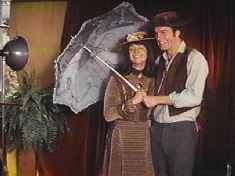
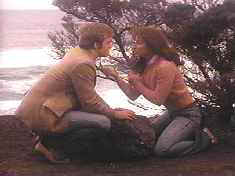
To be fair, the song here is not really bad so much as extraordinarily unmemorable. Especially given that it was nominated for a Best Song Oscar™. (Actually, to anyone who pays attention to your average Best Song nominee, it’s not surprising at all.) It’s even sung by an actual ‘name’ songstress, Melissa Manchester. Presumably, this is what got it nominated in the first place). The visuals, meanwhile, delineate the usual ‘small’ moments that are meant to make us smile and say, ‘Oh, yes, that’s what it’s like to be in love!’ You know: Meandering handholding walks, Frisbee tossing, a ‘cute’ moment when Nancy shows Michael some important paper and he pretends to nonchalantly toss it away, him giving her a piggyback ride (!!), window shopping and, of course, the obligatory appearance at a carnival. Here, our lovebirds don ‘old time-y’ garb for a picture, he wins her a prize, etc. (Oddly, there’s no shot of them eating either cotton candy or an ice cream cone, a seemingly de rigour element in these things.) In any case, by this point we can no longer agree with a key lyric of Manchester’s theme song: "Walk away…The thought would never cross my mind…" The tune (thank goodness!) finally peters out as our lovers arrive at a secluded cliff overlooking the ocean. Leaving their car, they go for yet another walk, faces aglow with, uh, love or something. This is the first good look we get at lead actress Kathleen Quinlan’s face, and it looks a bit weird. It wasn’t like I was going "Hey, that’s not what Kathleen Quinlan looks like!," because frankly, I couldn’t tell you what she looks like. I mean, rather, that she somehow looks a little off, like someone you just met who you can tell once had radical plastic surgery. Close-ups confirm this. Quinlan’s face has been altered for important (if extremely silly) plot purposes. She's been given a putty nose, the shape of her eyes has been changed somehow, and prosthetics have been inserted into her cheeks to change her jaw line. Also, some kind of tanning agent has been used to alter her skin tone. It’s not an awful or dreadfully obvious botch job, but you can tell that there’s something artificial going on there. In an extremely silly exchange, the duo exchange their views of what God they "don’t believe in." For the record, Michael doesn’t believe in the one "on a golden throne in the sky." Meanwhile, Nancy expresses disbelief in more of a New-Agey sort of gooey energy-that’s-in-all-of-us kind of deal.
To explain it to the modern reader, let’s say that Nancy and Michael are, basically, extremely primitive ancestors of TV’s Dharma and Greg. He’s the stiff scion of a wealthy family, she’s a let-it-all-hang-out Earth Child. Only here, we’re to take the characters (especially, of course, free spirit Nancy) absolutely seriously. To emphasize this (in case any of us have failed to ‘get’ it), Michael the Square asks Nancy to marry him. She, in turn, wonders at his need for "a piece of paper to tell us what we feel." Michael responds that he’s been trained to think more conventionally, in terms of "blueprints and statistics." Getting married would actually mean something to him, no matter how silly and pointless such a communion is. Nancy indulgently tells him that if a ceremony is so important to him, well, a ceremony they’ll have. Walking near the cliff side, Nancy leads Michael to a largish rock. She then has him help her flip it over. (Oddly, as they lift the stone and look beneath it, "Peace on Earth" it doesn’t say.) Finally, she removes her blue beaded necklace (won at the carnival - wow, continuity!), places it under the rock, and they exchange vows. Nancy: "See, I believe that when two souls are destined to meet, like ours, and they grow like one, nothing can pull them apart! So, with these beads, I thee wed! For as long as this rock, on this earth, and the sea and the sky shall live! And I promise [Hey, The Promise. Get it?] never to forget these beads, or what they stand for!" (OK, am I the only one who thinks that these beads, hidden under this rock and known only to these two characters, will be making a reappearance right before the end of the movie? And could they have possibly made that more obvious? Perhaps a sign with an arrow pointing down: "Please remember these beads. They will resurface as a Plot Device at the end of our picture.")
Dwelling, no doubt, on the beauty of all that these beads "stand for," Michael makes his vow: "And I promise…I promise never to say good-bye to you." Uh, very…pithy, Michael. Still, I guess it’s a very romantic moment. Otherwise, why would Michael and Nancy exchange teary glances of joy while the obligatory Lush Romantic Music swells up in the background? We cut to an apartment, focusing on a valentine card stuck onto a mirror. The depth of focus changes, and we see, reflected in the mirror, a (ugh) shirtless Michael working on some little scale buildings. I suppose that this is to confirm (in case we didn’t get the "blueprints" line earlier) that he, like Michael Caine in The Holcroft Covenant, is an architect. A panning shot takes us over to a bed. Upon this lies a dozing Nancy. She then awakens and instantly evinces alarm at Michael’s absence. Michael, hearing her, comes over to comfort her. He asks her if she had the "same dream" about her father. No, she replies, this time it featured Michael "I open the door," she frets, "and you started running and you kept running and I couldn’t catch you and I reached out and you were gone." This bit of expository Freud is clearly meant to inform us that (plot point!) Nancy has abandonment issues, presumably relating to her father. (Hence Michael’s wedding vow "never to say good-bye to you.") An equally logical explanation is that it wasn’t the character Nancy who was having this dream at all. Instead, it might simply have been actress Kathleen Quinlan, who during a catnap between takes had a prescient dream regarding audience reaction to this film. Now usually, I’ve seen these films prior to reviewing them. This one, however, I haven’t (although I’m aware of the basic plot). Still, I imagine that any viewer at this point is probably thinking along the same lines: "Nancy has a fear of abandonment, Michael ends up being forced, somehow, to abandon her, and the beads under the rock are used at the end of the movie as a device to reunite them, thus fulfilling…The Promise." Michael reassures Nancy that he’s still there. "You’re the only friend I got, you know that, Michael?" she lovingly avers. While this information will fail to surprise anyone who’s spent, say, seven minutes with her (i.e., us), it does serve to make this couple a little creepier. Providing further evidence for this proposition, Michael proves so inspired by her utterance that he jumps up and begins putting on his shoes. Questioned as to his actions, Michael replies, "I’m getting the heck out of this screwball picture while the getting’s good!" Well, actually, he doesn’t. Still, I like my version better. Instead, Michael plans to catch the next shuttle to New York. He tells Nancy that he plans to inform Marion (his mother) that the couple’s getting married. Only, you know, for real this time.Nancy is worried, first noting that Marion (obviously the flick’s villain) is sure to be against the wedding. Then she immediately jumps (linear thought appears not to be one of Nancy’s gifts) to asking "Can you stay my friend and be my husband at the same time?" Boy, that makes you think, doesn’t it? For instance, it made me think, "Good Lord, there must be something better I could be doing with my time than watching this dreck!" Michael answers that if they start hating each after they’re married, they’ll just get divorced and start living in sin again. Reassured, Nancy asks what she’s supposed to be doing while he’s in New York. (Yep, this woman leads a vibrant life, alrighty.) He suggests that she could work on her partially completed painting, standing on an easel about two feet away from them. Oddly, he doesn’t continue that she should remember to brush her teeth, put on her jammies and go to bed no later than eight o’clock. Perhaps he’s planning to call and read her a bedtime story and figures he can check on her then. A stock footage plane arrives at a stock footage airport. Next we see a taxi arriving at a rather ritzy abode. Michael enters the front door (which apparently is kept unlocked) and we immediately hear two voices arguing over some business venture. Given the rather immense size of the place, I find it rather unlikely that Marion would locate her business room right off of the front door. It’s almost like they’re not really in a house at all, but more of a set of some sort. But what do I know? Marion happily greets her son, as does her kindly old business partner, George Calloway. Marion breaks up their discussion by literally pulling Michael away. (Watch for the boom mike shadow that flickers across Michael’s face as she does so.) Before they leave the room, though, George reminds Marion to "take your medication," a line that has ‘Plot Point!’ written all over it. Michael, who has the kind of relationship with his mother where he calls her Marion, asks her to sit down. Reacting to his goofball ‘happy’ expression, Marion sagely guesses that his news has something to do with "The Girl. The Painter." Boy, is Nancy going to be pissed. I don’t know who this other woman is, but I did see the ‘painting’ Nancy was working on, and certainly no one would describe her in that fashion. It would be like calling a fellow who wrote bawdy adolescent limericks on bathroom stalls an ‘author.’ Amazingly, though, it turns out that they are talking about Nancy. Apparently, this is an example of an Informed Attribute™, i.e., a talent that we are to recognize a character as having, even if this belies our personal observations. Marion, having guessed that her son’s elation is connected to Nancy, suddenly appears shocked when Michael explains his plans to marry her. I’m not sure what other news concerning Nancy she thought had caused her son to fly into New York in the middle of the night, but whatever. Michael tells her that the wedding will be in two weeks, after he graduates. (Notice that he’s discussed none of this with Nancy. I guess he’s pretty much got free reign on this deal.) Marion, although acting sly, is obviously against the coupling for snobby ‘we’re rich and she isn’t’ reasons. (Boo! Hiss!) She particularly resents the danger Nancy poses to her own plans for Michael. Basically, her firm will be designing and building a hospital complex in San Francisco, and she wants Michael to head up the effort. At this point, the conversation takes a rather bizarre turn. Marion expositories that Michael’s grandfather founded the business. We also learn that in all its long history, the firm has never suffered from even "one taint of criminal scandal." Here she removes a folder from a drawer, while noting that all Michael knows about Nancy is that she was (get this!) a foundling left to be raised by "a passel of nuns" at an orphanage. (Get it? Abandonment issues?) Marion gives Michael the folder. Being an Evil Suffocating Matriarch, this proves to be (duh) a report on Nancy that Marion hired a private investigator to compile. It turns out (*gasp*) that Nancy’s father died in prison while Nancy was still a baby. Her mom, meanwhile, died an alcoholic. "Did she tell you any of this?" Marion accusingly asks. (Uh, if she was a child at the time, left to be raised in an orphanage, how much of this would she know?) Michael, needless to say, doesn’t appreciate Marion’s nosing around. And admittedly, her contention that Nancy’s past might stain the family business’ essential "reputation for honesty" seems a bit laughable. For instance, what big business is built on a ‘reputation for honesty?’ This is the issue that Michael raises. An even more obvious one? Who would hold it against a firm’s president that his wife’s parents were a crook and a drunk who died when she was a kid? I mean, we’re not talking 1840 here. Michael makes a generic ‘If I have to choose between Love and The Family Business, I choose…Love!!’ speech. When you think about, though, these speeches all tend to be pretty self-righteous. Why shouldn’t Marion be proud of what her father built and she expanded, and hope that her son would follow in their shoes? Building a big company is a major accomplishment. Yet it’s always implied that such finial obligations are frail, at best. Michael, meanwhile, is truly a product of his times. He doesn’t even mention choosing Love (with a capitol ‘L’) over his family duties. Instead, he uses the phrase, "If I have to choose between being happy…" Now, forgive me for being out of step with the modern ethos, but placing as the highest standard your own happiness strikes me as a tad selfish, not to mention somewhat adolescent. You of course have the right to live your own life, but ignoring social and family obligations purely on such grounds strikes me as a tad childish. Of course, it doesn’t help that the film so stacks the deck against Marion. She’s portrayed here as a cartoonish shrew who has the lamest possible reasons to oppose her son’s marriage. Perhaps later they’ll have her send out a brigade of flying monkeys to harass Nancy. Michael storms out of the house. He’s next seen on a pay phone, calling Nancy. He tells her to get dressed and pack a bag, as he wants her ready to get married tonight. (What’s the rush? Is he afraid he’s going to wimp out and give in to his mother? Or is it merely to get the film’s real plot rolling? [And wait until you get a gander at what the plot is!]). We next see Michael bursting into the apartment of his friend Ben. Much like Michael’s mother, Ben apparently sees no reason to lock his door. There must not be a lot of crime in this universe. Ben is occupied with brushing his teeth, which act he is timing with a stopwatch. I can only assume that this is meant to be humorous in some fashion. And in one of the weirdest examples of set dressing I’ve seen lately, he also has a framed picture of an orangutan on his bathroom wall (?). Learning that he’s to be the best man at Michael and Nancy’s impromptu wedding, an elated Ben shares a rather too, uh, manly hug with his buddy. Michael and Ben then pick up Nancy (as Ben ‘drunkenly’ sings "Here Comes the Bride" in a ‘humorous’ fashion). Nancy asks about Marion’s reaction. Michael confirms that his Mother objected but replies that he doesn’t care. Soon, our trio is racing along down some road. (Where are they going? Don’t you need a license to get married? Is this going to be like one of those films from the ‘30s, where you just wake up the Justice of the Peace in the middle of the night and he marries you?) To express their high spirits, the threesome are shown singing ‘On Top of Old Smokey’ (!) in a aren’t-we-too-happy-for-words manner. And yes, this is every bit as stupid as it sounds. Then, to make it even ‘funnier,’ Ben starts slipping in lyrics from ‘On Top of Spaghetti’ instead. Ha. Ha. Of course, the Movie Gods can only endure so much. Therefore, their car is soon confronted by a trailer truck driving right at them. As if rewarding us for our patience, we now witness a satisfying, slow-motion car crash. However, the Film Gods are also oft cruel, and we soon learn that this doesn’t mark what appeared to be a particularly satisfying ending to this movie. In fact, we’re just getting started.
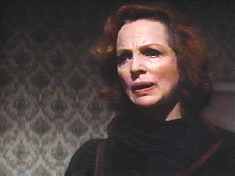
Marion is awakened with the news. She calls family physician Dr. Wickfield and is soon at the hospital. Wickfield appears and expositories out some plot points. Michael is unconscious, and may remain that way "for a week," but will survive. Here they again take the opportunity to mention Marion’s dangerously high blood pressure. This tends to confirm my earlier hypothesis that her medical condition is a further plot point. Dr. Fenton, the attending surgeon, comes out and gives us the scuttlebutt on Nancy. She’s medically sound, but her face is completely messed up. "There’s not an awful lot left under those stitches," he notes. Hey, wait. Maybe Fenton’s a script doctor, and he’s referring to the screenplay. Uh…nope. No, he’s talking about Nancy, alright. (They don’t even bother to mention what happened to Ben. In fact, I presumed that he had kicked the bucket, until he made a reappearance later in the film.) Marion is next seen calling the famous Dr. Gregson long distance. Nothing much is explained to us here, and Marion is soon checking in on Michael and then Nancy. Nancy, unsurprisingly, looks like an amateur version of Kharis the Mummy. And now, finally, the film’s incredible, epically inane plot really kicks off.
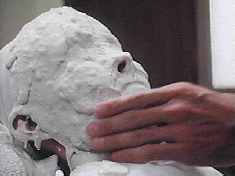
Nancy is quickly filled in on her medical condition by Marion. (Uh, shouldn’t a, you know, doctor, be handling that?) Marion then offers to pay for Dr. Gregson, the world’s greatest broken face surgeon, to work on her. It’ll cost a small fortune, but she’ll cover all expenses. Marion then starts working on Nancy. She’s asked if she wants Michael to see her as she is now. Figuring that Nancy will refuse to see Michael again anyway, given her lack of a face and all, Nancy baits her hook. That’s right. Marion will pay for Nancy’s operation, under the stipulation that Nancy promise (again with the promises!) not to see Michael ever again. Nancy agrees to abide by these terms, but asks what happens if Michael refuses to. Marion agrees that this couldn’t be considered Nancy’s fault. If this happens, Nancy’s obligations would be voided. Nancy, presumably certain that Michael will appear by her side once he’s recuperated from his own injuries, agrees to these terms. A medical jet arrives from San Francisco. Dr. Gregson, played by Lawrence Luckinbill, disembarks and is met by Marion. (If Gregson’s bedside manner includes telling his patient that he "feels their pain," man, I’m out of here!) Soon looking at x-rays, Gregson grimly notes that "This is not a repair job." He runs down what Nancy will need: Hospital time, a place to live during the long recovery, a private nurse, etc. Most important will be psychiatric help. This is because Nancy will "lose her identity, temporarily." "People who are forced to go too long without a feeling of self," Gregson continues, "usually get into psychological difficulties." This would presumably be more traumatic had Nancy ever evinced any sort of personality. As it is, however, it doesn’t seem like much of a loss. Marion (plot point!) explains that she prefers not to be billed for all this. Instead, she’d like to pay the whole thing upfront. (Apparently, Gregson can pretty much just figure out in advance what this will all add up to.) She explains that this way Nancy can feel secure that all her care will be covered. We, however, being omniscient audience types, suspect this kindhearted (and somewhat stupid) motive to be a cover for a more malign purpose. Im Ho Tep the Mummy Woman is soon being packed into an ambulance. Marion is shown overseeing this from an upper story window, staring down like some manipulative goddess from high upon Mt. Olympus. (Wow! Subtext! Or something!) A battered Michael, at some later date, finally comes out of his coma. (It’s noticeable during all these scenes that qualified medical professionals are nowhere to be found. Otherwise, Mom could never have these necessary-to-the-plot conversations with our leads.) His first question is about Nancy. (See! He loves her! No matter what happens, we must always believe that he loves her!) Ben, we belatedly learn, survived the wreck after all. Then we get another piece of the plot puzzle: Mom lies to Michael, explaining that Nancy died in the crash. OK, this is where we, once and for all, cross over into fairytale land. How is it possible that she can maintain this charade? Weren’t there newspaper articles on the crash (especially given Michael’s Hoi Poloi background)? Wouldn’t any of the hospital’s staff, assuming that they will at some point actually check in on Michael, inform him of Nancy’s fate? Since Ben lived through the crash, wouldn’t he have heard about what happened to Nancy? Wouldn’t Michael want to visit her grave? I’m sure there are more fallacies here that I’m missing, but that should do for a start. Michael, later convalescing at Marion’s place, sits in the backyard with Ben. Michael reveals that once he’s better, he’ll complete his studies and get his degree. Ben, meanwhile, proves ignorant of Nancy’s true fate. This seems, uh, less than likely to me. But then, it’s necessary to the plot. Michael, who avers that "She was my life!", has utterly capitulated. He intends to surrender and enter the Family Business, just as Mommy has planned. Ben, too, is to come work for the firm. Next, Michael, still limping and sporting a broken arm, hobbles back to ‘their’ old apartment. We see that the place is now up for rent. Tears leak from his eyes, the theme music swells, he looks at that valentine card we saw earlier, now but a tragic reminder of the past, yada yada. Confronted by a guy re-painting the apartment, Michael takes his leave. A stock footage shot of the Golden Gate Bridge communicates to the savvy viewer that the film has changed locals to San Francisco. Of course, a savvy viewer, almost by definition, would have stopped watching this movie a long time ago. Further shots take us to the Franklin Medical Office Building, where an operation is being performed on Nancy. (I’m assuming that we’re talking a series of operations here. Of course, this is a movie, so maybe not.) Hey, wait a minute! Isn’t San Francisco the location of that big project that Michael will be overseeing soon? Boy, that’s a coincidence, huh? (More to the point, wouldn’t Marion have arranged for Nancy to be treated somewhere where she wasn’t likely to bump into her son?) Next we see Nancy (presumably) sitting in a chair, plaster smeared across her face. She looks like someone trying to get a cast of her teeth from an extremely clumsy dentist. Next, Dr. Gregson leaves the room, carrying either the cast or Nancy’s old face under a towel. This he reveals, complete with remaining scars, to a shocked Nancy, who’s still swathed in bandages. Yep, Ol’ Doc Bedside, they calls ‘im.
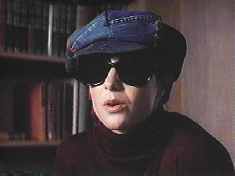
All this, by the way, is under music and without any dialog. A ‘recovery montage,’ if you will. More images follow: Gregson sketching faces on a drawing pad; a return to the operation room (plastic surgery must be very neat, as no one ever has any blood on them). Finally, a white fade out informs us that it’s time to return to the actual movie, you know, with dialog and everything. Lucky us. Dr. Carol Allison (Besch), Nancy’s psychiatrist, enters our heroine’s hospital room. Nancy must be getting better, because her forehead is now unbandaged. However, the shock of the accident has apparently made her hair become darker. In a fit of ‘nostalgia,’ Our Heroine is looking over a picture of her and Michael. It’s the photo of them in old-time clothes from the carnival. Apparently, she’s trying to get Michael out of her mind by revisiting the most humiliating moments of their relationship. We learn that it’s Michael birthday, that Gregson is unaware of the deal she made with Marion, and that Nancy still expects Michael to pop up. Apparently, she hasn’t even contemplated the idea that he might not know what’s going on. Considering Marion’s antipathy to her, this doesn’t say much for Nancy’s overall intelligence. We next catch up with Michael. Now that he’s ensnared in Corporate Culture, we see to our horror (well, bore-er) that he’s newly sporting a conservative haircut and wearing a (*gasp*) three piece suit. Presumably, this horrid fate would never have befallen him if Nancy’s freeing presence had remained in his life. He still has his soul, though. As proof, Michael is engaged in a none too credible ‘architecture’ debate with Calloway. Since the building they’re pitching would be near the ocean, Michael wants to have the wall facing it constructed of glass, so as to provide a pleasant view. Calloway responds by noting that this would adversely effect the heating bills (in California?). Being what Hollywood thinks of as an idealist, Michael is enraged at these petty ‘pragmatic’ objections. Damn it, he’s concerned about The People! Of course, in the real world, you have to worry about things like heating bills. In real life, Michael’s fit would reflect incompetence rather than idealism. After all, it’s the people paying him to design the building that he has a responsibility to. And if he really believes in this idea so much, why not run it past his clients and let them decide? You know, actually expend some effort to make it a reality. Answer: Because in Hollywood, actual solutions don’t count as much as showing that you care. As long as we know that Michael (or Susan Sarandon, or Alec Baldwin, or…) is a being on a higher moral plain, we can move on. We cut to Nancy’s apartment. Her face is apparently healing, as the bandages are now restricted to her nose area. In a scene so maudlin as to be cruel (to us, I mean), Nancy is again perusing her photo. This alone proves quite nauseating. But then we are forced to endure some flashbacks of ‘happy scenes’ from earlier in the movie. Hey, do we really need flashbacks from, like, twenty minutes ago? And as if they weren’t stultifying enough the first time! A final nail in the coffin is the reprise of the title song, lyrics and all. We then cut to back Michael, seen through his office window. It’s obviously late at night, yet he’s still seen slaving away at his desk. Wow. Him and Nancy. Two Lost Souls that…well, you know. Still, the filmmakers are yet afraid we’re not ‘getting’ it. So, we establish the shot of Michael in his office, as seen from outside and through his window. Then the camera slowly pulls away from him. His image gets smaller and smaller, lost in the growing facade of his office building. See? The shot symbolizes his isolation. Get it now? Because we don’t want anyone to miss the import here. It’s the next day. (Or something.) Marion pops into Michael’s office, informing him that they’ve officially received the contract for the Medical Center job. More than that, Michael is being put in charge of the project. (Uh, didn’t we already know all this?) Marion is surprised at Michael’s lack of excitement over their good fortune. Oh, Marion, can’t you see? It isn’t Fame or Worldly Success your son wants! It’s the simple love of a good woman! Well, actually, Nancy, but you get the drift. We next see Dr. Gregson taking Nancy out on what appears to be a fieldtrip of sorts. Wearing a hat and sunglasses (we haven’t gotten the official ‘Unveiling of the New Face’ scene yet), Nancy runs excitedly around a beach, taking photos. Looking over Nancy’s photographs after they're developed, we learn that she "can’t bring myself back to painting." (This is evidently to explain why, when she meets Michael again and he doesn’t know who she is, he doesn’t spot one of her paintings and identify her that way. Man, this thing’s constructed like clockwork, isn’t it?) Nancy, meanwhile, is wearing a hideous large denim cap and giganto sunglasses - OK, already, show us her face and get it over with!
We see that Dr. Allison’s also in the room. Because I am a merciful man, I am going to spare you Allison’s "You’re finding the Artist within!" speech. Be thankful, because I had to sit through it all. (On the other hand, misery loves company. So check out Immortal Dialog.) We also learn that it’s now about a year since the accident, and that Nancy has come to believe that Michael has simply abandoned her. At the office, we see Michael conversing with Wendy, an attractive blonde employee. (Bum bum bum!) She’s showing him some designs she’s come up with. Michael, trying to learn how to be practical, begins to grill her. (Earlier, Calloway noted that Michael had to catch up on current trends. This despite the fact that, according to the script, he’s been out of Architecture School for only a couple of months. What exactly was he learning there?) We cut to the construction site, where a crane shot shows us the couple going over the plans. To make sure that we are able to identify them from this distant vantage, they don’t have them wearing construction helmets. I believe that this is a no-no of some sort. Also, unless the dialog is meant to portray Michael as an idiot, or is purposely trying to sound unbelievably simplistic, it’s not doing very well. Michael: "This is going to be the main reception lobby. [Oddly, they
appear to be on about the fourth floor, which seems a strange location for a Medical
Center’s "main lobby."] The Council wants to use lots of hanging
plants. What problems does that create?" Yeah, I guess that that’s easier than picking plants that don’t need a lot of light. This is followed by a truly fakey sequence in which the actors are walking through a beautiful building, pointing around willy-nilly and trying to suggest that they’re enjoying the architecture. You can tell that the characters are miming the ‘dialog.’ Why not just shoot the scene with no sound and Foley in some background noises? Meanwhile, I guess that we’re supposed to be worried that Michael might be falling for Wendy. After all, we desperately want him to reunite with Nancy. Right? Being the kind of movie it is, it beats its point to death. The current point being, "Michael, can’t you see that you don’t love Wendy - it’s only her knowledge of Architecture that’s creating this false bond!" Therefore, even at a potentially romantic dinner at a fancy restaurant, all they discuss is trade talk. Wendy: "Because Rococo, in my opinion, produces exactly the opposite
emotional reaction in the observer." My general impression that they didn’t use an ‘Architectural Consultant’ on this film was confirmed when Wendy mispronounced ‘Rococo’ as ‘RO-co-co’ rather than ‘Rah-CO-co.’ After some more, er, banter, Wendy invites Michael up to her apartment. "I designed it myself," she notes. We join them there, but Michael is still looking over plans and asking for fabric charts. Finally, she beats him over the head until he gets the ‘I invited you up for sex’ idea. Michael, however, isn’t ready to move on yet. He leaves, as the camera focuses on Wendy, wearing that embarrassed ‘I can’t believe I couldn’t get a guy to have sex with me!’ expression.
Back to Nancy (still wearing her enormous sunglasses) and Dr. Allison. Setting up still more of the plot, Nancy now notes that she’s planning to change her name. So that when she bumps into Michael, and he doesn’t know who…well, you get it. Say, is anyone else noticing that this plot is incredibly silly, and that the ridiculous contortions used to keep it on track aren’t fooling anyone? Nancy has chosen the moniker "Marie Adamson." Adamson was her mother’s maiden name, Marie one of the nuns who raised her. (I guess that Michael isn’t supposed to know any of this, since otherwise you’d think he’d immediately catch on.) Asked as to her motives, Nancy, er, Marie notes, "I feel I’m beginning a new life, so why not have a new name?" Dr. Allison asks what if Michael comes looking for ‘Nancy’? Marie no longer believes he will. She’s sure that Marion didn’t inform Michael of their arrangement. She’s come to believe that he was aware of her injuries but not of her recovery. She now assumes that he’s been scared off by the thought of her disfigurement. Trying to reassure her (albeit in a quite odd fashion), Allison reminds her that she would look that way if she hadn’t accepted Marion’s deal. Marie agrees: "I shook hands with the devil and I have no right to complain." Allison reinforces this idea. "That’s right! It’s very important for you to remember that!" This seems, to say the least, unlikely. Marie is her patient. Given the situation, I’d have to think that Dr. Allison would urge her to break an oath she made under duress and contact Michael. The only way this makes sense is if Allison is corrupt and accepting money from Marion to keep Marie from contacting Michael. However, while this may yet prove to be the case [Future Ken: Nope, it doesn’t.], I just don’t think that this movie is that three, or even two, dimensional in its characterization. And I might as well pause and raise another issue that’s been bothering me. OK, technically, Michael doesn’t have a great amount of money on his own. However, Marion plans for him to inherit the family business and wealth. Now, wouldn’t Nancy/Marie assume that Michael, learning of her fate, would cajole Marion into loaning him the funds to pay for her operation. I mean, really, how could Marion have refused him? Surely, Nancy would have expected Michael to have moved Heaven and Earth to get her medical attention. ‘Marie,’ however, feels betrayed. Why, if it was Michael that had ended up looking like The Phantom of the Opera, she would still have tracked him down! His lack of doing the same has almost emotionally crippled her. "Do you realize what’s happened to me in this last year?" Marie bitterly concludes. "I almost lost me!" Cut to Dr. Gregson, pulling the last bandages off of Marie’s face. As is traditional for the ‘Unveiling Scene,’ Marie is sitting with her back to the camera, prolonging the tedium. Er, suspense. The camera tracks up over her shoulder, and you just know that she’s going to grab a hand mirror and that the reflection will be our first look at her new face. Oops. My mistake. Instead, Marie walks over to a wall mirror, and the reflection from that is our first look at her new face.
Unsurprisingly, Marie now looks a lot like Kathleen Quinlan. This is what I think might have happened. Gregson gave her a book containing pictures of movie actresses and told her to pick one out. Marie, not wanting people to recognize her, chose Quinlan’s face. I can’t help noticing, though, that the main changes from her old look are her skin tone, which went from a well tanned brown to a milky white color, and her hair color and style. Sure, her face is somewhat different, but they use these cheats to exaggerate the effect. It’s like those commercials where a woman goes from her old lipstick to a new and more flattering one. Meanwhile, we’re not supposed to notice that she’s better dressed, has had her hair done and is being lit more attractively for the ‘after’ shot. We see a brush working on that painting of Nancy’s from earlier in the movie. Then we cut to Marie stepping out of her car, carrying the canvas wrapped in a cloth. She’s dressed in a very bad ‘70s sort of way (pardon the redundancy): Much too tight, light blue and massively bellbottomed jeans; a too-red button down shirt with the ends tied off, exposing maybe a half-inch of midriff (so why bother?) and a white scarf tied off around the neck, Mr. Furley-style. Oh, and the new face. She approaches a house and knocks on the door. Gregson answers and lets her in. Marie notes that Gregson and Allison’s work is done, and now so is hers. She reveals the canvas, noting that it’s "Marie Adamson’s first painting. She’s just been born." Which is sort of weird, because I thought that photography was going to be Marie’s schtick. Last we heard, ‘Marie’ couldn’t bring herself to paint. Besides, she in fact started this painting when she was ‘Nancy.’ So it’s not really Marie’s ‘first’ painting at all. Also, does anyone else suspect that this picture will eventually be seen by Michael? Man, do they telegraph things in this picture! Western Union must have made a fortune from this film. This is as bad as the beads-buried-under-the-rock thing. Cut to Ben arriving at the airport. Here the film makes a major leap into the Land of Unlikely Coincidence. Ben grabs a taxi (presumably being driven by the fabled "First Cab Driver") into town. On the way, they just happen to drive by an art gallery displaying Marie’s photographs. Boy, that’s convenient, huh? In the real world, by the way, the cab would have whipped past the little shop before Ben could even have gotten a good look at it. Good thing the actor playing Ben knew it was coming, and so could warn the driver to pull over before they drove past it. Ben is attracted to the framed photographs on display in the window. Man, what are the odds, huh? Of all the galleries in all the world, he had to walk into this one. This is incredibly poor scriptwriting. I’m sure that the screenwriter would say something like, "No, no, it’s not coincidence, see, it’s destiny! Kismet! A Higher Power meant for this meeting to occur!" Which explanation you’d perhaps buy, if you were one to consider a laughably contrived script a ‘higher power.’ Ben enters the store, unnoticed by Marie, who’s lecturing patrons in the foreground of the shot. However, she soon spots him, and her emotional turmoil is apparent to all. Well, all those who are still awake, anyway. Of course, this is another moment in the film where everything could be instantly resolved with a single sentence. Why Marie would fail to identity herself to Ben remains a mystery. It’s certainly doesn’t fall under the scope of her deal with Marion. But then, we all know the reason: If she told Ben, he’d tell Michael, Michael would show up, and the movie would be over with roughly forty-five minutes of running time left. It’s like when Hunter or Starsky & Hutch is chasing a killer just before the thirty minute commercial break: You know that they won’t catch him yet, because there’s still half of the show left to fill. In any case, to paraphrase Roger Ebert’s ‘Idiot Picture’ definition (essentially, a film which can only proceed if all its characters are idiots), this is a Moronic Lack of Communication Picture. So Marie just listens as Ben explains how his company is building a Medical Center out here. And, hey, Ben thinks that Marie would be the perfect photographer to execute a "photo mural" meant to be the centerpiece of the reception lobby. However, Marie steadfastly proceeds to go further than the letter of her agreement with Marion, presumably because she still thinks that Michael abandoned her. So when Ben requests a few of her shots to show his boss (Michael), Marie turns him down. Cut to a generic ‘blowing out the birthday candles on a cake’ shot. This is the film’s clever way of signaling to us that it’s Michael’s birthday. See, that explains the cake I just referred to, the one with the candles and the legend ‘Happy Birthday, Michael.’ Are we all on the same page, here? Good, because I don’t want anyone falling behind. I think that the birthday thing is to help establish a timeframe. Earlier in the film, the recovering then-Nancy noted to Dr. Allison that it was Michael’s birthday. So I guess that it’s now close to two years or so since the accident. I have to admit, though, that I only caught this while reading over the review. The film really doesn’t do a very good job with the time issue. They do imply that time’s passed (i.e., Michael’s now with the firm, so he must have finished school, and that would have taken a while). Still, that means that we are to assume that months have passed between certain scenes, and the film doesn’t provide us with many clear signals on this. It often seems like everything’s happening in a couple of weeks, except that we know that it couldn’t be. Back to the party, taking place at the film’s East Coast headquarters. To our dismay, Marion, Calloway, and a bunch of extras soon break into a chorus of "He’s a Jolly Good Fellow." (Wendy, conspicuously, is nowhere to be seen. This leads me to suspect that her only purpose in the film was to proposition Michael and provide him the opportunity to show that he’s still in love with Nancy.) [Future Ken: Yep, that proves to be the case. Wendy never makes another appearance.] Michael notes that he’s bad at giving speeches. Marion says that then she’ll give one instead. For students of masterful oratory, here’s Marion speech, reproduced in its entirety: "Your grandfather would be proud. His business reaches across the country, and his grandson steers the ship." Kind of puts the Gettysburg Address and that ‘…day that will live in infamy’ deal in their place, doesn’t it? Michael grabs a call from Ben (see IMMORTAL DIALOG). After wishing him a happy birthday, Ben explains that he’s found the person to do the building’s mural. Needless to say, this is Marie. Let’s examine this latest illogical chain, link by link:
We also learn that Michael will be coming out to San Francisco the following week. This, for plot reasons so obvious that I’m not even going to go into them. We cut to Marie’s apartment/studio. The phone rings, and it’s Michael. The initially flustered Marie (not to be mean, but Quinlan’s acting here leaves something to be desired) soon realizes that he doesn’t know who she is. He’s just calling about the job. She tries to put him off. Michael, however, won’t take no for an answer. Apparently this photo-mural thing is the single most important element of the entire project. (Either that or Michael is just pathologically insane). She again rebuffs him and hangs up. Michael shrugs his shoulders and calls one of the other photographers wrangling for this lucrative assignment. Oh. No, I guess he doesn’t. That’s right, Marie Adamson (who just happens to be the woman he loves and believes to be dead, only with a new face - we all get that, right?) is the only photographer in the world pedestrian enough…er, brilliant enough to do the job. Ansel Adams? A hack! Diane Arbus? Please! Mapplethorpe? In San Francisco? Are you kidding?! I should also point out that their phone conversation lasted over a minute. I find it hard to believe that he didn’t find her voice to be even slightly familiar. A shot of a trolley car alerts us in the most unimaginative fashion possible that we’re now in San Francisco. Why not just show bystanders chowing down on big plates of Rice-a-Roni? A huge limo drives up to a fancy hotel and disgorges Michael. Soon he’s walking down a funky side street, ending up outside Marie’s apartment. (Does he really have nothing better to do? Is there some reason why Ben’s not following up on this? I mean, the guy flies out to San Francisco from New York, and this is his first order of business?) Marie’s a sly one, though, and meets him in a darkened room. As an excuse, she pretends to be examining projected slides of her work. In a laugh inspiring moment, Michael looks upon one of her generic, this-is-what-I-saw-in-San-Francisco-while-on-vacation photos. Reacting with awe at her amazing artistic abilities, he notes that "You know, your work is unique! Already, I could walk into a room anywhere, see one of your pictures, and know it was yours." This is a further attempt by the film to justify why Michael’s so intent on hiring Marie. Too bad the blandness of the work shown here so thoroughly belies his remarks. Michael continues to babble on, while Marie struggles to suppress her (*yawn*) emotions. Again, Michael shows no indication that he finds her voice familiar. This, despite the fact that he’s now standing in the very same room with her. Furthermore, her gambit of keeping the lights off would surely result in his paying more than the usual amount of attention to her speech. Michael, frankly, is not coming off like a rocket scientist or anything. One of the sick thrills of this kind of movie (Damaged Woman Flick; not Bad Movie) is observing how much agony the lead woman character will nobly suffer before allowing herself to experience True Love. (Guy Movies feature heroes surviving terrific physical beatings, Chick Flicks feature heroines surviving terrific emotional beatings.) So the script now has Michael attempt to be reassuring. He notes that he understands how hard it can be for an artist to trust another person, to commit herself. See, and Marie thinks that this is the guy who said he loved her, but who turned tail the moment things got rough. And now this same fellow is asking her to trust him again, while not knowing who she is. See? See the irony here? Because I wouldn’t want anyone to miss it. This is all, naturally, salt being rubbed into Marie’s wounded psyche. (Again, that’s sort of the whole point.) Finally, she reaches over and turns on a light, apparently to see if Michael will recognize her. He seems to come close, and the two characters freeze into a silly, I mean, taut tableau. The only motion or sound comes from the automatically changing slides being projected onto the wall. I have the feeling that the director thought that this shot was some sort of artistic coup, and I imagine him patting himself on the back for thinking of it.
Ultimately, however, Michael fails to recognize her. Marie, now more bitter than ever, orders him to leave. Confused by her turning down his offer, Michael serves up another big, fat line from Irony Theater: "What I’m offering you could give you the kind of recognition that you must want." Oh, Michael, you’re wrong! The only recognition she wants is for you to know her for who she is, to take her into your arms and love her! Can’t you see that?! Sob, bawl, etc.! We cut to Michael and Ben attending a basketball game. Michael’s telling Ben that he still intends to work on Marie. He’s going to offer her a sum of money so large that she’ll have to say yes. Ben, meanwhile, finally expresses some confusion as to why Michael’s pushing so hard to sign her. He also wonders if it’s money that motivates her. "Maybe the best buildings get designed by people who don’t care about the deal." "Everyone cares about the deal," Michael cynically replies. (Geez, first he’s an idealist, now he’s a cynic…which is it?) Oh, Michael! Can’t you see? That’s not you speaking, it’s your mother! You don’t believe that, it’s only that the pain of Nancy’s death has driven you into an emotional shell. Come out of your shell, Michael! Feel! Live! Only then will you see that the woman you love is right in front of you, only then will you both find the love you need to make you whole! Sob, bawl, etc.! We cut to a cocktail party being held at Dr. Gregson’s. In the foreground, we hear a guy we never see relating an anecdote about giving a hypochondriac some sugar pills. Later, she tested positive for diabetes. I guess that this is supposed to be funny, or add verisimilitude to the scene, or some damn thing. Anyway, the camera pans and shows us that Marie is in attendance. Next we cut outside, where (surprise) Michael is approaching the house. Nobody answers the door (good party etiquette, Doc). However, since this is that Universe where no one locks their doors, Michael lets himself in. Barging in, Michael apologizes but explains that he has business with Marie. Astoundingly, he wasn’t actually invited to this shindig. Apparently, he learned of it somehow and decided to crash the party so as to corner Marie (!!). Why he thought that this act of extraordinary rudeness would convince her to work for him is left to our imaginations. Now, I’m no script writer. Still, wouldn’t it have made more sense to have the eminent Dr. Gregson somehow be connected to the new Medical Center? This would better explain Michael’s presence at the party. Then he could have accidentally bumped into Marie again. All the scene as depicted here accomplishes is to portray Michael as some monstrous jerk. Marie, hoping to avoid a fuss (and, presumably, keep Michael away from Gregson, for fear that he’ll somehow spill the beans), grabs Michael’s arm and leads him off. She drags him to a side terrace and begins, with good cause I might add, to rag him out. Michael responds by hauling out his big contract. Marie again refuses to work for him under any circumstances. She then responds to Michael’s evident confusion (since she’s a commercial artist) by asking "Don’t you know who I am?" I think we’re supposed to think that maybe she’ll reveal her identity here. However, we’ve still half an hour of running time to go, so obviously we know that she’s not. Instead, she merely continues that she’s an artist, and doesn’t work at other people’s direction. Michael leaves and Marie reenters the party. On her way through, she grabs Gregson’s hand and gives him a heartfelt look. Then she exits, and the camera zooms in on Gregson, who’s wearing a thoughtful expression on his face. Uh, oh! Watch out, everybody! I think he’s starting to feel her pain!! Cut to Michael in a hotel room. He’s telling his mom about this fabulous artist that Ben came across. Marion tells him to hire her, and he launches into a recap of what we’ve already seen. "It doesn’t make a damn bit of sense," he concludes. (Tell me about!) "She’s a professional. She’s done work for magazines. You know, it’s as if it’s me she won’t work for! And I’ve never even met her before." Marion, proving to be an intuitive genius of sorts, figures out what’s going on. She asks him to describe this woman, and his answers substantiate her hunch. Michael, exposing himself as some type of pathological stalker, notes that he intends to see her again. At this point, I had fantasies of these two appearing on The People’s Court or Jerry Springer. I’m telling you, there’s a great skit in there somewhere. Under the above dialog, concluding with Marion noting that she’d like to meet this woman, we cut to Marie’s car arriving outside the hotel. Why Marion would wish to do this, and even more, why Marie would agree, defies any possible explanation I could even attempt. Nonetheless, Marie is soon walking down the halls of the hotel, arriving at Marion’s suite. Marie enters the room. She apparently believes that Marion doesn’t know who she is, and keeps up the charade of not knowing her in return. OK, that’s it. Are all these people nuts? Does any of this make sense to anyone? I feel like I’m watching a movie made by robots or aliens, ones who have superficially studied humans and think that they know what makes us tick, but who in reality don’t have a clue. This film is insane. There’s no other word for it. Marie hands Marion the samples that she supposedly requested. Marion asks if this means that she’s considering taking the job. "No, I’m not," Marie responds, "I just thought you might want to see my style." Then she stares coolly at Marion. By which I guess that she in fact does believe that Marion knows or suspects who she is, and is taunting her. Or something. Man, my brain hurts. Marion nonchalantly tosses out the line, "Dr. Gregson was the right choice, wasn’t he?" as a gambit. "You’re guessing," Marie replies, which line confirms Marion’s hunch in itself. The cards on the table, the two exchange some (I think) catty dialog. Or something. Look, I don’t know. I’m just guessing here. Can we just go to the part where Marie gets back together with Michael? Please? I guess not. Marie tells Marion not to worry. She’s pretty pissed that Michael isn’t able to recognize who she is, and has no intention of accepting the job. Insanely, Marion then replies that she wants Marie to take the job. It’s a big job and would make Marie’s professional name. Apparently Marion’s feeling guilty over screwing over Marie/Nancy, not to mention her son. However, she’s too frightened to tell Michael about the situation. About how, you know, she blackmailed the woman he loved into leaving forever and then told him that she was dead. That whole thing. Presumably she figures that if Marie takes the job that Michael will eventually figure out who Marie is. She even tacitly nudges Marie to reveal herself. Marie isn’t buying it, though. She just can’t believe that Marion is anything less than evil and manipulative. As for not buying it, though, I’m not buying Quinlan’s performance here. Sure, she manages to cry on cue, but it’s just not enough. And yes, she’s better than, say, Pia Zadora in the ‘hose’ scene in The Lonely Lady. But it’s surprising how little better she is. Still, this is the closest thing Quinlan gets to an Oscar Clip™ moment in the picture, so she proceeds to spit out her clunky little speech. "You assumed that a Love, an absolutely genuine Love, would somehow keep Michael from being fulfilled." But Marie has seen the damage that her absence has done to Michael. "He aged four years in two!" she notes. Wow. So he’s, what, thirty, but he appears to be thirty-two? Man, that’s brutal. I’d also like to point out that, contrary to Marie’s assertion, Michael seems pretty much the same as he was when he was with her. I guess you just have to know him really well to see the pain. I didn’t intend to, but Marie’s speech is so long and insipid that I guess I’ll include it as IMMORTAL DIALOG. I’m doing this for any budding actresses out there. After all, I gave the guys a bad speech to audition with in my Johnny Mnemonic review. So this one’s for you, ladies. We cut to Marie and Gregson. They’re disembark from a boat and begin walking down the pier. Marie is prancing and romping around joyfully. Just in case we can’t properly interpret her actions, the screenplay thoughtfully provides her with the following line: "God, I feel free at last!" (Strangely, I shouted this exact same sentence when the movie finally ended.) Apparently, her yelling at Marion was a cathartic experience for her. Meanwhile, Gregson is acting in such as a fashion as to, perhaps, indicate that he’s taken a shine to Our Heroine. As usual, though, I really can’t tell what the heck is going on with any of these characters. Anyhoo, he proceeds to give her your standard ‘We all lose faith, but you mustn’t lose faith’ speech. "This is something that happens to every one of us. [!!] You lose you faith in human nature. But you don’t let it ruin your life."
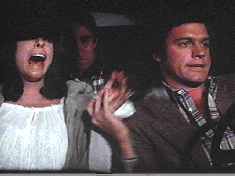
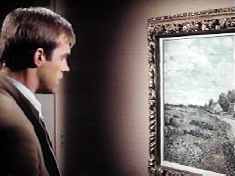
Marie, entranced by this brilliant philosophical discourse, gazes at him with steely admiration. "God, I respect you," she blurts. (Oh, oh! "I respect you" is movie code for "I’m going to end up with the other guy.") "I admire your kindness, and your skill. That’s all I can say about my feelings, except that the other is completely over." Which means…how the heck should I know? I guess that maybe she’s signaling her availability to him. Or something. You probably think I’m exaggerating here, but I’m not. This film is so darned elliptical that I can’t tell what’s going on or what anyone is supposed to be feeling at any given moment. Then the characters explain what they’re feeling, and you’re more confused than ever. In any case, we next see Gregson and Marie driving in his car. She’s gazing at him, in a manner that maybe, perhaps, is meant to indicate some sort of romantic feeling for him. Whatever. Look, I’m not Nostradamus, here. OK, I have another major nit to pick with this movie. We’ve got twenty minutes left, and they’re introducing, utterly out of left field, this possible romance between Marie and Gregson. Now, obviously, being the kind of film this is, we know that Marie is going to end up back with Michael. Therefore, Gregson will do the standard ‘second banana boyfriend’ thing and nobly stand aside in the face of True Love. My problem is this: Do we really need to toss in another lame sub-plot? One that’s been designed as to be introduced and then resolved in less than twenty minutes? Remember Wendy? The ‘other woman’ that Michael seemed to be dating? The one tossed into the film, showcased for almost exactly three minutes, and then ushered off never to reappear? Look, if you can’t mine your central storyline for enough material to fill out a screenplay, don’t make a film out of it. You certainly don’t pad things out with these excruciatingly pointless plot cul-de-sacs. Good gravy, we haven’t even gotten back around to Marion’s dangerous medical condition yet! [Future Ken: Nor, it turns out, will we. For Marion herself disappears from the movie after the scene where Marie shouts at her.] The drive back home is interrupted when Marie spots a truck driving from the opposite direction. This results in her experiencing a flashback to the crash. (Presumably because she’s feeling happy and is, I guess, sort of in love, and is riding around in a car…get it? It’s just like it was before the big accident.) Marie begins screaming while the concerned Gregson pulls the car over to comfort her. He takes her in his arms, but grimly notes that she’s obviously not "completely over it," as she stated earlier. Now, I’m not sure that, just because she retains a phobia about car crashes (like, you know, the one that tore her face off), that means that she’s not over Michael yet. Still, I believe that that’s the inference here. Or something. Cut to Marie, standing on another dock on a blustery day and taking photos of a boat berthed there. Needless to say (after all, we’re running against the clock here, and we’ve got a lot of boredom to squeeze into the remaining eighteen minutes), Michael soon appears. He’s come to apologize to her. "My work is my life," he begins. This is obviously leading into a soul baring speech that will finally convince Marie that Michael has never forgotten her, and that he was as much a victim as she was. Sure enough: "There’s something about your work, Miss Adamson, that haunts me. I’ve been selling you on what this job could mean to you. I haven’t told you what it means to me. It haunts me. See, for a long time now I’ve been walking around in kind of a busy dream…" Well, you get the idea. The music swells up, and tears fill Marie’s eyes. Still, I wager that she’s still not going to confess her identity to him yet. That’s because she’s the heroine, and can’t leave Gregson until he nobly sends her off to Michael. So we're unsurprised when she hands him a single photo of a boatyard, tells him to use it any way he likes, and walks away. Cut to Marie leaving her apartment. Outside, she pauses, shocked. Across the street, we see either a billboard or a truck emblazoned with a giant blow-up of the photo she gave to Michael. Apparently, this is his latest scheme to convince her that she should work with him. The man himself, in fact, is standing right outside her door. At this point Michael officially, to me at least, graduated from useless to creepy. Maybe it’s just the day we live in, but I’m telling you, this scenario has ‘stalker’ written all over it. Michael asks her to imagine her work, just as impressively embiggened, adorning walls in not one building, but in buildings all around the country. Marie admits that it would be a kick. She’s also nervous, however, that’s she finally beginning to relax around Michael. Who, after all, is obviously a monumental clod. I mean, these two were deeply in love, right? Sure, her face is different. But what about her voice, her body language, even her scent? Assuming that he still believes Marie to be another woman, wouldn’t he suspect that he’s attracted to her only because she reminds him of Nancy? And wouldn’t that sort of freak him out? I mean, I’m not expecting Vertigo here, but still. Anyway, Marie decides to test him out. She asks about the wee scar on his forehead, a souvenir from the accident. Michael explains that’s it from a little crash, something that he’s already forgotten. We can tell, of course, that he’s just hiding the pain. Marie, however, takes this as further confirmation that he’s a huge jerk and begins to stalk off. Michael, pissed off (he’s pissed off), follows, demanding an explanation for all the mixed signals she keeps tossing him. This leads to a boring argument wherein she references his lack of commitment and loyalty. Meanwhile, a confused Michael objects that she doesn’t know him well enough to make such accusations. ‘Ah, Michael,’ we’re no doubt supposed to be thinking, ‘if only you knew.’ Cut to Marie with Gregson, telling him that she’s ready to kiss the past good-bye. It seems that Marie has decided that going back to Boston will allow her to finally exorcise the past. There’s something there that she has to deal with once and for all. (Hmm, it couldn’t be a hidden blue beaded necklace, could?) Gregson’s against it, and finally reveals his feelings for her. Marie, however, is adamant. She asks him to drive her to the airport, but assures him that she’ll return. Then she kisses him. This all seems a little cruel, given that Gregson’s got a snowball’s chance of landing Marie at the end of the picture. Michael we next see walking the lonely streets of San Francisco. He visits a bar, and obviously, and I mean obviously, gets an idea of some sort. All he needs is a light bulb appearing over his head. He goes to Marie’s apartment, but, naturally, she’s not there. Then he shows up at Gregson’s. To which I must wonder: Why? Because he knew that she attended a cocktail party there one time? (We never learned how he found out about that, either.) Of course, the reason that he really goes to Gregson is your classic IITS: "It’s In The Script." Gregson, see, has that painting for Michael to stumble across (with Marie’s signature prominently featured in the corner, to boot). Michael, appearing more psychotic than ever (and presumably drunk after his trip to the bar), barges in and starts searching the house for Marie. Gregson snarls that Michael will never hurt her again, and an exceedingly fake looking bout of fisticuffs results. Much not to our surprise, though, as Michael starts to pull himself from the floor, he spots the painting that’s been waiting around for the whole movie for exactly this purpose. Sure enough, the camera tracks down to Marie’s signature, and our moronic male lead finally FINALLY FINALLY!! puts it all together. (Continuity fans might want to watch the pattern of blood on Michael’s bloody lip here, which constantly seems to change shape.)
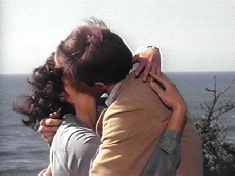
Cut to Marie, first on a plane, then driving a car. Marie ends up outside the apartment she shared with Michael. She takes a look, then drives on. Next, she drives past the empty tents of the carnival where she cavorted with Michael during the opening credits. Finally, of course, she ends up at the seaside spot where she and Michael ‘got married.’ There’s still about four minutes of the movie yet, so the stroll to the rock is extremely slow. Eventually, though, she reaches the rock, rolls it over, and finds…nothing. Michael then steps from the surrounding trees, holding the necklace. (Apparently, he teleported in from San Francisco, as Marie seemed to have a start of at least a couple of hours on him.) Yet we still have well over two minutes left, so Michael does some extremely lame speechifying. Of course, if the movie had worked the way it was supposed to, the audience would all be crying their eyes out over our lovers’ triumph (such as it is). They’d be glad for the remaining two and half minutes so that they could savor a good weep. As things have turned out, though, these last few minutes are interminable. It’s like running through a gauntlet in which you must take a final horrific pummeling before reaching the end. Watching Michael spew out his ridiculous speech is bad enough. Worse is Quinlan’s job here. She has to just stand there, waiting for him to finish his lines so that they can clinch and finally end the movie. The poor blocking of the scene is especially apparent given that Michael’s speech lasts nearly two solid minutes of screentime. Take my word it, that’s a lot. And after watching the travails of these two lunkheads for the last hour and a half, what’s Our Heroine’s reaction to this speech (and her last line in the film)? "Michael!" Here’s a Promise - I promise never, ever to watch this movie again.
AFTERTHOUGHTS: The first thing about this film, as I’m sure you noticed, is that it has one of the most idiotic plots in the history of motion pictures. Talk about contrived! Who could have heard this story without bursting into laughter, much less greenlighting it as a film project? Was it OK’d by someone who knew they were about to be fired, and left it as a little FU to his old studio? That seems to me to be the only likely scenario. If I had to pick one particularly unlikely bit, though, it would be how Michael fails to learn of Nancy’s true fate. I mean, he’s only out about a week. And he wakes in the hospital, whose staff, one would think, would at least know that Nancy wasn’t dead. Wouldn’t a nurse, making that ‘nurse’ small talk while sticking a thermometer up his bum, have let slip something? They try to cover one end by noting that Ben was released almost immediately and that he then went back to Boston. However, we also are told that he’s called the hospital "every day." That he would have failed to learn what happened to Nancy during these calls seems, well, unlikely. Meanwhile, Michael comes off as a complete moron. Didn’t he even ask about the funeral? Didn’t he ask about her effects? Nor is he any swifter later. Never once does he indicate that he finds Marie in any way familiar. Given this, his fixation and pursuit of Marie borders on psychosis. He bursts into private homes and, once she’s cornered, demands that she explain herself to him. This from someone that he thinks he has maybe a two day relationship with. As for Nancy/Marie, what can we say? What a maroon! And yet the film expects us to care if these two get together and find True Love. Frankly, we’re more likely to worry that they might somehow manage to reproduce and inflict their defective genes upon another generation of humankind. Another thing that’s immediately apparent in The Promise is how padded the film is. Despite a fairly modest running time of about 97 minutes, the movie seems to be endlessly heading off on tangents that ultimately go nowhere. The best way I can think of to describe the movie is that the story was intended as an episode of some TV show, but that someone decided to pad it out to movie length instead. I mean, let’s look at our characters. Other than Nancy, Michael and Marion, no one really needs to be here.
To make my point, here’s how the film could be pared down to, at best, the forty five minutes required for an hour long TV slot. As well, I believe I’ve managed to tighten up some of the character motivations. It’s still dumb, but at least it moves faster: Nancy, a painter, and Michael, an architect, are lovers who plan to get married. Marion, his mother objects, but can’t dissuade her son. However, a car crash occurs. Nancy’s face is horribly mutilated and Michael’s in a coma. Marion offers Nancy the deal. Nancy, not really thinking straight and assuming that Michael will hunt her down, agrees. She’s flown to California to receive the finest medical treatment, paid for by a trust established by Marion from her private funds. Meanwhile, she has the comatose Michael moved to her mansion and hires a private medical staff that knows nothing of Nancy’s fate. Michael doesn’t come out of his coma for months. When he finally does, he’s devastated when Marion informs him that Nancy died in the crash. This slows down his recovery and leaves him somewhat addled. About a year down the line, Marion, weakened by her guilt over the arrangement with Nancy and its effect on Michael, passes away. This inspires Michael to snap out of his funk and to take control of the family firm. Still grieving over Nancy’s death, he throws himself into his work. He eventually flies to California to supervise the design of a building his firm is erecting. Michael, we learn, has developed a passionate interest in art. Although he’s violently reluctant to share his pain with others, it’s his way of maintaining a link with Nancy. While in San Francisco, he attends various gallery showings. The plans for the building include a photo mural. Michael has taken this minor element as his pet project, a way to meld his work responsibilities with his interest in art. At one exhibit he becomes intrigued with the photography of Marie Adamson. Believing that she would be perfect for the photo mural, he asks the gallery manager to introduce him to her. Marie, ironically, proves to be Nancy, not long recovered from her reconstructive surgery. Fleeing the pain of her old life, for she believes that Michael abandoned her, Nancy has changed her name and forsaken painting for photography. Unnerved by Michael’s appearance, Marie coldly rebuffs his offer and flees the exhibit. Michael, however, still wants her for the job. He also finds himself strangely drawn to Marie. However, he suppresses his feelings, still wanting to remain loyal to Nancy’s memory. He has a contract drawn up, hoping that the large proposed fee will change Marie’s mind. Then he goes back to the gallery to ascertain Marie’s address. Escorted into the manager’s office, Michael is shocked to see a painting that Nancy had started but never completed before the accident. Examining it, he sees that the signature is Marie’s. The manager explains that Marie gave it to him as a gift. Although he was impressed by her talent, Marie told him that she had abandoned painting for personal reasons. She had finished this last painting, she said, as a way of closing the door on a painful chapter of her life. Realizing that Marie is indeed Nancy, Michael worms her address from him. He presents himself at Marie’s door, explains that he had been told she was dead, and begs her forgiveness. They clinch. The End. IMMORTAL DIALOG: Dr. Allison and Nancy discuss the import of her reawakening Artistic
Proclivities in the kind of Touchy-Feely, "I’ve been to Paradise, but I’ve
never been to Me" dialog that is guaranteed to send any males in the audience fleeing
from the theater: Ben calls Michael on his birthday, providing the occasion for some witty and highly
naturalistic banter: As promised, here’s the speech Marie gives upon confronting
Marion (and remember, ladies, more is better than less, so don’t be stingy with the
histrionics): Our Readers Respond: Jabootu correspondent Eva Vandergeld kindly (and no doubt therapeutically) shares the details of her own run-in with our subject: "Not two weeks after I read this review, a guy I was dating, a rancher's son from near Corpus Christi, apparently decided, sweetly, that he wanted to show his vulnerable, in-touch, soft, girlie, whatever-you-want-to-call-it, side. We liked to watch movies, typically good ones in the Ronin calibre, which I didn't mind because I would never see them if it wasn't with him. He was the genuine tough-guy boot-wearing Aggie Corp-type, nice of course, so I mustn't be too hard on him. But...I don't know what online relationship-advice-for-guys article he read, but apparently they suggested bringing over a chick flick and wouldn't your girlfriend be astonished at your thoughtfulness if you showed a 'genuine' interest in watching it together. At the time I was sporadically reading a borrowed copy of a Danielle Steele novel. (*shamefaced glance at floor* -I SWEAR I never read another.) He said later that he saw it lying on my coffee table and apparently some infernal light bulb went on in his head. One night, he brought the The Promise. When I saw the box, I had to excuse myself to the bathroom; the laughter that wanted to explode in his sweet-but-badly-misguided face was strangling me. I don't know where he got it, particularly in rural Texas. I suspect he garnered some looks at the video store. Maybe you guys know what this is like. Oh. My. God. was that movie bad. Imagine me, wanting to laugh all the way through it but not wanting to hurt his feelings. And imagine him, watching this all the way through without being able to comment once; his impatient restlessness, repeated trips to the fridge for Budweisers, and barely-constrained caustic comments all spoke of untold suffering. I think it hurt him somehow. When it was over he was visibly upset. All he could manage was a tight-lipped "good night" as he slunk out the door. He looked somehow older as he stumbled out to his big macho duelie diesel. No good deed goes unpunished. I heard later, through a girlfriend, he had told one of his buddies something like: "I now know what it feels like to become less of a man." Review by Ken Begg |