Another feature of... |
|
Another feature of... |
|
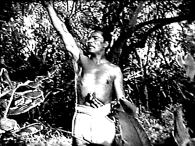
Film genres die. Westerns were once the biggest, most popular genre. Now they make one or two a year. Medical movies, like the Dr. Kildare flicks, faded away also. Private eye pictures, and Whodunits. Even the Horror Movie is considered to be waning by some, who warn that it might be gasping its last. The fact is that, rising ticket prices aside, movie attendance is down, certainly as compared to the heydays of the 1930s and ‘40s. Back then, the average person would often go to their local cinema on pretty much a weekly basis. And then they would generally see not one but two movies, along with cartoons, news reels, comedy short subjects, chapters from "serials", etc. The top billed film, the "A picture", was generally a fairly expensive studio film. The second movie on the bill was usually a cheaper "Poverty Row" flick of some sort. This is where the term "B-Movie" came from. A B-Movie wasn’t necessarily a bad film, but rather a film produced quickly and on a tight budget. These factors required a large amount of films being produced, and at a quick rate. So formulaic genre pics were just the ticket. However, if there’s one popular genre that's not just dead, but almost forgotten, it’s the "Jungle" adventure. Yes, there were "Jungle Movie" series other than the Tarzan flicks (and, in fact, more of those than most people realize). For instance, after Johnny Weissmuller became too, uh, zaftig to continuing starring in big budgeted Tarzan flicks, he continued with the Poverty Row jungle adventures of "Jungle Jim". The "jungle film" had budgetary advantages over some of the other genres. Of course, the whole point of genre flicks is a certain (how do I say this?) continuity of plot elements. In jungle movies, evil witch doctors and bad White Exploiters filled the bill, cutting out the time wasted when attempting to write an original script. Also, once a mini-studio built a "jungle" set, well, there you go. No use constructing another, just so it looks "different" than the background of the studio’s last twenty jungle epics. And, ahh, let’s not forget the best time and budget saver: stock footage, and plenty of it. Need the hero to wrestle a lion, or an alligator? Hey, just use the "fight" shot for your last jungle movie (or the one before that, or the one before that…). And hey, have "scenic" shots of animal herds in your film library? Well, splice ‘em in, bwana! Since the B-Movie portion of the bill generally ran sixty minutes or less, you could make a jungle extravaganza and usually only have to shoot, say, thirty or forty minutes of new footage. Or less. Hey, that reminds me of one movie…. Jungle Hell (a.k.a Jungle Boy, although it should be titled Stock Footage Hell or Elephant Hell) was one of a series of Jungle Movies starring "Sabu, the Elephant Boy". And, I think I can safely say, the worst of the lot (or so I would hope!). Sabu was an (East) Indian lad, and so wore a turban and one of those Indian diaper deals instead of the general issue "jungle hero" loincloth. Since he wasn’t "white", of course, he would be rather more differential to the bwanas than, say, Tarzan, even if he was the hero of the piece. Certainly, he never got the obligatory white chick included on every safari, even if he still had to rescue them all the time. Rather, a white guy would sort of share the hero role. He would get the girl, but boy, was Sabu honored to be able to help out the white folks. Sabu had all of the standard "jungle" adventures, if in an increasing threadbare fashion. Still, even Sabu fans must be embarrassed by this flick, which is easily one of the five most incoherent movies I’ve ever seen. And let me just say, without bragging, that that’s like Harry Carry talking about one of the five greatest home runs he’s ever seen. On top of that, it ranks an impressive #2 in terms of stock footage usage. Only the obscure Devil Monster, in my experience, is more greatly composed of previously shot material. So if my description of Jungle Hell also seems a little incoherent, well, then my work here will be done. We open with a silly badge, informing that we can thank (or blame) "Medallion TV" for this presentation. Then an eerily appropriate (as we shall see) royal crest, featuring two elephants with intertwined trunks, appears. A message is superimposed: "With grateful acknowledgement to the Ministry of Information, Division of Films, of the Government of India, and to his highness the Maharajah of Mysore for their aid and co-operation in the production of this film". Well, if either of these entities had anything to do with the making of this movie (unless they were in the habit of providing stock footage to impoverished American film companies), then I’m the Maharajah of Mysore (Mysore eyes, maybe). We cut to a reflecting pool. The camera tilts up to reveal India’s Taj Mahal (!), and credits inform us that Taj Mahal Productions, Inc. (!!) "proudly" presents… Sabu… in Jungle Hell! Gee. Taj Mahal Productions, Inc., huh? Maybe it was made in India. (If you buy that, write to me for details on how you can obtain immortality with a reasonable monthly payment.) Directly under these credits we see our hero, pausing as he runs through the "jungle." He looks around. Perhaps he’s eluding pursuit. More likely he’s making sure he doesn’t run into one of the walls surrounding this rather small, eh, jungle. Ten seconds into the actual film, we get our first hunk of stock footage, which runs throughout the rest of the credits: a campsite composed of circled covered wagons (hey, that’s our idea!), a blurry shot of Indian dudes dancing (I think), a guy leading a water buffalo, a rather bogus looking "village," and, amazingly, back to the same shots of the campsite. You know you’re in trouble when they can’t make it through the credits without repeating footage, especially stock footage. Eventually, the film "proper" begins. A silly looking map of India is shown, as inane, half audible narration (provided by Sabu, I guess) is heard: "We are in the country of mystics, magic and strange legends. This is the strangest, most unexplainable story of all [I’ll say!]. India is my country, an ancient land of four hundred and fifty million people, speaking many dialects. It’s a land of contrasts; of people, climates and cultures. The most primitive cults live side by side with the most modern ideas. The Taj Mahal [the same shot used for the production credits!] is the most beautiful piece of architecture in the world…"
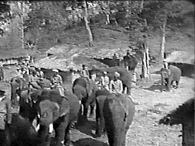
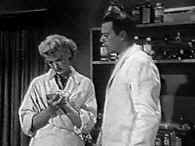
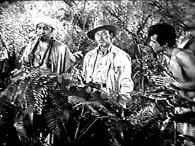
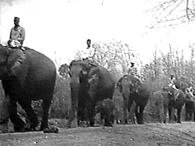
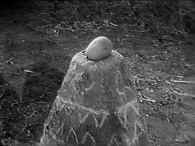
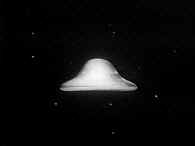
This speech, sounding rather like a third grader’s report on "India, my Homeland," runs on for over three and a half minutes (!). It is, of course, accompanied by copious amounts of stock footage. We see architecture, bustling cities, rivers, people, fakirs, etc., then segue into "jungle shots." The best segment involves stock footage of a tiger intercut with separate stock footage of startled deer. This supposedly fosters the "illusion" that we are watching this tiger scaring these deer. The result, however, is less than totally successful. We go on, watching a stock footage mongoose kill a stock footage cobra. Next, a monkey. Now, a panther. Finally, we end up on a knee-high rock marked with the kind of "hieroglyphics" that ancient peoples might have produced. Had they been, you know, intellectually stunted and used crayons. On top of that rock is a smaller, round rock. For plot clarification, we’ll call the larger stone the "Hieroglyphics Rock," the smaller rock the "Burning Rock," and the both of them as a set will be referred to as the "Mystery Rock". Sabu promises that the tale we’re about to watch is the "strangest." No argument there, buddy. Continued narration informs us that the Hieroglyphics Rock is "strange," and was found in Mysore. The drawings tell of "ancient, or prehistoric times, before man came to this country." Then we cut to a shot (I swear!) of a really bad flying saucer (!!). The rock tells of a ship that came "from another planet, or galaxy. This is not made too plain." Alien beings "planted a substance, in India, and other places on Earth." Then, in an important moment, we cut to our first stock shot of an elephant. This is because elephants were chosen by the aliens to watch over the substance (or something like that. If you can understand this any better, you tell me!). The aliens will one day return to "harvest the crop." "That is our story," Sabu continues, "a story about a rock, and a being from another place." And now, after narration lasting four minutes plus, a full six minutes since the opening credits started, we actually begin the "story." A native woman prays as the local (surprise!) Witch Doctor/Holy Man, Shan-Kar, mumbo jumbos over her sick son. The kid is sprawled on a stone slab, over the Mystery Rock. Shan-Kar strangely looks more like a Caucasian with tanning cream on than an Indian. He tosses that "whooshing" powder that all witch doctors are supplied with into a fire, which, naturally, whooshes. The boy’s uncle, Sabu, is apparently not a firm believer in holistic medical techniques. He urges Mom to seek help from Dr. Morrison, a white doctor bringing medicine to the primitives (jolly good!). To say that this battle between "Western" medicine and "Native" medicine was a regular "Jungle Movie" plot element would severely understate the issue. Given the circumstances, of course, Sabu is right. Still, he’s not going to earn any kudos from the Multicultural crowd for siding with the "imperialists." He tells Mom of how Doc Morrison healed a burn he himself had (and like the one the kid has), but she is afraid of offending the powerful Shan-Kar. Shan-Kar’s lackey, Kumar, rats Sabu out, and expositories that if Morrison goes around curing everybody, Shan-Kar will be out on his ass. He agrees, and suddenly proclaims that the "will of the gods" dictates that the lad stay on the altar throughout the night, after which he will be cured. Kumar hangs around to see that this proclamation is followed. Around dawn the next morning, we see Mom, Sabu and Kumar dozing near the altar. The camera cuts to an extremely bogus series of "stone" ledges, adorned with fake trees and a woefully inadequate painted "mountain" backdrop. A tiger enters from stage right. Luckily, the ledges come complete with ramps leading down to the next level, so that our "wild" jungle cat can gingerly descend. Sabu’s village is adjacent to the steps, and the beast walks around a bit. This is intercut with some stock shots of an ape (of course the lighting levels don’t match) to add "authenticity." Sabu awakens in time to see something startle the tiger on the other side of the village. The tiger runs off. Wow, that was exciting! Not to mention disjointed. The above description is really a rough guess, considering the way the footage was edited. Since he’s up, Sabu checks on the kid. He’s burning up with fever, so Sabu wakes Mom and implores her to go to Dr. Morrison. Leaving her to get the boy ready, Sabu runs off to the garage to start up the family elephant. Actually, he gives one of those "Tarzan" yells that summons elephants (or more accurately, stock footage of elephants). Unfortunately, he wakes up Kumar in the process. No sooner has a stock footage pacaderm returned Sabu’s call then a fight breaks out. "Fight" music plays over the desultory "action," which ends with Sabu triumphant (duh). They flee, leaving an angry Kumar to rub his supposedly aching chin and scowl. Next we witness a stock shot of people riding on an elephant. It’s a rear angle shot, to, uh, disguise the fact that the people on the elephant in no way resemble Sabu and his companions. Then the camera pans to the dirt on the set’s floor. Sham "elephant" prints have been stamped into the dirt. This "clever" device is used to help cover up the fact that we never saw an elephant actually interact with the actors. A fade takes us into Dr. Morrison’s office. He’s playing chess with a guy who has a Russian accent, Mr. Trosk (oh, brother. Gee, that’s not supposed to sound like "Trotsky" or anything, is it?). Hmmm, a Russian guy who plays chess. This movie was produced in the ‘50s, so that’s not a good sign. To make sure we don’t miss the subtle clues that he’s a Russian (and hence has instant "bad guy" status, like a German guy in a ‘40s picture), Trosk mentions "your United Nations." And for modern audiences to hate, Trosk is also (I think) an ivory hunter. Sabu and company make their appearance, begging for Morrison’s assistance. Sabu mentions that the boy was burned by a strange rock he found, causing Trosk to assume a "devious interest" expression. Morrison goes to the fridge and pulls out what appears to be a container of Vaseline, screw top and all. Meanwhile, the kid looks pretty lively for someone supposedly on the brink of death. Nearby, we see pre-cut pieces of medical tape hanging off the furniture, just in case Morrison needs to secure a bandage in a hurry. It’s not like exposed glue would dry if you just hung tape out, right? He spreads the balm on some non-stick pads, just like he was making a peanut butter sandwich. As he patches the kid up, Trosk splits, complaining about the interrupted game. This, of course, highlights the fact that he’s an uncaring, heartless Commie bastard. After this intensive medical procedure, Morrison sends Sabu and company back to their village. Then he washes his hands. Uh, doc, shouldn’t you have done that before treating the open sore? Morrison gets a "thoughtful" look, and begins a letter to "Dr. Angus Caldwell [uh, that’s what, Swedish?], Public Health Clinic, Department of Scientific Research, London, W1, England." We know all this because Morrison apparently can’t write a letter without speaking the contents out loud. This perhaps explains why he’s practicing medicine in the wilds of India. Through the magic of (you guessed it) stock footage, we tour London as his voice-over continues. He reports that he’s been treating patients who exhibit "all the symptoms of an x-ray burn." An enlargement of his letter acts as a segue to Caldwell’s office. We know it’s a scientist’s office because of the test tubes. The segue is completed when Caldwell’s voice takes over the narration of the letter from Morrison’s. This is the movie’s greatest artistic triumph. The letter reveals that the mysterious rocks "were exposed by some newly uprooted teak trees." He then posits the theory that there are radioactive materials in the area (wow, brilliant!). Still, he doesn’t want to report this to his United Nations superiors until he has some real proof. You know, more than just the rocks that give you radiation burns when you play with them. He continues that he couldn’t, of course, ship possibly radioactive materials to Caldwell. Apparently, this is before "lead" was invented. So the easier course would be to fly Caldwell out to India to confirm the situation there. Caldwell is reading the letter to an attractive blonde, Dr. Pamela Ames (well, as attractive a blonde as they could afford on their tiny budget [look, I know that’s mean, but it's also true, so sue me]). Anyone who has any familiarity with ‘50s sci-fi flicks knows what this means. Caldwell will send her in his place. This will provide a comic moment when Morrison sees that they’ve sent, you know, a girl, as well as provide the necessary Caucasian love interest for our white guy hero. Ames tries to talk Caldwell into going himself: "But suppose there really is a radioactive grouping of some sort. Wouldn’t you like to be the one to confirm it, for the benefit of Humanity?!" Whatever that means. Still, I’ll bet that commie Trosk isn’t worrying about any "benefit to Humanity." That’s the difference between us and them, you know. Suddenly, Caldwell has a brainstorm. Why doesn’t Ames go instead? (Wow, what a twist.) She hesitates, then agrees. After she leaves, Caldwell laughs to himself about how Morrison will be surprised when he meets Dr. Ames. Gee, how come? Hey, you don’t mean because she’s, like, a girl and everything? Meanwhile, further stock footage takes us to Geneva, to U. N. Headquarters. Half audible (not to mention half-witted) narration by Sabu attempts to make us believe that this jumble of stock shots (guys in an office, operators at a switchboard, women answering phones, etc.) has anything to do with our "story." "The United Nations was searching for answers," we’re told, "Answers to many questions." Thanks for clarifying that for us. The stock footage travels to civilized India, then segues to stock footage supposedly representing Sabu’s village. Finally, we spy Sabu himself, in footage actually shot for this movie (wow!). He and Kumar are gathering sticks for Shan-Kar to start a ceremonial fire with. Sabu places these right next to the Mystery Rock. Hmmm, maybe Morrison should have mentioned that, aside from not touching the stone, that you shouldn’t stand right next to it either. Ah well, maybe Sabu didn’t want kids anyway. Then we cut to stock footage (gosh!) of people with elephants (boy, who’da thought?). Then we cut back to Sabu and Shan-Kar. Shan-Kar throws whooshing powder on the fire, which whooshes. Then he does it twice more (is there no end to his powers?). Next, he mumbo jumbos in what I suspect is not quite authentic Indian. The apparent purpose of this ceremony is to make us cut to some stock footage.
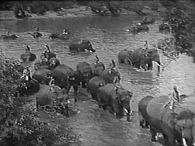
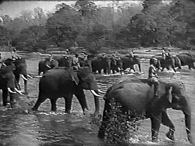
And we do. This time it’s a blurry far away shot of people with a horse and a wagon drawn by a water buffalo. I think. After about one second of this, we return to the chanting Shan-Kar. This time the fire whooshes before the whooshing powder even hits it, indicating it’s one of those artificial gas ceremonial fires. You know a guy’s a fake when he can’t even get real whooshing powder. Back to stock footage. Hey, score one for me. A closer stock shot reveals, yes, a guy on horseback and a buffalo drawn wagon. This approaches a village, one that doesn’t resemble Sabu’s in the slightest. Then it cuts back to the earlier stock footage of people with elephants (look, I didn’t make this damn thing, I’m just describing it). Then we cut to a different stock shot of people and elephants. Finally, we see a guy enter the set, joining the ceremony already in progress. It’s Trosk, nosing around to find out about the Burning Rock. Coming up to Shan-Kar (of course, both being Bad Guys, they get along famously), Trosk gives his cover story. He wants help catching (I think) a "rogue tusker" down by the river. This is my conclusion after listening to the sentence about two dozen times. That phony baloney Russian accent ain’t helping, either. In any case, he means an elephant (surprise). Shan-Kar sends Kumar to help him, but Sabu is forbidden to go, due to his recent visit to Morrison. Shan-Kar leaves, and Sabu does a Suzanna Hoff impression, moving his eyes from left to right. Then, being unobserved, he runs off. A stock footage guy who is sorta dressed like Kumar but doesn’t look much like him climbs a stock footage elephant. Then a herd of stock footage guys on stock footage pachyderms head off from a stock footage village. Presumably, they are heading to the (no doubt stock footage) river Trosk had mentioned. This is portrayed through a succession of stock footage "guys on elephants" shots, all apparently from different movies, none of which match each other. We also get a shot of Trosk riding his horse through the jungle set, for "continuity." Suddenly, we arrive at a big bunch of stock footage, involving lots of elephants around a river. Trosk and Kumar are now seen dismounted, wandering through the set. Trosk point to a piece of stock footage of the "rogue tusker" he wants. Kumar runs off to tell all the stock footage guys which stock footage elephant Trosk wants. Then Sabu jogs onto the set. "Bring the tusker near the bank!", he cries, as we watch the exact same shots of the targeted elephant that we saw earlier. "Bring him around the tree!", he continues. Amazingly, the stock footage guys appear to obey his orders (sort of), in spite of the fact that they’re not really in the same movie. Kumar shows up and yells at Sabu for not staying in the village, per Shan-Kar’s orders. Sabu replies that he is the "Jungle Boy," and that the elephant would not have been caught without the two or three instructions he shouted. Yeah, if they hadn’t brought it near the bank and around that tree…man, I don’t even want to think about it! Kumar says that he could have led them, but Sabu preens that only he, the official Jungle Boy, would be obeyed. "When you get to be the Jungle Boy," he sneers, "then they shall obey you. Now, they shall obey me." Relying on his regal Jungle Boyness, Sabu haughtily sends Kumar off. You know, and this might be the reaction of a Western Imperialist to an indigenous native culture, but Sabu seems, well, a trifle too proud of the whole "Jungle Boy" thing. Kumar runs back to Trosk, implying that he was responsible for the elephant’s capture. Satisfied, the expedition heads back. This provides the opportunity to show some elephant themed stock footage. Suddenly, in a daring move, we cut to some more "Big City" stock footage. Then an establishing shot of an office door, with helpful expository info literally written all over it, brings us back to Angus Caldwell. Walking into shot from stage right (pretending that she just entered the "office"), Pam Ames informs Caldwell that all her travel arrangements are made. "I’m taking off right after dinner, and should land at the Department of the Interior Airport #7 in about thirty hours.", she blurts. Caldwell’s secretary, who unfortunately looks rather like Bizarro Lois Lane, brings in some reports for Ames to take with. One look at this woman explains how the actress playing Ames got the female lead. Then we cut to some stock footage of an airport, and people entering planes, and planes taking off, and planes flying, etc. The illusion that this plane is in fact part of our film is artfully wrought by some voice-over narration of the pilot doing that "This is Flight So & So…" spiel. We cut back to Morrison’s place. Sabu enters unseen (although from the personal quarters, not the front door [?]). Morrison has his back turned, and the inquisitive Sabu starts monkeying with some test tubes the doc has lying around. This is accompanied by "comedy music," just in case anyone in the audience failed to get how "zany" this is. Of course, Sabu pours one chemical into another, resulting in the inevitable "bang" sound. Morrison turns and laughs at the antics of the chagrined Sabu. Maybe he thought them funny. Or perhaps he was laughing in relief that Sabu didn’t mix vials of the Ebola virus and growth hormones together. Morrison relates that Sabu’s village Chief is only suffering from a stomach ache. "He’ll think I’ve done wonders for him with these sugar pills.", he chuckles. Sabu laughs along at the idea of how foolish Doc Whitey will make his Chief look. "No wonder, the way he eats!", he chimes in, ingratiating himself with his oppressor in a sickening display of self-loathing and cultural genocide. Then Morrison’s radio kicks in with a message about Dr. Ames being on "his" way. Morrison decides that it’s time to procure a sample of the Burning Rock. Packing some gear, he and Sabu head into the village. After a short stroll across the set, Sabu and Morrison reach the village. Sabu points to the Burning Rock. "It’s still here!", he exclaims (where would it go?). Morrison, who brought some (admittedly primitive) protection gear in his bag, reaches out to grab it barehanded. It’s becoming clearer and clearer why this guy ended up in the jungle dispensing sugar pills to credulous natives. Sabu stops him. Not because, you know, you get burned by touching it. No, because Shan-Kar has a spell on it, or something. Kumar, sitting nearby, informs them that Shan-Kar is down by the river, washing logs to make a stockade out of. Morrison and Sabu go off to seek permission to take a rock sample. Suddenly, when we most expect it, we cut to stock footage of elephant hauling logs behind them (at least I hope they’re hauling logs!). Shan-Kar stands on the jungle set, watching the stock footage, which of course is lit differently than the newly shot footage. Trosk also makes an appearance, and watches the stock footage along with Shan-Kar. Apparently there’s not much to do in the jungle. Sabu and Morrison show up, and Morrison asks after the rock. Shan-Kar, unsurprisingly, refuses to let him take it. Sabu and Morrison split. Really, really grainy stock footage of a bon fire of some sort heralds the next scene. Native men rhythmically beat sticks together nearby. Either we’re watching a native ritual, or the origin of the group "Stomp". Suddenly, stock footage elephants make the scene. In these scenes it’s night, but when we next cut to Kumar on the jungle set, it’s day. What a mysterious place the jungle is. But a little expository dialog puts things right. Sabu pops up, and asks Kumar why he wasn’t at the ceremony "last night." Sabu threatens to expose Kumar’s secret dealing with Trosk to Shan-Kar, who would exile him. Basically, Sabu is pissed off because Kumar hasn’t been pulling his weight since being in the pay of Trosk. The enraged Kumar jumps Sabu (no, to fight him!). After a struggle so fake that members of the World Federation of Wrestling would be embarrassed, Sabu leaves the unconscious Kumar in the jungle. We cut to stock footage of a group of Indian dudes walking in a line with various noise making implements. Then we cut to (gasp!) stock footage of elephants. Then a stock footage village (a different one). Then, finally, to Shan-Kar sitting in a wicker (not rattan) chair. He’s got a little trident nearby, like he’s Poseidon or something. Mom brings Sabu’s nephew by, and Shan-Kar hogs all the credit for the kid’s recovery. Next in is Trosk (this guy really gets around). We learn, in incoherent fashion, that the stockade has been finished, and that the featured ceremony was to start the hunters out to capture some elephants (or something). Trosk asks permission to stay until the hunters return, to check out the booty, but his eye is really on the Burning Rock. Trosk rather non-cunningly asks if he can remove it for Shan-Kar. Shan-Kar refuses, noting that "it can do no harm" where it is. Maybe somebody should explain how a radioactive article, well, radiates. Next, a "blur" effect on some stock footage of guys on elephants implies that we’re to witness a flashback. But guess what, we don’t. My theory: in the movie they took this footage from, it did herald a flashback, and they just didn’t bother to remove the "wavy" part when they included it here. This is followed by various stock footage shots involving elephants, both domesticated and wild. Perhaps this is the hunting trip Shan-Kar and Trosk were talking about. Yes, I guess if you squint real hard, only watch the film peripherally, and think about something else, this melange could be taken for the herding of stock footage elephants. Barely. Ah, finally. Stock footage. This time it’s (again) "Big City" stock footage. Then to an airport, where we watch an airplane land. Presumably, this is to indicate that Dr. Ames has arrived in India, whereupon she will transfer to a smaller plane into the interior. Of course, I’m guessing, because this is all stock footage, and we never actually see Dr. Ames. You know they’re trying to pad a film out when they insert stock footage to indicate the catching of a connecting flight. Then, after this quick respite, we cut back to more stock footage of the elephant hunt. The captured elephants are now being brought back to one of the stock footage villages, which are all supposed to be the same village. Even more amazingly, they’re also supposed to be the same village Sabu and Shan-Kar live in, in spite of the fact that nothing remotely matches. The stock footage is intercut with shots of Shan-Kar and Trosk "watching" the "action." Again, none of the lighting of the various shots matches, or is even close. Apparently, the elephants have now arrived at the stockade. Kumar runs up to tell Trosk to pick out the elephants he wants. Then he runs off, leaving Shan-Kar and Trosk to, yes, continue watching the stock footage. If it’s any consolation, the actors look as bored as we are. Suddenly, for a change of pace, we cut to Sabu and Morrison walking through a "different" part of the jungle. They, too, stop to look at the stock footage (look, just shoot me now). Morrison and Sabu are apparently searching for a Burning Rock, so that Dr. Ames has something to work with when "he" arrives. Hmmm, maybe Morrison should have procured a sample before asking someone to fly for thirty hours into the wilds of India. Sabu promises to get one when the elephants are used to knock over teak trees for harvest (because that’s how they were found in the first place, remember?). How will he know if it’s a "Burning Rock"? I guess he’ll just keeping picking up stones until one burns him.
Next, oddly, we cut to our "flying saucer" shot. Then a hand pointing at a "weather map" (don’t ask). Something about how a really big storm’s brewing. I guess, perhaps, that it’s being caused by the aliens, since we just saw a shot of the flying saucer. Or maybe not. I don’t know. Then we watch stock footage of various radar dishes, radio antennae, oscilloscopes, flying saucers, etc. Next up: stock footage of a toy airplane flying through a faux "horrible storm". Given that they had prior knowledge of the storm, you’d think they’d have waited. Nah. Lightning shots are cut in to increase tension. The pilot radios the airport. He reports that lightning has hit an engine, and he may have to crash-land the plane. Landing gear is lowered, then a toy plane on a saggy wire "crashes" into a bad tabletop "forest" set. This shot, to say the least, won’t be winning any Academy Awards for special effects. This is then followed by another shot (well, the same shot, repeated) of the flying saucer. Did it cause the crash? If not, why do they keep splicing it in? If so, how come? And most important, who cares? A stock footage search plane finds nothing. This is reported to a stock footage radio operator. For some reason the search plane does a lot of upside-down flying and loop-de-loops. Does this aid the search? The pilot recommends a "U.S. air search." Sure enough, we cut to stock footage of a U.S. Air Force plane taxiing for takeoff. Bunches of Air Force planes of various makes take off to continue the search. Personally, I would use the slower Helicopter to conduct a search, rather than jet planes, but what do I know? Stock footage of the planes runs on for another minute or so. We cut to Morrison’s lab. Assuming that the UFO shots are stock footage (and why wouldn’t we), this is the first "new" footage in almost five minutes. Hey, it’s a repeat of an earlier comic "highlight." Doc Morrison is again facing away from the entrance. Sabu (this time in a turban) enters, and spies the rack of test tubes. He starts to remove a test tube when Morrison spots him, and smilingly hands him a glass mortar and pestle. Why? I don’t know. Just then the ham radio comes on. Morrison is told that the plane carrying Ames is missing, and gives him a general location. Morrison sends Sabu, who knows a convenient shortcut through the jungle, to investigate. Sabu reaches a river. But above him (c’mon, let’s work with them here) a flying saucer keeps watch. Then a stock footage tiger is seen. In a "dramatic" scene, shots of Sabu running on the set are intercut with various stock footage shots of tigers. Oh, wait, I get it. It’s supposed to be the same tiger, and chasing after Sabu! Sabu reaches another (?) river, but is halted by a stock footage alligator in the stock footage water. Is this the end of Sabu? No. Sabu jumps into the water, and the tiger follows him in for a bit. Suddenly, two of nature’s most vicious predators, the stock footage tiger and the stock footage alligator, meet in a struggle to the death. Actually, the alligator here appears to be much smaller than the one previously shown, but so what? The tiger wins, but by this time Sabu has reached the opposite shore, narrowly escaping a raft shaped like another alligator. And what was up with the flying saucer? Did it cause the tiger to attack Sabu? If not, why did they splice it in? If so, how come? And most important, who cares? We cut to a groggy Dr. Ames, sitting up against a paper machè rock. To show that she’s been through a plane crash, her jacket is torn and she has charcoal smudged on her face. Luckily, the set’s not that big, and Sabu quickly locates her. He shakes her, to make sure her spine’s not broken. Having blacked out, she was thrown clear when the plane crashed (?), and was woken up when the plane exploded. Or something. In tears, she reports that she’s the only survivor. Sabu helps her up and they head back to his village. On the way there, they stop to hide from a stock footage elephant. Then a stock footage elephant herd appears. They sit and watch as a stock footage elephant cow gives birth. Luckily, this isn’t too graphic. Even more lucky, Ames doesn’t appear to need immediate medical attention, since she sits and watches the show. "Why," the scientist notes, "they have a complete life pattern of their own!" Thanks for the insight, Einstein. Finally, having sat through this particular run of stock footage, they head on. We cut back to Morisson’s, where he’s conferring with the radio operator. Search parties have now found the plane, but no survivors are apparent. Hey, in the corner of the room is the same wicker (not rattan) chair Shan-Kar was in earlier. Now I know why they draped a blanket over it then (so we wouldn’t notice it was the same chair as in this scene). Hah, you can’t fool a Bad Movie vet like me with that old dodge! Sabu runs in with Ames in tow, then splits back to his village. Morrison sits the battered woman down, and as his initial medical procedure, offers to make tea. Instead, she asks for a glass of water. When she realizes who Morrison is, she introduces herself as "Pamela Ames." "Did you say Ames?!", Morrison replies, "Well then, you must be the daughter of the Dr. Ames I was expecting!" The shocked Morrison, upon being told the startling truth, blubbers that "…Dr. Caldwell’s message, he, well he led me to expect a man!" So she apologizes (plus, let’s remember, she’s just come through a plane crash)! Now that Morrison has added insult to her injuries (and now that the wacky "bu-ut, you’re a girl" scene is completed), we can move on. Morrison suaves takes his foot out of his mouth by replying that he didn’t expect, "..an attractive young women like you to be a research scientist!" Instead of getting enraged by this further piggery, Ames lights up. "Thank you, Doctor Morrison!", she glowingly replies (low self-esteem alert!). "Now how about that glass of water." Yeah, after being in a plane crash, lying unconscious for hours and stumbling for miles through the jungle, maybe she’s thirsty. Handing her the water, Morrison offers to let her tidy up (really, girl, why you’re a mess!). At no time does he even offer to check her out medically. A wipe cut takes us to Trosk and Kumar, out in the "jungle." Kumar is too chicken to steal the Burning Rock, in spite of the gold that Trosk tosses around in front of him. Still, he notes, tomorrow the elephants will down more trees, for the new stockade (another one?). Maybe a new Burning Rock will make an appearance. Back at Morrison’s, Paul and Pam are conferring. She’s in a bathrobe. Ah, love is in the air. No, you lewd jerks! Movie characters didn’t start hopping into bed with one another right after meeting until the ‘70s. Of course, nowadays they don’t do anything but. Pam mentions that, even if they do get a rock sample, she’ll have to start all over again, as her papers burned up in the crash (?). Morrison, obviously boggled out of his gourd by the sight of a white woman, starts up the chauvinist questions again. "How did an attractive young lady like you happen to become a research scientist, instead of, oh, a society belle?" Or a nurse, maybe? Ah, the ‘50s. Ames finally starts to notice that this line of questioning could be construed to be somewhat insulting. So she asks him why he’s holed up practicing medicine in a remote jungle instead of treating society belles himself. (Uhm, actually, that’s probably due to the fact that he appears to be utterly incompetent.) They agree to change the subject, all happy smiles. Sabu runs in to inform them about the trees harvesting the next day. All three head out, hoping to procure another Burning Rock. On the way to the village they are blocked by passing stock footage (hey, of elephants!). They decide to rest awhile. Later, the herd has passed, but Pamela is sleeping (just like a girl, huh!), so Morrison decides to stay there for the night. He wanders off a bit to have a smoke. Suddenly, we see a stock footage shot of a panther. I would have assumed that the "fight with the jungle beast" would be assigned to Sabu, but I guess not. Luckily for Dr. Morrison, in order to jump from stock footage into the "actual" film (if one can call it that), the panther apparently must turn into a stuffed animal. This phenomenon can be observed in, not only jungle pictures, but Biblical epics as well. Note, for instance, Victor Mature’s battle with a stuffed lion in Samson and Delilah. Our fight scene here, as usual for these jungle cheapies, uses stock footage of a carefully shadowed stunt man (probably having been shot ten movies ago), combined with new footage featuring our star and the stuffed cat. Sabu, finally noticing the loud growling noises and Morrison’s cries for help, runs to his assistance. Like a tag team wrestling match, Sabu takes over rolling around with the puppetty beast, vainly trying to make it look like a life-and-death struggle. Finally, leaking stuffing, the big cat dies. I think. In any case, the soundtrack stops featuring panther noises. Still, the peace has been shattered. Who knows when, say, a big Gund teddy bear may go on the attack? To settle down the audience after all the "excitement," we cut to a reassuring stock footage shot of elephants bathing in the river. Trosk is watching this, still tossing that bag of gold from two or three scenes back (wasn’t that yesterday?). Kumar shows up, wearing the exact same outfit (gee, could they have shot all these scenes at the same time?). He informs Trosk that the "river drive" is about to begin. As they head for Trosk’s canoe, Sabu, Morrison and Ames show up. They ask for a ride across the river. Told that the canoe only seats four, Sabu offers to swim across and meet them. Hmmm, I wonder if this is actually to "match" a stock shot of four people in a canoe. Trosk seems unsurprised at the appearance of a white woman in the jungle, and apparently Morrison doesn’t even think to introduce them. Next we see a stock footage shot of a canoe with four people, carefully not showing their faces. And yes, the canoe looks like it could hold five. Also, it’s not really going across a river so much as along a river. But c’mon, maybe that’s the only stock shot of a canoe they had on hand. What did you expect, they should run out and shoot new footage, just so it makes sense? Back on the bank, the foursome watches stock footage of the elephant drive. Listen, I like elephants as much as the next guy, but brother! We watch roaring elephants and elephants being driven across the river, intercut with shots of the actors reacting to the "spectacle." Trosk mentions that this will wrap up his buying for the season, and Kumar looks concerned (this goes nowhere). When this scene, almost three minutes long, is completed, we cut to further stock footage of elephants pulling up trees. Now, rather than explain the river drive to Dr. Ames, they explain how elephants are used to harvest lumber. The stock footage elephants pull up stock footage trees and dump them in the stock footage river, where they float down to a mill (apparently, they had no stock footage of this). Sabu catches up with them, and tells Morrison that they’re harvesting trees near where the first Burning Rock was found. Trosk and Kumar exchange a "conspiracy" look. They all run over to some stock footage of an elephant knocking over a tree. After this, as Sabu notes, "He’s started to push down another one!" Apparently they had stock footage of another tree going down (or of the first tree being knocked down, but from a different camera angle). When this stock footage runs out, they go over to investigate the spot where the elephant supposedly was (which, of course, in no way matches the stock footage). Morrison and Ames begin to unpack their gear. An insert shot of the flying saucer makes its appearance. Our leads put on gardening gloves to protect them from any radiation. Using a monkey wrench, they pick up a few rocks to take back to the lab, to check them there for radioactivity (uh, guys, ever hear of a Geiger counter?). The rocks, by the way, are put into a little lead cauldron that doesn’t have a lid. I guess they’re going to carry it all the way back to the lab. Their work done, the group departs. That night we see the evil Trosk (who really hasn’t done anything too evil) heading back to the spot. The flying saucer again makes its appearance. We see Trosk walking. The Flying Saucer. Trosk walking. The Flying Saucer. (Get on with it!) "Beams" shoot out of the Saucer, alternating like from a disco globe. Now we cut to stock footage of a tiger. The Flying Saucer, shooting beams. The Tiger, stalking. Trosk walking. The Tiger. Trosk walking. The Tiger. Finally, Trosk reaches the glade and examines it with a flashlight. Back to the Flying Saucer, shooting beams. Trosk searching. The Flying Saucer, shooting beams. The Tiger. Trosk finding some rocks, and putting them in a box. With a lid, yet. Too bad Morrison didn’t have such sophisticated gear. The Tiger. Trosk putting on gardening gloves. The Tiger. Trosk. The Tiger. Trosk. Trosk lighting a little stove, just like Morrison did earlier. Why? I haven’t the foggiest. The Tiger. Trosk picking up a rock. The tiger finally arrives (off stage, of course). Trosk grabs a knife just as the tiger turns into a stuffed animal and attacks. Trosk stabs it. The Flying Saucer hovers (no more beams). Badly matched shot of two different guys stabbing two different stuffed tigers are edited together. The tiger turns back into an actual animal in time to die, but Trosk also succumbs. In a "poetic" shot, we see the Burning Rock just inches from his outstretched, bloody hand. Then back to the Flying Saucer. Back at the lab, Morrison and Ames are working on the rocks. Morrison slyly suggests she stay longer to continue her, uh, work. Could it be love? Then back to the stock footage, as Sabu’s closing narration begins (yep, that’s the movie). Through dialog, we learn that Morrison and Ames have discovered that Mysore is, in fact, "the exact geometric center of Earth." Ah, now it all makes sense! Footage of the UN Building in New York is shown as Sabu explains that a giant UN research facility will be set up in Mysore. He mentions that Morrison and Ames have gotten married (awww!). Then he asks barely audible and incoherent questions about the flying saucer, and "its control over the elephant and the tiger. Wasn’t it the beings aboard it? Why have they used Earth as an incubator? When did they return to harvest their crop? The question is, Why Earth? Peace, or destruction?" Wow, that about sums it up perfectly. BACKGROUND: Actually, what little is known about Sabu is kind of interesting. An actual stable boy for an Indian Maharajah in Mysore, Sabu was cast by the producers of the British film The Elephant Boy. His most prominent film was The Thief of Baghdad. Sabu then fought with distinction in WWII, but when he came back, tastes in entertainment had changed. He was forced to work in ever more lowly projects. For a while, Jungle Hell (a.k.a. Jungle Boy) fell completely off the film guide radar. When it did pop up in source materials again, it was usually credited as an Italian (?!) production. However, Bill Warren, in his massive and authoritative study of ’50 science fiction films Keep Watching the Skies, reports on rumors that this was in fact a compilation of episodes from a failed TV project, Jungle Boy. This reportage is even more impressive in that Warren had never seen Jungle Hell, and included it in his study because he heard about the "flying saucer" angle. Having seen the movie, this explanation makes a lot of sense. For instance, we never ultimately deal with either the treacherous Shan-Kar (who pretty much disappears here) or Kumar. And Morrison’s inviting Ames to "stay on" sounds like the cementing of a character from a pilot onto a show. Also, the obvious cheapness of the production, with its relyal on stock footage to an extent uncommon even for this sorry genre, points also in this direction. Who knows, if the show had been picked up, with the flying saucer angle intact, well, it might today be considered the great-grandfather of The X-Files. Review by Ken Begg |