Another feature of... |
|
Another feature of... |
|
I’m hoping that some of you out there aren’t just reading these reviews (although I appreciate the compliment). Instead, I would like to think that some are inspired to go a step farther, and are watching Bad Movies on their own. In that spirit, I would like to introduce you to a concept intended to increase your enjoyment of such fare. Now, admittedly, the most important tool to increase the joy of Bad Movies watching is someone to share the agony with. The more the merrier, in fact. Next, you can always try the ‘fest,' gathering four or five movies at once and marathoning them. However, I’d like to propose a little something that my associate Andrew Muchoney and I came up with. We call it "The Compare and Contrast." A C&C involves picking two movies, one from either extreme of the Cinematic Bell Curve. The trick is to pick two films that share an important feature or element. Perhaps a thematic similarity, or maybe great and awful performances by the same actor or director. For instance, one night we watched a film with a sublime lead performance by Richard Burton, The Spy Who Came in from the Cold. This was teamed with Bluebeard, one of Burton’s all time worst performances. Burton was picked by Bad Movie pioneers Harry & Michael Medved as the Worst Actor of All Time (in their book The Golden Turkeys). As they noted, Burton was like The Little Girl who had a Little Curl: When he was good, he was very, very good. But when he was bad, he was horrid. This principle was more than substantiated by our double bill. Burton is utterly brilliant in Spy, and jaw-droppingly awful in Bluebeard. Watching these films back to back, it’s simply astounding that both performances are by the same actor. It literally defies explanation. Especially when you consider that these two flicks were made within a few years of each other. So, as I’m sure is obvious by now, the whole point of a C&C is that the very good movie and the very bad movie illuminate one another. The Bad Movie highlights how good the Good Movie is, and vice versa. This brings us to A Stranger Among Us. The great thing about this film is that it presents not one, but rather two fantastic Compare & Contrast possibilities. First, you can go the obvious route and watch it with Peter Weir’s Witness. As I’m sure many remember, Witness is a quite marvelous picture starring Harrison Ford as a wounded cop who hides out among the Amish. As he heals, he learns to appreciate a great deal about the simple life that they lead. He also falls in love with Amish widow Kelly McGillis, and she with him. However, aware that he must ultimately return to the outside world, Ford declines to consummate the relationship. In the end, the villains routed, Ford leaves, having learned many lessons. Now, we all know that there’s only one taboo word in Hollywood: Originality. But still, A Stranger Among Us must surely rank as one of the all-time, most naked rip-offs in cinema history. The differences (such as they are) are that the tough cop is a woman, and that she’s undercover in a community of Hasidic Jews. The fact that the movie so thoroughly apes Witness, and so poorly at that, led many a wag to refer to it as ‘Witless’. Amazingly, some critics liked the film and its lead performance. This is difficult for me to believe, and I wouldn’t have had I not read the reviews with my own eyes. Because I’m telling you, this movie sucks. All I can say is, watch it for yourself, and you tell me. But the double bill of Witness and A Stranger Among Us is only the most obvious of two possible line-ups. Andrew and I instead watched it with the David Mamet/Joe Montagne movie Homicide. The link is that both films deal with cops, murder investigations and Jewish issues. The differences, on the other hand, are seemingly limitless. One film is well acted, sharply written, unpredictable and thought provoking. The other is inept, poorly constructed, obvious and headache provoking. In any case, either of these team-ups makes you better appreciate how many things are done right in a good movie, and vice versa. Bad vibes are on the horizon from the very start of this film. This is a well-funded picture, made by professionals, and thus is technically proficient. Still, hackles rise when we realize that the opening credits will play over some utterly generic ‘helicopter over a big city’ shots. We even start with the ‘copter gliding over the water,' ala Miami Vice, before rising to fly over the skyscrapers of New York city. Somber, jazzy music plays, letting us know that this will be a ‘serious’ drama. I mean, it’s all well done in a technical sense. But if I had a buck for every film that started this way I could retire and work on Bad Movie reviews full time. The camera descends and cuts to a shot of a Hasidic Jewish classroom. Children are singing songs in Hebrew. The orange filters, soft focus lens and exaggerated lighting, all right out of the Auteur’s Handbook, invest the scene with a nostalgic, otherworldly glow. This is then suddenly contrasted by cutting to a noisy city street, outside a generically glitzy club bearing the unlikely moniker of ‘Zap!’. The panning camera ultimately reveals our heroine, Police Det. Emily Eden. She and her partner/lover Nick are watching the ‘action.' I’m sure that the name ‘Eden’ is supposed to be fraught with symbolism, but frankly I just don’t care enough to examine it. Emily’s dialog is meant to clue us in that she is a rough and tough chick, able to hold her own, and more, with any male on the force. This, however, only heightens one of the film’s most serious miscues: The fact that Emily is played by Melanie Griffith. Talent aside (and Ms. Griffith is one of those actors that tends to display real talent only sporadically), her slight build and Betty Boop voice make her about the worst choice to play a ‘Dirty Harry’ type cop this side of Gary Coleman. To better imagine her performance here, suck on a helium balloon and then shout out things like, "Hold it, Creep!" and "Stop busting my balls, Buster!" Or, perhaps you could try some of her actual lines from her scene here, such as, "Born to Rock, that was us!", or "We were so hung over that I thought I was going to barf right in the Mayor’s lap!" In any case, we stand alerted that Emily is a two-fisted, worldly party girl. The scene plays on, as Emily and her partner talk about the good times that they’ve shared. Then he asks her if they’re in love, and she saucily (if obviously) answers, "We’re in lust!". This exchange, of course, alerts the savvy viewer that something bad is soon to happen to Nick. So we immediately cut to two punks walking up to the club’s entrance. "Just like my stool pigeon told me," Emily relates in one of her better ‘helium balloon’ lines, "It’s goin’ down!" Inevitably, Nick asks if she’s arranged for back-up (he’s asking this now?), and even more inevitably Emily rolls her eyes, draws her weapon, and heads in. The intellectual integrity of rousting two potentially violent felons with all these innocent bystanders around is skirted.
They continue their lame tough-guy banter until they’re standing directly behind the two, who somehow manage not to hear them spouting such cop lingo as ‘back-up’ and ‘on the scene.’ Nick then fulfills his ‘dead-meat partner’ obligation by taking his eyes off his guy before he cuffs him. This results in Nick getting knifed in the abdomen. (Screentime expired since the "Are we in love?" question indicated that he was going to get it: 38 seconds.) Emily, of course, spins and blows his assailant away. In spite of the fact that he’s twenty feet away or more, that he was running, that it’s nighttime, and that huge neon signs are blinking on and off nearby. In fact, she manages to put the shot right through his heart. Good thing she didn’t miss, what with all the civilians standing about. Of course, the filmmakers use an explosive squib on the front of the guy’s shirt, for a cool ‘exit wound’ effect. Don’t they realize that this means that the slug went clear through his body, presumably retaining lethal velocity? I guess Emily’s just lucky that it didn’t go on to kill someone else. We cut away to another room lit like the Jewish classroom. This room contains a group of young Hasidic males studying the Torah (or whatever). Informed that it’s time for evening prayers, Ariel, one of the students, stands up to lead the others. Then we cut to the hospital, where a frazzled Emily is awaiting word on Nick’s condition. She’s smoking a cigarette, even though she’s standing directly in front of a No Smoking sign. Gee, she’s really quite the rebel, isn’t she? Lt. Oliver, her superior officer, comes by to relieve her of her service weapon. He informs her that the Internal Affairs Division investigation will begin in the morning. Emily responds by pouting, which is one reason the ‘Dirty Harry’ thing ain’t working for her. "I shot the perp," she whines Boopishly. "Why should I have to face those headhunters?" This is an odd statement. I’m no cop, but I believe it’s standard procedure for an investigation to follow any shooting by a police officer. So she’s going to be investigated because she shot the ‘perp,’ not in spite of it. Instead of pointing this out, Lt. Oliver replies that it’s because she’s used her weapon ‘again.’ This is another failed attempt to get us to buy the idea that the cupie-doll like Griffith is some kind of a balls-to-the-wall crime bustin’ machine. Then, just like clockwork, he gives her the obligatory ‘I’m tired of your rouge cop shenanigans’ speech. Gee, didn’t see that coming. We cut to the Synagogue, or Temple, or whatever, where the men are attending service. (I’m not really up on Jewish terminology, so if I word anything incorrectly, I apologize.) Many of the men are wearing shawls, and all have those long hair curls hanging down the sides of their heads. The lighting is the same as in the earlier ‘Jewish’ scenes. Perhaps it’s supposed to represent gas lighting, but instead it looks like they’re using novelty orange light bulbs. The Rebbe (the head Rabbi guy) enters and begins the service. Again, we cut back to the hospital, where all the cutting edge medical equipment and florescent lighting stands in stark contrast to the Jewish locales. (Yes, we get it, already! It’s like two different worlds! Let it go!) For some reason, Emily is allowed to bother the half-comatose Nick. But why not? He’s already been bothering the half-comatose audience. Nick tells her that she’s "some cowboy," as if it’s her fault that he was winking at her instead of cuffing his suspect. Frankly, he deserved to get stabbed. Nick then passes out, earning the envy of all the rest of us. Back in the Jewish study place, we see another young man, Yaakov Glassman, come up to Ariel. He is shocked to see that Ariel is reading the Cabala (var. spellings). He starts rambling. We learn that the Cabala is a body of Jewish mysticism, advanced stuff that is restricted to those of forty or more years of age. Even then only the most brilliant can discern its mysteries. Or so Yaakov says. In case you don’t recognize what’s going on here, this is Expository Dialog. Expository dialog is when characters discuss things both or all of them know, in order to provide background information to the audience. Done correctly, expository dialog can advance a film’s plot and lend a movie texture with a minimum of time expended. Done incorrectly, and you have the audience noticing that the characters are discussing things they already know. This can make said characters look a little dense. In any case, the information meant to be imparted here is that Ariel is both brilliant (he’s precociously reading the Cabala while in his twenties) and a bit of a rebel (he’s ignoring the age rule). To further display his Sherlock Holmes-like intelligence, Ariel proceeds to reassure Yaakov about his upcoming wedding, before Yaakov can even bring it up. Ariel then asks him if he wants to hear something wonderful. Quoting a section of the Cabala, he reads, "God counts the tears of women." (Frankly, if that’s the Cabala’s ‘A’ material, Ariel might want to skip it after all.) Ariel admits that he doesn’t know what that means. Now, I’m not Jewish, or brilliant, for that matter, but I think it means, "God counts the tears of women." I also think that Ariel’s quoting of the passage is supposed to clue us in that Ariel’s a sensitive ‘90s guy, Hasidim or not, in touch with the woes of women everywhere. Hmmm, could they be setting him up as a possible love interest for our fiery heroine? We next see Yaakov leaving. It’s nighttime. After riding the subway, he ends up entering an otherwise closed Jewelry Store in the diamond district. After setting up, he’s interrupted by the door buzzer. We cut to Lt. Oliver’s office. Emily has been cleared by IAD (that was fast!). He returns her gun and its ammunition magazine. Emily proceeds to flip the pistol around like a Rubic’s Cube, evidently trying to figure out how to insert the thingie into the whatsthamacallit. This isn’t exactly brain surgery, and doesn’t really help us believe that this is someone who knows their way around firearms. Then she sits down with the loaded gun (after chambering a shell) clasped in her lap (!). We get a couple more Cop Movie Clichés. For instance, the Lt. wants her to take a little "R & R." (Wow, that insular cop lingo, huh?) Emily, of course, wants to keep working. Anyway, why would she need time off? Wasn’t she off duty during the period that the shooting was being investigated? Oliver gives in and hands her a file, but Emily is chagrined to learn that it's merely a missing persons case. She does, however, manage to stand up without accidentally discharging her weapon. Sure enough, Emily is soon driving into the Hasidic section of town (wow, it’s all coming together now!). She looks out the car window, noting the strange dress of the locals, and stereotypically ‘Jewish’ music slowly starts. The music starts getting louder and faster. She drives and looks. She parks the car and gets out. She sees people in strange conservative garb. Odd hairstyles, like those long curls the men wear. Signs in Hebrew. Newspapers in Hebrew. All the while the music plays faster and faster, louder and louder. This goes on for two straight minutes (!). Wow, it’s like she’s entering another world! Get it? The people dress differently! They act different! And the signs and newspapers are weird! Wowsers! The only reason that this scene isn’t offensive is that it’s so funny. I mean, stop beating the kosher horse, already! Really, the only sane reaction to this scene is to burst out laughing at how clumsy it is.
Emily arrives at the Rebbe’s residence. Immediately, Leah, the young woman who’s the Rebbe’s daughter, expresses surprise that Emily is a ‘policeman’ (ha ha, how provincial these Hasidim are!). Then she’s left in a waiting room with a bunch of dour Hasidic folks (har har!). Emily’s chosen to show up for this interview, in this extremely conservative community, wearing a shortish skirt that rides well up her thighs when she sits down. Leah proceeds to place a blanket over her exposed gams. Emily, noting the stoic reaction of the Rebbe, asks if he can understand her. "He speaks eight languages," Leah replies. "Is one of them English?" Emily continues. (Ha ha! Hey, ask if he’d like any bacon with that!) Emily continues in this vein. She notes that, when young men and women disappear, it’s usually because of some "sh*t" going on (whatever that means). Now, remember that Emily is a detective. In other words, she’s a sort of like an executive in the private sector, or analogous to an officer in the military. In other words, she’s in a professional class. Yet she shows up to speak with an important man in the community, a religious leader of a conservative order, and dresses inappropriately and starts cussing. Don’t police officers have to take any community relations classes when they graduate to detective? Or just maintain some level of professionalism? How about dressing appropriately? After all, she is in this guy’s house. Would you enter any stranger’s house and just start swearing? Emily proceeds to interview the missing person’s father. We learn that it is in fact Yaakov, last seen working with those diamonds, that’s missing. Griffith continues to play the cop rather unconvincingly, altogether failing to sound like someone who routinely interviews people. It turns out that, aside from Yaakov, a quarter of a million dollars in diamonds are missing. Hmmm, that sounds like something that they might have wanted to mention. Emily jumps to the obvious conclusion: Yaakov grabbed the gems and split. "I’ve seen it a hundred times," she notes. "In your world, perhaps," the Rebbe interjects, "not in ours." "Are you in charge here?" Emily inquires. "The Almighty is in charge," he replies. This brief exchange lets us know a number of things. First of all, the Emily is no great shakes as a detective (Is the Rebbe in charge? Duh!). Second, the script is going to provide the Hasidic types with a rather low grade of stilted ‘foreigner’ dialog, like having Chinese people constantly quoting Confucius. Why doesn’t he just call her a shiksa (sort of a gentile hussy) and be done with it? (I know, I know. ‘Shiksa’ is Yiddish, not Hebrew.) Ariel has been in attendance. He identifies himself as Yaakov’s best friend, and as the last person to have seen him. Everyone else starts to leave, except for Leah, who stays behind. Emily asks if she can leave, too. Ariel notes Leah is remaining as a chaperon. It would be inappropriate for him to be in a room alone with her. "Why," Emily asks, "planning on jumping my bones?" (See re: professionalism, above.) Ariel responds that it’s to maintain proper modesty, and Emily chuckles and notes that she was "just kidding." What a card! Anyway, having gotten that knee-slapper off, we cut to the diamond store where Yaakov worked. The film actually manages to accomplish something here. The contrast between the traditional ways and garb of the Hasidim and the ultramodern equipment used by them as gem merchants is so obvious and interesting that even this film can’t entirely ruin it. Emily (who at least now is wearing jeans instead of mini-skirts) asks and learns that Yaakov was a stone cutter, but was behind on his work because of his imminent wedding. Then, apparently bored with investigation-type questions, she asks what their hair curl things are called and why they wear them. Told that the Bible commands them not to shave there, she replies, "How come?" After getting a lengthy explanation regarding the history of this habit, she lackadaisically responds, "Yeah, whatever." This, again, seems off the mark, less than professional, and somewhat insulting, to say the least. One has to wonder if the filmmakers would have been as comfortable allowing their heroine to treat, say, militant gays or Islamic Blacks in this manner. Anyway, Emily continues to sneer at their faith in Yaakov’s integrity. After all, her ‘experience’ in the ‘real world' has taught her that, "Inside of every honest man, there is a thief waiting to get out." We then learn that the alarm had been found turned off when others arrived later. Normally, the alarm is only turned off to admit someone, then is immediately reinstated. This indicates (plot point!) that Yaakov opened the door for someone he knew. After spending all this time mocking their naïve belief in Yaakov’s innocence, Emily happens to look up and see a bloodstained ceiling tile that no one has yet noticed. Showing her first sign of intelligence, she asks that Yaakov’s parents be taken from the room. Moving the panel, she finds Yaakov’s corpse. Uh, shouldn’t she have called for a forensics team before messing with evidence?
Ariel shows up at Emily’s office (which is improbably large). He complains that the direction of police questioning is still in the direction of Yaakov being involved in the diamonds heist. (Why?) He refuses to believe this. Emily continues to act worldly-wise, rolling her eyes at his simple beliefs in what his people would never do. Considering her batting average so far, this seems a little presumptuous. Anyway, they get into a discussion of the Cabala and human nature that fails to support either the idea that Emily is a tough, streetwise cop or that Ariel is a brilliant master of philosophical nuance. Your average sixteen year olds, drunk on beer and having just read Ayn Rand for the first time, could probably maintain a better philosophical conversation. Ariel spills his guts about his lifelong friend Yaakov, and what a special guy he was. Obviously touched, Emily offers him an eclair (!). (Presumably, this was considered less cliché than a doughnut.) He turns it down, noting that it’s not kosher. She urges him on. "Go ahead, cheat a little," she replies, "I won’t tell." Somehow, I don’t think that Emily is getting the whole ‘Hasidic’ thing. When told that he never ‘breaks the rules,' Emily is amazed. "Do you have a lot of rules?" she inquires. (Hel-lo!) Now, I don’t want anyone to miss the subtleties here because I’m not doing a good job of explaining what’s going on. See, Emily is a streetwise, cynical cop. She has little faith in people, and is always ready to see the worst in them. Ariel, however, comes from a community where strict compliance with moral and traditional norms is the rule. He believes in people’s basic goodness, and that those of his community could never be involved illicit matters. Is everyone up to speed on this now? Because I wouldn’t want anyone not to ‘get it.’ Informed of the number of various rules and commandments (around a thousand, roughly), Emily wonderingly replies with an elegant, "No sh*t!" It’s easy to see why Ariel will eventually become attracted to her (oops, hope I didn’t blow anything there). Emily offers him a lift. But because he’s not supposed to be alone with a woman while unchaperoned, he turns her down. She suggests that they open the car windows. This would expose them to the public, and technically not make them ‘alone.’ This bit of flummery causes Ariel to note that ‘You’ve got a fine mind." (!!) If so, this is certainly the first evidence we’ve seen of it so far. Anyway, this scene ends with us all too aware that soon these two will be making goo-goo eyes at one another. Next we see Emily meeting with the Rebbe, as she finally broaches the film’s retarded central plot device. Emily (Emily!) must be allowed to go undercover as a member of the Hasidic community (!!!!), the better to ferret out the culprits. Now, first of all, I have to wonder why Emily remains the only person assigned to this case. Let’s review. First of all, she’s assigned a missing persons file. Then it turns out to be a grand larceny case, as three quarters of a million dollars are missing. Finally, a corpse pops up, making it a murder case. Would Emily even still be assigned all this, much less be the only person working the case? Is this the way things are run in a big city Police Department? Anyway, Emily explains that if she is to catch Yaakov’s killer, she must live among the Hasidim. The Rebbe replies that this is, "an unusual request," showing himself to be both extraordinarily polite as well as a master of understatement. This also points out another gigantic flaw in the plot. If the killer’s intention was to make off with the diamonds, well then, mission accomplished. Why would they still be hanging around? Is nobody in this most tightly knit of communities going to notice when one member suddenly becomes a millionaire (more or less)? Emily always states that with the murderer at large, all the Hasidim are at danger. Why? What evidence is there that this person is going to do on killing? Ariel, of course, supports Emily, and the Rebbe rather improbably goes along with this, uh, counterintuitive scheme. His only caveat is that Emily obey all the strictures of Hasidic life while she lives among them. (Yeah, right!) Leah will help her in this. Emily is next seen leaving her apartment, her hair somewhat darkened to aid in the ‘disguise.' Why, she’s even wearing a long skirt! However, she continues to act like a jackass, making it literally impossible for us to believe that this whole thing has any chance of working. They stop by the Glassman’s Shiva, or mourning ceremony. Already wearing an inappropriate bright jacket, Emily looks around and notes some of the ceremony’s specific details. Windows and mirrors are covered. Shoes are removed. Etc. This all serves to points out that, even if Emily wasn’t such an arrogant doofus, there are just way too many little customs and rules that would reveal her to be an outsider in an instant. Ariel gives his condolences to Mara, Yaakov’s fiancée. This gives Mia Sara, the actress playing Mara, the opportunity for an amusing little display of overacting (I suppose the phrase ‘hamming it up’ would be inappropriate, given the circumstances). Outside, Leah explains the ‘rules’ of the Shiva and their rationale to Emily. Emily is bewildered. "You people really care about each other," she wondrously notes. (After all, she is a detective.) Luckily, Emily is told that she only has to identify herself as a ‘buctuvah’ (or something), which means ‘one who has returned.’ After this, no further questions will be asked. (Gee, that’s convenient!) Leah continues to fill Emily in on things. At one point, she notes that some of the Rebbe’s family died in ‘the camps." Amazingly, Emily fails to get the reference, unable to connect ‘Jews’ with ‘dying in camps.' So Leah has to further explain that she meant the Nazi death camps. Again, how are we to believe that Emily is a detective, with a ‘fine mind’ no less, when she keeps revealing herself to be such a moron? Learning that the Rebbe had been at Auschwitz, Emily finally displays embarrassment at the way she talked down to him (yeah, I’d think so).
We catch up with Emily at a department meeting. Humorously, we’re to believe that none of her fellow detectives recognize her, due to her somewhat died hair and conservative outfit. With Nick in the hospital, Emily is teamed up with Levine. Played by the guy who plays Ira on TV’s Mad About You, Levine is a horny, foulmouthed non-practicing Jew, who frankly views the Hasidim as somewhat embarrassing. He’s obviously supposed to represent the worst of Emily’s old world, as she becomes somewhat more attracted to the Hasidim’s lifestyle. As Levine regales the other (male) detectives with raunchy jokes, Emily stands apart from them for the first time (wow!). Emily, who’s supposed to be undercover, still packs her pistol under her jacket. Leah, seeing Emily holster her weapon, reacts with a rather over the top, tearful (?) look of horror. I mean, she’s knows that Emily’s a cop, right? At dinner, Emily displays her usual grasp of etiquette by grabbing some food before prayers are said. (Would even a ten year old make that kind of mistake?) Then she joins the Hasidim on a bus trip. The buses are adorned with sheets hung down the middle. Guys sit on one side, gals on the other. Since there are two buses, you’d think it’d be easier just to separate them, but what do I know. Of course, Ariel ends up sitting directly opposite Emily, a fact she learns when she (naturally) rudely pulls aside the curtain to peek at the other side. Yeah, she’s a master of blending in. No wonder she got this assignment. We get some quick shots of New York streets, especially of the diamond district. These are reminiscent of the opening of Green Acres, when Lisa reveals that, "New York is where I’d rather stay." The Hasidim disgorge from their buses, entering their places of business. Meanwhile, we see Levine looking out a window at them. He’s got a stake-out post here on the street. Actually, he’s watching the street indirectly. He’s affixed a mirror outside the window (gee, that’s subtle), and is watching via that. He also has a camera set-up. Inside the shop (presumably the one where Yaakov was killed), Emily awkwardly continues her undercover role, pretending that she works there. Seeing Ariel with a walkman, she asks if he’s listening to Madonna (?!). Again, the whole ‘detective’ thing, here: not working. Ariel replies no, as I’m sure will not come to a surprise to any of the rest of us. In fact, he’s listening to Rabbinical lectures. Mara, Yaakov’s former fiancée, notices that Emily is installing a surveillance camera. Apparently, we’re to believe that the Hasidim believe in Fort Knox-style safe rooms with elaborate alarm systems, but not in security cameras. Mara’s discovery, which somehow no one else notices, forces (sort of) Emily to take her into her confidence. Mara responds with relief that someone is searching for the killer, and ‘promises’ (the Hasidim not being allowed to ‘swear’ anything) Emily to keep her secret. When Leah asks Emily who it is she’s searching for, Emily replies, "Serious scumbags." Modest little Leah repeats this phrase. I think this is supposed to be ‘funny.' Maybe if she sucked some helium and sounded more like Emily, who continues to sound like a five year old reciting dialog from last night’s episode of NYPD Blue, it would be funnier. Emily gets up during the night to grab a snack. To their mutual embarrassment, she finds Ariel alone in the kitchen. Grabbing some tea, Emily hightails out of there. The next day, we see Emily helping to put away groceries. Again displaying a lack of knowledge about Jewish customs that would embarrass a ten year old, Emily gets caught almost putting milk into the meat refrigerator. Realizing that she’s not exactly dealing with a mental giant here, Leah adorns the fridges with post-it notes that read ‘meat’ and ‘dairy.' This prompts Emily to ask ‘why.' The filmmakers skip the explanation, perhaps understanding that no one in the audience is likely to be as ignorant of Jewish traditions as Emily. Asking to be introduced to as many people as possible, Emily again puts her foot into it when she attempts to shake hands with a man on the street. This proves to be a no-no. Wouldn’t this have come up before? Back at the jewelry store, we spot two very, and I mean very, Italian goons checking the place out. Amazingly, they don’t ask to see something in a pinky ring, but rather relate that they’re looking for a present for one of their girlfriends. Goon #1 proves almost as gauche as Emily (who’s looking on), yelling, "Hey, Ar-iel!" across the counter. The goons start dropping vague hints about Yaakov’s death, and how maybe the store needs, you know, protection. Ariel asks for time to think their ‘offer’ over. He’s given a week. Meanwhile, Mara hears what they’re saying and freaks out, yelling "Murderers!" The Goons take their leave, promising to return for their answer. Meanwhile, Levine, still on stake-out, takes their pictures as they exit the store.
They’re soon identified as Chris and Tony Baldessari, small time hoods. Levine has their pictures, and the store was bugged, so the whole conversation was recorded. He asks Emily how she wants to handle it. Her ingenious scheme? To wait until they return, and then arrest them after the extortion money changes hands. (Brilliant!) Levine, exhibiting a sense of decorum that apparently could get him elected President of the United States, thrusts his face into Emily’s chest. She somehow manages to resist his suave romantic appeal. Levine persists, noting how much alike they are: fun loving hedonists seeking no strings. But Emily, of course, although she recognizes the truth in what he says, is on a spiritual journal (or whatever) due to her exposure to the Hasidim. So she nervously leaves. She drops by her father’s house. He, it turns out, is both an ex-cop and a recovering alcoholic. This whole scene reeks of Psychology 101. This is obviously (and I do mean obviously) the scene where we’re supposed to ‘understand’ Emily’s inability to trust and love others, yada yada. She and her father are outwardly polite towards one another, but obviously not really ‘connecting.' Trying to ‘reach’ her father, Emily tearfully asks what he would do if she ‘bought it.' Now, that seems a trifle unfair. I mean, how do you answer that question satisfactorily? Anyway, when he fails to give her the proper response (whatever that might be), she leaves. At the Rebbe’s house, a horrible scream is suddenly heard from outside. Rushing out, Mara is found lying on the ground, screaming about two men that jumped from a car and assaulted her. Hearing the news, Emily requests around the clock patrols around the house. Mara explains that, why she didn’t see the men who attacked her, she thought she might have recognized the car. Once, she explains, a similar car had seemed to follow her and Yaakov when they were out on a walk. Emily posits that it was probably the Baldessaris. Leah asks if they are the ‘serious scumbags’ that Emily had earlier mentioned, leading the Rebbe to look aghast at her language. (Cue laughtrack.) Later, we see Emily tending to Mara. Mara explains how the Rebbe saved her. She was leading your standard no-good-nik life, sleeping around, doing drugs, etc. Yaakov found her stumbling around one night and took her to the Rebbe. He gave her a home and helped her turn her life around. (Hand me a tissue, would ya?) Emily meets up with Levine. He’s uncovered receipts from the jewelry store showing that Yaakov had a long standing commercial relationship with the Baldessari brothers. He believes that this relationship might have caused Yaakov to go ahead and buzz them into the store’s safe room if they appeared. (Sure. Right. And to do so after closing? Oh, yeah. I buy that.) We also learn that the word on the street is that the Baldessaris will be in big trouble with their crime lord father if they get arrested again. Why was this item tossed in? So as to ‘explain’ why the Baldessaris will initiate a cinematic, action packed gunfight when Emily attempts to arrest them. (Oops, hope I didn’t blow anything there.) Otherwise, there’s no reason for them not to just go along quietly and receive a suspended sentence. Emily mentions that she wants to run a phone tap on the Baldessaris. Resourceful Levine pulls the completed paperwork from his pocket: all she has to do is sign them. Uh, doesn’t a tap require a court order? And since Emily has to sign the papers to make them official, I guess that means that she’s listed on them as the officer requesting the tap. So, apparently, we’re to believe that Levine got a judge to sign off on the papers, even though they were lacking the signature of the Applying Officer. Is this the way things work? Back at the Rebbe’s, Emily, because she is a chick and everything, finds herself helping in the preparation of Shavuot, or the Feast of Weeks. We get a merry montage of Emily clumsily helping the rest of the womenfolk cook and prepare foods. Look! Emily thinks the fish she’s washing are all slimy, and drops them on the floor! Ha! Ah, good times, huh. This scene goes on for quite some time, as more ‘Jewish’ music plays loudly in the background. Finally, it hits me. This scene is meant to be an analog to the ‘barn raising’ scene in Witness! In that scene, Harrison Ford’s cop earns the respect of the Amish by displaying expert carpentry skills during a community barn raising. This was a major turning point in the film. Amazingly, we realize that the makers of A Stranger Among Us are ripping off their model so nakedly that they’ve even aped this pivotal sequence. After the long feast sequence, some of the men rise to dance, reminding one of a bad road show production of Fiddler on the Roof. Everyone eventually ends up doing group circle dances, and Emily starts wending misty eyed glances in Ariel’s direction. The wise old Rebbe notices this, and takes the opportunity to drop a bombshell. Calling for the attention of those present, he announces Ariel’s betrothal. Emily is taken aback by this, to say the least. She spends the night tossing around in the room she shares with Leah. Then she notices Ariel sitting alone in the garden, and goes out to join him. For some reason, Ariel asks her if she’s ever used her gun, and how taking a life made her feel. Rather elliptically, Emily responds, "I don’t know. You tell me." (?!) Finding the Cabala in his coat, Emily asks him to read her something. The passage she randomly picks (in Hebrew) just happens to be explicit instructions on seducing a woman (or something). Gee, what’re the odds? An embarrassed Ariel notes that much of the Cabala contains such eroticism, but that most of it is ‘theoretical.’ (?!)
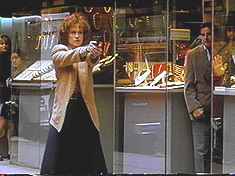
Emily freaks out in a major fashion upon learning that Ariel has never met his intended, Shayna. However, Ariel believes that Shayna will prove to be his beshartah (or something), his destiny and soul mate. Hasidic tradition teaches that God created one perfect soul mate for each man and woman on Earth. He believes that Shayna is his, and vice versa. Emily, of course, finds all this a little odd, and asks what about love and passion and romance and that stuff. He replies that, if she has known love, where her husband and children are. Angered, Emily replies that love needn’t result in those things. Of course, you can argue either side here, but what’s noticeable again is that Emily has a total inability to deal with the fact that other have different expectations than hers. His point is telling: if ‘love’ is so important, than why has it failed to provide her with a lifetime companion. If Emily finds the idea that one equals the other personally offensive, than she should be adult enough to realize that Ariel is entitled to find her conception of ‘love’ and ‘passion’ less than satisfying. When you get down to it, Emily is annoyed because she finds Ariel attractive and wants to sleep with him. Yet, because of his beliefs, that will never happen, even if he reciprocates her feelings. Ariel practices immediate self-denial, believing in long-term benefits. In the end, Emily resents Ariel’s beliefs mostly because they deny her what she wants, when she has made a habit of denying herself nothing. There’s a word for this, and it’s selfishness. Emily sees something she wants and takes it. Ariel sees something he wants and is willing to deny himself that thing. Frankly, I find Emily’s inability to see this as anything other than a ‘lie’ to be both childish and offensive, and I don’t think that I’m alone in this. Of all the grotesque moral postures, the self-righteousness of the Hedonist is perhaps the most offensive. At the store the next day, the Baldessari brothers make their entrance. After they accept the payoff, Emily pulls her weapon and places them under arrest. Hilariously, when she informs Levine over the bug to call for backup, we see that he’s getting a busy signal on the phone. Apparently, this is before police officers were issued the exotic technology known as ‘radios.’ Going through their belongings, Emily comes across a jewelry bag from the store. "It’s Yaakov’s!" Mara bizarrely divines. "It’s one of the three he had the night he was murdered!" Emily then stupidly attempts to come from behind the counter, rather than just holding them until backup arrives. This allows the Baldessari’s to smack her with the push-up counter panel and take off running. Frankly, this entire operation is an ill planned fiasco. No wonder Emily kills so many suspects: she keeps giving them the chance to run off and has to shoot them to prevent their escape. The following shootout sequence appears to have been, shall we say, ‘inspired’ by the bank robbery shootout in Don Siegal’s Dirty Harry. Levine pops up and puts a bullet through the Baldessaris’ car window. The car is disabled, but Levine breaks his ankle in all of the, uh, action. The Baldessaris jump from their crippled car, hijacking a cab just as backup arrives. Standing in front of their car, Emily pumps a couple of bullets through the driver’s side windshield (hey, just like Dirty Harry, in the scene previously mentioned!). The car crashes through the window of jewelry store. I’m sure that at this point all of Emily’s Hasidic pals are really glad to have made her acquaintance. Fatally wounded, one of the Baldesseri’s makes a sort of reverse deathbed confession: They were not, in fact, responsible for Yaakov’s death. Exactly why a dying man would feel compelled to un-confess to the woman who just killed him and his brother is utterly ignored. Emily visits Nick, still in the hospital, but almost recovered. Nick asks Emily if she’ll marry him. She turns him down. When she also turns down his offer to live together, he tells her that he just can’t be around her then. He wouldn’t be able to control himself. Almost getting killed has given him time to think, and he’s decided that it’s time to move on to a relationship that could go somewhere. Emily stills finds herself unable to surrender her independence. Gee, could her inability to commit stem from her unhappy relationship with her father? (See earlier scene.) What a rich psychological tapestry this film weaves! We next see Emily sitting alone in her apartment. She’s been bingeing on junk food and cigarettes, sitting on her couch wearing only an old shirt and watching Fred Astaire movies on the TV. The bell rings, and she gets up to answer the door. It’s Ariel. Emily notes that he’s breaking the rules by being here alone with her, and he agrees. Uncomfortable with her minimalist attire (although ignoring her microscopic acting ability), he asks if she could throw something on. Proving to be a gracious a hostess as she was a guest, she tells him to lump it or leave. (Are we supposed to actually like this character? Just wondering.) Ariel, seeing Astaire and Rodgers dancing on the tube, expresses wonder at their magical skill. Emily proceeds to show him some steps. I assume, again, that this is supposed to be that analog of the ‘romantic dance’ scene in Witness. If so, then the comparison again ill serves our present feature. Ariel expresses his disappointment that Emily left without saying good-bye to anyone. (Uh, is it just me, or does that seem especially rude, even for Emily?) She replies that that’s how her mother left her father (wow, it’s all coming together). Well, I guess that that justifies it. She notes that her mother couldn’t take how her father took the strains of this job out on her. Emily asks if he thinks that’ll happen to her, if some guy will find her too angry, too hard. Perhaps, but from what I’ve seen, ‘rude’ and ‘ignorant’ would top the list. Emily continues to whine about her crappy life. This makes her all the more attractive. When she learns that Ariel is due to meet Shayna that evening, she attempts to seduce him. Ariel finally asks her to lay off for his sake, and she agrees. The relieved Ariel reveals his other reason for coming by. He wonders what Emily thought of Tony Baldessari’s anti-confession. He believes that Tony was telling the truth. He wonders if Emily’s original theory, that it was one of the Hasidim that killed Yaakov, was right all along. Emily, thinking about it, suddenly latches on to the fact that Mara mentioned that Yaakov had three gem pouches the night he was killed. How would she have known that? (See my examination below for the film’s faults as a mystery.) Mara also could have planted the gem bag in Chris Baldessari’s pocket. She even could have self-inflicted her ‘beating’ to implicate the Baldessaris, who could have read about the killing and decided to take advantage of the opportunity to offer the store ‘protection.’ Emily evens posits that Mara wanted her to bump off the Baldessaris, so as to tie up all the loose ends. Apparently, Mara was relying on Emily’s reputation as a trigger happy maniac to take care of that end. Ariel and Emily have figured this out just in the nick of time. For over at the Rebbe’s house, Mara is saying good-bye to Leah. In order to provide a convenient (if boring) ‘suspense’ element for the climax of the picture, Leah decides to hide her necklace in Mara’s purse, as a gift. She’s shocked to find a pistol and bricks of cash in Mara’s bag. (Hmmm, that Mara’s a regular Moriarty!) Unsurprisingly, Mara returns in time to catch Leah in the act. Outside, an assembly of the Hasidim are congregated to greet the arrival of Shayna and her father from France. Apparently, no one’s noticed that Ariel didn’t bother to show up for his soul mate’s arrival. Mara, meanwhile, tries to smuggle Leah out of the house. Our detecting twosome drive up just in time to spot Mara and Leah’s exit. Emily pauses to provide Ariel with a revolver. (Uh, is it standard procedure to equip civilians with firearms?) Her plan is to let Mara catch them, thinking that she’ll never think to search Ariel for a weapon. Leaving the car, they corner Mara into entering the deserted synagogue. Emily offers Mara a deal: She’ll drop Murder One, and settle for a ‘deuce.’ Now, there’s a couple of problems with this. First of all, charges are decided by the District Attorney’s office, not by the cop who makes the arrest. Second, ‘murder one’ in New York requires the killing of a police officer. Mara is liable, at most, for murder two. (Is that what a ‘deuce’ is?) In any case, Mara turns down Emily’s offer. Emily gets knocked out by Mara. Ariel offers to let Mara walk away if she’ll just leave Leah behind. Mara refuses, and, rather than endanger Leah’s life, Ariel pulls his gun and blows Mara away. Then he breaks down and cries. Perhaps because once he had the drop on Mara, he could have ordered her to surrender rather than shoot her. Still, better safe than sorry. Emily is taken to the hospital for observation. The Rebbe, Ariel and Leah drop by to visit her, and the Rebbe mentions that he views her as his own daughter. Presumably the really, really rude daughter with the potty mouth. The others leave, but Ariel stays behind for a word with her. He says his final good-byes, and then leaves the room. Shayna’s outside, and Ariel apologizes for being alone with another woman. He’ll understand if she wishes to leave him and return to France (cheesy French music, instead of cheesy Jewish music, plays under this scene). Shayna says she will leave, but only if it’s what Ariel wishes. Then, in a mind-numbingly ham-fisted bit (er, I apologize if ‘ham-fisted’ isn’t a kosher phrase), Shayna quotes the Cabala. Hey, she’s a brilliant rebel, too! Even more than Ariel, as (I assume) Hasidic women aren’t allowed to study the Cabala. This line is included so that the audience is assured (in case we were worried) that Shayna is Ariel’s real soul mate. Boy, that’s a relief! I know that I feel better. We cut to the wedding, which is quite an elaborate affair. In an odd shot, Ariel sees Emily. She’s presumably there to give her blessing, but she disappears after someone walks in front of her (?). Back at the station, Emily comes across Levine, hobbling around on his crutches. He offers to take her to Aruba while he’s on leave, but Emily has become a new woman due to her adventures. She now awaits her soul mate. End movie (and none too soon). Comedy Bonus: The Video Box for A Stranger Among Us: Now remember, when you rent a movie (depending on the store you rent from), you not only get the tape but the video box for a day or two. Since you’ve already spent your money, there’s no reason for the savvy Bad Movie fan not to cast an eye at the box in search of additional laughs. In this case, we hit video box paydirt. On the front of the box is a picture of Melanie Griffith, leaning against a car door, brandishing a large silvered handgun that fails to make an appearance in the movie. Aside from her name and the title, the following tagline is featured: "In a dangerous world of mystery and intrigue, she’s going undercover searching for the truth." (Uh, are we to take the Hasidic community to be the "dangerous world of mystery and intrigue" referenced?) Then there’s a critic’s quote, describing our feature as "A Riveting Top-Notch Thriller!" Here’s a hint for you from an old hand: When the cover of a video box features a quote from "WNCN Radio, New York", well, rent at your own discretion. But it’s the back of the box that really pays off. There are two more quotes from critics. Jeffrey Lyons, then of PBS’ Sneak Previews, describes Griffith’s acting here: "The Best Performance of Her Career!" This rather, er, unusual insight provides evidence as to why Mr. Lyons failed to become one of the nation’s preeminent movie critics. Meanwhile, "ABC-TV, Los Angeles" informs us that, "This Is A Film Worth Seeing!" I, of course, totally agree, although perhaps for different reasons. There are also four featured photos: Emily holding a gun on the Baldessaris, Emily in a clinch with Nick, Emily finding Yaakov’s corpse (although only his arm is showing here) and Emily entering the Baldessaris’ smashed up car. Then there’s the text: "Academy Award - nominated star Melanie Griffith (Best Actress Nominee - Working Girl; Pacific Heights) turns in a winning performance as detective Emily Eden, a tough cop forced to go undercover to solve a puzzling murder. Her search for the truth takes her into a secret world of unwritten laws and unspoken power - a world where the only way out, is deeper in! Delivering edge-of-your-seat excitement that won’t let you go, this action-packed thriller is sure to entertain you with it’s sizzling star power, electrifying story and non-stop surprises!" Ok, so what do we notice? How about that none of the box’s pictures or ‘descriptive’ text mentions anything about the Hasidim, who are rather unconvincingly described as "a secret world of unwritten laws and unspoken power". Now, not only are all the Hasidim’s ‘laws’ written, but what’s this ‘unspoken power’ they’re talking about? Had the writer of this description been reading The Protocols of the Elders of Zion or something? Apparently, when the movie bombed, someone must have thought that it was because of the whole "Jews" theme. (My theory: It was because the film sucks.) So they decided to skip this ‘minor’ element of the plot when writing about it. Also nice is when they try to imply that Griffith had been nominated twice for Best Actress. Despite the shifty description, she was only nominated for Working Girl, not for Pacific Heights. Also, notice how they use the phrase ‘winning performance’, obviously trying to dupe people into believing that she was nominated for this film, and won (!). Also, the only recognizable actor here is Griffith, which hardly warrants the term "sizzling star power." And since the only sequence in the entire film that could really be described as an "action scene" is the jewelry store shootout (and not much of one, at that), describing the movie as "action-packed" is a bit much. The copywriter also (and I can just see him patting himself on the back for this) has the temerity to paraphrase William Shakespeare’s MacBeth. MacBeth, so entrapped in his own murderous scheme to steal a kingdom, notes that, "I am in blood stepp’d in so far that, should I wade no more, returning were as tedious as go o’er." Maybe I’m reading too much into this, but I just picture this copywriter as a failed, frustrated ‘author’. A guy who thought to winkingly allude to the above quote by writing, "a world where the only way out, is deeper in!", and thus prove his own intellectual and artistic powers, no doubt vastly superior to those barbarians he worked for and the mutton headed proles destined to read his demeaning commercial prose. Finally, the video box description utterly fails to convey the very important fact that this film sucks big time. This could lead to people being surprised by this essential fact should they rent the movie. Afterthoughts and Perhaps Controversial Theories: On A Stranger Among Us, as a Mystery Film. Among the film’s major problems is its poor construction as a murder mystery. This is probably less of a disadvantage for more recent audiences. Murder mysteries is one of those film genres that has more or less died off. This is, I believe, because the point of a murder mystery was to figure out who the killer is before it’s revealed. In other words, it’s a kind of puzzle. Modern audiences, however, appear to resent the idea that they should be forced to think at the movies. They don’t appreciate basic plot or character nuances, much less puzzles. Largely unaware that they are even supposed to be figuring out who the murderer is, they remain content to wait until the killer’s identity is revealed. And this means that when a filmmaker occasionally decides to make an murder mystery (just as they periodically attempt to make a western now and then), they don’t have much expertise to fall back on. In fact, filmmakers often prove themselves to be as analytically deficient as their audiences. This leads to ‘mysteries’ that are poorly constructed, the worst possible flaw that can inflict a mystery. So you end up with a movie that most of the audience doesn’t even understand the purpose of. And those audience members that do bring analytical skills to bear often figure out who the killer is in about ten minutes, often more from the film’s structural flaws than from the ‘clues’ presented. Annoyed, then spend the remaining running time dissecting the film’s logical failings. For instance, take the Gene Hackman killer-on-a-train movie Narrow Margin (Warning: Spoilers!). Hackman is attempting to save a murder witness from an unknown professional killer. Less then halfway through the movie, I turned to my companion (much to her annoyance) and identified this one woman character as the assassin. It was just so obvious. The screenwriter had failed to provide any other suspects, except for one fellow who was so patently suspicious that he couldn’t possibly have been the killer. Instead, there was this woman who served absolutely no plot purpose, other than as a vague romantic foil for Hackman. When she made her third appearance, it became obvious that she was the killer. Otherwise there was no reason for her to keep appearing, other than to ‘surprise’ us when we learned her profession. Needless to say, this all proved to be, and I spent that whole picture fuming at its poor construction. A Stranger Among Us is rather like that. For the trained ‘murder mystery’ fan, even the acting credits give the killer away. Actress Tracy Pollen, who plays Mara, is listed forth in the credits. Now, first of all, she’s not a ‘name’ actress, so she didn’t get her placement that way. And through almost all of the picture, Leah is a much bigger character than Mara. But Mia Sara, who plays Leah, is listed sixth in the credits, two places lower than Pollen. So the conclusion of the savvy viewer is that Mara must be the killer, and so the role was considered ‘juicer’ than Leah’s, and thus listed higher in the credits. This line of thinking is similar to the general rule of TV shows like Murder, She Wrote and Diagnosis: Murder: The killer will most likely be whoever the ‘biggest’ guest star is that week. Besides, like the lady assassin in Narrow Margin, Mara had no other real plot purpose to justify her continuing presence. This was a red flag, and tends to draw attention to her as the possible killer. And by the time she tells Emily her history, revealing that she’s not a Hasidic Jew by birth, well, hit me with a brick. She’s obviously an ‘out’ character, designed so that the killer won’t turn out to be a real Hasid, which the audience wouldn’t buy. So the knowledgeable viewer is already keeping an eye on her. By the time they give her one of those classic "you said something only the killer could have known" lines, we’re rolling our eyes in disgust. After all, this sort of ‘clue’ is one of the hoariest kinds, both blatant and simplistic. They might as well blare sinister music at her every appearance. Finally, I must stress again that having the dying Baldessari inform Emily of his innocence is a plot device of the rankest sort. What possible motive could this guy have to spill his guts to the woman who just, well, spilled his guts? Did he not want to die with a crime, er, not on his conscience? They might as well as just had a guy walk up after the shooting and say, "Why, it’s the Baldessaris! I haven’t seen them since they were playing poker at my house on the night that Yaakov Glassman was murdered!" Compare & Contrast: Witness and A Stranger Among Us. Still, what really kills the film is comparing it to the movie that it cries out to be compared to; Peter Weir’s Witness. It seems impossible to ignore the fact that Weir’s modern classic ‘inspired’ A Stranger Among Us. This, to say the least, works to the disadvantage of the later film. Here’s a quick run down of Witness, for those who haven’t seen it. Rachel Lapp (Kelly McGillis) is a young Amish woman whose husband has recently died. We open with his funeral. Rachel has a perhaps eight year old son, Samuel, and they board a train to visit Rachel’s sister. However, the connecting train is late, and while waiting Samuel witnesses a murder is the depot’s washroom. They are soon interviewed by Detectives Book (Harrison Ford) and Carter. Book is shocked when Samuel identifies Narcotics Officer McFee (a young Danny Glover) as the killer. Book goes to his superior, Schaeffer, with the information. However, when McFee shows up and tries to kill him, Book realizes that his boss is in on it. Wounded, and realizing that Samuel is also in danger, Book drives him and Rachel back home before collapsing. Aware that if Book is found the killers will come after Samuel, Rachel convinces her father-in-law (in whose house she and Samuel live) to keep Book there until he recovers. Book does recover and hides out in the community until he can figure out how to handle the situation. Meanwhile, he and Rachel begin to develop feelings for each other. This is much to the disapproval of the community elders. Also alert to the situation is Daniel, an Amish man who obviously intends to court Rachel and sees her attraction to Book as a danger. This problem is magnified when Book displays his carpentry skills at a barn raising (actor Ford once made a living as a carpenter), winning the respect of the locals. Book, however, realizes that he must return to his world, and so refuses to sleep with Rachel when the opportunity presents itself. Book then learns that his partner has been murdered. In a resultant state of rage, he reacts to a local situation (yokels humiliate the proud Daniel, knowing that he can’t fight back) violently. Since he’s disguised as an Amish, this draws attention, and Schaeffer and McFee soon appear to take him out. Book manages to knock off McFee and another bad cop before being captured. However, alerted by an alarm bell, the entire Amish community comes running. Realizing that the situation is now totally out of his control, Schaeffer surrenders to Book. The situation over, Book leaves to return to the ‘outside’ world, leaving Daniel to be the husband to Rachel that he could never be. The biggest difference, by far, is the films’ respective presentations of the Amish and the Hasidim. Now, I’m assuming that Sidney Lumet was hired to direct A Stranger Among Us for two reasons. One, he had a history of directing strong police oriented films (Serpico, Prince of the City, etc.) Second, because he’s Jewish. One assumes that the filmmakers felt safer having a Jewish director for this film. Still (and here’s the ‘controversial theory’ part), Lumet’s ultimately a Hollywood Jew rather than a Hasidic Jew. It’s obvious that he, and the others involved in making the film, had trouble believing that the typical audience would be able to ‘connect’ with the Hasidic characters. There’s two ways to explain this attitude, neither very complementary to the filmmakers. The obvious answer is that, like Levine in the film, they themselves were at least a little embarrassed by the Hasidim. After all, Hasidic Jews live by rules and concepts that are anathema to Hollywood: self-restraint, the downplaying of physical pleasures in favor of spiritual growth through a lifetime of depravation, an utter rejection of what might be called the Life of the Self. Because, make no mistake, the Life of the Self is the only religion practiced in Hollywood. Ultimately, Hasidic Jews commit the only real crime that Hollywood as a community recognizees: they’re uncool. But let’s assume that I’m wrong. Perhaps the film’s egregious portrayal of the Hasidim isn’t due to the filmmakers’ instinctual loathing/bewilderment at all they represent. Very well, here’s a slightly less insulting theory: Lumet and company assumed that the film’s intended audiences ‘out there’ were going to be less sophisticated than they themselves (it’s generally recognized by the denizens of Hollywood that they represent the very pinnacle of Man’s progressive sophistication). Such audiences couldn’t be expected to be ‘open’ to the experience of identifying with such a, well, quaint group of people. As well, it’s also well known in Hollywood that the vast majority of those living outside it’s borders are, at best, unconsciously racist and anti-Semitic. Therefore, Emily aggressively represents the Life of the Self because the filmmakers either couldn’t themselves deal with the Hasidim, or because they believed that ‘those people out there’ couldn’t (most likely, they used the second excuse to cover up their own discomfort). To whatever extent the filmmakers believed that mainstream audiences wouldn’t care to identify with such lifestyles, however, they were mistaken. This is strongly suggested by the success of Witness. It’s worth noting that Witness director Peter Weir had recently arrived from Australia, and thus was unsaddled with the ‘intellectual’ baggage of the typical Hollywoodian. (In the same way, the examination of fascist politics in European Paul Verhoeven’s Starship Troopers shows that film to be the work of a non-Hollywood director.) As well, the portrayal of Aborigines in Weir’s earlier movie The Last Wave showed that he had an ability to portray members of insular sub-cultures while still allowing them to be fully fleshed out characters. He pays the Aborigines the respect of showing them to be, whatever their cultural differences, just people. I believe that this is why Witness works so well: Weir, unlike a director steeped in Hollywood-think, had no trouble understanding that mainstream audiences would find much of merit in the Amish lifestyle. If unable to live by their strict rules, they would still be able to recognize why others would choose to. Witness works because Weir (along with star Harrison Ford, who lives in Montana when not making movies) himself actually found merit in the way the Amish lived, and didn’t believe himself smarter than his audience. Where else to start contrasting these two films? Well, it’s hard to start with something more basic than the films’ titles. Witness is a nuanced, multi-layered title. Samuel, of course, is literally the ‘witness’ of the title. Yet the word witness also has religious connotations, i.e. baring witness, although that is admittedly more applicable to Evangelicals Christians than to the Amish. Still, the film’s plot is kicked off by with an act of witness (Samuel seeing the murder) and ends the same way. The film could have ended with one more act of violence, with Book killing Schaeffer. Instead, we see Schaeffer despairingly surrender when he realizes that there are now too many witnesses to his perfidy. Killing a small handful of people to protect himself was a logical progression of his corruption. At the end, though, even if he could somehow kill all the dozens of witnesses, the enormity of such a crime is beyond him. It would be too large an act for him to rationalize. A Stranger Among Us, however, fails as a title in even the most basic manner, as an accurate indication of the film’s themes. For the world of the Hasidim is presented as alien throughout the film. For the title to make sense, the film would have to present the point of the view of the Hasidic characters, and their reactions to Emily being in their midst. However, Emily is the character we’re meant to identify with, and it’s her point of view drives the film. So an accurate title would in fact be I Among the Strangers. Making this even more ironic is that the title would actually work better as an alternate title for Witness. There, we open in the Amish Community. When we eventually leave it to enter the ‘real’ world, we are shocked at its noise and chaos (despite that fact that this is our world). The Amish community is presented attractively, radically different but understandable, never as bizarre or alien. We spend most of the film there, and thus Book represents a stranger among them in a way that Emily never does. This is all the more true in that Book truly comes to respect the values of the Amish, but realizes that he could never live by them. Although his ‘original sin,’ the one which will cast him out of the Amish community, is violence, rather than sex. Book fully intends to kill Schaeffer and McFee after learning of Carter’s death, and he could never take the kind of abuse that Daniel, himself a proud man, accepts rather than to betray his beliefs. Significantly, this is the audience’s ‘sin’ as well. For the film’s biggest audience pleasing moment, by far, is when Book beats up the jerks who are harassing Daniel. (In a moment that makes the Amish characters human in a way that the Hasidim never are, we see Daniel taking satisfaction in Book’s actions.) Meanwhile, we accept the fact that Rachel and Book deny their intense sexual attraction as laudable. Even when there’s a point where they may have, in fact, given in, the film cuts away, leaving it up to us to decide whether they have or not. A Stranger Among Us, however, seems to assume that we’ll identify with Emily’s anger that Ariel won’t sleep with her because of his dumb, old fashioned rules. This largely reflects Hollywood’s Politically Correct mindset. While it might find a rejection of violence admirable, as with the silly shot of Leah’s tearful horror at the sight of Emily’s pistol, it finds repression of sexual urges childish, in fact actually dangerous. So it respects Ariel’s horror when he is forced to kill Mara, while largely sharing Emily’s frustration with his sexual ethics. Witness, meanwhile, constructs a context for the behavior of the Amish. Consistently, we see a disapproval of temptation, or behavior that isn’t itself sinful, but which could lead to sin. Therefore, the community disapproves of Rachel’s attachment to Book not because they necessarily believe that they have done anything, but because they are creating a situation in which wrongful behavior might occur. This explains Eli’s horror when he finds Book and Rachel alone and dancing to golden oldies issuing from Book’s car radio. Rachel refuses to be censored for acts that haven’t occurred yet, but her later actions prove that Eli’s fears were justified. Another scene has Eli sitting down with Samuel after he has expressed interest in Book’s revolver. Book had freaked when he caught Samuel handling it, but only because it was loaded. Once it was ‘safe,’ he allowed Samuel to handle it. To Eli, however, it remains dangerous. He explains to Samuel that a hand gun is designed purely to kill people (more or less true), and that makes it an unclean thing. As they believe that only God should take a human life, the mere existence of the gun borders on sacrilege. This scene, which lays out a consistent and coherent point of view, makes Leah’s horrified reaction to Emily’s gun seem all the sillier. Then there’s the ‘outside’ world, as presented in both films. While we live with the Lapps, the outside world, the one we live in, comes to seem vulgar and loud. When they venture outside their own community, the Amish are confronted with attitudes that range from patronizing to downright hostile. Tourists take their pictures, which the Amish dislike, and in general coo over them like they were those cartoon costumed folks you see at Disneyland. Then there are those who decide to taunt them, secure in the knowledge that their beliefs will keep them from responding in turn. This is reminiscent of those jerks who try to get the guards at Buckingham Palace to ‘break character’ while on duty. Meanwhile, Emily’s world is shown to be the ‘real’ one in her film. The Hasidic interiors are consistently shot in a sort of fairy tail lighting, emphasizing the community’s ‘otherworldliness.’ While we can believe that Book would want to stay in Rachel’s world, we never believe that Emily would possibly even consider staying in Ariel’s. And while they pay lip service to Emily being morally changed by her time with the Hasidim, this is ineptly conveyed. The scene that is supposed to convince us of Emily’s enlightenment is when she turns down a fun and free sexual vacation with Levine. However, since we never got any indication that she found Levine at all attractive, this is less than convincing. As noted earlier, the filmmakers felt it necessary to portray Ariel as a ‘rebel,’ in order to make Emily’s attraction to him ‘convincing’ to the audience. Then, in order to placate our expected qualms (which never materialize) about Ariel’s arranged marriage, we find that his intended is a fox who’s even more rebellious than he is. Witness, in contrast, feels no needs to make any of the Amish more ‘modern’ so that we can ‘identify’ with them. In fact, once Book leaves, we know that Rachel will eventually end up with Daniel. Not, however, because he’s the Amish guy closest to our own outside world. Quite the opposite, in fact. We understand that while Rachel may never love Daniel as she does Book, he can be the husband to her that Book never could be. Ultimately, Daniel is a good and attractive man who shares her world and beliefs, the very things that define them to their core. In the long run, this means more than her feelings for Book. One nice thing about the film is that Daniel is never presented in the manner of the ‘compromise guy.’ The Compromise Guy is the guy that the heroine of movies is going to marry, in spite of the fact that he doesn’t, you know, set her on fire. Compromise Guys are always nice and steady, which translates in movie land to boring. For instance, in Sleepless in Seattle, we know that Meg Ryan will never marry her boyfriend because he snores. This is exactly the kind of picayune flaw that marks a guy as a hopeless nerd. Instead, our heroines invariable opt for whichever Mr. Perfect the filmmakers come up with. And since Compromise Guy is so nice (translation: loser), he always chooses to stand aside, making it comfortable for us in the audience to deal with our central character dumping a perfectly nice fellow ("See, even he sees that she really belongs with him!"). Oddly, men are never allowed in movies to dis a woman for such ridiculous reasons (while the heroine can always relate these petty foiables to their friends, who react with horror). A rare exception of the Compromise Girl can be found in Twister, where we know that Bill Paxton’s fiancée will step aside so that he can be with soul-mate Helen Hunt. In How to Make an American Quilt, Winona Ryder is ultimately advised by her female elders to go with, not the guy who will always be there for her, but the guy who sets her loins on fire. (The loins is the closest Hollywood can now come to the heart. That’s why every time a couple in a movie falls in love, we are subjected to a sex scene. Because, you know, how can we believe that two people have some kind of emotional connection if we don’t see them having really great sex? You know, movie sex.) The fact that marriage might have to last past a time when flaming loins are the point of the relationship (I know, I know, how bourgeois) rarely seems to occur to anyone. Daniel, however, isn’t a Compromise Guy. He’s smart, funny and handsome. His wariness of Book as a danger to his plans to marry Rachel is never portrayed as selfish or unseemly. And we never doubt that he’ll make a good husband for Rachel and father for Samuel. Perhaps he represents a compromise for Rachel, but in the real world, he represents about the best possible compromise that a person could rationally hope for. As well, Daniel’s ability to take the abuse of the townies reveals him to be a admirable man of deep convictions. We know that Daniel is a proud man. Yet he allows himself to be made a fool of rather than compromise his faith in something larger than himself. His ability to sacrifice his dignity for his beliefs, the ones that he and Rachel share, mark him as the more appropriate mate. Ultimately, Witness is a film about adults. It’s appropriate that Book is played by Harrison Ford, one of the few stars we have today that honestly seems to be, well, a man. (Tommy Lee Jones is another. He’s the Scott Glenn who made it.) We live in a society in which growing old is one of the few recognized sins, and our movie stars reflect this. ‘Boyishness’ is perhaps the quality that best defines them. This is why so many of the them have trouble when they eventually try to play realistic everyday adults. Christian Slater is a prime example. But think of the others. Tom Cruise. The smirking Bruce Willis. Brad Pitt. Jim Carrey. Even today’s ‘serious’ actors, the Jack Nicholsons and the Al Pacinos and Robert DeNiros seem false when not playing goofballs and oddballs. Compare them to stars of yesterday. John Wayne. Kirk Douglas. Robert Mitchum. James Stewart. Burt Lancaster. Humphry Bogart. Charleston Heston. These guys were adults, and came off that way on the screen. The actors we do have now that can play adults on screen are all veterans who seem doomed to playing character parts, like Robert Duval, Morgan Freeman and Gene Hackman. (This is one reason why Unforgiven was such a classically great movie. Eastwood, Freeman and Hackman, all in one movie. Enough sheer acting talent and screen charisma to blow away any audience.) And many of them are in their sixties and seventies. What’ll we do when they’re gone? Here again the comparison works to the detriment of our subject. Harrison Ford stars in one. Meanwhile, Melanie Griffith gives a ‘performance’ that reeks of childish self-concern. She’s petulant and self absorbed, and as often as not is throwing a temper tantrum when she doesn’t get her way. We can buy that Book is as good of a cop as he thinks he is (and he apparently believes that he’s the cat’s pajamas). But we can’t believe that anyone takes Emily seriously as a police detective. And while Book deals with his wants on an adult basis (weighing th pleasure of fulfilling them against the harmful results that might occur), Emily pursues hers like some character on MTV’s Real Life. Aside from the big stuff, there’s the little things done right and wrong. In Witness, action scenes are exciting. Humorous scenes are funny. Little character moments enrich and illuminate the cast, from the main characters to the bit players. The acting is superb throughout the entire film. And so on and so on. Time, however, keeps me from pursuing this subject in even greater detail. I’ll leave that up to you guys. Review by Ken Begg |