Another feature of... |
|
Another feature of... |
|
|
|
The Trial of Billy Jack -
Jabootu's Bad Movie Dimension
The Trial of Billy Jack page 3
Billy, back in his normal garb and sans the red paint, returns to the bottom of the mountain. Sure enough, he finds the radical kids waiting for him. They entreat him to lead their bombing raid against the townsfolk, and maybe do a couple of kidnappings (!!). Hey! Wait a minute! It just hit me that the lessons Billy just learned from the Spirit Maiden coincidentally apply exactly to what the radical kids are asking him to do!! Wow, that’s almost creepy. Unsurprisingly, Billy turns the kids down and suggests they abandon the Road of Violence. At the same time, however, he lectures them at length about Social Injustice and stuff, but I’m frankly too tired to get into it. However, I did perk up when he criticized "psychotics" who would "kill a lot of innocent bystanders and maybe grab a lot of headlines by spouting some sophomoric slogans about ‘class struggle.’" OK, that legitimately makes his stance on non-violence a lot more even-handed and respectable. Again, though, he’s Billy Jack, so you know he’s going to be pulling those boots off sooner or later, no matter what the Spirit Maiden told him. We cut to the town. There the National Guard are deployed in the street, arms at the ready, as if awaiting a swarm of giant, mutant insects in a ‘50s sci-fi movie. (They should be so lucky.) "What the hell is that?" the commanding officer, a Colonel, snarls. "Sounds like…drums," a subordinate replies. The Colonel puts his men on alert, but it’s far too late. Yes, the horrifying truth of the matter is that, as the DVD chapter title states, this is where the "kids fight back with love". Blech! However, this allows a weirdly triumphant Sheriff Carl to scream mockery at the Colonel. A scout drives forward and learns that the
sound heralds a literal parade of hippies, who have come to march through
the town. Some are on flatbed trucks and some on foot, but all clap loudly
in rhythm to loud band music. One flatbed displays the school’s Yoga Belly
Dancers, decked out in full belly dancer regalia. Take that, Joe Sixpack! In any case, there’s little doubt that all
this unauthorized, unlicensed noise and traffic disruption is sure to get
the hoi polloi on the students’ side. And cannily, the majority of the
parade is designed to appeal to the unsophisticated hicks and rednecks that
reside in Anytown, USA. There’s a marching band and a cheerleading squad
performing baton drills and other vulgar sights to placate the masses.
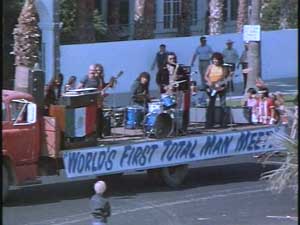
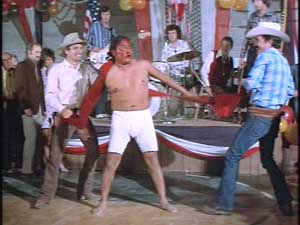
The Colonel sneers in frustration at the sight, presumably because this clever, non-violent ploy does not allow him to open fired on that tantalizing hoard of hippies. (Yes, it does, Colonel! Shoot! Shoot!) Soon a public address system is employed, and the townsfolk learn that they are witness to: "The world’s first Total Man Meet in history." Uh, you might want to work on that name a bit. Next the Loud Speaker Lady asks (seriously), "Howard Cosell, where are you?" (In a much better place sweetheart. In a much better place.) For some reason—and again I’m guessing it’s because they believed him to be an identification figure for the ignorant hillbilly town dwellers—this is a slogan for the parade, as indicated by a large sign posted on one of the lead parade trucks:
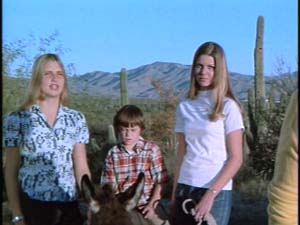
And yes, that’s right; they managed to spell his name wrong. (!!!) The parade, much like the movie it appears in, is loud, seemingly endless and highly unentertaining. Meanwhile, what is torture without first having instilled the fear of torture? And so the Loud Speaker Lady sadistically spells out what the innocent citizenry is in for: "Each team has a poetry team, a belly dance team, a rock band, a sprinter, a pole-vaulter and a relay team!" (A belly dance ‘team’? Has there ever been such a thing?) Moreover, the Loud Speaker Lady assures her captive audience that anyone can join in on these far out activities. However, there will be no prizes or awards, because those are icky and might even (ugh) favor the talented. Meanwhile, director Laughlin attempts a bit of satire—although again, humor isn’t exactly his forte—by contrasting in the same shots the glowering, rigid, automaton-like National Guardsmen with the joyous free spirits taking part in the parade. Of course, the Colonel must be a laughably paranoid sort, and so he reacts to the parade by ordering his men to be made ready for action. "Be on the alert!" the order dutifully rings out, as the camera plays over some cheerleaders, "This could be a clever diversionary tactic!" Ha! Dr. Strangelove had nothing on this picture. We jump forward to sometime that evening. On the way back to the School, a bus ferrying some of the Groovy Gang has become stranded in the desert, its tires mired in some loose dirt. Lynn and Carol are on the scene, and Lynn has been radioing into the school for replacement transport. Meanwhile, a call has been made to town, requesting a tow truck. After a while, some cars appear at their remote location. Russell naively assumes that someone has come to help, but Carol is wiser. Heeding her friend’s fears, Russell radios in and asks that somebody phone the Sheriff’s office. However, a whole posse of hostile cowboys—wearing ten gallon hats and even revolvers in holsters (!), the whole rig—climbs out and prepares to have their evil way with the peace-loving students. The leader of the Mean Cowboys, Jason, smashes one of the kid’s guitars. This apparently was manufactured in East Germany, since it appears to have been made of balsa wood. I personally was willing to give this guy the benefit of the doubt, thinking that perhaps he was trying to reach out to the groovy youngsters by doing his Pete Townsend impression. Either that, or he might have simply been acting in self-defense. These kids might not fight, but they do sing—sort of—and having heard them I know which one I’d be more worried about. Russell tells Carol that nobody can find the Sheriff, but that Billy is on the way. Of course, now that he’s embraced non-violence, I’m sure he’ll follow in the removed boots of Mahatma Gandhi and refuse to engage in fisticuffs no matter what the provocation. Suuure, I do. Tiring of picking on stringed instruments, the cowboys begin working over one of the students. Then they team up to push over the stranded school bus, an action punctuated by the sort of music that alerts the viewer that Bad Stuff is happening. Following this, a can of gas is produced and the bus is doused with petrol. Carol begs for them not to set their vehicle alight. In answer, Jason punches her in the stomach. (This is also Bad Stuff, according to the music.) That accomplished, he stokes up his disgusting phallic cigar—which is just the sort of thing a ‘man’ like him, who undoubtedly has a small penis, would be smoking—and tosses it at the bus, which bursts into aflame. It’s like the most terrifying episode of The Partridge Family ever. And thus, after nearly an hour and fifty minutes, we finally get the sort of action that Laughlin’s audiences theoretically wouldn’t want but no doubt were by this time badly craving. First, a nice bit of safely outrage-provoking arson, followed by the appearance of Our Hero. I can almost hear them as they sat in the theater: "Go, Billy! Show them that they don’t control you! Remain completely non-violent no matter what they do to provoke you! That’ll show them!" Billy surveys the situation and finds himself confronting not only about twenty guys, but with one veritable goliath who must stand at least six foot eight. Oh, wait, they actually go out of their way to confirm that he’s 6’ 9" and weights 285. Duh, sorry, this is The Trial of Billy Jack, and everything must be spelled out in excruciating detail. In any case, this fellow smugly towers over the diminutive Billy, which of course is meant to make us savor his inevitable ass-kicking all the more. Billy reacts by going into his patented, "Aw, shucks, you scamps, what am I going to do with you?" routine. At this, we’re supposed to start salivating like Pavlov’s dog, waiting for the moment when he beats this guy like drum. Except, of course, that at the same time we all abhor violence, but not, you know, against guys like this, because they’re like, you know, Nazis or something, and anyway people like that have always picked on us and certainly it can’t be too bad to see one of them get pounded into pudding, can it, even though of course it’s certainly beyond debate that violence can never be the answer but still… Taking his own sweet time about it—because this is, after all, The Trial of Billy Jack—Our Hero sets about repeating, only at greater length (which defines the relationship of the two films in a nutshell) that great moment in Billy Jack where he calmly informed Posner that he was going to kick him in the face and that there’s wasn’t anything Posner could do to stop it. This time around, Billy methodically explains to his gargantuan foe that all his mass isn’t going to stop Billy from taking him down by nailing a nerve cluster on the guy’s thigh. He even explains how such a blow done right—which of course, it will be—would "tear that muscle all the way down under the kneecap. You might even have to have surgery." It’s all a delicious set-up to that great moment of release when Billy finally does chop the guy, and one thing that’s so neat about the scene is that he does engage in what seems like real violence. This isn’t a movie fight where the two trade horrific blows for five minutes with little permanent effect. No, as Billy explains, he’s going to take the guy down immediately, in order to neutralize his size advantage, and in doing so do the guy real injury. This scene, therefore, fully illustrates the schizophrenia of Laughlin and Billy Jack. For all the hippy speechifying and Native American mystical mumbo-jumbo, the Billy Jack pictures are action movies, and ultimately they attract an audience because viewers want to see the good guy beat up some bad guys. In any case, I’m not someone who thinks that violence is never a solution. Therefore I’m not much bothered by the fact that Billy still decides to employ violence when he considers it necessary. If I were that sort of person—as, again, many of Billy Jack’s target audience proclaimed themselves to be—then I wouldn’t watch movies like this. So it’s not Billy utilizing violence that bothers me. Instead, it’s the undeniable joy Billy, and Laughlin himself, takes in being a bad ass. Perhaps Billy has decided that tragic necessity is now forcing him to lower himself to the beast level and allow someone else to control his soul blah blah blah. However, does that mean he has to take such evident satisfaction in it? Does he need to derive such patently obvious pleasure from being so superior to his opponent that he can taunt the guy about how he’s going to cripple him—which he does for well over two straight minutes before delivering the promised blow—secure in the knowledge that even so there won’t be any way for the guy to protect himself? That’s the fundamentally dishonest heart of the Billy Jack movies, and one the films’ fans can’t get around it. So Billy disables the guy, as promised, and then braces for an attack from the remaining cowboys. He responds to this by executing a series of kicks that downs four dudes, all of who scream loudly in agony. Again, I doubt that was intended to disgust or disturb anyone in the audience. That accomplished, he runs over to stop Patsy, who’s busting up one of the cowboys’ cars. "What do you think you’re doing?" he barks. "This just pulls you down to their level!" She sneers the obvious rejoinder, "Well, what the hell do you call what you just did?" Billy responds to this query with a look of profound shock. If I’m following this, this is meant to indicate that he only now realizes that beating those guys up violates the Spirit Maiden’s lessons. If so, Billy must be one of the densest heroes in motion picture history. In any case, Billy is bundled into a jeep and drives off with Carol and Russell. Hilariously, Patsy (and presumably others, given how many were in the bus) are left behind, still stranded, and at the mercy of the remaining cowboys, who you’d have to think are seriously pissed off right about now. Despite this, we never get any indication that the kids were subsequently molested. Cut to Russell and Jean walking around the desert and discussing the upcoming Indian Seminar. Then they come to a stop right in front of the camera, and Jean asks, "What’s the matter?" At this point we cut to an extremely tight close-up of the (presumably) just-arrived Carol. "Just look who They said would never leave his room," Carol replies. At this the image widens out and we see One-Armed Danny beside her, riding atop the previously established miniature burro. Jean then reacts with great pleasure at Carol’s triumph. Read that paragraph again. That’s right; this is just unforgivably horrendous filmmaking. The only way the action makes sense is if Jean doesn’t see Danny until we do. However, unlike the viewer, she’s not watching a film in which the flow of information is restricted by what the camera shows her. Instead, she’s supposedly facing both Carol and Danny, who are positioned three feet directly in front of her. It’s like one of those cheesy horror movies where the person in the film doesn’t see the monster until it lunges into frame with them, even when the setting would make its invisibility impossible. "Danny says he might like that thing now," Carol explains. She’s referring to one of those arm prosthetics equipped with an opening and closing pincer hook. So saying, we cut to Jean and Doc looking on later as Danny, prosthetic in place, is receiving instructions on how to play the guitar with his hook. (!!!) Consider that he would never even talk before, I’d say this represents a pretty good amount of progress. Freedom School, is there anything your enlightened inhabitants can’t do?
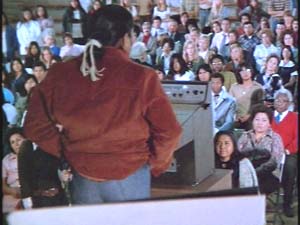
We next cut to some night or other, watching as an Indian male (this might be the same guy who was in Billy’s drowning vision) walks to his car. With a blare of music, a gang of rednecks previously obscured by the darkness is revealed when they turn on their car headlights in a synchronized fashion. I’m sure it was a lot of work to get that timing down just right, but hey, it’s a nicely dramatic effect. As an Ominous Tuba blats, we cut to the Indian, in slow motion, being forced down under some body of water, exactly as in Billy’s vision. (Wowsers!) This takes place in broad daylight, so I don’t know what they were doing with the guy in the meantime, especially since he doesn’t exhibit any obvious indications of manhandling. We then jump ahead, to find Sheriff Carl, Billy, Jean, Doc and others on the scene. The victim’s Volkswagen Bug (of course, what else?) is being hauled out of the water, and he himself is presumably dead. Even Doc is prepared to fold, telling Jean that "I hope this is going to end your Indian Legal Rights Seminar." Meanwhile, Jean cynically anticipates that the available evidence will suggest that the death was accidental. "What the hell did you expect?" the Sheriff asks. A bitter Doc picks up the refrain. "Yeah, a sign? ‘Courtesy of W. A. Posner and his friends from the CIA’?" (The CIA!!! Man, these people just can’t help themselves.) However—duh—the Seminar goes forward, and is even nationally (!!) televised. (So what, did they manage to rebuild their broadcast tower already?) A woman decked out with Indian jewelry is addressing a crowded room of, I guess, various civil rights experts and whatnot. Unsurprisingly, her remarks are oddly specific yet vague, fantastical but boring. "The mass confusion over what really are the Indian rights, makes it impossible for even Indians lawyers to grasp the laws that are mostly aimed at depriving him of thirteen million acres of prime real estate in the United States. Let us now look closely at…." And so on and so on. She also refers to a chart, apparently whipped up by twelve year-olds the night before the seminar, detailing various relevant committees of Congress. This purportedly illustrates how "two hundred and twenty million people are totally controlled by the votes of four or five [committee chairmen]." Well, sort of, except for the ‘totally’ part, which is ridiculous. Meanwhile, those four or five committee chairs first have to be elected by their constituents, but yes, that is in a gross sense how the representative form of government functions. Meanwhile, we cut away and see that these hearings are being watched by some of those selfsame congressmen in Washington. (!!) Next Blue Elk steps up and serves up another stew of obvious statements and outright balderdash. For instance he details (well, not details) how some Indians, who he charmingly calls ‘traitors,’ get themselves a monopoly from the Bureau of Indian Affairs to sell their fellow Indians supplies, at which point the prices of, well, something are marked up by 1,000%. Then the impoverished Indians are offered credit at "interest rates usually falling between 45 and 75% annually." Let’s just assume that all this is true, although it sounds like something from a Snidely Whiplash cartoon. Even so, I guess the non-traitor Indians could pool their money and establish their own loaning mechanism, one that would not charge such rates of interest. However, that solution, although it might actually, you know, work, smacks of that whole free market thing, which is unthinkable. Better to get on TV and bitch about things. By the way, it’s during Blue Elk’s spiel that we hit the one hour and fifty-three minute mark, at which point there’s exactly an hour of movie left. Yep, that’s right. An hour of movie left. At this point, we jump around, and see that the entire town is watching the broadcast, even those fascists at the furniture store. Meanwhile, Posner glowers as Blue Elk directly accuses him of processing congressional kickbacks to Congress through his bank. Needless to say, since there doesn’t seem to be any proof of this (although we ‘know’ it’s true), you’d think Posner would immediately be on the phone to his lawyer and preparing to sue the Freedom School out of existence. Once again, though, the villains allow an obvious solution to their problems to go by the boards, presumably because that solution is insufficiently Blofeldian. We then get our third speaker—this is why there’s still an hour left to go—who proves a wizened woman who looks disturbingly like Al "Grandpa Munster" Lewis in drag. After a further half minute of platitudes, we finally cut to Jean, who is (thankfully) closing the Seminar out. During her own speech, she references, "…the overwhelming despair, gnawing away at every Indian, and every other person in the United States, knowing that there is no longer any way he can directly affect the destiny of this country, and therefore, he can no longer control his own life." Hey, speak for yourself, Sweetie Pie.
Nonetheless, she continues on, and even sets the folks at the Freedom School up as the natural heirs of the Founding Fathers (!!!), who she lists the names of at length, because this is, after all, The Trial of Billy Jack. (Hilariously, for this crowd, she doesn’t mention that most of them owned slaves, or their record with the American Indians.) When she finally, finally, wraps up her address, she is, of course, given a standing ovation. Considering how numb my ass got while listening to her drone on and on, I almost joined in myself. Grievously wounded by this televised display of Truth Telling, the Establishment strikes back with all its many tentacles. Since this is The Trial of Billy Jack, each incident is detailed for our edification. First, the State has finally been granted legal custody of Danny. We learn this when we cut to Doc’s hospital, where a seething, guitar-brandishing Carol is holding off Harry, an unctuous John Carradine-like State Representative. (Hey, if you really want to hurt him, sing that "Don’t Turn Back, Billy Jack" song.) Behind her, a sobbing Danny cowers in the corner. When Harry attempts to carry out his malign mission, Carol indeed whacks him with the guitar. Of course, he doesn’t have her arrested, even though she just committed battery in front of several witnesses. In fact, by attacking him in order to keep him away from Danny, she’s technically guilty of kidnapping to boot. So why not have her tossed in jail? Hell, they could have nearly every student at the Freedom School in the pokey by now if they wanted. Man, I would so be a better eee-vil dictator than these guys. Anyway, Doc appears and is so furious that he himself threatens Harry in the most direct terms, which means he’s guilty of assault. Maintaining the peace for a while, Sheriff Carl escorts Harry off, but as Harry has been named Danny’s legal conservator, the victory is temporary. Meanwhile, Grandfather (!) is arrested on some trumped up charge or other, a frame-up orchestrated by the villainous Yellow Hawk. (Hmm, ‘Yellow’ Hawk. Are they perhaps trying to imply something?) Finally, that night we see Blue Elk and a friend walking along the street. Jason the Meanest Cowboy, number one stooge to Posner, drives up and offers Blue Elk an invitation to come talk with Posner one-on-one. The savvy Indian is suspicious—yeah, you’d think—but ultimately decides to see what Posner has in mind. However, as soon as he’s in the car, Jason drives off, leaving Blue Elk’s friend behind. This fellow turns and runs for help. Blue Elk is conducted to a town dance Posner is overseeing. As you might imagine, this is about the squarest such event ever, with somnambulistic old white couples shuffling around to catatonia-inducing ‘live’ music. (But hey, if it’s this to listening to Carol sing, there’s no contest.) Jason appears and signals Posner, who ducks into the back, where some of his men are holding a battered Blue Elk. "I’m not one of your drunken Indians!" the still defiant Blue Elk spits. "Doing this to me is going to create a lot of attention!"
Sadly, though, this is what Posner wants. Yep, with only about a third of the film’s running time left in which to actually act villainous, Posner has decided to take off the kid’s gloves. At his command Blue Elk is beaten further and then dragged unconscious out onto the dance room, much to the shock of the local gentry. Even so, the only dissention is presented by one old couple who leaves, while everyone just mills around. That’s the kind of country we live in, I guess. Blue Elk is then further degraded (stripped to his underwear) and tortured, and forced to perform an impromptu Indian dance for his tormenters. However, Billy—wearing a black knit cap, for no apparent reason—and Master Han (playing himself, remember) drive up outside as this is happening. They enter the building from the rear, and suddenly Jean magically appears (?), trying to keep Billy from doing anything that will get him sent back to prison, or worse. However, Billy’s at the "a man’s got to do what a man’s got to do" stage. So again, what was the purpose of all that Spirit Maiden stuff? Since Billy is being pig-headed (and searching rooms, which is weird, because he knows where Blue Elk is being held), Jean tries to stop all this by bursting into the dance hall and doing a J’Accuse number on the guests. Needless to say, though, since they are bourgeois white folks, they don’t do anything to help. Indeed, as presented, most of them seem to be getting a kick out of Blue Elk’s predicament. (To which I say, please.) Oh, wait, I see. Billy stayed in the back so that Jason and his crew could file in for a big fight scene. Now, considering how things went last time, you’d think they would just use those guns they’re always carrying. However, then Billy would be dead, so instead they apparently are determined to do the job manually. For this purpose, they’ve come equipped with clubs, pipes, monkey wrenches and so on. Jean runs in and tries her shame routine again, with even less impressive results. When she realizes it’s no go, she heads out, presumably to find help. Meanwhile, Han and Billy prepare for battle by, yes, removing their shoes. Because this is the Billy Jack universe, the cowboys all stand around waiting while Billy yaks and yaks and yaks, cordially allowing him to make the first move. Eventually, though, the battle is joined, featuring lots of slo-mo mayhem and sound effects right out a Road Runner cartoon.
This is probably the weakest fight scene in the Billy Jack series, largely because it’s the most ridiculously outsized. Laughlin had always tried to keep the violence on a somewhat realistic scale before. In the prior movie, when Billy was fighting a couple of dozen opponents, he got his licks in but eventually got whipped. Here, however, he and Han defeat a similar number of much more heavily armed opponents, and all without breaking a sweat. The moves, especially the kicks, still look fairly realistic, and at least their enemies don’t keep popping back up blow after blow, but the sequence is still shockingly run of the mill. The scene ends with Billy more or less
outright murdering Jason. Don't get me wrong, he had it coming.
Still, though, this was not, you'd have to think, the wisest idea. I mean, Billy’s been through this before. And again, why
did I have to sit through all that mystical pacifism crap if the whole movie
was leading up to another gee-whiz cool beans fight scene? Later, we see Han taken away in an ambulance. Sheriff Carl apologizes to Billy, but explains that he has to take him in. Billy, however, sees that as a death sentence, and refuses to go. A confrontation between the two is averted when hundreds of kids from the Freedom School swarm the area* and begin to attack the police. In the confusion, Billy slips away. Then a riot squad tromps onto the scene and starts laying down the Hippy Smackdown. I must admit, I found this was one of film’s more enjoyable moments. [*Despite supposedly being an enraged crowd, several of the extras are visibly grinning as they run into shot. I was actually watching for this, because no matter how frightened or angry a movie mob is supposed to, the extras are usually smiling away like fools because they’re in a movie. See the crowd that runs from the movie theater in The Blob for a classic example of this.] The Governor is enraged by news of Posner’s death, and tells an aide to "get" Billy. "We can’t, sir," the aide replies. "The whole world saw it, and it was clearly self defense." Actually, there were no witnesses at all to Posner’s killing, which you might think they’d expect us to remember, given that we just watched Billy kill him less than two minutes ago. As we move towards our pre-ordained climax, the National Guard troops appear and surround the same old church Billy barricaded himself in at the end of Billy Jack. For a picture that expects us to sit around for three frickin’ hours, it sure recycles a lot of material from the previous movie. "You have no legal right to be here!" an onsite Jean tells the Guard commandeer, which seems a somewhat dubious assertion, given the riot and the murder of a prominent town banker. Besides, they keep telling us the Law is the tool of the Man. If that’s the case, what’s the point with constantly telling the authorities that they don’t have ‘the right’ to do something? Meanwhile, Jean learns that the guard’s orders are to establish and maintain a position outside the church until Billy surrenders. How dastardly! Actually, I guess it is, for some reason, since the Groovy Gang reacts to this news with a mighty hue and cry. In another repeat from the prior film, we now get a pensive scene inside the church, as Billy and Jean discuss Where It All Went Wrong. (Here’s another similarity: The Establishment that we’ve been told over and over wants Billy dead is in a perfect position to kill him right now. Despite this, they for some reason instead do everything in their power to keep him alive, even though it would be easier to just storm the place and shoot him down.) Oddly, this mostly becomes an opportunity for Billy to explain why Jeans’ actions up to now have been hopelessly naïve. Billy wonders how they can get out of this without anyone else getting killed, although neither of them mentions the option of him just surrendering. Jean instead suggests that he try to slip away, despite the fact that the place is encircled by a fortified National Guard contingent. Jean mentions that this standoff is totally different from the identical one last time, because now the authorities intend to kill him. The problem being that then Jean said the exact same thing. Seriously, hadn’t the Laughlins ever heard the one about the boy who cried wolf? Noting that they "wouldn’t dare hurt me now," (??!!) Billy decides to peek over the roof and threaten all the assembled cops and guardsmen with his rifle. Oh, yeah, how could they possibly justify shooting him at this point? It’s now official, by the way: I’ve been watching this movie so long that I know longer can tell if it’s insane or I am. Apparently Nietzsche was right about that ‘staring into the abyss’ stuff. Getting confirmation from Sheriff Carl that The Powers That Be are only interested in his arrest, and will pull all the guardsmen off the Freedom School grounds once he’s in custody, Billy agrees to surrender. Gee, I wonder if it will turn out that The Authorities (with the Sheriff merely being a dupe) are lying? I mean, it seems pretty weird that Billy would take their word in the first place, so the only plot purpose I can see being served here is another abject lesson in the futility of trusting The Man. In any case, as a ‘comic’ coda, Billy then turns and reveals to Jean that in his haste he forgot to bring any ammunition for his rifle. Oh, my sides. As Billy leaves the church, Sheriff Carl is arguing with the Colonel, who insists that Billy is to be a state prisoner rather than a local one. Since the Colonel bears a warrant from the State Supreme Court, Carl loses the argument. Instead, the Sheriff avers that he will follow after the convoy of state patrol cars taking Billy into custody, "to make sure nothing happens." However, as Billy is taken way, Carl finds his way blocked by a guard truck. Obviously it’s all part of an Eee-vil plan. Then GASP!! it turns out that not only aren’t the guardsmen leaving the School grounds, but additional ones are being brought in to reinforce them. Tactfully calling them the "Gestapo" (yes, that will help keep things calm), Jean demands to know what’s going on. Well, I guess what’s going on is an abject lesson in the futility of trusting The Man. Goes to show you. In any case, the Colonel smugly notes that he’s "just an order taker." WHICH IS JUST WHAT THE NAZIS SAID! [One odd note: For no other reason other than plot convenience, there are absolutely no reporters anywhere around. This is strange, because Billy, you’d think, would be quite a famous character in these parts, and was standing off the police for the second time in five years following his having killed a member of the prominent Posner family. I don’t know, that seems like a story to me. Also, why aren’t the Freedom School news cameras recording all this? If they could reach a nationwide audience with an Indian rights symposium, you’d think this situation would inspire quite a bit more interest.] Meanwhile, the cops pull over on a deserted stretch of road. At gunpoint, they order Billy from the car, obviously intending to finally accomplish what we’ve been told The Man has been relentlessly attempting to do since about 1957: Kill Billy Jack. This strikes me as strange. Were I planning to kill him, I would have had a sniper shoot him during the standoff, rather than waiting until after he’d voluntarily surrendered himself before witnesses. Killing him in the public commission of a criminal act would seem to make more sense. The handcuffed Billy obeys, and while surrounded by cops, has one push a revolver towards him. I guess that’s because sticking it in his hand after they shoot him would be too complicated an Eee-vil scheme. Billy picks the weapon up, holds it against his head, and fires, knowing it’s empty. Still, it’s nice for them that he’s put his fingerprints all over it and everything. Then they shoot him and Billy dies and the movie’s over. Oh wait, that’s not what happens. And the movie’s not nearly over; there’s still thirty-six minutes of it left to go. Instead, Billy wryly notes, "Now that’s the funniest thing. You know, one time, I don’t remember where, somebody told me that if at any time I was ever arrested and they gave me a handgun…." That seems an oddly specific anecdote, but anyway. Having thus distracted his putative assassins, Billy tosses the revolver aside and manages to kick the two guys nearest to him. He then runs off into the desert, as the four cops stay in place and try to shoot him, without, as you might expect, overmuch success. However, as he runs over a rise, Billy finally seems to take some shotgun pellets to the back. Meanwhile, the cops are freaked. "Do you know what ‘They’ will do to us?" one frets. Despite this well founded fear, however, the same guy also refuses to go into the desert and hunt down the wounded fugitive. "Are you nuts?" he snarls. I mean, the guy out there is Billy Jack!! So he stays behind and cowers as his comrades enter the scrub. Just a few second later, numerous shots ring out, followed by silence. Unfortunately for Scaredy Cop, however, Billy has somehow Offscreen Teleported to a position behind him. Billy gets the guy at a disadvantage and requisitions his handcuff keys, revolver and the keys to his squad cars. Then, apparently, he sat there in the car waiting until the other cops returned some minutes later, I guess so that he could then dramatically peel off and be fired at as he escapes. Meanwhile, back that the Freedom School, the kids are responding to the Fascist Occupation by—three guesses—crowding into a room and all yelling at the top of their lungs. Here we learn that the devious dealings of The Man have finally radicalized many of the pacifist students. Russell, for instance, stands up and admits that her previous embracement of non-violence was misguided. "Brute power can only be met by brute power!" she shrills. One radical suggests bombing The Dam, because that would "get coverage on CBS." Finally, Carole manages to get a word in. "Jean built this school without any help from us," she observes, if inaccurately. Her point being that Jean should be allowed to give her position. This draws boos from the more radical students, but Jean finally decides that its time to step up to the plate. Yelling, she notes that whether they want to hear a speech from her or not, "You’re going to hear one, baby!" Enraged and crying, Jean reads them the riot act. This is supposed to be a Big Moment, and if you were genuinely a fan of the film—in the orthodox way, rather than the manner in which I and my ilk are fans of it—it might well be one. Even for myself, I’ll give it this: Non-violence is a hard row to hoe, and Jean’s continued belief in and advocacy of it, despite the rather cartoonish level of oppression she faces in this universe the Laughlins created, is admirable. (Now if the film could just decide whether it believes in violence or not, we might have some idea of what we’re supposed to take away from all this.) Even as I was writing that, though, and trying to be fair to the Laughlins and give them some points, they do what makes this film this film and go so far over the top that attempting to be fair ceases to be an option. Rather than letting her impassioned speech stand by itself, Jean then follows with a concrete example of The Power of Love That They’ve All Forgotten by—No! Yes!!—bringing young One-Armed Danny up onstage to sing a song with Carol. So they haul the kid up, and hand (hook?) him a guitar, and soon he and Carol are strumming away. They sing "I Saw the Ships on Christmas Day" (?) and needless to say, there’s soon not a dry eye in the house. Laughing uncontrollably will do that to you. With the situation defused, at least on their end, they try to get the guardsmen to decamp. Meanwhile, Doc is trying to get federal marshals on the scene, but of course, the Feds are In On It and it’s no go. By the way, and I guess this is supposed to be a naïve question, but exactly what is the justification for the National Guard is using to occupy the school? There isn’t any unrest occurring—now at least. And again, where is the press? They should be swarming this place. Oh, there’s the answer to one of my questions. The Governor is on TV, pledging that the government won’t start any confrontation ("Damn you, liar!" a miffed Jean yells), but will meet with immediate force any criminal act. Of course, that means the wise strategy would be for the students to peacefully hold tight until eventually the Governor starts looking silly and withdraws the Guard, but of course They won’t allow that. By the way, do I need to point out that this situation as drawn is nothing like the ones that preceded the real life shootings referenced at the beginning of the film?
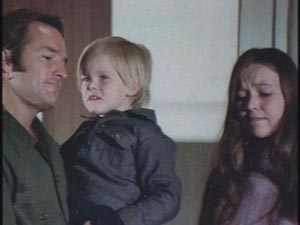
We cut outside for a variety of shots of the Guardsman setting up a perimeter, as Bombastic Sinister Music booms on the soundtrack. Hilariously, we then cut away for Ironic Contrast to an Ordinary Joe Guardsman, who that very night is leaving his house to report to duty. As mawkish, syrupy music plays, he bids farewell to his pretty wife and cute young son Danny—the name isn’t a coincidence—whom he is carrying around in his arms. "Now give your Old Dad a hug!" he demands, and wow, what a happy, happy family this obviously is. (The acting here is even worse than the general level the film provides. You can actually see the kid looking offscreen for his cue as to when to say his line.) And so, after showing that even some of the faceless Tools of the State are themselves only innocent pawns of The Establishment, we move on. Back at the school, the kids have lit bonfires and begun throwing rocks and crap at the Guardsmen. Yes, that’s a wise decision. Meanwhile, a squad leader is informing his men of the rules of engagement. If their position is approached, a verbal warning is to be given, followed by a warning shot, followed by orders to "shoot to kill." If anyone can provide evidence to support the idea that in any of the real school shootings, the Guard or cops propagated orders to shoot to kill, I’ll eat my hat. Indeed, Ordinary Joe Guardsman is aghast. "Do they really expect us to shoot college kids?" he asks in disbelief. Yes, my friend, because They are Just That Evil. However, in support of this, They have made sure to spread the idea that the students have set up snipers all over the place. Being a more typical example of the sort of ignorant redneck the Guard attracts—after all, could such a murderous organization really have many Ordinary Joe Guardsmen in it?—his squad mate has bought into The Lie without question. Even so, he has no answer when Ordinary Joe asks, "What are we shooting them for?" Well, because the Laughlins wrote the script that way, my friend. Meanwhile, a wounded Billy is being tended to by a group of Indian Elders, although (Thank goodness!) in a purely holistic fashion as they shake maraca-like gourds and chant. Whew! I was afraid they’d employ some of that awful Western Medicine, by injecting him with antibiotics or something of the like. None of that nonsense for the Wise Peoples of the Land! However, Blue Elk tells Billy that the Medicine has failed, and that "the bullets are killing you." This, however, isn’t because that’s what bullets are designed to do, but instead because Billy has failed to live by the teachings of non-violence provided on his Vision Quest. Well, that’s convenient. You can’t sue for malpractice, I guess, when the effectiveness of the tribe’s medicine varies according to your own moral worthiness. A weakened Billy admits that this is so, but that they still have to stop The Man from killing Jean, which I guess is their plan now. On the face of it, that doesn’t make much sense, since Jean is the only one keeping the lid on things. However, if you buy into the idea that everything is a big conspiracy, then I guess the idea is that The Man actually wants the kids to riot, so that his forces finally have an excuse to crack down on them and inaugurate the police state that we know is The Establishment’s fondest wish. Also, Jean is Good, and The Establishment is Evil, so, you know, that’s probably enough right there. The more radical students skulk about the grounds with torches, and eventually set fire to a shack. Well, that will strike fear in the hearts of their enemies. Meanwhile, Carol is frantically wondering where One-Armed Danny has gotten himself to. When somebody reports seeing him in the bonfire area—didn’t anyone think that was weird, a ten year-old kid wandering around a potential riot zone?—she runs out to find him. Some of the cops are skulking around too, and some of the radical kids decide it would be a good idea to sneak up on them and hit one in the face with a tossed brick. I have to admit, my sympathy for their plight sort of diminished after that. Meanwhile, some of the Guard arrive outside the burning shack and begin pushing the kids back. Why a shack in the middle of the desert would be worth such effort is left to our imaginations, but that’s the Madness of War, I guess. The wounded cop, the one beaned and knocked unconscious with a brick, is reported—whether by innocent mistake or malign purpose, I couldn’t tell—to be the victim of one of snipers the Authorities have been warning about. Believing that one of their men has been shot, the Guardsmen are even more inclined to end the protest through force. I’m sure the fact that the kids—who are the only ones on the grounds who have employed violence up to now, we should remember—are currently tossing Nazi salutes in the Guardsmen’s direction isn’t exactly helping. With the kids approaching the barracks, a warning shot is fired. However, some civilian guys with a pistol, and I have no idea who he is, assumes that the shot came from a sniper and begins firing into the massed protesters. In the confusion, the Guardsmen around him follow suit, and things quickly escalate when the Guard command, believing themselves under fire, issue a general order to begin shooting. As the students flee and the wounded tumble to ground, we get a scene so appalling that it’s hard to describe with a straight face. This is the ultimate example of how the Laughlins sabotaged their own film. Up until now, the situation has been played as resulting from a tragic series of mistakes. That, you would think, would be bad enough. However, the Laughlins just can’t let bad enough alone. The authorities can’t just be misguided, they must be evil. Therefore, in one of the rankest displays of political paranoia since the heydays of the Nazi and Soviet propaganda films, we now cut to Danny, who is cowering in the stables. The One-Armed Lad, who we’ve watched heroically break free from his psychological chains, is there, clutching a bunny rabbit (I swear!) as he seeks to protect his pet miniature burro. Running to find him, Russell takes a bullet and goes down, one of seemingly dozens of students to do so. Several of the featured students (Patsy, Bugger, etc.) also are seen being shot, and then Jean gets her, as we watch in loving slow motion as packets of stage blood secreted under her sweater spew forth their contents. This is accented by shrilling hooting horns, like the ones heard in the original Planet of the Apes, so that we get that seeing the film’s heroine shot down is bad. By the way, trivia fans might like to note that the music here is by Elmer Bernstein (!), certainly his most impressive assignment since Robot Monster. Again, though, seeing a number of the film’s featured cast being shot down isn’t enough. Therefore, we cut back to Danny, still clutching his bunny rabbit. Meanwhile, an officer comes up to Ordinary Joe Guardsman, demanding to know why he isn’t firing into the crowd. When he refuses to do so—and I really, truly swear this is what happens—the officer puts his .45 up against Ordinary Joe’s head and threatens to kill him if he doesn’t shoot down into the crowd. Really. No kidding. With no recourse, Ordinary Joe turns and fires, and naturally—for this movie anyway—his bullet lands plumb in the center of One-Armed Danny’s back. (Damn, he probably killed the rabbit, too.) I mean, what can you say to that? No matter how nutty you expect Laughlin to be—and in my case, that’s pretty nutty—you cannot be prepared to see an officer of the National Guard order a subordinate, at gunpoint, to kill an eight year-old boy. A boy with one arm. Holding a bunny. Trying to protect his pet miniature burro. And remember how I said that Ordinary Joe Guardsman’s son, roughly of Danny’s age, was also named Danny. Get it? He has just been forced to kill a boy just like his own son! Oh, the humanity! Obviously Joe didn’t really intend to kill anyone, but now he will forever have to live with the fact that he killed a little boy, one just like his own son. Only with but one arm. Holding a bunny. Trying to protect his pet miniature burro. Amazingly, despite taking an M16 round square in the back, Danny is still alive (!), because, you know, if you’re going to go this far you might as well milk things a bit. So the lad painfully begins dragging himself forward with hand and hook. (Oh, we do see that the rabbit is OK, so apparently there were some places Laughlin wasn’t willing to go.)
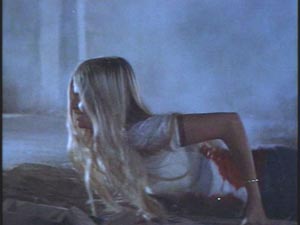
With the firing more of less concluded, Carol comes running up, calling for Danny. She sees him just as he gives up the ghost, and screams and runs toward him and takes a bullet herself. Then, as the bullet continue to fly around her—and the general firing has stopped, so obviously the sole intent is to make sure she’s dead—she begins crawling forward towards her fallen protégé. Dragging her body over his, she takes two more bullets and presumably dies. In the aftermath of the massacre, several wounded students pitifully call for help. At that moment, though, some flares light up the sky. This heralds a torchlight procession of Indians marching in the Guard’s direction. Meanwhile, uninjured students run outside and collect up their wounded comrades. I’m sure the ones with spinal injuries especially appreciate their efforts. In what I guess is meant to be an inspiring image, although I’m not exactly sure why, the large number of Indians, several hundred of them perhaps and with torches held high, form protective ranks in front of the school. Then Blue Elk steps forward. In perhaps my very favorite of the film’s myriad absurdities, he informs that Guard that a treaty from 1868 disallows government troops from setting foot on the local Indian land, including, I guess, the land on which the school sits. (Which, if I recall from way the hell back earlier in the movie, was built atop an "abandoned military base.") Apparently the idea is that while the Guard might be willing to fire into a dense crowd of unarmed college students, threatening man, woman, child, bunny and burro, they would certainly be daunted by the prospect of violating a hundred year old treaty. Meanwhile, Blue Elk warns, raising his Walther (?) in the air, "If the country must have another civil war, then let it start here!" At that moment, however, Sheriff Carl drives up in his squad car, gets out, and joins the Indian ranks. At this, Ordinary Joe Guardsman, sickened at being forced to shoot a young boy—with one arm—holding a bunny—protecting his miniature pet burro—tosses his rifle away in disgust and also crosses over to the other side. (Why Evil Officer doesn’t respond to this by shooting him, as he was quite prepared to do a few minutes ago, isn’t explained.) Acting as a Moral Example, other guardsmen follow along after him. At this the Guard’s commanding officer, a General (!), admits defeat and leaves. Meanwhile, the wounded are carried inside where they may be tended to. Now, obviously, because of the whole thing with Danny and the guardsman getting a gun held to his head and so on, you can’t really take this scene seriously. However, it’s only Laughlin’s inability to scale things short of outright ludicrousness that prompts the viewer to just write it off. Ironically, had they employed a little more restraint, the scene would be much more successful at selling a still wildly exaggerated scenario. In fact, this provides a useful example of how the Big Lie can become the Slightly Too Big Lie. The worst part is their attempt to tie this in the aforementioned, real life shootings. In an effort to forestall accusations of exaggerating things—although what callous madman could level such charges?—let’s remember the title card that noted that during the Freedom School shooting, 3 were killed and 39 wounded. The number of students killed corresponds to the real deaths that occurred in the real shooting incidents. However, the number of wounded is rather higher. Where the grotesque and, to my mind, morally bankrupt exaggeration really comes in though is in the presentation of the massacre. As horrifying as the real life incidents were, they were not the result of ordered, sustained firing into a crowd. Instead, the casualties resulted from short, and in all probability, unplanned reactive bursts of fire. Otherwise, given the lethality of modern military arms, many more deaths would have resulted. Here, though, we are shown lines of guardsmen, positioned behind fortified lines, pouring sustained fire directly into a massed crowd, for minutes on end. Given the way things are shown us, there’s no way that many, many more students wouldn’t have been killed. However, by maintaining that only a small number of deaths resulted, they imply that this sort of purposeful, sustained shooting characterized those real life shootings too. Hence the earlier remark made by Jean about "thousands of bullets" being fired at those events. Unless our guardsmen were staggeringly inept, however, there’s no possible way that "thousands of bullets" fired into a massed crowd would not have killed dozens, at the very least. In contrast, at Kent State, the incident in which the greatest number of people were killed--four students--the firing lasted for a period 13 seconds, and, as noted earlier, a total of 61-67 shots were fired. Aside from so pimping, for their own political ends, such gruesome and sad incidents, though, I must also give the Laughlins points for writing and filming a slow-motion sequence wherein their own daughter is bloodily shot to death by the government. Nice.
Anyway, after a final shot of a fat cop radioing in to, what else, gloat about the massacre, we cut back to Jean in her hospital bed, where the film began several weeks—no, wait, is it…hours? No, it’s got to be more than…. Really? Ok, several hours ago. Tearfully, Jean says, "I thought the Freedom School was the symbol of everything good and right in the American Spirit. [I think she means the Yoga Sports.] We had kids of different races, ideologies [yes, from far left to waaay far left] and religions, all living and working together in peace and harmony." Yes, and then the fictional fascists that your real life self helped dream up came and destroyed all that. Tragic, really. The Reporter notes that the kids want her to reopen the school, but Jean is devastated by the knowledge that the local townsfolk, in her words, "not only supporting the shooting, they were happy about it." Not a couple of morally retarded oafs, mind you, but the townsfolk writ large. I’d point out that these were the same townspeople who earlier in the film were identified as providing the funds that allowed the school to flourish the way it did, but why bother? Such incongruities will never penetrate the minds of the Laughlins, who apparently believe themselves to live in a country that I thank God I don’t even remotely recognize. Meanwhile, an apparently comatose Billy has been hauled to a mountaintop, where further drumbeating and chanting are taking place. Blue Elk is asked if he’s gone yet, and replies that, "Not as long as there’s the chance for another sequel." Well, OK, that’s not what he said, but it’s the general impression I got. Instead, Blue Elk calls for some of the men to go find Jean and bring her here. Meanwhile, Billy is (gaak) having a vision—isn’t this friggin’ movie over yet?—wherein he lies in the desert in a hospital bed, while the Spirit Maiden, sitting up upon a limb of a monstrously huge cactus, continues to lecture him. "You haven’t learned enough to come over this to side yet," she hectors. "Besides, shouldn’t you be working on the next Billy Jack sequel?" OK, maybe not that last part. However, the Spirit Maiden still is cradling a bunny, which I guess is meant to tie her in somehow with the deceased One-Armed Danny, but I’ll be darned if I can figure out how. Not that I have much energy left to muse upon it, I must admit. Oh, wait, there is a hospital bed there, but Vision Billy is not lying in it, he’s sitting on the ground nearby. "Why?" he asks. "My spirit progresses so poorly over here." (Not to mention his filmmaking talents.) Yeah, this is a little weird. Earlier we were told the Indian Medicine wasn’t working because he hadn’t learned enough from his Spirit Guide, and now apparently he’s not being allowed to die because he…hasn’t learned enough from his Spirit Guide. Oh, well, those spirits. Who knows what goes on in those ectoplasmic heads of theirs? Then we cut to a direct shot of the Spirit Hospital Bed, and see that Carol lies within its oxygen tent. Man, that girl’s tough. Normally taking three rounds from a M16 would do the job. However, as we watch, she comes awake. Yes, inside Billy’s vision. I don’t know what that means either. Anyway, Billy has to go back to serve as an example of how someone so violent can learn to give up violence and find peace. Plus, you know, there are still Billy Jack sequels to churn out. Unless one were to screw the pooch with the next one and…oops. This goes on for a while, but frankly, I’m dying here. Cripes, there’s still ten more minutes of this to go. Blah blah spirits, Fourth Level, Billy sees a vision of Jean, etc. Anyway, sent back by the Spirits, Billy returns to his earthly body. Coming awake, he finds Jean sitting in a wheelchair and waiting for him. You might think the lovers would take a personal moment or two—you know, maybe a "Hey, good to see you’re alive" or something—but nope, it’s straight back to business. Billy is shocked, for his part, to learn that Jean’s thinking about giving up on the whole Saving Mankind project. When she fails to deny it, he says, "Look over there." She turns, and sees an eagle flying. Well, that proves it. But wait, there’s more. The eagle lands on a branch directly over Jean’s head, and inspiration music bursts on the soundtrack. Unable to deny the whole, er, eagle thing, we cut to Jean meeting with her incredibly tough underlings, including Carol, Patsy and Russell, who are wearing bandages and braces and perhaps on crutches yet are still extant. (Carol is also, like Jean, in a wheelchair. Again, that’s one weird family dynamic the Laughlins have going on.) Jean still looks uncertain, though. "Tomorrow, all over the world," Russell tells her, "kids are going to march to rebuild the School." Uh…OK. Kind of a Hands-Across-America thing, I guess. In fact, rather than being discouraged by the best efforts of The Pigs to murder them, they’ve been reenergized. (And why not, as they’ve apparently learned that they cannot be killed. They must be some of those Highlander folks.) Russell notes schemes to build a series of Freedom Schools, everywhere, and to actually ramp up the Establishment-scorching exposés. After all, there are probably old women all over the world in danger of losing their furniture just because they haven’t paid for it. Billy signals towards a double door, which Russell opens, revealing a chapel filled with the Freedom School kids. And a marching band, albeit one that is presently stationary. And a girl with a guitar, although thankfully it’s not Carol. She immediately starts to sing, however, and my relief that she wasn’t Carol quickly dissipated. This is both because the lady frankly can’t hold a note, and even more so because her musical tribute to Jean included gag-inducing lyrics like, "Golden Lady, made of Love / You gave so much to me / when I-I-I had nooothing…" And so Jean weeps as the Laughlins stage yet another scene showing how damn inspirational their alter egos are to those around them, and gah. This just goes on and on, and the song is dreadful, and I know there are those out there who wonder why people like me hate hippies so much, but as I watched this scene, I wondered how it was possible that there are people who don’t. And at this we finally hit the film’s mind-bogglingly hypocritical final note, one that has drawn the movie much scorn over the years, as the song is followed by a mass rendition of "Give Peace a Chance" that proceeds on for several minutes, despite the fact that sum total of the song’s lyrics is "All we are saying is give peace chance" sung over and over and over again. And there were many hugs and an ocean of spilled tears and, for me, an inescapable, Lovecraftian feeling of horror. Eventually the camera tracks back until we
leave the building, and we cut to one last helicopter shot pulling away from
the Chapel and into infinity, and then we get a series of cards as the
Laughlins lamely try to cover their asses one last time… Some may feel this picture is too violent…*
** Yes, I agree, real people actually killed probably found their deaths "more violent" than the fictional deaths of fictional characters. Er, whatever that means. *** Well, we really don’t mean ‘ourselves,’ we mean people like you, but we’re trying to pretend that’s not the case. **** Events like Kent State went "unchallenged"? I guess, aside from the Presidential investigations and saturation media coverage whatnot. A note for trivia fans: The film’s Production Manager was William Beaudine, Jr., the son of infamous bad movie director William "One Shot" Beaudine, famous for his lack of interest in shooting things a second time, even if some small snafu, like an actor supposedly playing a corpse opening their eyes on camera, occurred.
The Critics Rave :"The Trial of Billy Jack is nearly three hours of naiveté merchandised and marketed with the not-so-innocent vengeance that I associate with religious movements that take leases on places like the Houston Astrodome…Though it means to preach nonviolence, the only scenes of any interest are the violent ones, and always violence shows up as the only meaningful way to deal with evil…We are told that the Freedom School kids have successfully exposed the oil industry's influence on Washington, yet the kids we see and hear would have difficulty exposing anything more complicated than a Baby Ruth bar. Senator Sam J. Ervin Jr. and Representative Peter W. Rodino Jr. didn't get to the bottom of Watergate by sitting around and listening to their hearts, for heaven's sake." Vincent Canby, The New York Times. "[P]robably represents the most extraordinary display of sanctimonious self-aggrandizement the screen has ever known…I fled the theater." Pauline Kaul, The New Yorker. "It is one of the longest, slowest, most pretentious and self-congratulatory ego trips ever put on film." Charles Champlin, Los Angeles Times. "Unintentionally funny. New Left rhetoric translated to the screen in the most juvenile manner imaginable…political brainwashing of the most irresponsible kind." Benjamin Stein [yes, probably the Ben Stein], Wall Street Journal. "BOMB. Further adventures of Mr. Peace-through-Violence prove that Laughlin is the only actor intense enough to risk a hernia from reading lines. Laughable until final, nauseating massacre scene that renders film's constant yammering about "peace" ludicrous." Leonard Maltin's 2005 Movie Guide."Half-Native American ex-Green Beret ass-kicking machine Billy Jack takes on the feds and beats the hell out of a lot of people to prove that the world can live in peace…the film is overlong and stumbles with silly psychedelic "spirit" encounters." Video Hound’s Complete Guide to Cult Flicks and Trash Pics. "Zero [stars]…The self-gratifying project by Laughlin is one of the most cliché-ridden, absurd films ever to force its way onto the screen and down the threats of millions of people who flocked to theaters to sit through it…[t]he whole thing is told in flashback from the point of view of Taylor, whose acting ability consists of crying a lot because people are cruel." The Motion Picture Guide. "I'm tempted to call The Trial of Billy
Jack the worst [film of the ‘70s], but I'll have to hold off on
officially naming it as such until I have the chance to witness the awful
sounding Billy Jack Goes To Washington. I can't imagine that it would
in fact be worse than the stupefying self-indulgent mess that the famous
half-breed found himself in while he was on trial (the titular trial plays
very little part in the movie - though they manage to shoe horn every other
idea - good, bad, or mind numbing that Tom Laughlin and Delores Taylor had
into this one) in this movie…the movie is a stunning kaleidoscope of
unfocused ranting and raving about every social ill that was popular back in
the seventies….this movie goes on and on beyond all human conception (a
little like the universe, I guess)." Monster Hunter, Monster Hunter.com.
Vox Populi The public has its say via reviews [edited
by yours truly] at the IMDB and Amazon.com:
Deeply Misunderstood Film, April 20,
2004
And as for you, Gentle Reader...
-Review by Ken Begg |
|||||||||||||||||||||||||||||||||
|
|
||||||||||||||||||||||||||||||||||