Another feature of... |
|
Another feature of... |
|
|
for April 2001 (1999)
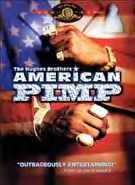
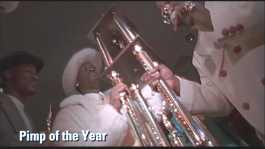
Plot: An alternately amusing and appalling documentary on pimps. Allen and Albert Hughes, the sibling auteurs behind Menace II Society and Dead Presidents, took a breather from fictional films to compose this bizarre documentary love letter to pimps. (Their next film will be the period Jack the Ripper epic From Hell, adapted from the comic book by Alan Moore and starring Johnny Depp and Helen Graham. Their theory is that this fits in thematically with their other movies, since Whitechapel was, after all, an urban ghetto.) If I’m reading the film correctly, the race card is bluntly played almost immediately here. It opens with a succession of people on the street giving their uniformly negative thoughts on the subject of pimps. It was hard not to notice that all the scornful commentary was coming from whites. The only whites in the film, by the, other than a couple of the working girls who briefly make an appearance and one white pimp we see. Assuming I’m correct on this, then American Pimp is to an extent meant as a rebuke to the ‘uninformed’ -- and presumably racist -- opinions of these white folks. That was my initial impression, anyway; as the picture went along I became increasingly unsure about this. Yet I can’t explain otherwise the fact that all the people mentioned above were white. The Hughes brothers are too talented as filmmakers for me to buy this as being a coincidence. Equally dodgy are the regular shots of flowing American flags, presumably meant to suggest that pimping is in the finest tradition of American capitalism. It’s not that I don’t see what they’re getting at, but rather that I think they’re connecting those dots a little too easily. The picture is largely a succession of interviews with various prominent pimps from around the nation. Whatever the Hughes Brothers’ intensions, which I don’t wish to overly second-guess, one thing the film doesn’t accomplish is to dispel many of the standard ‘myths’ about pimps. As we see, they do uniformly call their employees ‘bitches’ and ‘ho’s.’ They do exhibit what to a midwestern eye seems an appalling predilection towards outrageously loud clothing. (Admittedly, the clothes are restrained compared to the pimp attire we’re shown from the ‘70s, but then everyone dressed horribly then. The pimp duds now are as relatively outré as they were then, I think.) Pimps do – the ones here, anyway -- make enormous amounts of money. They do drive ostentatious cars (Roll Royces, weirdly painted Caddies, whatever). They do wear horrifically gaudy jewelry. One fellow, in fact, is seen sporting a ring with a six-inch gold statue on top of it. Basically, the subjects come off – or they did to me, anyway -- as parasites of the hookers they so cavalierly boss around. The film also downplays the violence meted out by pimps to their workers. We do eventually hear some rather chillingly casual references to beatings they administer, although they – the pimps, not the Hughes brothers – try to laugh off the idea that they ever inflict much beyond the occasional ass kicking. When the matter of hookers being slain by their johns comes up, the pimps mostly talk about how such events affected themselves, rather than the actual victims. Meanwhile, the issue of sexually transmitted diseases is sidestepped entirely, as far as I could tell, proving one of the film’s more glaring deficiencies. Of course, the film’s not about the ladies, it’s about their bosses. The pimps here are careful to separate themselves from more supposedly low-class members of their profession. The sort who hook their whores on drugs to keep them compliant are mentioned as an example. The men portrayed here, they assure us, are Players, the crème de la crème of the profession. And so we meet such members of the vocation as Charm, Payroll, Ken Red and Rosebudd, the latter a survivor from the profession’s heyday back in the ‘70s. Some of their stories are indeed fascinating. Rosebudd’s first ‘ho’ was Sandy, a white woman who apparently pursued him to, uh, represent her. When he agreed to take her on, he told her he’d get with her first thing Monday. "That’s how big of a square I was," he laughs. "It was Friday night, prime time…and I told her I would see her Monday." As he eventually relates (with LA Times articles thoughtfully showcased for documentation), Sandy later fell in with some crooked Los Angeles cops. They eventually murdered her when she threatened to testify against them. One of the more amusing aspects of the film is the inserted clips from various Blaxploitation films of radically different quality. 1973’s The Mack seems the universal favorite of the film’s subjects, with the hilarious looking Willie Dynamite (1974) appearing to be the most comically exaggerated. These are used to contrast the crude publicly held image of the pimp with the real things. And yes, Antonio Fargas is much on display here. However, I imagine we’re also meant to see how the pimps themselves are influenced by these baroque portrayals. In this they recall the white hoodlums of the ‘30s who began adapting their behavior to more closely correspond to the characters in the then popular Warner Brothers gangster films. Another highpoint is footage of the apparently annual Players’ Ball, sort of a pimp convention (!), which in 1998 took place in Milwaukee. We even see the winner of the Pimp of the Year pageant holding his trophy. Shortly after this we begin following ex-pimp Bishop Don Magic Juan. Attired in a gator skin wide-brimmed hat and duster and boasting the requisite pounds of gold jewelry, he takes us to meet his proud mother and sister. (On a side-note, I saw this film a couple of days after an Alec Baldwin episode of Saturday Night Live. In one sketch he played a lowbrow photographer who offered to ‘class up’ your place by placing the subject of your photo inside of a larger picture of a brandy snifter. I couldn’t help but laugh to see that Bishop’s mom had just such a photo hanging in her living room.) He also shows us a calendar he’s had made up with photos of him meeting various celebrities, including former Washington D.C. mayor Marion Barry (big surprise there), Ike Turner and even Donald Trump. (!)
Other highlights include watching Charm trade in his red pimp suit to play the links (!); hearing the pimps complain about the ways they’re portrayed in the media ("there’s a million misconceptions," Charm carps whilst clad in his golfing togs); New York pimp R.P. explaining that they "don’t make ho’s do a [expletive] thing," instead they just keep the women acting professionally; the whole "Code of the Honorable Pimp" montage; and the following analogy: "Priests need nuns, doctors need nurses, so ho’s need pimps." (??) Ultimately, I do feel the film serves to glorify what are, after all, a pretty disreputable bunch of guys. The idea of violence or coercion being involved in pimping is at best lightly touched upon. Nor do we hear but short bits of commentary from any hookers themselves, much less cops or DAs or ex-prostitutes, who might be more candid. And the rather pervasive sexism on display --- real sexism, not the tool-calendar-on-the-wall stuff, is pretty much taken in stride as an essential part of the mystique. Not to mention the equally casual racism. The phrase ‘white bitch’ is inevitably heard. I could only recall a black roommate I had in the Naval Reserves who proudly displayed his assembly of Polaroids of the various women he’d nailed. "And this one," he pointed out with some pride, "is my white bitch." I found it a weird moment then and continue to regard it as such. Equally obnoxious are the omnipresent rationalizations constantly issuing from the pimps themselves. I found the seemingly inevitable "we’re pimps because of slavery" stuff to be especially contemptible. "In Reconstruction times," pimp Danny Brown lectures, "after the slaves had been set free, they didn’t have any skills and they didn’t have any money…" I’ve no doubt that this is a fairly accurate origin of the black American pimp. Still, it’s a tad self-serving, to say the least, to hear this from someone who’s a pimp himself. Moreover, you about fall out of your chair when they straight facedly explain that it’s for the hooker’s own good to have a pimp. One fellow explains that a whore, left to her own devices, might only work the weekend and then just blow the money over the following week. However, a pimp will keep her working every day. He slips, though, by ending the last sentence with "and let me see my money grow." Uh, if the advantage to a hooker is steadier income, what’s with the "my money," thing? In fact, after explaining how lost these women would be without their help, each and every one of them later categorically states that their hookers don’t get to keep any of the money they make. Even so, one young lady tells us herself how lucky she and her fellow sex workers are to have these managers. Now, I’m not one to go tossing around phrases like ‘false consciousness,’ but…yikes! An interesting contrast to the typical pimp as presented here is the white guy who runs The Bunnyranch Brothel in Nevada. Here prostitution is run more in line with Libertarian political theories. Unlike the street whores, these prostitutes keep a percentage of what they earn, can leave their jobs at will, never get beaten, and can even decide on their own work schedules and what clients they take. Now, I don’t want to sound like I’m championing such antics. Still, the women here do seem to have a lot more control over what they’re doing than do the street hookers we’ve been seeing. Even so, and this is going to sound weird, but I can’t help admitting that the white guy brothel owner lacks the style that his street counterparts bring to the game. The black pimps might be criminals, which this guy isn’t, since his business is legal. Some of them are even perhaps evil ones. Yet somehow they don’t exhibit the lack of class that this sleazy fat white guy in his denim jacket displays. This is entirely hypocritical of me, so I want to be right up front about acknowledging it. Despite my views on this subject, I’m still, to an extent, falling for the allure of the pimp mystique. Nor am I the only one, I learned. In the filmed interview included on the DVD, the Hughes brothers reveal that audiences regularly see this guy as the ‘villain’ of the piece. Which, again, is really rather interesting, because he’s definitely much less exploitative of his employees than the street pimps are. We wrap up by seeing what ended the careers of some of the pimps featured here. One finishes up in jail, another found God (sort of), one retired, married his last remaining hooker and became a manager in a telemarketing firm. (!) (Insert your own joke here.) This is a film made by people who know what they’re doing, and it shows. It’s an informative and often funny look at a world that – hopefully -- not too many people are likely to become personally acquainted with. If the Hughes Brothers keep making films they’re probably make a bad one someday, but this isn’t it. (In their interview they express dissatisfaction with Dead Presidents, but it’s actually a pretty decent flick.) There were questions raised here that weren’t really explored, and other areas could have been afforded greater scrutiny. All in all, though, it’s well worth a look. The filmed interview mentioned above, included on the disc as an extra, lasts about a half hour and provides a lot of interesting information on how this film was made. Summation: An interesting view at an oft-mythologized occupation. Of especial interest, perhaps, to fans of ’70s Blaxploitation flicks. The Cosmic Man
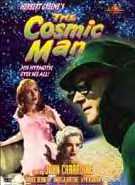
Plot: Have you ever seen The Day the Earth Stood Still? Well, so have these guys. To an extent, any sci-fi movie pitting pacifists against militarists is a con game run on the audience. Let’s refer to this as the Thing From Another World / Day the Earth Stood Still schism. It all depends on how the script develops the aliens (or whatnot). If they mean to conquer or just basically destroy us, then the pacifists look fatally naïve. If the aliens are benevolent, then the militarists tend to look like paranoid brutes. We in the audience are secure, though. We’ve usually seen the previews or the film’s poster, and so know what to expect of these specific visitors. And even if that’s not the case, we’re generally privy to things that the characters haven’t seen. The Cosmic Man is a low budget and fairly naked rip-off of the latter of the above two films. (As, apparently, is Visitor from Venus, which stars Patricia Neal, the female lead from that film. Again, it’s always a bad sign to star in cheapo remakes of your own hit movies.) Cosmic Man even apes the widow - and - her - young - son - who - befriend - the - alien subplot. To give the film credit, it occasionally tries to do more with characterization than simply painting its human cast in black or white terms. Ultimately its heart isn’t in this, though, and it awkwardly slithers back into two-dimensional representations at regular intervals. We open on an Air Force base tracking a UFO, one that has been sighted all around the globe. Our military guy is one Colonel Mathews. We can tell which ‘side’ he’s on because he’s against bringing in civilian scientists to help investigate. Soon after the object leaves their screens a call comes in. What looks like a UFO has been spotted by nearby Bear Lake. Mathews is sent to look things over. Upon arriving he’s taken to what looks like a man-sized grapefruit hovering five feet in the air.
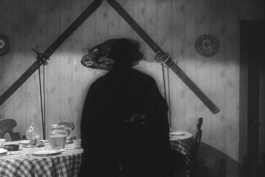
Mathews is unhappy to learn that the eminent Dr. Karl Sorenson has also been called in. Sorenson proves to be your typical movie Unified Field Scientist, in that he is expert in pretty much every scientific discipline. For instance, he’s skittish about the UFO’s technology being used to develop weapons. Not because he’s a damn pinko, but due to his guilt about being largely responsible for the development of the Atomic Bomb. Yet his specialty, we see, is Astrophysics. (!) Not exactly a type of scientist that the Manhattan Project was flooded with. Mathews is also displeased when local civilian Kathy Grant drives up. With her is her Cutely Precocious but Tragically Crippled son Ken. Kathy owns the local inn, and hearing some rumors drove over. Mathews tells her it’s a security case and asks if his men can set up at her inn. Since it’s off-season this is no problem. Meanwhile, Ken, a budding astrologist, is excited to meet Dr. Sorenson. "Mother, he’s the famous scientist who discovered omicron radiation," the tyke exclaims. As ever, the movie world is populated by many more famous scientists than ours tends to be. That night a beam of light flashes out from the UFO. This signifies the appearance of the Cosmic Man (CM), who eventually is represented as a negatively exposed image of John Carradine wearing a cape. Oooh, spooo-ky! They don’t really handle the matter of his appearance very well. Sometimes he’s just difficult to see while in the dark, at other times he’s utterly invisible. At one point he sneaks a ride in a military jeep and the vehicle’s driver doesn’t notice him at all. Yet later he goes for a nighttime stroll through town and gets spotted all over the place. CM shows up in disguise at the inn and requests a room. (Lucky that the military team based there hasn’t established even the most obvious security protocols.) He’s all bundled up ala the Invisible Man, except for his face. Since he’s ‘negative,’ I can only assume this is a mask or some sort, but it’s never explained. He also sports thick coke-bottle eyeglasses. These amusingly lend Carradine the appearance of Shemp Howard when he’s disguised as that knife-throwing Maharaja.
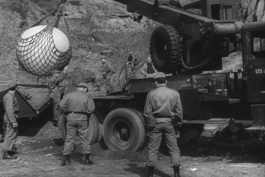
Although modestly achieved, there’s a neat bit where Mathews unsuccessfully tries to budge the sphere with a giant construction crane. This immovable object deal is probably the neatest moment in the film, and certainly the most original. Otherwise it’s a pretty lackluster affair. CM speaks to those that will listen, warning us not to *yawn* bring our warlike ways to the heavens. The military guys try to kill CM with practically no provocation. Crippled young Ken befriends CM, thinking him another scientist, and let’s just say that things are – surprise -- looking up for the kid by the time the movie is over. One of the goofier aspects of this film is the oft-weird dialog. Sometimes it’s inadvertently leant a depth it probably doesn’t deserve. Sorenson questions whether the technology represented by the UFO should be thought of solely in military terms. The hawkish Mathews replies that the only issue is "which team you’re on." "There’s only one team now," the scientist replies, "ever since Hiroshima." He means that after that event scientists and the military are indelibly on the ‘same team.’ Despite this, the line can obviously also be read another way. More often, however, the dialog is merely odd and/or silly. At one point Mathews chats up Kathy - he expresses an abortive romantic interest in her before she inevitably winds up with Sorenson -- and their banter is downright painful. Nor is the scene aided by the actress playing Our Heroine, who’s easily the worst actor the film sports. At times her mugging suggests a belief that the silent movie is still extant. Or take this exchange,
wherein Sorenson and his assistant discuss whether an alien exists: Huh? Then there’s the aforementioned characterization. The script throws bones at granting the military view of things some less-than-villainous basis, although usually as when Kathy defends Mathews by telling Sorenson "he’s afraid." In other words, Mathews is acting irrationally, but you can understand why. And what is he afraid of, according to her? "You [Sorenson] mostly, and what you stand for." Wow!! I guess that really sums it up, eh? They also provide an oddly venal scientist at the film’s climax, apparently to somewhat counterbalance the heretofore-saintly array of same. When it comes down to it, though, the military guys are barbaric oafs. The bit where they just open fire on the apparently peaceful alien is goofy and a half. They’re also insanely secretive (or so they’re portrayed). In contrast, the scientists wisely muse things like "how much all of us could learn without these international barriers." Yeah, dude, like, uh…yeah. Even so, it’s the film’s typically inane technobabble that really takes the cake. Sorenson initially explains the UFO’s hovering as the result of "anti-gravity." Rather that leaving it at that, though, he later decides he was wrong and develops a whole new theory of gravity. "Maybe there isn’t such a force as gravity pulling everything towards the center of the Earth," but instead a force from above that pushes down on things. This is furthermore described as perhaps being "like an X-Ray." (!!) Said theory is gone into at some length and is as hilarious and incomprehensible as you’d suspect. Even funnier is that I’m not sure why violating the ‘from above’ gravity would functionally be any different than violating the regular kind. I guess it’s just supposed to be cool or something.
Summation: Middling ‘50s sci-fi, not good or bad enough to be of note. Quicksand
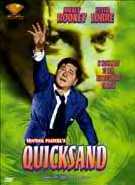
Plot: What a wicked web we weave when first we ponder to deceive. When I reviewed The Big Combo, I said it was quintessential Film Noir. And stylistically, it was. Quicksand, however, is prototypical Noir in a thematic sense. Like many Noir classics, it revolves around an average joe whose involvement with a treacherous blond leads him to disaster. Mickey Rooney (!) plays a down on his heels but happy-go-lucky auto mechanic. He’s recently dumped Helen, his devoted girlfriend, because she wants to get married. Rooney’s not ready to give up playing the field yet. He meets Vera, a haughty waitress, and asks her out. (If you guessed that Vera’s a blond and Helen’s a brunette, then you know your Noir.) She eventually consents, and he promises to get her after work. Later, though, he realizes that he’s flat broke. None of his pals have any money and his boss is a gouging skinflint who would "give ya the sweat off his glasses." A friend owes him twenty bucks but won’t get paid until the next day. By now he’s panicking a bit, fearing that he’ll only get one shot at Vera. Knowing that the accountant won’t be in for two more days to check the receipts, Mickey decides to boost twenty bucks. He figures he’ll pay it back the next day with no one the wiser. That evening he picks Vera up, and she proves a piece of work. She even takes him over to an arcade run by a former lover, just to rub it into the guy’s face. This fellow’s played by Peter Lorre, and if any other actor could suggest as much sick, desperate longing with a mere facial expression I can’t think who it is. Well, as you might have suspected, the accountant comes in early. Rooney, desperate to get the money back, thinks up an apparently ingenious scheme that quickly backfires. One misstep leads to another and soon he’s in deeper trouble than he ever imagined. As in the titled quicksand, the harder he squirms to escape, the deeper he sinks. Much of the success of a film like this depends on how well the plot is constructed. Each step has to seem internally logical, or we’ll distance ourselves from it. Here screenwriter Robert Smith (The Beast from 20,000 Fathoms) proves well up to the job. Aided, no doubt, by the fact that he was adapting a story by Cornell Woolrich, perhaps the preeminent author of literary Noir. Woolrich’s work was adapted into numerous films, including Hitchcock’s Rear Window. To their credit, events here proceed like clockwork. Events never seem wildly improbable or implausible; instead we get the impression that Rooney is an extraordinary hard luck case. Just when he thinks he’s out the cards cut against him. It doesn’t help, either, that he’s a tad dense and more than a little amoral. Or that almost everyone he meets is more crooked then he is. The actors are a mixed bag. Rooney is quite good in the lead, although modern viewers may scoff at the 5’ 3’’ Rooney’s easy success with women. They shouldn’t, though. Rooney was married as often as Liz Taylor, eight times altogether. Here his regular guy quality works much to his advantage. He allows his character to be kind of a heel without ever totally losing our sympathy. Lorre is equally good, in fact it’s a delight to see him with such a good part. He made so much crap later that sometimes you forget what he could do when he wasn’t chewing up the scenery. Buffs will also be elated by a cameo appearance by a very young, though still ugly, Jack Elam. No, if I had a problem it’s with the ladies. Jeanne Cagney, and I don’t want to be mean here, just doesn’t have want it takes to suggest an irresistible femme fatale. (Although maybe that’s the point; that the loser men here don’t require a top notch one.) Actress Barbara Bates, meanwhile, has the thankless task of playing good girl Helen. Luckily her part grows less insipid towards the end. The rest of the cast is fine, filled out by such veteran character actors as Richard Lane, Minerva Urecal and Art Smith. I suppose many viewers today will have trouble identifying with Rooney’s predicament, especially in the beginning. It’s hard today to see the big deal about borrowing twenty dollars from your boss’s till; most of us wouldn’t even get fired, much less fear the boss calling the cops in. And the idea that a hundred dollar charge could result in a prison term if not immediately paid off will again strike many as farfetched. (I know some people who couldn’t get into Steven Spielberg’s suspense classic Duel – from 1971, mind you – because they couldn’t imagine anyone on a desolate road not having a cell phone at hand.) This was 1950, though, and they didn’t have lawyers on TV offering to get up you scot-free out of your debts then. In any case, by the time Rooney’s induced to commit a stick-up I think it’ll prove earlier to suspend disbelief. For myself, my favorite part of the proceedings was tracking Mickey Rooney’s appearing and disappearing split lip. If I had to guess, I’d say he hurt it in the middle of filming and they couldn’t figure out how to cover it with makeup. It therefore seems to pop up every other scene. The film’s available on a quite nice little DVD. Summation: A slick, fast-paced thriller with an appealing cast. Slaughter
Plot: Really, when are Mafia hoods going to learn not to kill the parents of a Blaxploitation hero? I’ve said it before and I’ll say it again: Jabootu bless the folks at MGM’s DVD division. As difficult as it is for me to understand, MGM apparently comes under a certain level of fan criticism because they are releasing so many films in a bare boned fashion. To which I can only say, count your blessings. While studios like Warner Brothers are dishing out their genre backlog with an eyedropper, MGM has been flooding the market with low-priced discs showcasing reliably gorgeous transfers of junk cinema. In January of 2000 alone they released around a dozen of the more prominent Blaxploitation titles. Street priced at a more than reasonable $15, the actual cost, especially through net venders, often hovered around ten bucks. Which meant that for not much more than a hundred dollars you could buy yourself the rudiments of a quite decent Blaxploitation library. Sure, we’ve become quickly spoiled with commentary tracks (some of these releases did include those, by the way) and Making of… featurettes. Still, when people are complaining about markedly superior transfers in a widescreen presentation, selling for about half of what patently inferior VHS pan and scan copies were going for, all I can say is What the Heck? Slaughter is not one of the great Blaxploitation pictures; certainly it’s no Detroit 9000 or Cotton Comes to Harlem. Yet after a slow and often confusing start it picks up real steam and ends up a more than satisfactory outing. As for the jumpy beginning, I’d say they edited out a lot of exposition stuff in order to keep things moving. Note the early scene where hero Slaughter visits his deceased father’s (I think) mistress, seeking the name of the people who ordered a hit on him. She’s nearly petrified with fear, and Slaughter says something to the effect of "When I came to the door, you thought I was them, didn’t you?" However, we don’t see this indicated business. The scene starts with the two of them already in her living room.
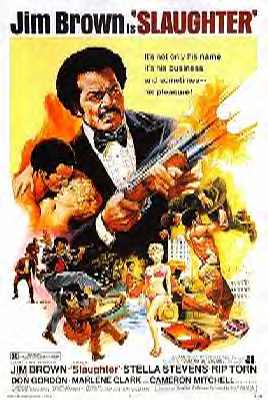
Certainly plot isn’t the selling point here. Slaughter goes after the assassins, who are Mafia guys running some sort of operation in Mexico. Meanwhile, the head of the Treasury (or something, I wasn’t able to follow much of this) tries to put the squeeze on Our Hero, enlisting him in their efforts to learn where the crooks have their mainframe computer hidden. Of something. Again, I couldn’t keep track of this end of it and basically just went for the ride. Jabootu fans, though, will be glad to hear that this Gov’ment SpOOk guy is played by Cameron Mitchell. Don’t get two excited, though. Although fourth billed, Mitchell only has two short scenes in the movie. Other names of note here include the venerable Samuel Z. Arkoff, who had been producing classic junk films since the ‘50s. His name appeared almost immediately, and I knew I was in good shape. Arkoff had a hand in many of the most famous Blaxploitation films, including Coffy and Blacula. Other films on his amazing resume include It Conquered the World, The She-Creature, The Amazing Colossal Man, Reform School Girl, Reptilicus, House of Usher, Beach Blanket Bingo, The Abominable Dr. Phibes, The Thing with Two Heads, The Food of the Gods and Q: The Winged Serpent. And that’s a representative list, not an exhaustive one. (Many of the above films, by the way, are among those already released or scheduled to be so by MGM.) Also on hand are Rip Torn, playing the vicious and bigoted Main Bad Guy, and Stella Stevens as the White Moll who Falls for Our Studly Black Hero. One has to wonder what mainstream audiences of the time, who would have remembered Stevens from starring in such films as The Nutty Professor, thought of her numerous nude romps with Slaughter. Stevens went on a few years later to a much flashier Blaxploitation role as a rather baroque villainess in Cleopatra Jones and the Casino of Gold. Meanwhile, character actor Don Gordon does well with a meaty part as Slaughter’s white sidekick. Actually, I thought lead Jim Brown to be the weakest main player. Although he had appeared in a number of films before this, including a memorable turn in The Dirty Dozen, Brown doesn’t seem overly engaged here. (Certainly he isn’t yet an actor who could hold his own opposite Al Pacino, as Brown recently did in Oliver Stone’s Any Given Sunday.) Even so, like the film itself, Brown gets better as the film progresses. And you have to admit he fulfills the necessary requirements: He’s a great big black dude who looks like he can kick serious ass. He even looks like he’s used a gun before. For that matter, this is one of the best films I’ve ever seen in terms of guns actually being reloaded when they should be. I also like how the race stuff is handled here. Many of the film’s whites are indeed caustically racist, especially Torn’s bad guy. Mitchell seems so, too, although here we suspect that it’s more a gambit to get on Slaughter’s nerves. Meanwhile, Stevens appears to be the inevitable White Chick who craves the dark meat. However, she doesn’t end up as the usual sexual plaything who’s tossed away (i.e., killed) after she’s dropped her clothes for our amusement. Unpredictably, she and Slaughter actually seem to become a couple. This surprised me, especially since there was a black chick readily on hand for Slaughter to hook up with once his White Conquest bit the dust. Slaughter also seems pretty comfortable with his father’s mistress, who’s white as well. Moreover, the Don Gordon character isn’t the Goofball Caucasian Sidekick you’d expect. He’s a brave, competent guy who follows Slaughter’s lead out of sheer respect. On the minus side, the film is rather over-directed, particularly in the use of UZS (Unnecessary Zoom Shots) and a much too often deployed fish-eye lens. Director Jack Starrett would do better with Cleopatra Jones and Race With the Devil before settling in for a comfortable career directing TV episodes. The film did well enough that Brown returned (sans Stevens and Gordon, unfortunately) in Slaughter’s Big Rip-Off the following year. Summation: Solid fare for Blaxploitation fans. -by Ken Begg |