Another feature of... |
|
Another feature of... |
|
|
for December 2000 It’s the All Action Issue!! (1985)
Plot: Joe Don Baker is a redneck cop on a rampage in Malta, in a film brought to you by Greydon Clark! The guys at Mystery Science Theater 3000 famously gave Joe Don Baker in Mitchell such an epic lambasting that the actor reportedly threatened to beat the hell out of them. (I learned since writing this that MST3K also did this film. I missed that one. Does anyone have a tape I can borrow?) Another bonus was that the episode helped me to solve a mystery. There was always something different about the protagonists Baker played, but I couldn’t put my finger on it. Finally it dawned on me. I had always just assumed that Baker’s characters were doing that thing where you pretend to be dense so that your opponents will underestimate you. You know, like Columbo. Eventually, though, I realized that his characters weren’t pretending to be dumb and mean. They really were dumb and mean. His opponents should have just shot him. But they thought he was pretending, too, and wanted to see what he was up to. Instead, Mitchell and the rest of the characters he played – although, now that I think about it, they were pretty much all the same guy -- were actually just dumb and mean and, most of all, tenacious. A Joe Don Baker hero was like a pit bull that clamped on to you and wouldn’t let go even after you shot it in the head. Added to Baker’s stalwart contributions here are those of the brilliant auteur Greydon Clark. Mr. Clark is most famous amongst Jabootuists for his killer cat/rat-puppet picture The Uninvited. He also appeared as an actor (sorta) in Dracula vs. Frankenstein. This is merely the cream of the crap, though. Other films that of his that might someday make an appearance here in one form or another include The Forbidden Dance, Angels’ Brigade and Satan’s Cheerleaders. We open with Texas Deputy Joe Don Baker dozing in his office. I think. Given the level of energy Baker usually expends while acting, it’s a little hard to tell. Anyway, we learn that he’s now stationed in the sticks because of his typically (for a Baker protagonist) violent history. This is a classic bad exposition scene, with Baker and his boss Sheriff Bob (Greydon Clark!) trading info they both already know. Then the Sheriff pulls out photos of his kid. When Baker says, "You’re a lucky man, Bob," we know he’s a goner. Meanwhile, hotheaded Italian hood Palermo and his younger brother Tony are involved in a nearby fender bender. Proving rather a nutcase, Palermo shoots the other driver down in cold blood. His car, however, has been disabled, and he conveniently tries to acquire a new one right outside the Sheriff’s station. (!!) Baker calls him on it and the guy opens fire, killing Sheriff Bob. Time between being told he’s a lucky guy and getting shot? Nine seconds. Well, they’re not wasting time, anyway. (That’ll come later.) Baker leans up from his deceased friend and wipes the guy’s blood off onto his deputy’s badge. Wow! Or something. Needless to say, Baker is soon in pursuit of Palermo and Tony. The latter begins to panic, but Palermo orders him to get his act together. If they can make it over the border, they’ll be home free. They find the fence and climb over (albeit offscreen). We’re talking Joe Don Baker, however, so fancy-pants notions like National Sovereignty don’t matter very much. Employing his rather lame trademark line, "You think you can take me?" Baker lowers his gun hand for a good old fashion quick-draw contest. Tony inevitably goes for his gun and is blown away, falling off of a little overhang for good measure. Palermo, being an emotional Italian, swears vengeance over Tony’s death. Now, you’d think Baker would just blow the guy’s head off. But then we wouldn’t have a movie, so instead he takes him in. In one of the few decent moments here, Baker tells Palermo that he has the right to remain silent and then kicks him in the head. Now that’s comedy! Cut to the courthouse. Baker (we learn that his moniker here is Thomas Jefferson Geronimo the Third – oh, brother!!) learns that Palermo is to be extradited to Italy, and that he’s been assigned to take him there. Here we cut to them on a plane. A couple of rows to the rear, two overtly suspicious men -- the one guy’s sunglasses give them away -- open a briefcase and start assembling a generic prop doodad. Once activated, it sets off a warning light in the cockpit. Per their evil plan, the pilot announces that they’ll be landing in Malta rather than Sicily. It’s here that we begin to fear that this is one of those films made overseas largely so that the participants can write off their vacation expenses. In a bit that somewhat strained my credulity, Baker is allowed to wear in his gun holster on the street of Malta, since he’s a Texas lawman and all. With Palermo handcuffed to his side, he hires a cab to drive them to police headquarters. Proving largely blind, though – perceptiveness not being one of the hallmarks of a Joe Don Baker hero – he fails to notice his prisoner gesturing to the nearby and quite obvious goons who have followed them from the airplane. The henchmen catch up with the taxi and Palermo knocks Baker out in the confusion. He then shoots the cabdriver, apparently just to reaffirm his psycho credentials, and makes his escape. As they drive off, Palermo opens fire on the cab. Being an automobile in a motion picture, it explodes, but Baker manages to lumber away unscathed. This seems like a good spot to stop and discuss another singular aspect about Baker. When I used the word ‘lumber’ in that last sentence, I wasn’t exercising comedic license. Baker’s always been portly, but here, twelve years after his Walking Tall prime, he’s made the transition from stout to fat. Don’t get me wrong. Baker always seemed that sort of blue-collar, muscular fat, like someone whose job entails lugging hundred pound tires around all day. So I have no problem believing that he could kick the ass of most people he managed to get his paws on. (The problem would be catching them in the first place.) Even so, it’s a little hard to figure out how Baker ended up playing leads. His bearish physique and rather brutish features, coupled with a seemingly natural aura of piggish meanness, would seem much more likely to typecast him as a redneck villain. Which, admittedly, is a part he’s played more than once. (To be fair, I should note that Baker can actually act on occasion. See his supporting role in the remake of Cape Fear.) Yet it remains a fact that he’s mostly played the protagonists in his movies. Go figure. Palermo ends up living the good life at the estate of Lamanna, a local crime lord. This homestead inevitably includes a backyard swimming pool complete with hot and cold running chickadees. These spend much time walking past the camera in skimpy bikinis. One particular chippee, apparently having gotten herself a nudity bonus, reclines topless in a pool chair. Palermo wants to go back to Sicily (yeah, good idea, that’s where they were extraditing him to), but Lamanna explains that things are too hot for him there. He’ll have to stay where he is and take things easy until he gets his next mob assignment. Here, in one those bits I thought a tad too unpleasant for an entertainment flick, we learn that Palermo is a sexual sadist. Admittedly, he’s supposed to be a violent nut job, but it’s hard to kick back and enjoy a movie when having to watch a guy physically abuse women. And, yes, I know it’s bizarre to say that it’s entertaining to watch copious amounts of people get blown away but that battering women crosses the line. I don’t care. Yuck. Besides, most people must agree with me or we’d see more wife beaters than Dirty Harrys in our movies. In any case, my real complaint is the general tone of the movie. After all, you have different expectations when seeing a Martin Scorsese picture than you do when watching one by Greydon Clark. Despite Baker’s glowering presence, this film is largely played as a lark, complete with the inevitable fish-out-of-water material. Palermo just seems too authentically nasty for this particular movie. Meanwhile, Baker is being escorted from a jail cell to the office of Superintendent Mifsud, the local police chief. On the speakerphone is Wilson, the federal dude who got Baker the extradition gig. Of course, hailing from Washington, he proves a weasly sort who only wants Our Hero to stay out of trouble. In fact, he’s ordered to fly home as soon as possible. Baker, however, has some Eye-ties to blow away and isn’t about to be yakked out it by some fork-tongued polecat. Then, following traditional B-Movie strictures, Baker is given back his revolver (after some halfhearted advise not to be brandishing it about) and assigned a foxy policewoman, Maria, to act as his tour guide until his plane leaves the next day. Cue a nude shower scene at Lamanna’s place. It’s funny how this film is filled with gratuitous nudity while other Clark films bypass it entirely. Take, as an obvious example, The Uninvited, made three years after this. That film, with its bimbos-on-a-boat plotline, seemed intentionally constructed so as to afford numerous opportunities for some audience pleasing T&A. However, not a single uncovered T or A was to be found there. The same, as I recall, with The Forbidden Dance. Here, however, the director shows few such qualms, and in this particular bit we get some full frontal stuff. One can only conjecture that the moneymen behind the different pictures had varied levels of tolerance for such material. However, whatever enjoyment might be derived from these antics is ruined when Palermo enters the room and begins to rape the young lady. Either Clark thought this was the sort of thing his audience wanted, or else he decided to screw around with our expectations. Either way, he’s a sick bastard. Maria comes by Baker’s hotel room and offers to show him around. Figuring that he might catch a lead on Palermo, he agrees. In a bit I found a tad unlikely, she sort of glares at him but says nothing when he straps his holster on. Considering that Maltese cops do not, as a habit, carry firearms themselves, I found their casual attitude towards Baker doing so to be highly unlikely. Anyway, it’s carnival time, and so we get a whole lot of touristy parade footage as Baker questions random people on the street. As this occurs, we see Palermo’s three henchguys entering The Smuggler’s Tavern, an obvious set identified with a patently bogus piece of signage. Inside we see two of Lamanna’s bimbos getting ready to perform on stage. (See, the filmmakers could only afford so many nude actresses, so they had to use them were they could.) Their act, one of the film’s comic highlights, involves them engaging in an extremely lackadaisical swordfight as their skimpy little vests flash their goods to the audience. The guys leave the club and immediately get spotted by Baker. Shrugging off Maria, he challenges them to a draw with his trademark line, which sounds even lamer the second time around. (I especially like how Baker evinces no reservations about drawing on his opponents, given the numerous innocent bystanders directly behind them.) This entire scene is strenuously ripped-off from Sergio Leone, and suggests what Once Upon a Time in the West would have been like had it been directed by an untalented hack. Sure enough, after the obligatory ‘tense’ prolog, a largely slow motion gun battle ensues. My favorite moment is when one guy, shown standing right in front of an occupied phone booth, gets shot. We are treated to the image of the bullet erupting through his chest and out of his back, yet somehow not plowing into the guy standing literally a foot behind him. Once again I must inquire whether filmmakers understand what an ‘exit’ wound is. Also, a couple of these guys are quite burly, and I had to wonder what kind of loads Baker was supposedly packing in his .45 Colt Peacemaker (what else?) that would so readily blast completely through their thick torsos. Baker ends up using his "Do you think you can take me?" line twice in this scene. (Because it’s that bitchin’!) That’s three times altogether. We cut to the same guard again taking Baker from the same cell to Mifsud’s office. So now I guess it’s a running joke. Actually, ‘gag’ would be a better word. Anyway, Mifsud’s a bit firmer this time. He appreciates Baker’s diligence, but he wants him on that plane back to Texas. Wilson, again on speakerphone, harshly concurs. However, Maria has rather implausibly fallen for Baker’s beefy tough-guy charms. Amongst the various examples I’ve witnessed of the "It’s in the Script" phenomena, this is rather a biggie. This time Mifsud’s smart enough, though, to hang on to Baker’s weapon. With an extensive hour and a half to fill, we jump around to various time-eating filler scenes. Palermo convinces Lamanna to let him go after Baker. Baker and Maria go to lunch and have that rogue cop ‘Law vs. Justice’ discussion. Then it’s back (that’s right) to the Smuggler’s Tavern, where the same girls are still, uh, performing. In the audience Palermo nods his approval of this Bacchanalian display. Lamanna shows up and engages in another round of arguing with the quarrelsome Palermo. Then Lamanna chats up the girls. And then back to Baker and Maria wandering the streets. Yep, it’s a thrill-a-minute. Figuring that Palermo’s a sleazebag, Baker has Maria take him to the seamy side of town. A quick questioning of two whores (with a hood standing close by who’s all but sporting a "Bad Guy" placard) reveals that Palermo’s at the tavern. Amazingly, this actually makes some sense, since Palermo’s spread around word of his whereabouts, hoping to lead Baker into a trap. The two soon arrive outside the bar, where Palermo and his goons are lying in wait. Baker smells a rat, though. Grabbing one of the ceremonial spears (!!) carried by the town’s Guard, he quickly takes out two guys in black suits. Luckily, every guy in a black suit is a mob henchmen, so no innocents are harmed. One of the fallen adversaries provides Baker with a gun and the fireworks begin. One guy up in a balcony is dispatched, and therefore, according to tradition, must topple over into the street. However, there’s a high-ish railing and this manuver proves so awkward in the execution that we can pretty much tell that he’s making an effort to go over the side. Palermo beats feet, prompting a lengthy and rather ludicrous chase. I mean, c’mon, the guy’s trying to outrun Joe Don Baker! In a foot chase! You figure it out. This takes them through a church (don’t ask), then to a marina and from there into a boat chase. Basically, it’s the sort of thing that calls for liberal use of your fast forward button. The scene ends with Palermo knocking out Baker for about the third time. Of course, he then takes off without finishing Baker off, because if he did the hero would be dead and that would screw everything up. Cut to Palermo hashing it out with an exasperated Lamanna, who’s starting to run out of henchmen. Palermo begs for another day and barely gets it. Meanwhile, Mifsud is chewing out Baker. Unbelievably, though, he stills lets Baker walk. Because if he just locked Baker up until they could escort him to the plane back to America, then Our Hero wouldn’t get Palermo and that would screw everything up. So Baker heads back to the Smuggler’s Tavern -- Can you say ‘Limited Sets’? -- to try to get some leads. On the stage the same two chicks in the same two outfits are still strutting their same two breasts. (Apiece, I mean. Obviously.) Apparently exotic dancing is a twenty-four hour a day profession in Malta. Anyway, Baker asks for milk, because he’s got an ulcer, as was earlier established. This leads to the expected japes and the even more expected barroom brawl. Cue the breakaway furniture, candy glass bottles, etc. Amazingly, though, and undoubtedly because of budget constraints, they don’t smash a big mirror behind the bar. The scene ends with the cops arriving and… …Cut to Baker lying on his cot back in his jail cell. Ha! It’s just like the scenes with ‘Cooler King’ Steve McQueen in The Great Escape. Well, OK, maybe not just like. Anyway, Baker is again allowed to go back to his hotel room, but is told to stay there this time. This last, no doubt, because of his marvelous track record for obeying orders. By now this is getting a little bit stupid, but if they kept him locked him up then our movie couldn’t end. And believe me, no one wants that. This time, though, they actually have left a guard on his hotel room. However, a quick snow job regarding his ulcer and Baker is back on the streets. (That this entails assaulting a police officer results in surprisingly few ramifications.) Baker heads back to the now closed Tavern and threatens the bartender. Apparently cowed, the fellow sends Baker to the bar’s dressing room to talk to one of the dancers, who, by my estimate, has now been here for roughly thirty-seven straight hours. Baker offers to protect her if she spills the beans, but Palermo shows up (having been called by the bartender – yep, Our Hero’s looking like a real Brainiac) and knocks Baker out with a hypodermic needle. This is, I think, the fourth time now that Baker’s been rendered unconscious by the villain of the piece. Lamanna’s mansion comes equipped with a dungeon – dank stone walls, cobwebs, torches, the whole deal -- and they take Baker there and toss him into a cell. Then Palermo pops upstairs and subjects the chick Baker was talking with to further unpleasantness. This turns out to be the last straw. Tired of being treated in this fashion, she later frees Baker and gives him a gun, which proves a bad move for her. Again, Baker’s heroes are not marked by their intelligence. In fact, they’re generally pretty incompetent. I mean, look at Baker’s record in the film so far. Sure enough, he gives his word to protect her, and she ends up with her throat slit about two minutes later. Still and all, Baker makes his escape, so I guess that’s all that matters. Cue another boat chase. This ends with Baker’s boat exploding, and, just like with the blown up taxi earlier, they assume Baker was killed. You know you’re in good hands when they have to keep repeating themselves like this in one picture. We cut to about a week later. Wilson’s flown in, but the general consensus is that Baker’s bitten the dust. However (we should be so lucky), we see that he’s been recuperating at an isolated seaside home. This leads to some nauseating scenes with him and the kids of the family that presumably fished him out of the drink. He’s showing them how to use slingshots. In an amusing bit, he fires and clearly misses, as is indicated by a large cloud of dust over to the right of the target. However, the can flies away anyway, through the magic of monofilament wire. Eventually, though, this idyllic respite comes to an end and he *sigh* returns to the mainland. Same old, same old. Wilson orders Baker back to the States, he refuses, etc. Meanwhile, Palermo, a flunky and Topless Chick are on Lamanna’s boat. We learn *gasp* that Palermo is due to leave Malta the following day. That and the fact that we’ve only fourteen minutes of running time left indicate that we’re finally approaching the film’s climax, such as it is. This established, we cut to Baker and Maria having lunch at an outdoor café. Then we cut to Baker ‘questioning’ the bartender guy (haven’t we already done this?) by sticking his head in a fish tank. Oh, the comedy. Then the cops arrive…again. Good gravy, just get on with it, would you? Cut to Baker in his cell. (Where else?) Maria, having had a change of heart about having him arrested, shows up and breaks him out at gunpoint (!!). "I hope this works out," she notes, "because God knows I’ve just ruined my career." Yeah, and guaranteed yourself ten to twenty years in jail, you’d have to think. So Baker questions the bartender for like the hundredth time. However, as I said, we’re moving towards the finish (nine minutes and counting), so this time he gets what he needs. If the bartender had just spilled the beans fifty minutes ago we might all have been spared much unpleasantness. Baker and Maria held over to Lamanna’s estate, which is pretty pitifully guarded for the home of a Mafia bigwig. Our Hero orders Maria to stay behind, noting that she’s unarmed. (She used Baker’s gun to break him out of jail.) This is the most suspenseful moment of the film, as I was horrified that they might make the actress playing Maria actually kiss Baker or something. Luckily, we are spared this gruesome sight. Baker skulks about and gets the drop on Palermo. Inevitably, though, he fails to take advantage of it and ends up as their prisoner, again. Or so it seems. When he drops his gun to the floor, it fires. This is technically possible I guess, since the hammer’s cocked, but it’s still unlikely. Even more unlikely is the idea that Baker somehow planned this to happen. Anyway, Baker grabs the shotgun of a startled hood and Lamanna is toast. Then he and Palermo tussle, as an issue of what looks to be Paris Match makes a cameo appearance. Baker almost has him when again a henchguy sticks a gun into his back. Now, at this point you’d really think they’d just blow him away. But no, of course not. They shepherd him out to Lamanna’s boat (?) in which we see that Maria is hiding (?!). Then an armed Wilson shows up, shouting "Freeze!" Now remember, Wilson works for the U.S. Government, so imagine our shock when *double gasp* we learn that he was in cahoots with Palermo all along. Gee, the corrupt Government official. What a twist. And talk about crude plot mechanics. If Wilson was working with the bad guys, why would he suddenly appear here armed, crouching and shouting "Freeze"? Why, so that we in the audience will be all the more stunned when we learn the truth, of course. Meanwhile, Maria is still hiding in the boat. Proving that she’s seen lots of movies, she arms herself with, what else, a Very pistol. Anyway, Wilson ends up showing that he’s got a certain ‘flare,’ (ha, damn, I’m so funny). However, this leaves Baker still covered by the remaining henchguy while Palermo takes Maria below. He begins to have his way with her, the henchguy violates Ken’s Rule of Guns and so on. Now, this particular henchguy is like 6’ 8" and a real bruiser. So watching Baker take him is rather comical. In the struggle both barrels of the shotgun go off, which is weird, as we never saw the gun reloaded after Lamanna took (at least) a barrel. Needless to say, Baker ends up the victor, albeit with a wounded gun hand. Palermo comes up holding a gun to Maria’s head. If you guessed that Baker ends up with a final opportunity to trot out his trademark line, well, that doesn’t exactly make you the new Nostradamus or anything. So Palermo takes a bullet in the head and, pretty much, end movie. Just like that. Guess they didn’t want to deal with the aftermath of Maria breaking Baker out of jail or anything. Summation: A lame and twenty-years-too-late update of Coogan’s Bluff that substitutes Joe Don Baker for Clint Eastwood and Greydon Clark for Don Siegel. Plus, lose the sadism against women thing. __________________________________________________________________________ Final Voyage
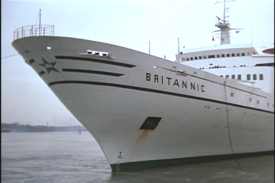
Plot: It’s "Die Hard" on a ship! No, not the good "Die Hard" on a ship! That’s "Under Siege." Nor is this the monstrously expensive yet sucky "Die Hard" on a ship! That’s "Speed II." No, this is the incredibly cheap yet sucky "Die Hard" on a ship! Aside from a small number of desultory CGI effects, this horrendously shoestring actioner apparently spent its budget on procuring a (sorta) ‘name’ cast. And what a B-Movie lineup we have here, with everyone reaching the nadir – one would hope -- of whatever career they have left. Our lead is actor Dylan Walsh. Walsh once looked to be an actor on the rise, but now appears to be a slightly younger Treat "The Substitute 2" Williams. Meanwhile, our main villain is Ice-T, who’s come a long way since New Jack City, and all of it southward. That’s what happens, I guess, when you accept parts in both Johnny Mnemonic and Tank Girl. Our heroine is former-Baywatch queen Erika Eleniak, late of Under Siege. (It’s a bad sign when you end up in Grade Z remakes of your own hit movies.) Meanwhile, Claudia Christian plays Ice-T’s obligatory Evil Sidekick Chick. She’s apparently playing off of her years as Commander Ivanova on Babylon 5, as well as her cult-making appearance as an alien-infested stripper in The Hidden. Meanwhile, supporting actors like Rick Ducommun and Stephen Macht have also done their share of work in actual movies. Of the major players, Eleniak can’t act, Christian just rolls with things and tries to have as much fun as she can, Ice-T looks staggered at ending up in bottom basement crap like this and Leprechaun 4, and Walsh actually attempts to create some sort of performance. Meanwhile, our director is Jay Andrews, better known to B-Movie fans as the prolific Jim Wynorski. Under this name and many others (Noble Henry, Arch Stanton, etc.) he’s directed such junk fare as Chopping Mall, The Return of the Swamp Thing, The Bare Wench Project, Body Chemistry 4, Ghoulies IV, and 976-EVIL 2. His major claim to fame, as listed in the DVD’s ‘talent’ profiles, is that he ‘discovered’ Jennifer Love Hewitt, soon to play Satan opposite Anthony Hopkins in Alec Baldwin’s The Devil and Daniel Webster. Final Voyage is a film where anything remotely expensive -- or competent looking -- such as shots of an airport or of a ship leaving dock, are inevitably hunks of stock footage crudely stitched into the ‘original’ footage. This technique of larding on shots from, you know, real movies, in order to *cough* disguise how immensely cheap the proceedings are, is also on display in Tycus. This is a Dennis Hopper killer meteor epic (of sorts), and a film that I’ll be examining here some time in the future. (Both Tycus and Final Voyage also share familiar character actor Chick Vennera.) The stock footage here is made overtly funny by the fact that, without fail, it is continuously used to segue to scenes taking place on exceptionally cheap and obvious sets. Admittedly, these are better than, say, the airplane cockpit set in Plan 9 From Outer Space. Just not much better. We open with, that’s right, stock footage of an airport, before cutting to the patently bogus interior of an airplane. We now meet professional bodyguard Walsh, here assigned to an aging female movie star. As she yaks with a star struck and flamboyantly gay comical flight attendant, Walsh notices two suspicious acting (to say the least) passengers. One is swarthy and another is wearing sunglasses, so we immediately get that they’re hijackers. This leads to a lame action set piece wherein Walsh nearly causes the deaths of everyone on board by acting ‘heroic.’ Of especial note are the appallingly chintzy effects used to portray the bad guys being sucked out of the plane. He-man credentials established, Walsh is next assigned to a purportedly headstrong heiress, played by Erika Eleniak. She doesn’t really seem all that bossy, but she does, like every other woman in the film, boast the sort of chest that implies a level of surgical augmentation. (Except, as we learn in the commentary, for Christian’s. Hers was built up the old fashion way, by stuffing her bra.) Walsh’s job is to guard her on a cruise of the Britannic, the last of the great cruise ships. Supposedly this trip has attracted the cream of the world’s Hoi Polloi, but you couldn’t prove it by me. Here the greatest fun can be gleaned from watching the launching of the ship. The new and very, er, economical footage of a sparse number of extras on a ship obviously sitting in dock is quite evidently different from the more expensive shots of it leaving port. Anyway, we are soon provided with a plethora of villains. There’s the inevitable Evil Capitalist, who cut corners in refurbishing the ship (a bit stolen from Irwin Allen’s The Towering Inferno). This means, *gasp* that it’ll sink at the drop of a hat. Which makes the Evil Capitalist’s presence on board all the more mysterious, one would think. Meanwhile, a crew of terrorists lead by Ice-T and Psycho Sidekick-in-Leather Christian come aboard and begin slaughtering a humorously large amount of people. Frankly, considering how they started this job, you’d think that they’d just go ahead and kill everyone else on board. Especially since this doesn’t appear to be as many people as you might think would be on a cruise ship (wink wink). So it’s up to Walsh, Eleniak and comic relief crewmember Ducommun to somewhat tediously save the day. As you’d expect, the ship eventually starts to sink. (Cue mucho stock footage and bad CGI effects). The terrorists issue an SOS and manage to raise a nearby stock footage aircraft carrier (!!). How exactly the villains are planning to deal with their military rescuers is left to our imaginations, especially since they don’t show up until the bad guys are all dead – oops, sorry to blow the surprise ending – and the surviving passengers are floating around in lifeboats. In fact, the rescuers never arrive, in so far that we see them. I suppose the filmmakers only had stock footage of helicopters leaving an aircraft carrier, not of helicopters approaching lifeboats. Anyway, I guess I was wrong earlier. This wasn’t "Die Hard on a ship," so much as "Die Hard meets Titanic," with each of those films being about as well served.
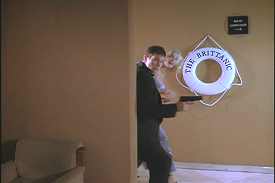
Well, that’s our motion picture for the evening. But wait, the DVD of this film holds much more entertainment. Really, it’s amazing how much work they put into it. For instance, they actually did fairly elaborate animation segments for the menus. Go to the Scene Selection menu and you’ll see all the chaptered sequences playing on little computer displays. The Special Menu is on an elevator keyboard. Meanwhile, the elevator doors open and show you little clips of the film. The special features include a fairly ho-hum trailer and amazingly detailed and numerous Filmographies. These are so in-depth as to be a little weird. Moreover, both ‘Jay Andrews’ and ‘Noble Henry’ get one. Yet we’re informed in Andrews’ file that Noble Henry is an alias of his. So I’m guessing that this, and perhaps the writer’s filmography under the name J. Everitt Morley, are fictitious joke ones. The reference to Henry’s cinematic homage to Jerry Lewis, Professor Nutt-Nutt, in his native France would seem to support this contention. Also, the actors’ filmographies all sport photos, while the three production-side ones don’t. The actors’ files are also quite extensive, often listing TV work as well as film credits and biographical info. Hence we learn that Eleniak made a guest appearance on TV’s Full House, Charles in Charge and Still the Beaver. We learn that Claudia Christian "typifies the true Renaissance woman," and that she sings "unique European erotic dance music." She also hosts "marvelous dinner parties." A Renaissance woman, indeed! Meanwhile, actor Rick "The ‘Burbs" Ducommun was a handful as a teen. "[H]e also managed to find his share of mischief." He founded and developed (?) "one of the world’s largest skateboard and snowboard manufacturing companies." On TV he’s appeared with fellow Canadian Alan Thicke. Moreover, he’s made appearance in probably more real movies than anyone else associated with the picture. He is also extensively involved in restoring classic cars, and even named his children after antique automobiles like Hudson and Nash. Oddly, despite this apparent evidence that he’s a Renaissance man, we aren’t informed officially that he is. Probably the oddest inclusion, though, is the filmography for actor Tony Colitti. He’s admittedly done a lot of TV, but little film work. Moreover, his appearance in Final Voyage lasts maybe three or four minutes. I don’t know, maybe it was a contractual thing. Next we have the Audio Setup/Commentary menu. This features an animated shot of the bowels of the ship with cartoon steam flying about. Here we find the jewel that makes the disc truly special: A downright hilarious commentary track (!!) featuring director Jay Andrews and co-star Claudia Christian. The two have no illusions about the sort of film this is, and they are refreshingly candid towards its flaws. This should not be assumed. I once rented a terribly boring giant snake opus called King Cobra. It was so dull that even I fast-forwarded through it. However, I was intrigued that the two brothers who made the picture had bothered to provide a commentary for the disc. Unfortunately, they seemed utterly unaware of how dreadful their movie was, and provided a dull and hubristic commentary that seemed more fitting for some beloved cult classic than this little loser of a movie. Andrews and Christian make no such mistakes. (They are also either very drunk or just extremely goofy people.) They open with bad Ed Sullivan impressions over the credits. When Dylan Walsh’s appears Christian warns that he’s "not to be confused with Dylan Thomas." She then greets her own credit -- which, as Andrews points out, "is spelled correctly" -- by noting, "I’m huge in Bangladesh." Meanwhile, they express honest puzzlement over the more unknown actors. Noting Ducommun’s name, Andrews remarks that "You loved him in The ‘Burbs." Then we next see the credit for Heidi Schanz, who played the ex-girlfriend. "I don’t know where you love her," he confesses. Then three more names come up. "I don’t know who these people are," Andrews notes, while Christian assures him "they were in the movie, Jay." Our first shot of the film proper is greeted with the candid, "Here’s some nice stock footage from another picture." Next we see, as we’re told, "an extra." "Watch how he sits down here," Andrews observes. "He’s really good." Here we get a nice piece of trivia. The veteran movie star being guarded by Walsh was, we’re told, played by Terry Moore. In younger days Ms. Moore starred in such films as the original Mighty Joe Young. (You know, the good one.) She was also one of Howard Hughes’ wives. Meanwhile, the guy playing the flamboyantly gay flight attendant provokes the first comment in what will prove one of Christian’s main concerns. "Who did his hair?" she wonders, and such observations will be one of her fortes. Meanwhile, Andrews draws our attention to another actor. "He’s quite swarthy," he explains, "and he looks like he might take over the plane." And sure enough, he does. Then they laugh over the fact that the bad guys have somehow gotten all these guns aboard. In a classic exploitation movie moment, Andrews refers to an exterior shot of a restaurant, noting that he illegally grabbed the shot sans permit. "I took the camera out of my car," he notes, and Christian responds with "You rock." Here we see the film’s worst hair moment, courtesy of Dylan Walsh. This, needless to say, quickly draws Christian’s attention. "I have some issues with everyone’s hair in this movie," she begins. Apparently not recognizing the film’s star, she asserts, "This guy. It’s crisp looking…[like] those little fried onion rings that come in a can." Andrews laughs, but warns, "You will not hear that on the commentary!" "What is this scene about?" Christian asks. "’Cause I didn’t read the script, even though I starred in this movie." Then we see the dirt bike scene, and learn that Walsh wasn’t really riding it. "I’ll tell you when he’s driving it," Andrews notes. The bike comes to a stop. "Right here he’s driving it, " indicating the helmeted actor now shown straddling the non-moving vehicle. Then we get to the scene with Walsh and Erika Eleniak in a small passenger plane. "Here comes some fabulous, fabulous stock footage," Andrews gushes. And while we learn that Eleniak didn’t really fly the plane, we are told during a close-up that "those are her hands." When we get to the introduction of Walsh’s ex-girlfriend, Andrews explains that she’s played by Heidi Schanz, but that it’s not her voice we hear. "She wouldn’t come in for looping," he explains. (We later learn a possible reason why. In the original version of the script, Walsh ends up cuddled with her [which would have made more sense]. Andrews changed this and Walsh ends up instead canoodling with Eleniak, presumably because she had higher billing. Schanz apparently took offense at having her character downgraded, perhaps explaining her absence at the post-production looping sessions.) "Her hair looks funny, too," Christian inevitably notes. "It looks like her head’s shaped like a lima bean." This is followed soon after by Christian having sport with a bra and panty-clad bit part player, another highlight of the proceedings. Another secret of the trade is then revealed. Andrews explains that a shot of a completely backlit Christian executing two guys was composed in this way so as to hide the fact that another actress was standing in for her, as she was busy elsewhere at the time. "Nice wig," Christian comments. From here on the one-liners fly thick and fast. Responding to some of the film’s painful banter, Christian notes "I just wanted to hear that playful sort of Thin Man repartee." Then Andrews helpfully points out during a scene purportedly set in the bowels of the Britannic that it must be "the only ship with concrete walls." He also mentions the omnipresent misspelled lifesaver, which, to his present regret, he ordered hung on practically every set. It now supposedly sits in his garage. (However, I think he’s wrong when he says there was only one – I think in one long take I saw two different ones.) One of the overall funnier aspects of the commentary is Andrew’s downplayed yet still occasionally evident discomfort at the way Christian mocks the cheesy conventions of the sort of fare he makes his living at. She laughs when he mentions a previous opus of his, Dinosaur Island, and then expresses little contrition when she later mistakenly refers to the film as "Dinosaur Park." He also seems somewhat uncomfortable about having his breast-fixation discussed at such length. Moreover, Christian gets even more dismissive of the film as it rolls along, and starts being openly derisive about many of her co-stars. (Although both she and Andrews comment on what a nice person Eleniak is.) Ice-T, in particular, is often the butt of jokes regarding his propensity for needing numerous re-shoots before getting his dialog in the can. Summation: A brazenly crappy timewaster, but worth a DVD rental for the hilarious commentary track. __________________________________________________________________________ The Mercenaries Plot: Low-grade action star Stuart "Night of the Lepus" Whitman gets involved with a group of mercenaries. Their mission: Assassinate Fidel Castro! Now, it’s possible for a film to overcome the fact that it’s ending is historically inevitable. As an obvious example, take the similarly themed Day of the Jackal (horrendously remade – sorta – as The Jackal). That film concerned a plot to assassinate Charles De Gaulle, who obviously was never assassinated. Even so, the film was so suspenseful that audiences managed to suspend even their awareness of historical fact. Less successful was The Hindenburg, which concerned George C. Scott’s attempts to keep someone from sabotaging the title airship. And, while I’ve yet to see our current subject, I’m betting it’ll be less successful yet. I was surprised to learn from Steven Scheur’s handy Movies on TV guide that this film was released in 1980. That’s because its components, from the premise to its stars, scream The ‘70s! At least it does in my head, in which I predict a film full of rote ‘70s cynicism, ‘realistic’ violence, conspiracy theories, political betrayal and the like. You know, stuff like Sam Peckinpah’s The Killing Elite, only much worse made. Maybe the film will surprise me. But probably not. (A Message from Future Ken: No, it didn’t.) Possibly the picture was made earlier but not released until Reagan’s presidential run, when it was figured that the plot concept was ‘relevant’ again. We open with a recreation of the 1961 Bay of Pigs incident. This proves as inept in execution as the real event, if rather less tragic. Footage of American soldiers rafting onto a beach is interspersed with actual news footage of JFK and Castro. Ominous music plays. The soldiers are ambushed and die in the water. Meanwhile, we watch actual footage of Kennedy denying that the incursion occurred at all. This is one of the more shameful incidents of the Cold War (at least on our side), and thus lends the film unearned weight. Ignored, however, is the fate of homegrown anti-Castro insurgents, who paid with their lives for trusting on U.S. aid in their endeavors. The invasion scotched, we see a rather longhaired army guy throw his helmet to the ground whilst cursing Kennedy. Where the guys who were just mowing down our troops went is left to our imaginations. Cut to The Present, as the film takes us to, where else, Key West, Florida. A small passenger plane arrives and disembarking we see, who else, Robert Vaughn. (His three-piece suit, wide lapels and humongous tie substantiate my theories regarding when this was made.) Stuck with a comic relief gabby chauffeur, Vaughn experiences flashbacks to the Bay of Pigs. He was the officer on the beach we saw earlier. Vaughn is one of several guys, including loudmouth goombah Michael V. Gazzo (!), taken to meet with Raymond St. Jacques (!). Vaughn learns that he is being sent to Cuba to…well, you know. Next he arrives to see the marksmen that Gazzo has arranged for his team. These prove to be Tom and Something-or-Another McGee, a father and son rifle team. (Whatever.) They prove their skills by blowing a coconut apart. Vaughn also requests that Gazzo get a fellow to act as their boat getaway guy. "I want a captain who knows every inch of these waters, every rock, every clam," Vaughn explicates. Gazzo contacts bar owner Whitman, who method acts a drunk here. He threatens to kill Whitman’s ladylove, just to ensure his cooperation. Vaughn later meets with Whitman and tells him the details of his mission. He’s to drop off two Cuban dissidents who will scope out Castro’s movement. They will have a box, which unknown to Whitman contains heroin. The dissidents will carry this, and that way if they’re caught, they’ll be instantly executed as drug runners. (I’d hold out for a better plan, but then that’s me.) However, Vaughn also tells the dissidents that if there’s trouble aside from this, they should (bum bum bum) kill Whitman and his crew and head back to Key West. We see the mission take place. First Mate Woody Strode (!!) goes with the dissidents to the beach. (Cue really loud monkey [?] sounds.) He’s dropping them off and grabbing an iron box, and at this point I really have no idea what’s going on. As he heads back to Whitman’s boat a Cuban patrol boat runs down his raft and he barely makes it back. He even brings along the box (!), which they find full of newspaper. Whatever. Whitman unexcitingly crashes his car into Vaughn’s headquarters in a very silly bit. Whitman gives his notice. Vaughn wants him out, too, but spymaster St. Jacques wants him kept in. He gives Vaughn permission to kill him afterwards, though. (Boo! Boy, those Evil Gov’ment SpOOks!) See how treacherous the gov’ment is? Then, after Vaughn leaves, Gazzo appears, and we learn that they’ve been lying to Vaughn as well. They never intended to assassinate Castro, that was just to gull Vaughn in. Again, this is all very ‘70s. St. Jacques calls in femme fatale Tracy to keep Vaughn, uh, compliant. To make sure that Whitman’s gal is out of the way Gazzo is told to kill her (!). I think. Actually, this doesn’t happen, so…whatever. Also, and I mean really, does this kind of thing go on all the time? Of course, I guess I’m supposed to be naïve even for asking. Tracy literally bumps into Whitman by driving into his car. Then, being an apparent student of It’s a Wonderful Life, she gets Whitman’s further attention by driving her car into the bay, thus forcing him to dive in and rescue her. Clarence the Angel would be proud, my dear, you’ve learned your lessons well. Then, once on land, she has Whitman arrested. (!) Whatever. Hey, isn’t there supposed to be a plot in here somewhere? Something about Cuba? Tracy starts hanging out in Whitman’s bar and gets under his skin. She heads off to a cockfight (getting back to that Cuba thing…) with a prearranged scumbag, thus to give Whitman another chance to play hero. Tracy, by the way, seems kind of squeamish for a woman who is supposedly this Mata Hari sort of deal. Anyway, the cockfights end and a no-holds-barred wrestling/fight match proceeds. If you even wanted to see two muscular black guys wrestling only in string thongs, this is your movie. Whitman, meanwhile, learns of her location and rushes off to the rescue. The fight gets out of control and one of the participants is killed. Then, just when the second guy is about to rape Tracy (how pleasant), Our Hero arrives and calls him off. Luckily, Whitman’s one of those movie characters who knows everyone in town. This allows him to defuse the situation verbally, which is good. We never would have bought the aging Whitman physically taking out a buff street fighter a rather less than half his age. Cut to Whitman’s bar, after closing. A corrupt cop with a grudge against Whitman busts into the place and threatens to haul him in on the killing. However, Vaughn (who comes out of nowhere – he must have been hiding in the bathroom this whole time) appears and alibis Whitman. Then he splits, informing Whitman that he’ll collect on the favor later. After this, the craggy Whitman and Tracy do the deed (most of which we are spared, luckily), despite his knowing that she’s mixed in on it somewhere. Later he tells Maria, his regular girlfriend, to get out of town for safety’s sake. She’s a tad upset, though, that his plan to figure out what’s going on involves him sleeping with Tracy. He talks ‘reason’ to her, though (yeah, right), and she agrees to leave town, taking her young son with her. They waited too long, though, and Gazzo’s guys grab Maria and her kid. Under pressure from Vaughn and Tracy, Whitman agrees to make a second run to Cuba. Then, to show what a heart Whitman has -- despite the fact that he’s been kind of a complete bastard up to now -- he tells Strode that he’ll be giving him the entire five thousand dollar fee they’ll be getting. Then Strode can buy his own boat so as to better provide for his large family. (Gee, I hope they’re not setting up a tragic death here.) Next we cut to Gazzo’s boat, where he and his moll Sybil Danning (!!) are holding Maria and the boy. If you don’t know what Gazzo looks like, well, I just hope Danning got a good buck for even pretending to get all cozy with him. Meanwhile, Vaughn goes to St. Jacques to complain yet again about Whitman’s participation in their plans. He’s told not to worry, as it’s been arranged for Whitman to be killed that evening. (Uh…what? Oh, never mind.) Whitman, Tracy and Strode head out for Cuba. Once there, Strode heads off in a raft to pick up the guys they left there a couple of days ago. Meanwhile, Whitman prepares another raft and fills it with dynamite and cans of gasoline before launching it. Strode retrieves the dissidents but is spotted again by the Cuban gunboat, which opens fire on them. Then, in a truly moronic bit, Whitman takes out the gunboat by tossing a grenade into the raft full of dynamite, which luckily drift right up against the other craft. Boom. That’ll learn ’em. Strode, meanwhile, has been injured, and sends the other guys swimming over to Whitman’s boat. He eventually follows, with Whitman paddling to meet him in a third raft. (How many of these things does he have?) However, tragedy strikes (duh) when a stock footage shark eats Strode. You know, Whitman never should have offered him that money and talked up his big family. That was just asking for trouble. St. Jacques finally tells Vaughn that there never was to be an assassination attempt. His extremely stupid plan (it’s supposed to be devious and intricate, but it’s just moronic) is to get the Florida Cubans hot to kill Castro and then alert Castro to their plans. All this to score points with Fidel, for some rather vague reason. I mean, c’mon, the Soviet Union was at its (apparent) peak at that point, with Cuba its most loyal lapdog. What would be the point? In any case, this apparently is meant to show how evil and untrustworthy and stuff gov’ment spOOks are. Vaughn is, of course, somewhat bitter at learning of these machinations. Meanwhile, both Whitman and Tracy have been marked for death. You know, considering how often spymasters nonchalantly betray and murder their own agents, well, it’s surprising that they have anyone left to betray and murder. An assassin tries to sneak into Whitman’s loft apartment, but Our Hero (such as he is) is awoken by his pet monkey (!) and dispatches the fellow. I have to admit, as a portrayal of complete ineptitude, this is one of the more realistic portrayals of our governmental ‘intelligence’ agencies. Meanwhile, Vaughn is meeting with Gazzo. I thought Gazzo knew there was no real assassination planned, but maybe not. It hurts my head to think about it. Whatever. Anyway, Vaughn’s not taking ‘no’ for an answer, and intends to go ahead with the operation. Gazzo agrees to help. Gazzo again secures Whitman’s help by threatening to kill Maria and the kid. Vaughn, meanwhile, grabs Tracy. (Although later she’s back home…whatever.) Then, that night, Vaughn and a small armed force -- these guys are going to off Castro? -- board Whitman’s boat. Meanwhile, Gazzo is sending his own boat out, containing a box "worth ten million dollars." Drugs, presumably, or something. I’m really long past caring. Oh, and Tracy, home and ensconced safely in bed, is blown up real good by the treacherous St. Jacques. Whatever. It’s the price you pay, etc., etc. Vaughn, knowing it’s undoubtedly a trap, sends his meager forces ashore, where they’re quickly slaughtered. However, this was only a diversion. He has Whitman drop him and his two marksmen guys (remember the beginning of the movie…oh, never mind) off to finish the job themselves. I think Vaughn’s supposed to be some grand romantic figure, haunted by the Bay of Pigs thing, an obsessed Ahab figure or something. Meanwhile, the film dwells at some length on the tragic fate of the men he sent in. I think this is supposed to be some sort of Oh, The Humanity! of moment, but that’s, at best, a guess. So now we have Vaughn and the marksmen outside Fidel’s mansion. Needless to say, things go awry and the three are gunned down mere seconds before they can assassinate Castro. The fact that Fidel is still running around to this day, though, sort of tipped the ending off. Meanwhile, Gazzo’s men have smuggled in the heroin and are meeting with Cuban drug dealers. They get the money and are being chased, either by the dealers or the Cuban government, and just barely make it back to their boat. However, once aboard they find that Whitman is driving the craft (?!). Just how the hell he managed to get from his boat to this one and take out its original captain is left to our very sore and tired and bored imaginations. Look, maybe the guy’s a genie and just used magic. I really don’t care anymore. In a less than convincing sequence, Whitman gets the info out of them by whipping the boat around. Learning that Maria’s on Gazzo’s houseboat, he whips around some more and manages to dump the guys into the ocean. Meanwhile, we see Danning sunning herself on the deck of the houseboat. She’s tied up Maria but left the kid loose (?!), so he unties her. However, the kid yells out when finished (!), alerting Danning in time for a good ol’ traditional catfight. No, my mistake, that might have been interesting, so we just see Danning hit the ground. However, Maria’s flight is interrupted when Gazzo appears. Anyway, here comes Whitman, and there’s some very lame action stuff, accompanied by hilariously inappropriate jazzy action music. I always love when the soundtrack writes a check that the events on screen can’t cover. Anyway, Gazzo’s money ends up in the water. (Considering how many bills there are, it must have been ten million in hundred thousand dollar notes.) Gazzo goes after it – and suffers the inevitable horrible fate. Then, just because the whole thing’s been so confusing, Whitman spells things out to Maria, providing some too-little, too-late exposition. Then there’s some other boring stuff, like a scene of St. Jacques triumphant (it’s the inevitable you-can’t-beat-the-bastards cynical ending), and the movie ends.
Summation: A grubby little flick made all the more unbearable by its grotesque conceit that it’s ‘telling it like it is.’ __________________________________________________________________________ The Storm Riders
Plot: Chinese historical drama meets Mortal Kombat. Man, now this is a great flick. I’ve always liked martial art movies, albeit in the form of the comparatively pale American stuff. I also remain a big fan of the first Mortal Kombat movie. This, I felt, was the closest anyone’s come in some time to those great Ray Harryhausen fantasy adventure film of yore. One definite plus of the DVD revolution has been the ability to view a lot of Chinese martial arts flicks. Moreover, the wackier examples of these make you realize that someone’s been doing superhero movies for a long time now. (I will point out that director John Carpenter was way ahead of his time in bringing this type of film to the States with Big Trouble in Little China, a film I’ve always loved.) I have to admit, though, that some of the crueler ones I could do without, and I’m not a big fan – surprise -- of the very weird sexuality many of these films feature. Still, any country that makes movie stars out of Jackie Chan and Jet Li is OK in my book. Luckily, Storm Riders is, in many ways, quite Western -- or rather universal -- in tone. There is romance rather than sex and the violence is well done without becoming gruesome. (Although one last-ditch fighting technique used by the character Cloud comes close.) I also liked the way that the super-powers aspect of the film is nonchalantly introduced. At first the film appears a straight historical martial arts piece. Then we get some wire-fu. Only after that do we see characters using Mortal Kombat-styled superhuman fighting techniques. As I said before, this is a superhero movie. Only instead of gaining their powers through science run amok, which remains the American fashion, they are achieved through the honing of martial art techniques, although a large measure of supernatural destiny is indicated too. Meanwhile, the main story of an evil ruler who seeks to evade his destiny is hardly unknown in the West. The Greek legend of Jason and the Golden Fleece is right up this alley. The villainous Lord Conquest is told that he’s fated to rule the clans. In order to achieve this, though, he must acquire two young boys named Wind and Cloud as his disciples. This he does, in each case by murdering the young boy’s father. The prophecy comes true, and worldly success follows for the next ten years. However, he inevitably then attempts to evade the second part of his destiny, which prophecies that the duo, now grown into young men, will also prove his downfall. Two actions of Conquest’s work to bring about this fate. First is his quest to acquire the Ultimate Sword, forged by Cloud’s father before his death. The second is his attempt to betroth his daughter to Wind. This is a measured, stately film, running a bit over two hours. There’s a romantic triangle between Wind, Cloud and Conquest’s lovely daughter Charity. (Her indecision between the two is poetically summed up in a scene where she drapes two silk scarves over her head – each emblazoned with the name of one of the suitors – and waltzes around her bedroom.) Wind’s childhood friendship with Frost, Conquest’s son, also comes into play. There are some interesting court machinations between Lord Conquest and his advisers Mud Buddha and the foppish Jester. All in all, Storm Riders is an interesting historical film featuring marvelous fantasy elements, rather than just another martial arts movie. Things come to a head at Wind and Charity’s wedding. The event brings martial art masters from around the land, many of who bear grudges against Conquest. One such faction brings a personal challenge for the warlord from Sword Saint, his only possible rival as a martial artist. Conquest, having awaited this battle for ten years, gladly accepts, and a time is set for the match. Then the ceremony begins, whereupon a crazed Cloud arrives and things really hit the fan. It’s with the ensuing battle between Cloud and Wind that the film really takes off. The fight scenes, spaced out a bit in the beginning but becoming more regular and elaborate as we move towards the end of the picture, are great stuff. I especially like how CGI is used here. Unlike most American films, computers are more used to create backgrounds for the battling contestants, rather than the fighters themselves. (Although there is a pretty good computer generated beastie in there.) Of course, the various manifestations of the characters’ powers are often brought about in this fashion, although just as many use ‘practical’ effects, i.e., ones that are physically achieved. Ultimately the CGI is but one technique used here, employed when appropriate but not overly relied upon. And while the fight scenes are great, other scenes flow nicely from the character’s powers. As you’d expect, these abilities are indicated by the character’s names. Wind can fly and command the air, Frost has a freezing blow and Cloud controls water and uses it as a weapon. In one neat little bit Cloud is standing under a waterfall, increasing his physical stamina by letting the cascading waters beat down upon his body. (I believe this actually was a strengthening exercise used in ancient times.) He is then attacked – by a manservant, whose duties include these Kato-like exercises – and he creates a shield from the water that repels his attacker. I also like the alternate-history aspect of the film. Here the Shaolin monks still exist, only, naturally, the monks in this universe themselves possess superhuman fighting techniques. Oh, and that thing where we see bones shattering via X-Ray views in Jet Li’s Romeo Must Die was stolen from this film, or at least used here first.* *AMAZING B-MASTERS' TRIVIA: The All-Knowing (well, almost) Andrew Borntreger of Badmovies.org let me know that an earlier example of the X-Ray Cam occurred way back in 1991 in The Story of Ricky, and even provided a link to Dr. Freex's site wherein a still may be found! Thanks, Sgt.! Summation: All in all, though, an excellent film, although I might have wished for a less abrupt conclusion. Try to watch it on DVD if you can. I had trouble capturing stills from the disc on my computer, but such can be found, with additional commentary, at the Badmovies.org site. -by Ken Begg |
||||||||||||||||
| tHE |