Another feature of... |
|
Another feature of... |
|
|
for December 2001
Legends of Kung Fu
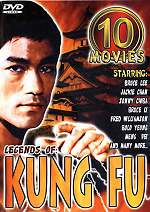
A company called Brentwood Home Video has recently released a series of DVD box sets. Each contains ten movies on five double-sided discs and sells for a MSRP of $20. While a couple of these, one of westerns and another of inspirational dramas, will probably not prove of much interest to fans of this particular site, the other subjects are more promising. Aside from the collection I’ll be examining today there are sets of horror movies, Blaxploitation flicks, and both general action films and another bunch of actioners featuring female protagonists. Some of these titles are also available in smaller collections. The collection titles, for those who are interested, are Vault of Horror, Livin’ Da Life, Action Arsenal and Women Who Kick Butt. I’ve found that some Internet purveyors, such as Samgoody.com, are mistakenly selling the smaller sets under the title of the larger ones. So make sure that the description mentions there being ten movies. This was the first collection I received. With an outlay of two dollars per film – and that’s when paying full price – I wasn’t expecting much. I’m glad to say that I was quite pleasantly surprised, however, with this first set. Note: Any artwork below is from other releases of *** Our first feature is Blind Fist of Bruce – Li, that is. I knew I was getting into the chop-socky vibe when I instantly identified that a raggedy old blind man would turn out to be a secret master of Kung Fu. Anyhoo, Li learns Kung Fu to take on a gang of ruffians who are preying on the locals. The first couple of bouts he gets beat up. Eventually, though, he masters Kung Fu and opens up a big ol’ can of whupass. Then the villains bring in an even tougher villain, and…oh, you’ve heard of this one? Beware also the typical Odious Comedy Relief. Things I Learned:
***
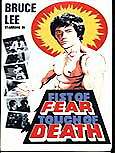
The bogus documentary Fist of Fear, Touch of Death showcases the action at the ’79 World Karate Championships, held at Madison Square Garden. It’s shortly after Bruce Lee’s death, which remains the central topic of conversation. We see part of a match from the previous year, also held at the Garden, where one contestant plucks out the eyes of his opponent. "And, in a dazzling piece of showmanship," the announcer pants, "tossing them to the crowd!" Yeah, that’s the kind of thing one tends to see at Madison Square Garden, I guess. We meet a variety of fighters who are supposedly competing for Lee’s title of King of Kung Fu. One, Roy Van Clief (!) is a boxer/martial arts champion who, and I’m entirely sure this is just a big coincidence, looks quite a lot like Mohammed Ali. Another contestant is real-life Blaxploitation star Fred "The Hammer" Williamson. We mainly watch him as he tries to get a taxi. Other participants relate, in flashback, conversations they had with Lee before he died. These recollections are produced by cutting from the actors to what is, quite patently, entirely unconnected and overdubbed footage of Lee (!). You know, like how they inserted Raymond Burr into the American version of the first Godzilla movie. The remaining bulk of the film is a bizarre and quite hilarious telling of the Teenage Angst of Bruce Lee. This is assembled from an early film or TV appearance of his, dubbed over with risible dialog and intercut with footage from a samurai film (!). This sequence goes on for like half the picture. Even so, those interested in a Lee biopic might want to stick with Dragon. This is one of the better-looking films of the set, is presented in widescreen, and is surely the funniest of the lot. It’s almost worth the price of the entire set. Things I Learned:
IMMORTAL DIALOG: The film’s narrator talks about Bruce Lee’s hereditary background: "Bruce’s great-grandfather was one of China’s greatest samurai master-swordsman of the 19th Century." *** Kung Fu – The Punch of Death is presented in the edited, full frame format. The action entails a young hero who seeks revenge on the evil brothers who murder his father. In a somewhat interesting change of pace, it’s the hero’s mother who is the obligatory Kung Fu expert parent. She keeps advising him to train until he’s ready to exact his revenge. He refuses and continues to get his ass kicked in a series of confrontations. Until the last one, of course.
*** 36 Crazy Fists features fight choreography by Jackie Chan. Too bad we can’t see much of it because of the pan-n-scan presentation. Chan himself doesn’t make an appearance, although even a novice fan will recognize that he arranged the fights. The image quality for this is the worst of the batch and occasionally features some severe artifacting. All in all I’d give it a C-. As you’d expect, this revolves around a lad who gets beaten up a lot until an unlikely Kung Fu master – here it’s a drunken bum rather than a blind guy – teaches him to kick some ass. A humorous note is provided by the fact that many of the characters have been dubbed with Cockney accents (!). Much other broad humor is on display as well, for good or ill. This one also features the one essential element for any Kung Fu classic, which is that the characters yell "You Bastard!!" at each other a good three or four hundred times. Also on display, briefly, is the only female nudity to be found amongst any of the films. [Future Ken: Actually, Legend of Eight Samurai has a very little also.] Some Internet sources indicate that Jackie’s the actual star of this one, but again, he doesn’t appear here. ***
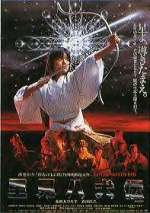
The third disc features two Japanese films starring cult icon Sonny Chiba. The first is the two-hour plus Legend of Eight Samurai. (I thought at first that this might be a rip-off of another movie, but that one only had seven samurais.) This proves a rather lavish, special effects laden fantasy epic. An evil female despot has used her black armored legions to conquer the lands and bring forth a reign of darkness yada yada yada. Unsurprisingly, a young princess has escaped the general slaughter. The Evil Queen orders her forces to scour the countryside for the fugitive. For her part, our heroine attempts to raise forces to overthrow the tyrant. Basically this is a Japanese analog to all those Sword and Sorcery flicks ground out in the ‘80s. It’s a little more lush than most of those, albeit a bit more ponderous too. Editing out another twenty minutes might have been a good idea. Eventually the Princess assembles, uh…let’s see here…six, seven…eight samurai. Yeah, eight samurai. One is the master swordsman (Sonny Chiba, dressed all in white), one a gun powder and explosives expert (!), a pair of them a young lad and his protector, the latter being the group’s inevitable Really Strong Guy; the affirmative action woman warrior/assassin; the guy with a tragic past who doesn’t care if he lives or dies (he hates the woman warrior); a, uh, miscellaneous guy; a fellow who’s one of the Evil Queen’s soldiers until he learns of his cosmic destiny yada yada; and the inevitable roughhewn samurai wannabe guy, i.e., a direct rip-off of the Toshiro Mifune character from The Seven Samurai. This is not, unfortunately, one of the better presentations here. The biggest problem is that the film’s presented in a full frame, pan & scan format. This is especially bad given the large-scale nature of the proceedings. The transfer is colorful and serviceable, but not razor sharp by any means. Occasionally the action is too dark and sometimes things are a bit over exposed. Generally, though, the image is presentable enough. Things I Learned:
IMMORTAL DIALOG: ***
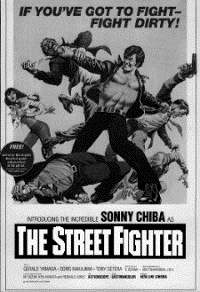
The most famous movie provided here is undoubtedly Sonny Chiba’s whomp-ass classic The Street Fighter. I hadn’t seen this one before, which was fine since I could now enjoy it in a surprisingly crisp letterboxed presentation. In fact, this is probably the best transfer of the bunch. I’d give it a solid ‘A’. Street Fighter depicts the modern day adventures of the inordinately lethal karate assassin Chiba as he seeks revenge for … well, who cares. There’s gore aplenty in this one, not to mention copious use of slow-mo, ‘70s wakka-chicka music and loud swishing sound effects with every wave of a fighter’s arms. Another obvious ‘70s element is that Chiba character is a real prick, albeit one who gets (mildly) reformed in an oddly expedient manner. It’s hard to imagine him being the main character in a movie nowadays, though. Things I Learned:
*** After our side trip to Japan we return to the Land of Kung Fu proper. Our next feature is the imaginatively named Blood Fight. Emphasized here is the appearance of Bolo Yeung, although it turns out he’s the villain of the piece rather than its hero. (It’s the DVD itself that overplays his prominence; in the film’s credits he’s properly given fifth billing.) Novice Kung Fu fans, such as myself, will remember Bolo as, well, Bolo in Bruce Lee’s Enter the Dragon. He was also the villain in the early Jean-Claude Van Damme actioner Bloodsport. Bolo is best known for his massive physique, which has earned him the nickname ‘The Chinese Hercules.’ Opening in 1989 Hong Kong, our setting is that year’s championship in "Free Fighting." This is one of those things where a sumo warrior takes on a kickboxing champion. All this for crowds that range from the thousands in the stock footages inserts to the dozens seen in the actual background of the matches. The contestants include a giant, the typically huge sumo guy, a little monkey-like fellow and so on. Unfortunately, these traits are used to generate much Odious Comic Relief. Another of the contestants is Bolo. From here we segue to the film’s backstory. With Bolo more or less disappearing for the next half hour, we watch as a Hong Kong-based martial arts instructor tutors a Caucasian (?) street gang leader. Unfortunately, the punk uses his new skills to become an even bigger menace to the locals. On one typical spree he and his cronies run into a guy named Ryu, who hands them their asses. Seeing this, the repentant gym owner decides that it is Ryu who should be his student. Rye refuses, which unfortunately leads to further Odious Comic Relief wherein everytime Ryu turns around he finds the trainer guy there. Eventually the issue is decided when Ryu is ambushed by the gang. This time the punks bring weapons and administer a savage beating. Horribly battered, Ryu crawls over to the gym, finally ready to receive some whup-ass instruction. Only now the teacher refuses, fearing that his new student would only use his improved skills to gain revenge. This leads to an equally awful reprisal of the earlier OCR sequence, only with Ryu following the teacher everywhere rather than the other way around. Having inflicted enough pain on us, finally, the training sequences begin in earnest. This is pretty rote stuff. Ryu’s girlfriend also pops in occasionally to try to talk him out of fighting. He’s got his blood up, though, and Ryu is soon cutting a bloody swathe through the competitors at the 1987 Free Fighting Championship. His last match is with Bolo, who is half plastered for some reason. Even so, Bolo beats the hell out of Ryu and then kills him as he lays unconscious. Ah, the pathos. Wracked with guilt, the teacher becomes a drunk. When the street gang guys -- remember them? – pop up to give him a hard time he savagely beats them. Later, though, and in a very unconvincing manner, they run him down with a car and break his leg. Or something. Then the gang disappears from the movie entirely. Whatever. Redemption, of a sort, arrives when the teacher – I’m sure he’s got a name but I haven’t managed to catch it yet, it’s that kind of movie –who himself was a former winner of the Free Fighting competition, is invited to fight Bolo in an upcoming tourney. I think you can take it from there, Rocky-esque training montages and all. (These latter seem to run on forever, by the way.) Blood Fight is presented in a full frame format. The print quality is generally pretty good. However, it’s the lamest film here, all too typical of the cheap and cheesy direct-to-video martial arts junk ground out by the boatload in the ‘80s. The acting especially is a problem, as few among the mostly Asian cast can coherently spit out their English dialog. Compounding this is that the film’s main Caucasian character, the street punk guy, is played by a hideously bad actor. To be fair, these problems may have been magnified by the fact that I’ve been watching all these Kung Fu movies in row. But I don’t think so. Blood Fight is just an utterly generic piece of work. Not to mention that ‘star’ Bolo is in maybe twenty minutes of the movie, tops. Things I Learned:
***
When I saw that the second Bolo flick, Breathing Fire, also boasted a modern day setting I pretty much just fast-forwarded through much of it. I apologize to my reading public (yes, both of you) for this lapse, but even I have my limits. Had I known better I would have sped through Blood Fight instead, since it’s a lot more boring. Breathing Fire is just weird. Weird, that is, in a tonal and a structural sense. Set in California, the film is about two teenage brothers, both state martial arts champions. Both are all-American lads, although one of the kids was a Vietnamese war baby. He was adopted after his then soldier father killed his mother during the war. And while the kids do eventually emerge as the film’s leads, this doesn’t happen right off the bat. For much of the time the hero is a martial arts wielding ex-Viet Nam vet, one who knew their father in the conflict. However, after dominating the movie for about a half hour he gets incapacitated. He then moves into a tutor role for the youngsters, who take over as the protagonists. The plot is pretty convoluted, with characters popping in and out so that you forget about them until they turn up again. For instance, a teenage girl whose parents are killed plays a prominent part for a while, only to then disappear for a good stretch of the action. The main idea is that the boys’ dad is secretly a vicious bank robber. He and his crew, including Bolo, steal a large consignment of gold bars from a bank. We see the actual robbery, but not how they remove and transport the gold. And for good reason, because the stuff would weigh tons and there’s no possible way they could do it. The film also provides one of the funnier McGuffins I’ve seen. The oversized keys to the gang’s gold cache are heated and pressed into the back of a rubber pizza (!). Then the pizza, with the outlines of the keys burned into it, is sliced into pieces and distributed amongst the gang (!!). This way nobody alone can access the loot. Needless to say, this is majorly retarded, and watching people die for possession of a rubber slice of pizza supplies much unintended mirth. Also amusing is that this is one of those movies where seemingly everybody knows martial arts. Meanwhile, the flashback scene with the two characters back in the war – let’s pretend that we don’t notice how the actors look exactly the same, age-wise – plays with all the authenticity of a high school drama production of Apocalypse Now. The tonal weirdness is that the film generally seems, with its youthful leads, to be intended as a combination of the Hardy Boys and the 3 Ninjas series. The two leads engage in numerous fights, but there’s generally a mild slapstick tone to them. For instance, at one point Bolo is held off with a stream of water from a garden hose. All it all the fights are of the ‘people getting beaten up but not seriously hurt’ variety. Then suddenly the film will change gears (strip them, in fact), and feature a gruesome murder or two. Let’s take one character, a big clumsy black guy who’s one of the robbers. He gets into a couple of set-tos with the leads, again with a mildly humorous tinge to them. This leads to a scene where the guy shamefacedly confesses to his elderly sitcom-ish mother about what he’s done. Then, after all that, we end up watching the boys’ father killing the guy! What’s that about? Also, the film’s climax features the unmasked father attempting to beat his bewildered adopted son to death in a martial arts fight. This is markedly cruel, and radically out of sorts with much of the rest of the movie. As for Bolo, he must wistfully look back at the good ol’ days. At least then he would fall to the likes of Jean-Claude Van Damme, or at least Cynthia Rothrock. Here he receives thumpings at the hands (and feet) of a generic Jeff Speakman manqué and later from a couple of teenage boys. Moreover, he’s been reduced to playing a mere henchman, a villainous second banana. I was also sorry to see that he’s reached the point of his career where he uses a stunt double for falls and stuff. Admittedly, this guy’s career was never a high flying one, but you still have to feel a bit sorry for him. The martial arts stuff is plentiful, although the levels of expertise on display flucuate wildly depending on who’s on the screen at that moment. Still, there are some fairly good moments scattered around here and there. *** After these modern day diversions, it’s good to get back to some meat ‘n potatoes chop-socky. Our penultimate feature is Blood of the Dragon. This stars Wang Yu, a name that I guess is familiar to aficionados of the genre. We open with two dudes from that indeterminate Kung Fu time period fighting in a desert. From there it’s one largely unmotivated goofy fight sequence after another (which isn’t a complaint), not to mention what must be many thousands of Useless Severe Zoom Shots. I’m sure there’s terminology for these things among the fans, but this is one of those ones where the fights are conducted with swords and spears and more exotic weaponry rather than just hands and feet. Also, the folks here are capable of those impossible vertical leaps and flips. After a melee or two, a dying fighter gives a young beggar boy/scam artist a McGuffin and the *cough, cough* plot is off and running. Bad guys takes it from him and a Clint Eastwood-esque Mysterious Stranger makes his appearance. (It took me a minute to figure it out, but it’s one of the dudes from the opening desert fight scene.) Eventually the wounded hero ends up besieged in an inn, with the movie becoming sort of a Rio Bravo knock-off. The presentation here is about what I was expecting from the set in total. The movie is grainy, often washed out and none too sharp, and edited into a full frame presentation. The latter is a severe problem, as it tends to be with these things, since parts of the fights get clipped out of the picture. Given the image quality, you might easily think you were watching a cheapie videocassette. This is the only film where I fiddled with the brightness and contrast controls. Particularly bad was a long stretch of nighttime footage. Still, it’s generally passable, and it’s to the collection’s credit that most of the films look a lot better than this. Indeed, except for 36 Crazy Fists, this is the only really mediocre presentation in the bunch. Things I Learned:
***
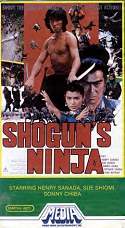
Our final film brings back Sonny Chiba in Shogun’s Ninja. Sonny is the title character, is one of the bad guys and has two Ninja sidekicks. One is these is mute, the other deaf. (That factiod never comes into play, so I guess it’s just there to provide color.) Past that I couldn’t follow things too well, this being one of those films with about a bajillion characters. Basically, Chiba’s ninja team kills a guy, an enemy of the Shogun. However, the victim’s young son is taken into hiding until he can grow to adulthood and yada yada. Still, at least this film knew the difference between ninjas and samurais. After the confusing fifteen-minute prolog, we meet our now grown protagonist. I’m sure you’ll be amazed to learn that he’s become a martial arts master. He returns to Japan where his sword, bearing his family crest, quickly alerts his enemies to his reappearance. Apparently he was raised in China, since he seems to be using Kung Fu rather than Karate or Judo. (Admittedly, though, I’m no expert on this sort of stuff.) Yep, some exposition confirms that. Anyway, he’s back to get his revenge. And a bunch of his childhood friends turn out to be a group of Robin Hood-esque thieves. Our Hero adds Japanese fighting skills to his Chinese ones, and acquires his own seemingly endless army of ninjas. Even so, after literally hundreds of deaths, it all comes down to Our Hero and the villainous Chiba. By the way, disco and jazz music aren’t any better than rock or pop scores for these things. And again, why would Asian villagers have Cockney accents? The print quality here varies greatly. Sometimes there’s very heavy grain, then in the following scene the picture will be nice and crisp. The colors likewise vary, sometimes overly dark, sometimes vibrant. However, the film’s letterboxed, so it gets points there. Things I Learned:
*** One nice element of the set is the variety of films provided. We’re afforded a wide array of subject matter and settings, from the pseudo-documentary Fist of Fear, Touch of Death to the baroque fantasy of Legend of Eight Samurai to the modern day milieu of The Street Fighter. Admittedly, I could have personally done without the two Bolo Yeung movies. (Not because of him, but rather because the examples at hand are so lame). Still, you have to give the Brentwood people credit for making the selections so diverse. As noted throughout, the films range widely in image quality. The majority of the transfers are surprisingly good, however, especially given the price. Even the worse one -- 36 Fists -- remains watchable. Still, some of these are obviously transferred from video, sport some occasional artifacting and, more regularly, heavy grain. On the whole, I’d grade the majority of them between a B- and an A. Blind Fist of Bruce would probably rate an A-, but I can’t give a non-widescreen martial arts film such a high score. (Although I was mildly surprised that any of the films were letterboxed.) As mentioned, The Street Fighter is the highlight here. I really can’t say enough about this set. For DVD fans burned by cheap but woefully low quality discs from various fly-by-night companies, the overall quality of the product here will provide great pleasure. And this, even if one pays the full retail price, at a cost of two bucks a movie. Additionally, most of the discs come with a bonus cartoon – generally early Casper the Ghost ones -- and a movie trivia game. All together, I was quite impressed. I certainly look forward to receiving some of the other Brentwood movie collections. Added Bonus: The Kung Fu Movie Drinking
Game: Take a drink whenever one of the following is said:
The eminent sinologist Dr. Freex suggests a bonus phrase for those who can really handle their liquor (or have recently suffered a deep penetration stabbing wound): "But still..." -by Ken Begg |