Another feature of... |
|
Another feature of... |
|
|
for February 2001 (1915)
Plot: Ten short films document the exploits of the murderous Les Vampires gang in 1915 Paris. Only two men stand in their way: Valiant reporter Philippe Guérande and his resourceful sidekick Mazamette. Many refer to Les Vampires, as the complete work is called, as a masterpiece. I’m not quite sure I’d go that far (a second viewing would help), but neither would I especially argue the issue. Made up of ten chapters running from generally thirty to sixty minutes in length, the picture works as a precursor to the American serials of the 1930s and ‘40s. The main difference being that each segment can basically stand on its own as a separate work. Joined together, though, they form a solid and often riveting story arc. Their European sensibility also calls to mind the Dr. Mabuse films that Fritz Lang would produce in Germany in the upcoming decade. For those who find interest in silent film, admittedly a fairly small clique, this will prove fascinating stuff. We open with hero Philippe Guérande discovering that his secret files on Les Vampires have been stolen. He doesn’t have far to look. Office clerk Oscar Mazamette, a mole planted by the gang, proves the culprit. A tearful Mazamette pleads not to be turned in, using pictures of his two young sons to sway Guérande. He gives in, and it proves the wisest decision he’ll ever make. Mazamette abandons his membership in Les Vampires and proves a wily opponent for his former associates. He and Guérande will spend much of the remaining seven hours of film saving each other’s life. On the other side of the aisle we have femme fatale Irma Vep, an anagram of vampire. (Irma Vep is also the name of a fairly recent French comedy featuring a director attempting to remake the earlier film.) The primary distaff member of Les Vampires, Vep connives with various male Head Vampires to bring about Guérande and Mazamette’s doom. Irma is no conflicted villainess. She’s quite ruthless, and in one gruesome sequence uses a knitting needle to murder an innocent man in furtherance of a robbery. She also, to many viewers’ delight, spends a fair portion of time slinking around in a tight black leotard. While she’d undoubtedly be considered almost beefy in these modern Flockhartian times, I doubt many of the men in the audience will complain. Aside from these central figures, there’s plenty of other well-drawn characters. Various male chiefs of the Vampires are introduced, sporting monikers like Satanas and Venemous. Another pivotal chap proves to be the charismatic Juan-José Moréno, a rival master criminal who spends time contending with both the heroes and the competition. We also meet Guérande’s mother, a rather stalwart old woman, and Jean, his eventual fiancée and wife. Even one of Mazamette’s young sons pops up to help out. As you’d suspect, Guérande proves the blandest character here. Such is often the fate of the hero. Mazamette comes off rather better. A bit of a rogue, especially when it comes to the ladies, Mazamette is the rare comic relief character who ably injects humor into a film without ever becoming a clownish figure on his own. Meanwhile, there is action to spare here. Everyone in the film, it seems, spends much time in disguise, attempting to learn the plans of their opposites. Les Vampires engage in grand criminal schemes, perpetrate a ghastly lot of murders and even take some time to relax in their various nighttime hangouts. There are numerous fights, plenty of gunplay, elaborate assassination plots, nutty super-villain sort of gimmicks (poisoned rings, hypnotic glances, a transportable cannon, etc.). The heroes often are captured by the villains and vice versa, with many hairbreadth escapes to follow. The film is available on DVD for about $50 on the web (that’s, again, for almost seven hours of material) and available for rental through Netflix. The picture quality is, in the main, pretty good for something made in 1915. Unfortunately, the last chapter is often seriously washed-out, with the facial features of the various characters prone to disappearing altogether. Still, on the whole the material is more than watchable. Monochrome tinting is used to break things up, with brown indicating interior scenes and green exterior ones. Summation: A pretty nifty piece of work. The
Pack
Plot: People are trapped on an island with a pack of ferocious killer dogs. I started Video Cheese for a number of reasons. One was so that I could finally start plowing through some of the literally hundreds of tapes I bought on Ebay since starting the site. Most of these, unsurprisingly, fail to merit a full review or even their own nugget. Some, like The Pack, even prove to be surprisingly (and disappointingly, for my purposes) decent efforts. Now, I’m not saying The Pack is great or anything. Still, anyone who’s lurked the B-Movie sections of their video store knows that most such flicks turn out to be just as lame and stupid as you’d expect them to be. Yet if you stalwartly continue to wade through the swill you’ll occasionally come across films that are a little better than you suspected they’d be. (And then there are those rare moments when you unearth an unexpected gem.) For a film that with this subject matter, and one starring Joe Don Baker as a marine biologist (how come so many of these movies feature marine biologists?!), this fell into the better than you’d think category. I mean, first, it’s not like killer dogs movie are generally very good. Admittedly, I haven’t seen Cujo, which has its fans, and I have fond memories of the James Brolin telepic Trapped. Still, most homicidal hound films are pretty lame. Pack of dogs movies in particular have never fared very well. Neither Dogs, aka Slaughter, nor Rottweiler have much of a fan lobby. One of the film’s advantages is that it sports a solid cast of familiar character actors. While not exactly household names, a number of them are of the "oh, I’ve seen him in a hundred things" sort. These include R. G. Armstrong (The Car, Devil Dog: Hound of Hell), Ned Wertimer (reporter Andy Anderson in Santa Claus Conquers the Martians; the comic doorman on TV’s The Jeffersons); Bibi Besch (Jabootu’s own The Promise; Star Trek II: The Wrath of Khan) and Richard B. Shull (The Big Bus; Splash; TV’s Holmes and Yo Yo). Even Joe Don Baker gives a comparatively decent performance, playing just a regular fellow here rather than one of his trademark exaggerated tough guys. Under the direction of director Robert Clouse (the killer rat epic Deadly Eyes and, get this, Enter the Dragon!) they keep their acting on the restrained side, helping things immensely. Also nice is that the characters are either kids (two young teen boys, neither of which is as annoying as usual) or actual, you know, adults. No sex-crazed twenty-five year old teens here. Nor is anyone especially stupid. I also liked how they downplay the gore. This will disappoint some, but I found the turning away from explicit violence made the film more effective. Especially in contrast to Clouse’s later Deadly Eyes, in which the gore effects are lingered upon to a much greater effect. (There’s also a slaughtered baby scene in that film I could have done without.) We also get a few well-staged attack sequences, one with a woman trapped in a car that nicely prefigures Cujo, another with the main cluster of characters defending a besieged house. The main dog, by the way, is great. I don’t know who taught it to bare its fangs, but it really looks vicious. Other than that, I was impressed by how a little Vaseline around the eyes could make the dogs look convincingly maddened and menacing. On the bad side, I’d say the efforts to strand the characters on the island without hope of aid from the outside world are a bit strained. Also the lack of firearms and ammunition, while necessary to the plot, seemed a bit of a stretch. Still and all, I had few complaints. Summation: A surprisingly solid and low-key killer animal entry. PrettyKill
Plot: Uh, plot, umm, well, there’s a cop, and a hooker, and, er, look, just read the following. We open with a man driving to the outskirts of New York City to dump a woman’s body into the water. He cries. We then cut (oh, brother) to a stock footage helicopter shot of the city, which, inevitably, is accompanied by the sound of a radio broadcast. Odder is the bouncy theme music, which sounds somewhat inappropriate for a film entitled PrettyKill. David Birney of Bridget Loves Bernie fame stars as a homicide cop suffering from a painful case of hemorrhoids. No, wait, he just looks like he’s suffering from a painful case of hemorrhoids. Instead, as he tells his girlfriend Heather, he had to kill a guy the night before. (This is a movie, you know, you can actually show stuff like that rather than just have the actor describe things.) And, hey, look, his uptight cop boss is played by Yaphet Kotto. There’s a shocker. Then Birney has to tell Kotto that a fellow cop is burned out. Kotto immediately confronts the guy, who, needless to say, resents Birney’s interfering. See, there’s a big operation going on that night to arrest a dealer named Lightning Boy. (!) It’s the culmination of six months of undercover work by the cop in question. (Actually, the big question is why Birney is involved in the operation – usually after a shooting an officer is relieved of street duty until there’s been an inquiry.) Anyway, uh, some stuff happens. Eventually we cut to a strip club patronized by a bunch of guys who have been instructed to glare like psychopaths. Presumably, I guess, because this is what men who frequent strip clubs are supposed to look like. Heather, we learn, is a high paid call girl auditioning another girl to help out. Or something. We see her interviewing Francie, a stripper with the sort of huge mane of hair seldom seen outside of a roadshow production of Cats. Francie ends up staying at Heather’s house until she can get her own place. As we will learn throughout this movie, you can’t meet a nicer bunch of folks than whores and madams. Back to that drug bust. Needless to say, things go wrong as Birney predicted and the cop-on-the-edge winds up dead. However, not because the guy blew it. Instead, Lightning Boy’s associate recognized him as a police officer. Yet somehow this is still used to justify Birney’s warnings. Don’t ask me why. Birney ends up shooting a guy and it was here that I realized that we were flashing back to the shooting he was talking about earlier. I think. If so, this is perhaps the sloppiest ‘flashback’ I’ve ever seen. We see Birney talking to his girlfriend about killing someone. Then they cut to him at the police station. The scenes described above happen. Then, ultimately, we have to piece together that these latter events were supposed to be happening prior to the earlier scene. This is in no way indicated by the editing. You have to just figure it out. Yea gods, we then get like two hours of scenes featuring Heather hanging out at her friend Toni’s house with Toni’s young daughters and stable of hookers. You know, girl talk mostly. Apparently somebody involved with this flick was under the delusion that this was a, you know, film. Either that or they realized that there’s nothing cheaper to shoot than people sitting around yakking. And meanwhile, we recognize one of the hookers as the one who witnessed the shooting of the cop. (Of course, Toni and Heather know nothing of this.) Boy, it’s a small world, isn’t it? Anyhoo, the big drama moment comes about when one of Toni’s daughters enters and starts crying. Apparently the mom of a friend doesn’t want her hanging around, and just because Toni runs a strings of whores. Really, people can be so judgmental. And…stuff. We’re still loping along with two distinct plot threads that show no sign of converging. One involves Birney’s search for Lightning Boy. The other is Heather’s impatience with the increasingly erratic Francie. By this time we’ve learned that Francie is a nutcase schizophrenic. Francie is her small town Southern girl side, Stella her learned but more seriously psycho side. Oops, I spoke too soon. Lighting Boy’s been captured. But the oddness continues. Heather and Francie go to dinner with The French Ambassador. (!) Stella makes her appearance and charms the guy, but leaves Heather determined to cut Francie/Stella loose. Later Heather is hanging around the living room while, uh, Francie/Stella and The Ambassador take care of business in the bedroom. Is this what a madam does? Shares an elegant dinner with a client and one of her girls and then hangs around to give the latter a ride home? Anyway, F/S goes a bit batty and starts smacking around the Ambassador. Which is quite entertaining, actually, because he is French, after all. Give him one for me, too, little lady. Unfortunately, though, Heather runs in to the rescue. And… more stuff. Good grief, could something happen in this movie? I know that reading all this gives the impression that stuff happens here, but believe me, it’s a false one. With a tad more than half an hour left, F/S finally manifests the personality of her abusive father. This is her murderous persona, and ‘he’ threatens to kill Heather, just like "all the others." Then we get another…oh, please, no…dialog sequence between Birney and Heather. They get in a fight, anyway, that’s the gist of things. Then Francie/Stella/Her Dad has another long-winded psychotic episode. Yes, yes, I think we get it now. Meanwhile, Heather, down the hall a bit and with both doors open, fails to awaken from any of this. Talk about a sound sleeper. Look, enough of trying to describe all this like it’s coherent. Here’s some more stuff that happens. Heather leaves her house and tells Francie Et Al., to be gone by the time she gets back. Heather then meets with a client, but he’s a bit of a jerk -- imagine! -- and she stalks out. After, at least, a typically drawn out sequence that just goes on and on and on. Anyway, I guess Heather’s feeling somewhat conflicted about beginning her second decade as a hooker. Next, in a bit that somewhat strained credibility, Kotto strikes a deal with crack dealer Lightning Boy – who’s an accessory to killing a cop – if he turns on Toni’s hooker ring. (!!) Or …something. I don’t know. So we get a bit meant to tug at our hearts where Toni’s kids have to watch her being arrested. Anyway, I guess the hooker that saw the cop-on-the-edge get killed is now going to be pinned with the murder. Which makes no sense whatsoever, and thus kind of undercuts the purported ‘injustice’ that the film is trying to get us worked up about. I mean, wouldn’t the cops rather use the hooker to implicate Lightning Boy, rather than the other way around? Which scenario would more likely result in a conviction in court? Anyway, Birney punches Kotto and…stuff. Oh, and while Kotto arrests the hookers at Toni’s house, the one who was at the murder scene gets away. Then there’s this weird looking guy who’s always lurking around outside Heather’s house. I haven’t mentioned him yet because he never seemed to have anything to do with anything. Then the hooker that witnessed the murder ends up over at Heather’s. The door is answered by Francie Et Al., who’s still lurking about. Hooker/Witness Chick turns out to be an old buddy of Francie Et Al., as was the Murdered Girl From the Beginning of the Movie. You know, the one dumped into the water, if you can remember that far back. So I guess Francie Et Al., had murdered her and the Mysterious Lurking Guy, whoever he is, has been cleaning up her messes. (They give him a noticeable limp so that we do, eventually, connect him with the guy dumping the body into the water in the beginning of the film.) Anyway, Francie Et Al., begins stalking Hooker/Witness Chick as we cut away. Outside we see Heather approaching, and Mysterious Lurking Guy warns her and asks her help capturing Francie Et Al., and Heather and Mysterious Lurking Guy go into the house, and find Hooker/Witness Chick’s body. Francie Et Al., pops up while Heather is calling the police. Mysterious Lurking Guy tries to comfort her and gets his throat slashed for his efforts. She then stalks Heather, who unfortunately proves repeatedly unable to hit somebody with a thrown object from about four feet away. Then, in a hilarious sequence, Francie keeps reverting to, uh, Francie whenever Heather gets the upper hand. Heather then backs off, following which Poppa comes back and again begins attacking her. Luckily, Heather continues to benefit from the Hero’s Death Battle Exemption until Francie Et Al., eventually falls from a stair landing and bites it. (I guess. Anyway, we see her land and then we cut away and we never see her again.) We cut to Heather at Toni’s, the latter now free and planning to return to England with her daughters. So much for her big arrest scene. Whatever. Then we learn that Birney and Heather are ending up together (duh) and moving to France, there to live out Heather’s dream of running a hotel there. Which means that after all that crap about Lightning Boy his plot thread is left unresolved. I mean, the last we saw he was cutting a deal to turn on Hooker/Witness Chick. Who’s dead now, so…oh, screw it.
Summation: As a hard hitting police drama it’s not nearly as good as your average episode of Kojak. However, it’s certainly strong enough on the unintentional laughter department to warrant a rental at your local video store. Running
Time
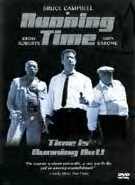
Plot: Ex-con Bruce Campbell is released from prison. Over the next sixty-odd minutes he has sex with a hooker, watches a carefully planned heist go awry and considers reconciling with an old girlfriend. Running Time’s strength and weakness lies in the fact that it’s basically an experimental student film made by professionals. It’s shot in ‘real time,’ i.e., the seventy-minute running time (har har, I get it) covers a corresponding seventy minutes in the life of the characters. We open with cult thespian Campbell meeting with his Warden (character actor Art LaFleur) prior to being released on parole. Outside the gate Campbell is met by his childhood pal/inept partner-in-crime Patrick. In the best scene in the movie, we see that Patrick has a hooker waiting in the back of his truck to, uh, help Campbell reestablish his roots. This is pretty funny stuff, with both participants taking care of business in a humane yet decidedly unromantic fashion. As you’d expect, this encounter doesn’t take very long, and the young lady is soon sent on her way. From there the truck continues on, picking up jolly middle-aged safecracker Buzz and drug-addict wheel man Donny. Campbell’s plan involves ripping off the Warden. Once every three months, the Warden skims off money from the prison laundry. The shipment is left with a bagman in a safe for twenty minutes before the Warden and his men arrive to pick it up. Coincidently, the shipment is due at the bagman’s office in the next half hour. The plan is simple: Patrick has scoped out the safe and given Buzz the model number. They go into the office, Campbell and Patrick watch over any hostages – no shooting, Campbell is explicit on that – Buzz cracks the safe, and Donny waits in the alley with Patrick’s truck running. Needless to say, things don’t go exactly as Campbell has planned. Watching things fall apart is, inevitably, the focus of things, followed by Campbell’s getting tangled back up with a high school sweetheart. On the good side, the film is a pithy if not muscular seventy minutes. So it really doesn’t have much time to get boring. (Although I did find a couple of sequences to lag a bit.) Second, it’s always nice to see Campbell in a decent part, and he’s definitely the star here. Third, the sheer technical achievement is kind of interesting for those of us interested in film. On the down side, well, first the film is yet another take-off on Reservoir Dogs, not exactly something the world’s been clamoring for. More important, the film seemed a bit too gimmicky. It’s shot in Black & White, and aside from the ‘real’ time thing they’ve filmed it so that it appears to have been shot in one long, continuous take. This is an illusion, of course – although most of the shots run from between four and nine minutes, which is extraordinarily lengthy -- but the meticulous planning necessary to realize it is sort of neat. On the other hand, I also found this distancing. The movie seemed more like a puzzle then a film, something whose challenge lay in overcoming the technical difficulties involved. Sometimes a work can overcome this. I once saw a British TV mini-series entitled The Norman Conquests. It was a series of three plays revolving around some people vacationing for a weekend in the English countryside. The gimmick was that each chapter took place in a single room. In the first show you might see two people enter the room whilst arguing. In the last show you might see the argument develop and watch them exit, knowing what happened next from having seen the first chapter. Running Time, to my mind, wasn’t quite as successful at overcoming the artificiality inherent to the project. Not helping is the extremely and often pretentiously frenetic camerawork. Bruce Campbell, meanwhile, is justly renowned for his informative and oft hilarious commentary tracks. Sure enough, the one real extra on the film’s DVD is a track with Campbell and director/screenwriter Josh Becker. Campbell generally acts as a moderator here, setting up comments by Becker. As you’d expect, much of the discussion revolves around the technical challenges of making the film. As such it works pretty well. By the way, a side note to the people responsible for the DVD: Please, please, include English Language subtitles when the disc features a commentary track. It makes it a lot easier to follow the film while listening to it. Summation: A film that’s more interesting than great, at least for me. Still, a decent enough effort accompanied by an amusing commentary track. For more info on the production of the film, check here: http://www.beckerfilms.com/page3.html -by Ken Begg |