Another feature of... |
|
Another feature of... |
|
|
for June 2001 _______________________________ (1970)
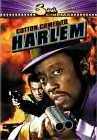
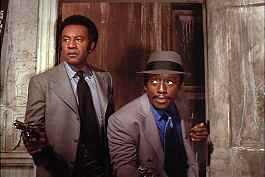
Plot: Following a heist, various forces search for a fortune hidden in a bale of cotton. First of all, kudos to MGM, who is being extraordinarily aggressive in releasing their catalog of old cult movies. In January of 2001 alone they release nearly a dozen Blaxploitation classics. Only a couple of these included extras like a commentary track (although as they go along more of their discs feature such goodies – see at least three recent DVDs with Roger Corman commentaries). Still, the transfers tend to be gorgeous and the price is right. With a suggested retail of only $15, their cult movie discs can readily be acquired for around ten to twelve bucks. Of particular interest is the recent batch of Vincent Price flicks they’ve put out, with more to come, at least half a dozen of his best movies. Jabootu bless ‘em. (MGM’s mirror opposite is Warner Brothers, who own a tremendous backlog of older films and who refuses to release them or allow other companies to do so. See an article over at DVD Drive-in for further info and what you can do to light a fire under their butts.) Anyway, this is a great movie. Made in 1970, and thus prior to the main wave of Blaxploitation flicks, Cotton Comes to Harlem is easily better than most of those that followed. As is typical with these films, we open with a heist, setting in motion a chase for the loot. Here a phony black religious leader, the Rev. Deke O’Malley, is conning the poor folks of Harlem by setting up a fraudulent return to Mother Africa. The only people on to him are cops Gravedigger Jones and ‘Coffin’ Ed Johnson. Taken from a series of classic crime novels written by Chester Himes, the detectives are played, respectively, by Godfrey Cambridge and Raymond St. Jacques. The two actors can be found in more Jabootuish fare in Beware the Blob! (Cambridge) and The Mercenaries (St. Jacques). Seldom have literary characters been more perfectly brought to life. Cambridge is Gravedigger, the cool, collected member of the pair. St. Jacques is the boiling Coffin Ed, always on the verge of beating the hell out of somebody. The two can’t stand Rev. O’Malley, not because he’s a crook, but because he victimizes his own people. ("When you steal from white folks, that’s your business," he’s told. "When you steal from black folks, that’s our business.") Coffin Ed and Digger are cops because that’s the best way for them to protect the local underclass blacks from both crooks and the white establishment.
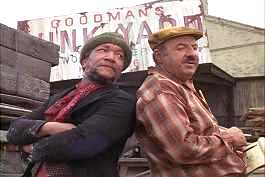
The duo assumes mythic, nearly superhuman status here. When they grab a troublemaker and toss him into the air, he flies up twenty feet or more before landing. And they can push through a crowd like Moses parting the Red Sea. They really don’t even care so much about the robbery, they just want the $87,000 back so that it can be returned to the people from which it came. What I like most about the film is how sly it is. Much of the humor, as would be typical in the genre, is quite broad. See, for instance, the comic relief doofus white cop. However, much of the comedy is also rather droll. There’s a surprisingly sophisticated air here that’s missing from most of the film’s progeny. Credit the film’s success to the lead actors, the razor-sharp supporting cast and especially the contributions of prominent black actor Ossie Davis, who co-wrote the picture and directed it as well. Mr. Davis brings an incredible sense of style to the proceedings, and it’s plain sad that he didn’t direct more movies. Speaking of that supporting cast! Familiar faces in the mostly black cast include Calvin Lockhart, Cleavon Little and Redd Foxx as Uncle Budd, an itinerant street scrounger and junkman. While more loveable than Fred Sanford, the film does offer a startlingly familiar argument between him and a rectified churchgoing black woman who matches Aunt Esther down to a tee. I’d really like to know if this was a staple in Foxx’s act and he himself provided the scene, or if this film inspired one of Sanford and Son’s most well-loved characters. There are also some familiar white faces here. Veteran character actor Eugene Roche plays the interference-running superior of Our Heroes. J. D. Cannon, one of the primary villains here, is best known as Dennis Weaver’s vitriolic boss on TV’s McCloud. Lou Jacobi makes an appearance as well.
The film was successful enough to spawn a sequel, Come Back, Charleston Blue. Unfortunately Ossie Davis wasn’t involved this time. I haven’t seen it, but it has a reputation from being much less humorous and much more violent. Which is a shame, because I’d love to think there was another film like this one out there. Summation: This is exactly the sort of film that makes you miss the ‘70s. Readers Respond: The extraordinarily quick Anthony Norris reminded me within hours of posting this article that Coffin Ed and Grave Digger made cameo appearances, played by different actors obviously, in the superior 1991 adaptation of the Chester Himes novel A Rage in Harlem. Anyone who enjoys the work of authors such as Walter Mosley is well advised to seek this nifty feature out. _______________________________ Ghost Chase
Plot: Roland Emmerich, who showed the Japanese how to make a Godzilla movie, does equally well with this hypothetical comedy. I’m a little surprised that this one’s stayed so completely buried in the closet. After all, a lot of people don’t particularly like the Centropolis boys, although Emmerich’s partner Devlin apparently can’t be blamed here. For myself, and I will be completely honest here, they are a mixed bag. I don’t think Universal Soldier was very good. I did enjoy Stargate One, a decent movie that’s become a better TV series. Independence Day I personally found an entertaining popcorn movie, as opposed to, say, Wild Wild West, which was an awful popcorn movie. Mel Gibson’s The Patriot? Didn’t see it. Oh, yeah. Godzilla. Well…OK. Actually, I thought it started out quite strongly. Things went downhill as we met the mediocre – and worse – human cast. (Good gravy, I mean, the female lead in that film. Yikes!) However, It wasn’t until they nakedly ripped-off Jurassic Park with the baby ‘zillas that it started to outright suck. This provided a long, tedious sequence that was completely out of place and which utterly ruined the film’s pacing. My final judgment would be that it was a sporadically entertaining giant monster movie. As a Godzilla movie…it wasn’t.Anyway, it sounds like Devlin and Emmerich are splitting up, a blow to the cinematic world not matched since Golin and Globis parted ways. So back to the topic at hand. I’ve said it before and I’ll say it again: Nothing is more agonizing than an unfunny comedy. And Ghost Chase proves in no way the exception to that rule. We open with a stereotypical slasher movie set-up. The joke is that this proves to be some young filmmakers making a stereotypical slasher movie. Which is about 10% fresher than the real thing. Meanwhile, certain clues (the clothes, the awful synth musical score) indicate that this was *cough* perhaps produced in the ‘80s. I haven’t as yet checked the production date yet – the one entered under the title above will be added after I’ve reviewed the film – but I’m pretty confident on this one. I haven’t seen such an evidently ‘80s film since Heavenly Bodies. The director of movie-in-a-movie proves to be one of those genius McGuyver-y juryrigger guys. Gee, I wonder if this will play a part in the movie. He’s also the high-strung one. His roommate buddy is the then inevitable slob dimwit guy. Why, they’re the original Odd Couple! Anyway, as they film Slobguy keeps tonguing Lori, the female lead, and she walks. Gadgetguy, worried about their mounting bills, is annoyed. Hilarity ensues. Assuming you take this film out of your DVD player and insert Blazing Saddles or something. Slobguy, having just turned twenty-one, gets an invitation to a reading of his father’s will. A plot device, I might add, that went out of style with raccoon coats. Comically, though, or something, he ends up only with a pawn ticket. Meanwhile, Stan Gordon, a rich, mean-looking rival (professional heavy Paul Gleason, who’s really slumming here) follows them as they the lawyer’s office. After a wacky interlude with the pawnbroker, Our Heroes leave with a small valise full of heirloom-type stuff, like a clock and a photo of his grandfather. Gordon tries to steal it from them but drives off empty handed. He then sends a wacky inept German to steal it. Back to Our Heroes’ house, later that night. Wacky Inept German Guy breaks in, looking to complete his assignment. The newly procured clock, however, strikes midnight and cartoon lights come out of it and scare the guy away. Then fog seeps under Gadgetguy’s door and he has a dream/vision of Slobguy’s grandfather having himself walled up alive with his money, so that his greedy relatives won’t get it. His faithful butler, who’s walling him in, is tricked into drinking poison so that no one will know the secret. As the butler dies, he falls near the clock. Actually, this is all presented in a fairly vague fashion, but they have GG spell it out a bit later. Gadgetguy wakes up and finds a ghost in his room. This specter bears the appearance, oh, how do I describe this…well, take a ‘life-size’ ET figure, glue on bushy white eyebrows and a fringe of white hair, and dress it in a little tuxedo. Got it? Ok, that’s exactly what it looks like. Anyhoo, Gadgetguy goes to tell Slobguy but by the time they check things out the apparition has returned to the clock. Gadgetguy decides to write the dream he had into his horror movie script. To further this, he builds a manikin or dummy or something that looks like the ET Butler. And I mean, exactly like the ET Butler. Following which the ghost of the ET Butler enters the dummy, bringing it to life. If he could do the same for the movie, I’d be much obliged. (By the way, I hope I’m not making the ‘action’ sound more linear than it is in the film.) Since he’s a butler, of course, he’s characterized as having a really bad English accent. This all results in some extremely low-grade antics. As Our Heroes freak out, to the extent that their meager combined acting skills will allow them to, anyway, Wacky Comedy Music erupts on the soundtrack. This is always a bad sign. If you have to use music to tell the audience that something ‘funny’ is happening, well, you might as well just flash the words ‘laugh now’ across the screen. I can only quote the great Tom Servo and repeat "Deeeep Hurting." ET Butler takes the boys to find the grandfather’s house, where millions of dollars are hidden. They are followed by the Wacky Inept German Guy. Along the way, ET Butler is, inevitably, seen by a Comical Drunk, with predictably tedious results. This comic sidebar executed – a choice of wording which you may take as you wish – the threesome continue on to an old movie studio. This happens to be owned, we’re told, by none other than Stan Gordon. Yeah, boy, now it’s all coming together. His supernatural task (sorta) completed, ET Butler departs for a long delayed rest. To my horror, this is actually supposed to pull at our heartstrings. The closest it achieved with me was in violently yanking my gut strings, causing my dinner to lurch around in a most unpleasant fashion.Lori, the girl that Slobguy was putting moves to in the beginning of the film, has come along for all this. This is because, unfortunately, his attempts to woo her is one of the film’s more pointless and agonizing subplots. I mean, Slobguy isn’t lovable, as no doubt intended, but a complete dickwad. So the idea that Lori will end up with him – and let’s just say that the suspense level on this isn’t very high –- is more or less just depressing. So they get into another fight, and Lori rather nonchalantly jumps into an offering stranger’s car (!!) to get a ride to work. Said car *gasp* belongs to Wacky Inept German Guy. Learning where she works, he calls Gordon and reports in. Meanwhile, Our Heroes check out city records to try and learn the history of spot the Studio stands on. Astoundingly, they try to make this sequence humorous, because, boy, if there’s a natural comic situation, it’s two guys going through ledger books. Lori, an aspiring actress remember, gets a call at the restaurant she works at from Stan Gordon. Failing to put this together with the fact that she was lurking outside his studio with a manikin possessed by a ghost about an hour ago, she remains pleasantly mystified that the head of a studio would call and personally offer her a part in a movie. She grabs her coat and takes off to meet with him, to the *sigh* zany consternation of her grouchy boss. Gadgetguy, being the *cough, cough* smart one, of course finds the relevant info back at the records office. The plot the studio sits on was co-owned by none other than Slobguy’s grandfather and junior partner Stanislav Gordonov. Upon reading this name, the two experience a Light Bulb Moment, and come to the realization that Stanislav Gordonov could be, in fact, Stan Gordon. Wow, and I thought Sherlock Holmes was sharp. Here we get the plot spelled out for us, in all its ridiculous detail, by Slobguy. Since I can’t make what he says sound any dumber than he does, here’s a verbatim text: "After Gramps is out of the picture, right, his partner takes advantage of the general confusion to get his hands on the property. He establishes a movie studio, under his new name, and then sells the property back to himself. At a good price, of course." Since I’m too tired to pick at that steaming pile of manure, let’s cut back to Gordon’s (or is it Gordonov’s?!) office. He’s interviewing Lori, all whilst stroking a two-foot tall statue of a gorilla he has next to his desk. (!!) Apparently he’s planning a production of something that sounds, say we say, suspiciously like a really sucky version of King Kong. (In other words, the Dino De Laurentiis remake.) Realizing that this is sort of old hat, Gordon reveals his masterful twist: His giant ape is twice the size of the old giant ape. At the risk of giving the filmmakers here too much credit, that’s actually a fairly successful jibe at Hollywood’s idea of ‘creativity.’ The real irony, however, is to put this in context of what Emmerich did when he himself remade Godzilla. Now that’s funny. Gordon reveals that he wants Lori to do him a ‘favor’ for the part, and she storms out of his office. On the way out she bumps into Our Heroes, arriving to learn some dirt on Gordon. Then, in a bit that defines Painful Comedy, the two ‘con’ their ways past the office secretary by pretending to be safety inspectors with broad Southern accents. Really, watching this sequence is like being pummeled in the face. It’s amazing how a film this lame can actually get worse as it goes along. With this horrifying bit completed, and thank goodness, the two make it into Gordon’s inner office. Gordon realizes that they are on to him, but remains nonplussed about them knowing how his father – apparently our Stan Gordon is the son of the first – stole the studio. He explains that there’s nothing they can do, because the Statute of Limitations on the fraud has run out. This actually isn’t how the Statute of Limitations works, and besides, they could still sue his ass off in Civil Court, but anyway. Even so, as Slobguy points out, it wouldn’t look good for Gordon if they publicized the situation. Gordon agrees, and offers them a deal: He’ll finance a film for them to make on any topic they’d like. Aspiring director Gadgetguy gets all starry-eyed at this, but Slobguy proves more savvy. (A standard sign of bad scriptwriting is that characters’ intelligence levels fluctuate at the convenience of the screenplay.) He’s figured out that Gordon wants Grandpa’s effects to search for a clue to where his money is. He vows to find the money first and not to let the Gordons cheat him out of his inheritance. Which is funny. Because in the earlier flashback, the one where we saw Grandpa having himself walled up with his cash, he said it was to deny the money going anybody, including his relatives. So much for the righteousness of Slobguy’s cause. Back to Lori at the diner, crying over how she’s been treated lately. In a, shall we say, rather convenient happenstance, she looks up and spots an old movie on TV that features the same house that Gadgetguy saw in his supernaturally inspired dream. (She recognizes it because he subsequently built a model of it.) Gee, what are the odds? She tries to call the guys but a hand, presumably Wacky Inept German Guy’s, disconnects the call. Wouldn’t it be easier just not to answer the phone? You’d think so. Puzzled, Lori decides to head out to their house. So she arrives, and sure enough, we see Wacky Inept German Guy inside. He’s got a gun, so I guess he’s planning to murder Our Heroes when they return. What a zany comedic situation this is! Lori enters the house – we don’t see how – and is captured after they attempt to milk a bit of suspense out things. Seconds later the guys arrive – again, convenient scripting there. Gadgetguy, seeing Lori’s car, waits outside so that Slobguy can hash things out with her. Whereupon the latter finds himself being held by at gunpoint by WIGG. In a bit that defies rational explanation, Lori and Slobguy talk about how she saw the house they’re all looking for, all with WIGG standing right there. This wouldn’t seem the time, you’d think, but there you go. Meanwhile, Gadgetguy, waiting outside, sees what’s going in through a window. He fools around with the clock, conveniently out in the car, and manages to make it strike twelve, whereupon ET Butler’s ghost re-manifests itself. Easier than calling the cops? You decide. Proving a student of British military history, ET Butler suggests an attack based on a WWI battle. Because, you know, if the Brits did well in any war it was that one. I can’t even bring myself to describe their moronic scheme, which would surely have gotten at least one of them killed in real life, but in any case we end things with…get ready for it…the Wacky Inept German Guy getting hit in the crotch and then knocked unconscious with a baseball bat. Ha, ha. He got hit in the crotch. Ho ho. Lori takes them to the house – I’m not sure how she located it from having seen it used as an establishing shot in an old movie, but anyway – and they find Gordon there with a work crew. The crew has gone through the house without finding anything, and Gordon orders them to…hey, wait a minute. I’m sorry, I should have thought of this before, but your brain tends to turn off when you watch stuff like this. Anyway, where are the cops? I mean, Our Heroes were just held at gunpoint by a guy who very well may have intended to kill them. However, their presence here indicates that they just left him behind after incapacitating him. Is anyone buying this, because I’m sure not. So our foursome sneaks over to the house, despite the fact that it apparently had a security fence around it, but whatever. Anything to get this over with. Meanwhile, the crew, at Gordon’s orders, are lacing the place with explosives (!!). Yes, that’s a good way to find treasure all right – by reducing it to its constituent atoms. Ugh, my brain hurts. Lori falls through a storm door into the cellar, screaming her head off while somehow not being heard by any of the crew supposedly working on the place. The others enter as well, despite knowing that the house is imminently going to be blown up. Because that’s the kind of movie this is. Meanwhile, Slobguy is carrying ET Butler’s manikin body around on his back, since that’s easier than making the thing move around on its own via strings or whatever. Directed to the correct area by ET Butler, the guys move out of the way a massive bureau which apparently weighs all of ten pounds. Using some prop weaponry conveniently sitting nearby, they quickly get the wall down. Apparently ET Butler wasn’t much of a bricklayer in his former existence. Meanwhile, the crew announces a five-minute countdown before blowing the place. After a hole is made skeletal (sort of) hands emerge and grab at our leads. Why are there so many spirits involved in this case? Got me. Also, I wouldn’t have thought a body that’s been rotting away for thirty or forty years would be capable of presenting much of a menace, but there you go. Then, in a less than awesome display of special effects, Grandpa’s ghost materializes. Slobguy urges ET Butler to stand up to the, uh, shade of the man who tricked him into drinking poison. Speaking of, why is ET Butler so eager to help the descendents of the guy who killed him? IITS, I guess. Knowing that Slobguy’s after his money, the specter animates an axe to go after them. They try to flee, but are trapped when the door is slammed shut by Powers from Beyond the Grave. Then a suit of armor is brought to life (no doubt by sticking a stuntman into it) and it goes after Our Heroes. Oh, and remember, the building is about to be blown up. Boy, whew, you can cut the tension with a knife, you know? After a very lame swordfight, Slobguy and Lori end up in a cage and Gadgetguy on one of those beds whose lowering canopy is full of spikes. Also, it’s been more than five minutes since the warning, so I’m not sure where that explosion is. As far as I’m concerned, it can come any time now. Finally ET Butler takes a hand, and I guess because he’s also a ghost, his attack destroys the armor (we can tells because sparks fly out from the suit) where the guys’ blows couldn’t. Or something. Then he stops the descending spikes from killing Gadgetguy, in the very nick of time. But wait, the armor isn’t dead (or whatever) yet. Although I wish I were. Somebody, please, end this movie! For heaven’s sake, how long do I have to sit here watching this crap? Picking up a spear, it menaces ET Butler, while also reactivating the lowering spikes. If only my interest could be so easily turned back on. On the brink of everyone’s death, which at last would have provided us with something enjoyable to watch, ET Butler shouts out for Gadgetguy to destroy the clock. First, gee, "destroy the clock," that’s a conveniently easy solution to everything. Second, couldn’t he have offered this advice before? Now, Gadgetguy’s still bound to the bed, but the clock is conveniently -- there’s that word again – resting on his chest. (Don’t ask.) In other words, Grandpa’s ghost, seeing the clock whose destruction would mean his own laying in the way, twice started a device whose operation would cause its obliteration. In fact, when Gadgetguy used it as a shield earlier, Grandpa whacked at it with his sword! Quite the genius, Grandpa. Sure enough, a spike penetrates the clock, with predicable results. Except for the door to the cage popping open and the spikes to stop descending, I have no idea why that would happen. (Well, OK, IITS, but you know what I mean.) Slobguy and Lori rush over, saving Gadgetguy, for the second time in two minutes, in the very nick of time. However, the destruction of the clock has also released the spirit of ET Butler, although it hangs around long enough for another horrendously cloying farewell scene with Our Heros. (By the way, the five minute explosion warning call sounded ten minutes ago.) Since we already had one of these, the second one is even more annoying. Especially stupid is Gadgetguy trying to get the prone ET Butler to walk out of there with them, since after all, he was carried into the building on Slobguy’s back! In other words, why this potentially life-threatening conversation when they could just scoop him up as they ran out of the building? So the house goes up (through some pyrotechnics so spectacular that you just know it’s footage from another, better movie). Our Heroes are still inside, so they survive basically because the script says they do. By the way, the house is indeed more or less blown to pieces, so again I’m not sure how Gordon expected this plan to reap him the long sought-after treasure. The bottom of the house remains suspiciously intact, especially as we saw explosives being placed down there, and we find ourselves generally unamazed and unrelieved that Our Heroes escaped being blown apart or crushed by rubble. This despite a tremendously lame attempt to milk suspense out of whether Slobguy survived or not. I don’t want to totally knock you out of your seat, but he did. And, and he wins the girl, another shocker. So they get the money, which proves to be what looks like hundreds of millions of dollars in bearer bonds, which is quite a fortune for the ‘20s or ‘30s or whatever, I’d say. Actually, the sheets are labeled as being stock certificates, but the characters note that they’re state they’re worth fifty thousand dollars apiece. (Comedy is attempted when they burn two of the certificates to provide light before realizing what they are. Ho ho.) Of course, stock certificates come in amounts of shares, not dollars, but apparently no one involved in the film knew that. So I’m assuming that they’re supposed to be bonds. Gordon is exposed and loses the studio -- I’m not sure how, but we see it in newspaper headlines – and Slobguy ends up on the cover of Time Magazine (!). We can’t see all of the cover, but the letters "MAN" appear, so I think they might be implying that he was made Time’s Man of the Year (!!), which is so dumb it’s not even funny. They also used dummy issues of papers like The Hollywood Reporter, and laughably we can see that the text of the articles in no way matches the headlines. In fact, two of the stories start in mid-sentence!! So the good guys win, and the bad guys are punished, and love triumphs, and all that kind of crap. Among the things I don’t get is who this movie was aimed at. The young leads -- for once they actually seem to the age stated for them, if not younger -- and drearily goofy antics would seem to indicate the targeting of a rather young demographic. On the other hand, the film is filled with the sort of copious swearing that defines the term ‘gratuitous.’
Summation: Child Abuse in a box. _______________________________ (1963)
Plot: Mike Hammer is back and fighting some damn, dirty Commies. Fictional sleuth Mike Hammer exploded on the scene in 1947. By the ‘50s he was a cultural landmark, albeit one looked upon with some disdain by the intelligentsia. This status was confirmed in the television play and eventual Academy Award winning film Marty. In one of the screenplay’s more famous moments, a pal of Marty’s is entranced by the concluding passage of the first Hammer novel, I, The Jury. His fixation with Hammer is meant to indicate his lower class mentality, which Marty will spend the rest of the movie becoming increasingly weary of. As their little gang bums around in a local hangout, the guy repeatedly and with much awe reads the passage out loud. And a famous passage it is, too. The novel follows Hammer as he searches for the killer of an old army buddy. His friend was found shot through the stomach, a horribly slow and painful way to die. During his investigation he meets and begins an affair with a beautiful blonde who, unsurprisingly, proves to be the culprit. Hammer tracks her down to fulfill an oath he made when he viewed his friend’s body. In an extremely hot bit for the time, the woman disrobes and rubs her naked body along Hammer’s as she reaches behind him for a gun. Hammer isn’t to be distracted, though, and puts a .45 bullet through her abdomen:
In essence, Hammer was a throwback to early gun-happy pulp characters like Race Williams. Such cartoonish ‘shoot first, then shoot second’ characters were the meat and potatoes of the pulp detective magazines of the ‘30s, like Black Mask. Eventually, however, a new and far more literate breed of writer came along. The first major author of this kind was Dashiell Hammett, himself a formerly a detective for the Pinkerton agency. (The Pinkerton logo, featuring an eye and the motto "We never sleep," is where the term ‘private eye’ came from.) Hammett’s series about the unnamed and workmanlike Continental Op brought a new realism and artistic depth to such fare. Next Raymond Chandler made the scene, contributing a series of surpassingly literate novellas that he eventually reworked into the Philip Marlowe novels. Mike Hammer brought back much of the simplicity of those earlier, violence-oriented characters. The difference, though, was that those earlier sleuths (if you can call them that) were crude, two-dimensional ciphers written to entertain readers who had no conception of what violence was really like. Their plentiful adversaries were shot down like so many silhouettes and the heroes themselves would take a beating or a bullet and shrug it off a couple of minutes later. Hammer, in contrast, was written for a much more cynical audience, comprised largely of World War II veterans. To them the explicit and far more realistic violence of Hammer’s world was all too recognizable. Created by Mickey Spillane, Hammer was featured in a series of seven paperback novels, each of which sold in the millions. By present day the aggregate sales of Spillane’s books have totaled nearly two hundred million copies. Hammer was as blunt as his surname, although he wasn’t really much of a detective. If he was following a trail it was because there was someone at the end of it he intended to feed a couple of bullets. He had a, to say the least, strict moral code, and anyone on the wrong side of it was looking to get taken out. Hammer is thus the precursor to later paperback series characters like The Executioner and Killmaster and the others of their ilk. Hammer was also, needless to say, irresistible to women. And unlike such characters as the downright prudish Philip Marlowe (see the scene in The Long Goodbye where Marlowe has a near psychopathic reaction to almost being seduced), Hammer always had time for a roll in the hay. Of course, his bed partners had a habit of turning up dead, either at Hammer’s hands or in order to provide him another vendetta to pursue. Still, it was all good. Spillane somewhat mysteriously stopped writing Hammer novels at the very peak of their popularity. By then, however, the character had begun crossing over into other media. There was a Mike Hammer comic strip (!) as well as numerous radio and television series and TV movies based on the character. The problem was that such incarnations had to radically tone down the sex and violence. This was almost as true of the Stacey Keach television Hammer of the ‘90s as the Darrin McGavin television Hammer of the ‘50s. (Although Spillaine never forgave McGavin’s Hammer for carrying a girly little .38 revolver. When he sold the rights for the Keach series, it was stipulated on Hammer carrying the classic military Colt .45, as well as wearing his trademark porkpie hat.) Hammer had similar trouble translating to the movies. Even on the big screen his trademarked bed hopping and violence had to be toned down. Meanwhile, the budgets weren’t always there. The first Hammer adaptation, 1953’s I, The Jury, starred the somewhat runty Biff Elliot. The film was mostly distinguished by the fact that it was shot in 3-D (!). If not for its status as a Mike Hammer picture it would be pretty well forgotten by now. 1955 saw what remains easily the most famous Hammer adaptation, Robert Aldrich’s Kiss Me Deadly. This is an acknowledged and quite authentic Noir classic. However, there’s one basic problem with the film – which is also its primary strength -- in that it completely reconceived its lead character. A member of the Hoi Polloi that loathed Hammer’s purported fascist tendencies, Aldrich presented the Hammer he saw in the novels. Out went any hint of a moral code. Instead of an unyielding dispenser of brutal justice, Aldrich’s Hammer was an out and out psychopath. It would be like Pauline Kahl directing a Dirty Harry movie. (Ironically, Aldrich later came under fire for his own ostensibly ‘fascist’ – funny how many people toss around that word without knowing what it means – work after making The Dirty Dozen.) Kiss Me Deadly also sports what is easily the best cinematic performance of Hammer, courtesy of Ralph Meeker. Meeker’s Hammer is a much more vibrant creation than that of any other actor so far. Meanwhile, Aldrich’s innovative directorial style seems decades ahead of its time. The film climaxes with one of the most startling and horrific deaths in cinema history. If you want to check out this movie, it’s a fine one. Look for the video containing both of the radically different endings, or wait for the DVD, due out in this month (June of 2001). In the long run, though, Aldrich’s Mike Hammer has as little relation to Spillane’s as Robert Altman and Eliot Gould’s hippyish Philip Marlowe from The Long Goodbye has to novelist Raymond Chandler’s. The search for a suitable onscreen Hammer continued. That Hammer could be so famously and thoroughly deconstructed and still continue to be featured in straightforward adaptations remains somewhat puzzling. Following Kiss Me Deadly, however, was 1957’s My Gun Is Quick, the lamest of the Hammer adaptations. A cheap mediocre film with a mediocre Hammer at it’s center (actor Robert Bray), this is probably the least well-known of the bunch. And for good reason. Fast forward another six years. Next up was our present subject, The Girl Hunters. Details below. After that it would be nearly twenty years before Hammer returned to the silver screen. Finally, in 1982 a remake of I, the Jury was released. This was the first Hammer film made in an era in which the requisite sex and violence could be portrayed in a suitably graphic fashion. (Sultry actress Barbara Carrera, for instance, has an elaborate and fully nude sex scene with Hammer.) The problem, though, was that by now the whole ‘private eye’ genre had, like Westerns, become dated and fallen out of audience favor. In other words, the cinematic world had finally caught up to the novels but had bypassed them at the same time. Another problem was, again, with the casting of the lead role. Hammer was played by Armand Assante, an actor far too suave and silky to properly inhabit the part. Anyway, I guess we should eventually get around to looking at our actual subject here. Made in 1963, The Girl Hunters was the first film that could come close to accurately portraying the brutality of the novels. It also sported the screen Hammer that most closely resembled Spillane’s. And no wonder, for in a bizarre piece of stunt casting Spillane himself assayed the role. (!!) A stocky, balding fellow, looking for all the world like a more pugnacious Curly Joe DeRita (or Coleman Francis, if you know who he is), Spillane captures fairly well Hammer’s bullet-headed toughness. As an actor he more recalls Tony Bennett from The Oscar -- they both have the same soft voice and Bronx accent -- although Spillane is merely mediocre rather than downright hysterically awful. The closet he comes on the comedy scale, aptly enough, is during Hammer’s voiceover scenes. Again, Spillane’s not nearly as bad as Bennett was during his, but this is where he comes closest. Also, his scripted irresistibility to the women in the picture remains more than a tad unconvincing. The film’s femme fatale is portrayed by Shirley Eaton, who played the girl who receives a fatal coat of paint in Goldfinger. That was made the year after this, by the way, so it isn’t why she was cast here. Eaton is adequate here, which mostly means she looks pretty good in a bikini. Like many, her stint as a Bond Girl was the highlight of her career. After that she spent another five years appearing in schlock like the tepid And Then There Were None remake Ten Little Indians, one of the Christopher Lee Dr. Fu Manchu flicks and two stints as her very own supervillainess character Sumaru. After 1969, at the age of thirty-two, she apparently retired from acting. This is less surprising when you consider that, in a film career lasting roughly fifteen years, she worked under directors Val Guest, Ivan Tors and Jess Franco (twice!) while appearing opposite the likes of Mickey Spillaine, Fabian, Frankie Avalon, Robot Monster’s George Nader, Phyllis Diller and Klaus Kinski. She also appeared with Christopher Lee, Sean Connery, Peter Sellers, Terry-Thomas, Bob Hope, Jill St. John, George Sanders, Jonathon Winters, Lloyd Bridges, David McCallum, Keenan Wynn, Robert Culp, Harry Guardino, Michael Gough, Donald Pleasance, Dirk Bogarde, Laurence Harvey, Jill Ireland, Jon Pertwee and William Hartnell, and Wilfred Hyde-White (thrice!). She appeared in three episodes of The Saint TV show opposite Roger Moore. Somebody tell me this woman wrote a book!! The real pro here, however, is Lloyd Nolan, who more or less made a living playing laconic crooks, cops and private eyes. He even had his own PI movie series as Brett Halliday’s character Michael Shayne. He played Shayne in seven different pictures in two years (!). Having appeared in over a hundred movies, Nolan’s final screen appearance was a nice role in Hannah and Her Sisters. Director Roy Rowland, meanwhile, remains most famous for directing the cult classic 5,000 Fingers of Dr. T. Apparently the makers of this film assumed that those who sent to see it would be conversant with the Hammer novels. This one hits the ground running, and you either know the characters in Hammer’s universe or you have to pick them up quickly. I’ve never read any of the books, but I’ve seen enough of the movies to generally know who these people are. We open with a jazz score so excessively brassy that it could more profitably be used in a parody of this kind of picture. This – three guesses – accompanies *gasp* nighttime cityscape footage. Soon after this some beat cops stumble over Hammer, now a pathetic booze jockey. In fact, they find him lying unconscious in an alley after having had the stuffing beaten out of him. It’s a sign of Hammer’s degradation that he’s taking beatings instead of dishing them out, you see. In the novel before this, Hammer’s secretary/lover Velda disappeared and was presumably killed. Velda was the one woman Hammer comes closest to loving. Largely because she ‘understands’ him, of course, and thus is fine with his voracious catting around. This is reminiscent of the Blaxploitation heroes and their women of the ‘70s. In fact, if any character serves as an ancestor to those movies, it was Hammer. Hmm, there’s an interesting article there, somewhere. Anyway, Velda’s apparent death, now some years in the past, knocked the detective for a loop, resulting in his present condition. Hammer is taken to the house of police captain Pat Chambers, another regular character in the books. (Played here by the guy who assayed David, the treacherous boyfriend, in They Saved Hitler’s Brain!) Hammer and Chambers had the typical up and down relationship between literary PIs and their cop associates, only more violently so, as you’d expect. Larry, a doctor friend of Pat’s, is at the house to bring Hammer around, and then Chambers begins a rather violent third degree. We will later learn that Chambers had also (duh) loved Velda, and blames Hammer for her death. Yet it’s not hatred alone that drives him, it’s also disgust. Hammer’s transformation into a "filthy, drunken bum" has violated the rigorously strict tough guy code the two follow. The one real sin in the Hammer universe is weakness. This is sort of an extreme (Hammer’s trademark word) counterpart to the relationship between John Wayne and Dean Martin at the beginning of the Howard Hawks classic Rio Bravo. There’s a reason Chambers has dragged Hammer from the gutter, we learn. There’s a dying gunshot victim named Cole who won’t talk to anyone else. Chambers wants Hammer sobered up so that he can find out who shot the guy. The bullet taken from him, you see, matched the bullet used in the earlier murder of Senator Napp, a prominent anti-Communist. Cole tells Hammer that he was shot by The Dragon, a top Soviet assassin (!). But the real bombshell is his claim that Velda is still alive. She’s also being hunted by the Dragon, and Cole exhorts Hammer to find her before the assassin does. He tells Hammer about an envelope left with Dewey, a local newsstand guy, and then passes away. Needless to say, Hammer blows off Chambers. Chambers tries to beat the info out of him, and Hammer later wakes to find himself staying at the hospital Cole died in. Larry the doctor drops in. He’s worried about how Chambers has gone around the bend and asks Hammer what happen to Velda. (Apparently, Larry has an M.E. doctorate; Medical Exposition.) Hammer was hired to protect a rich woman’s jewels at a party one night. Hammer brought Velda in on the case, since she could follow the woman around in places where Hammer couldn’t. The woman was found shot to death the next morning. Her jewels, her husband and Velda were gone and never heard from again. Now that he has a lead on Velda, needless to say, Hammer plans to clean himself up posthaste and get on her trail. The moment Larry leaves he jumps out of bed and looks for his clothes. Unsurprisingly, Chambers has had them removed. Next FBI agent Arthur Rickerby (Llyod Nolan) shows up. He also wants to know what Cole told Hammer. Cole had been Rickerby’s protégé at the Bureau, and he’s as hot to find Cole’s killer as Hammer is to find Velda. Hammer offers to deal if Rickerby will get him sprung from the hospital and give him one day out on the streets. Rickerby agrees, and tosses Hammer some cash to get himself spruced up. Hammer drops by a haberdashery and picks up a clean suit, as well as the inevitable porkpie hat and trench coat. He then takes a taxi. Humorously, these rather prosaic actions are loudly accompanied by the film’s bloated theme music. He stops by Dewey’s newsstand. Dewey isn’t there, though. Duck Duck, the kid manning the stand, tells him that Dewey just failed to show up the last couple of days. Since this kind of thing is seldom a good sign in one of these things, Hammer heads over to Dewey’s place to check things out. He finds the door to his apartment busted open. He rushes in, only to find Dewey’s corpse. He promises Dewey he’ll find his killer and takes off. Hammer next returns to the building where he used to have his office. He sees that he’s still listed on the directory and heads up to see Nat Drutman, the building manager and an old pal. After Hammer hit the skids a client dropped off a large fee, and Drutman used it to keep up the utilities. The rent he ate, owing Hammer a vaguely alluded-to debt of his own. "You don’t look like you did," Drutman notes. "Except maybe your eyes. That’s the worst part." "Is it?" Hammer laconically asks. "For somebody," Drutman replies. Drutman even kept the potted plant Velda kept in the office, which he returns now that Hammer’s back. Again, the music kicks in full throttle here, to rather comical effect. I especially like the bum-bum-bum chord when they cut to Velda’s fern. In his office Hammer is reunited with his trusty .45 automatic, and thus is now fully prepared to get back into the game. I don’t want to kill the movie for those who might wish to see it, so I’ll hit the high spots. Hammer works backwards to Cole. So he stops by the Senator’s house and meets Laura, the inevitable bikini-clad sexbunny widow (Shirley Eaton). Equally inevitably, they begin an affair as Hammer continues to seek out Velda and look for the Dragon. As noted, Laura’s instant attraction to the blocky Spillaine is a bit amusing. Meanwhile, Chambers stays on Hammer’s ass and Rickerby continues to pursue his own agenda, leaving us to wonder which side he’s really on. Highlights include Hammer’s visits to Hy Gardner, a real-life anti-Communist newspaper columnist, assuming the modern reader can imagine such a thing. Then there’s Hammer’s rather vivid description of why Laura shouldn’t keep her shotgun at hand by sticking it barrels first into the earth of a large potted plant. (Basically the tamped-in dirt in the barrels would result in the gun back firing, with obvious results.) This is gone into so richly that we’re expecting it to play a part later in the film, and we aren’t disappointed. Finally, there’s the climatic and quite vicious brawl between Hammer and the Dragon. Hammer wins, but just barely. To keep the Dragon from escaping after he leaves, we are treated to a recreation of one of the novel’s most infamous scenes, wherein Hammer literally nails the guy to the floor. Not something your Philip Marlowes are likely to come up with. Another doozy occurs when a would-be tough guy in a bar threatens Hammer with an ice pick. Hammer ejects a .45 cartridge from his spare clip and makes the guy eat it. (!) Aside from that, Hammer takes and dispenses the obligatory beatings, has the obligatory gun exchanges and stumbles across the obligatory bodies. Unsurprisingly, it’s as a detective film that the movie functions least well. Hammer doesn’t deduce much, he just bulls around until all the appropriate people try to kill him. He also finds clues in Cole’s apartment, as if the FBI wouldn’t have carted off everything and sealed the place up once their agent was murdered. My favorite part is that the solution to the thing is literally handed to him. He eventually stops by Dewey’s newsstand again. This time he thinks to ask Duck Duck if Dewey left an envelope for him. Duck Duck says no, just his regular array of periodicals. Being a complete dope, Hammer leaves without examining the magazines, which, of course, contain the envelope he’s looking for! What a maroon. (Of course, if Cole had just told Hammer the info rather than make him chase down the envelope, the movie would have been over in ten minutes.) Meanwhile, the film ends with the death of the villain, never even bothering to show the reunion between Hammer and Velda that supposedly drives the movie. Many will find the Cold War politics of the movie odd for a film made in 1963. However, it’s more a reflection of the fact that, especially after the HUAC committee and the Blacklist, Hollywood would very seldom make anti-Communist movies after the first surge of them in the ‘50s. Even so, the issue was hardly out of date. Even skipping over Viet Nam, The Girl Hunters was released shortly after the events of the Cuban Missile Crisis and a full five years before Soviet tanks rolled into Czechoslovakia and crushed the democratic Prague uprising. This latter event, certainly one of the most dramatic stories of the last forty years, wasn’t to become the subject of an English language film until 1988’s The Unbearable Lightness of Being, where it served mostly as a backdrop. Of course, Hollywood never produced a film on the Tiananmen Square uprising either, so go figure. My own problem with the Communist angle is that it’s so comic booky, in the worst sense. I mean, an assassin named The Dragon? And there’s something about a Communist plan to more or less take over the world. Good grief. Nor does the extreme seriousness with which this is presented help. And even for me, who ranks the Communist regimes down there with the Nazis, the conversations between Hammer and Hy Gardner about the Communist Menace seem a tad out of date. At this point the Soviet Union was (mostly) a strategic rival rather than a direct threat to our own existence as a nation. Our collective nuclear weapons and the Mutually Assured Destruction policy saw to that. The Girl Hunters is out on DVD, shorn of any extras but boasting in a nice clean widescreen presentation. Summation: Bizarre if entertaining schlock for the film noir/private eye crowd. _______________________________ The Night
Caller From Outer Space
Plot: An alien wants our woman (not again!) and lures them through an ad in Bikini Girl magazine. Boy, this film’s an odd duck. If it were American, it would probably be ludicrous. I mean, read that plot description again! This should be England’s Mars Needs Women. And it almost becomes one, at that. However, British actors know how to underplay things and thus earn credibility where little should be granted. Even so, I’ve seldom seen a film so regularly waver from decent to incredibly goofy and back again. Half the time I was thinking, "Hmm, this is pretty good." The rest of the time I was going, "Oh, come on!" The film begins fairly strongly. It initially appears to be a knock-off of those great black & white Hammer sci-fi flicks like the first two Quatermass films and X The Unknown. And, at times, that’s exactly what it is. (The rest of the time though…) We open on the obligatory research lab – the mentioned Hammer films all boasted scientist heroes – where we meet the Elder Scientist, the Handsome Younger Scientist (American cult actor John Saxon, on vacation I suppose) and The Girl. The latter, Ann, is described as "an analysis expert," although we mostly see her taking notes or typing them up. Other staff being extraneous to our plot, we don’t see much of any. The silliness begins when we cut to the credits, accompanied by the film’s hilarious pop theme song. This is obviously meant to evoke James Bond movie tunes like Goldfinger:
The scientists are soon tracking a mysterious object falling from the sky. When they go to look for it’s landing spot they find the military already on the scene. Including, inevitably, the by-the-book and utterly unimaginative Army Major who only believes in what’s rational, the comedy relief cockney privates and a Sergeant so broad and stereotypical that I half expected Cpl. Benny Hill to make an appearance. They eventually find a blown glass basketball and take it back to the lab. Various stuff occurs,
especially a lizard-like claw that emerges from a storeroom to menace Ann.
Eventually a rather shadowy alien comes through the globe, which proves a
teleportation unit. It escapes from the research lab. We then execute of
the weirdest turnarounds I’ve ever seen. We’re abruptly alerted
through various bits of dialog that, first, it’s four weeks since the
last scene and, next, that twenty-odd local girls have disappeared.
Moreover, we’re told, scientist Saxon has gone to the press with the
whole alien story, hoping to prod the police to follow this line of
investigation. (!)
He proves right, of course. The alien, outfitted with a hyper-futuristic business office, lures girls through an ad offering modeling and acting work. He has taken the name Mr. Medra, which I suppose might be an anagram for ‘dream.’ I don’t know, it sounds like it should be an anagram for something, and a dream does come to you in the night. From here the film suddenly becomes a police procedural. (I like the way the higher-ups immediately buy into the possibility of a spaceman being the kidnapper, since this saves us from an almost certainly boring subplot.) In fact, Saxon and Ann disappear for such a long time I was somewhat surprised when they resurfaced. We now mostly follow the investigation, including two long scenes of the officer in charge interviewing witnesses. The actors in these scenes were apparently encouraged to act in a very, well, actorish manner, and they run with it. There’re not bad, really, just a big much.This eventually leads to Medra, and…well, I’ll let you find that out on your own, if you’re interested. Good points:
Bad points:
Summation: Another oddity appears on DVD, bless ‘em. _______________________________ Slaughter’s Big Rip-off
Plot: The Mob’s out for revenge, baby. Jim Brown’s Slaughter joins the handful of Blaxploitation heroes (Shaft, Cleopatra Jones, Gravedigger Jones & Coffin Ed…) who returned for a sequel. There’s even a real attempt at continuity here, with the Mob seeking revenge for Slaughter killing their dudes in the first movie. Unfortunately, none of the initial film’s fine supporting cast, including the Stella Stevens and Don Gordon characters, are on hand this time around. On the plus side, Brown seems more relaxed in the part this time, and the supporting cast is strong, as they often were in this genre. Here we have appearances by such familiar performers as Gloria Hendry, Don Stroud, Scatman Crothers and Brock Peters. The main villain, meanwhile, is played (briefly) by…are you ready?…Ed McMahon. (!!) Meanwhile, the film is directed by veteran helmer Gordon Douglas (Them!, Sincerely Yours…). The direction is cleaner here than in the first film, which often strained for effect. Well, OK, there’s this thing in the beginning where the action freeze-frames every time a new credit appears, but at least that’s over with right away. Meanwhile, James Brown co-wrote and performed the film’s score, although he doesn’t do any singing here. This is a fun movie, but I didn’t like it as much as the first film. First of all, that movie seemed to have genuine affection for the supporting characters, who for once didn’t drop like flies around our hero. Here, however, it’s back to business as usual, as we learn again that hanging out with a Blaxploitation hero isn’t good for your health. Also, the action, especially the gunplay, is a lot goofier in this one. At one point Slaughter chases off a rifle-bearing sniper by firing at him with a handgun, despite the fact that the other guy would be completely out of his range. Later he takes out six guys with six shots (often at a rather silly distance), after which his submachine gun proves to be equipped with one of those two hundred round clips. On the other hand, the hand-to-hand fighting’s better this time around. Especially interesting is a scene where two karate dudes hand Our Hero his ass. Although a bit stilted, the fisticuffs are satisfyingly brutal here. Anyway, here are some Fun Facts:
Summation: Jim Brown’s the man! -by Ken Begg |