Another feature of... |
|
Another feature of... |
|
|
for March 2001
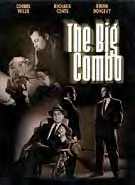
Plot: A cop is obsessed with bringing down crime boss Mr. Brown. As I noted in my review of Invisible Ghost, director Joseph Lewis went on to better things. His eventual specialty was Film Noir pictures, this being a prime example. The Big Combo is prototypical Noir. There’s an obsessed hero who is regularly brutalized as events proceed, a psychopathic villain, the possibly homosexual gunsels and, of course, the beautiful blond. There’s a brassy jazz score, sudden and brutal violence, and terse dialog is spit out like bullets. Most indicative is that little or none of film takes place during daylight hours. Not only is this a world of perpetual, often fogbound night, but even the interiors are so poorly lit that they contain shadows deep enough to swallow a character whole. The film is also blessed with the sort of cast that will have classic movie fans swooning. Our hero, Police Lt. Diamond, is well assayed by genre vet Cornel Wilde. (Wilde went on to direct and star in the classic guy’s flick The Naked Prey.) The villain, Mr. Brown -- even his lovers call him that -- is given memorable life by Richard Conte. Jean Wallace is the blond, Susan. Brian "Quatermass" Donlevy plays Brown’s resentful and nearly deaf number-two guy. And Brown’s loyal gunmen are portrayed by the young Lee Van Cleef and Earl Holliman. Those are just the guys I recognized -- somehow I missed the credited Whit Bissel -- but the film sports many other familiar faces. Mr. Brown is the kingpin in the local mob. Diamond is fixated on taking him down. So much so that his mildly sympathetic boss is pressuring him to get results or drop the matter. As we enter Diamond has focused six months and nearly $19,000 in department outlays on the investigation, which has so far achieved squat. And while $19,000 is a dangerously huge amount of department resources in those days, it can’t begin to rival the millions that Brown can muster. As his boss notes, "You’re fighting a swamp with a teaspoon." Indeed, whenever Diamond thinks he has a witness, Brown pops up with a Habeas Corpus writ provided by some friendly judge.
Moreover, Diamond has fallen in love from afar with Susan. She’s a socialite who became ensnared in Brown’s web years ago and now can’t escape. Brown won’t let her go, although we don’t know if it’s because he loves her in his fashion or because of his belief that as the strongest he should have his pick of women. Brown is a terrifically menacing character. He never raises his voice, and often ruminates on how it’s the sheer force of his hatred that keeps him dominant over those around him. The scenes where he casually humiliates Donlevy are especially cruel. "There’s Number One, and nothing," he often comments. Conte really manages to bring a quiet and quite scary menace to the role. The film is also solidly constructed. More than most of these, this one works pretty logically. Many of the villains in these things are kill crazy, and thus the fact that they lay off the hero often seems strained. Here, Brown actually berates Donlevy for killing a guy that might have possibly become a witness for the police. Brown might not be squeamish (to say the least) but he is smart. "I’m trying to run an impersonal business," he softly explains. "Killing is very personal. Once it gets started, it’s hard to stop." And he’s right. By the end of the film the murders are occurring wholesale, and this is what ultimately leads to Brown’s downfall. Moreover, Diamond cracks the case with actual police work. He interrogates subjects, follows up leads and just generally keeps up the pressure on Brown’s organization until cracks begin to show. Sure, things are a bit telescoped, but there’s a lot more attention to detail in this film than in many others of its kind. The violence is authentically brutal. In one genuinely horrifying scene, Brown tortures Diamond by sticking the lead from Donlevy’s hearing aid into his ear and shouting into the other end. The fact that he modulates his voice so that Diamond can’t acclimate to the sound level is a nice touch. (There’s also a nice bit with the hearing aid later on, but I’ll leave that for you to discover.) Meanwhile, Holliman receives a small wound to his hand, but it remains to bug him throughout the rest of the film. Nobody takes a bullet and shrugs it off in this picture. I also liked the fact that the film wasn’t too cynical. I half expected Diamond’s boss to turn out to be crooked, just because they usually are in these things. But no, he was worried about Diamond’s expenditures simply because he’s the one that had to justify them to the department brass. In other words, he’s played as a real life middle manager. It’s always nice to see a movie avoid a cliché. Summation: All the right Noir ingredients, served up with style. ______________________________ Detroit 9000
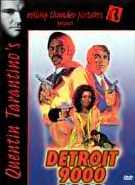
Plot: Two streetwise cops, one black, one white, team up to solve a politically charged heist. This film is out on DVD via Quentin Tarantino’s apparently defunct Rolling Thunder line. As usual, Tarantino proves he knows his stuff here. Detroit 9000 starts out like a well-made yet rather typical Blaxploitation flick. Aubrey Hale Clayton, a black congressman running for governor, is ripped off at a lucrative fundraiser by a masked team of thieves. This opening sequence, albeit well executed, is entirely what you’d expect from a Blaxploitation flick of this vintage. Following the robbery the city is in an uproar. Unlike most of the nation, Detroit sports a majority black population. The local black press, always on the outlook for evidence of racism, accuses the thieves of being whites who want to stall Clayton’s run for office. They also accuse the largely white police department of giving the theft a pass for similarly racist reasons. The case is assigned to white detective Danny Bassett, a legendary street cop who’s lost promotion after promotion from a department newly focused on advancing those with college degrees. Meanwhile, suave black police detective Jesse Williams wants in on the case, figuring that between the two of them it’ll be quickly solved. Bassett is hesitant: "What happens if I get lucky and crack this thing. Who gets credit? The poor, sad honky sonofabitch lieutenant or the beautiful black glamour boy?" This is where the film more than transcends its apparent genre. For Bassett isn’t portrayed as a racist. Instead, he’s just honestly judging the political side of the situation. Bassett is a good cop and, moreover, a good man, but reeling under the strain of the huge piles of crap he’s been dealt. First he keeps getting passed over for promotions. This is especially problematic because his wife is hospitalized with some sort of degenerative disease. In a wince-inducing scene, Danny visits her in the ratty facility that is the only place he can afford, and is shocked when she suddenly unleashes a racist tirade against the blacks who care for her there. Danny’s distress seems to suggest that his wife is someone whose perhaps once dormant racism has erupted due to her bitterness over her state. Overall, Danny is an astoundingly complex character, particularly for one in a genre film. All too vulnerable (his staple characteristic is his horrible sinuses, which dog him throughout the picture), Danny is well portrayed by character player Alex Rocco, an actor generally known for his comedic turns. As a character, Jesse fares less well. First he is a much straighter tough guy type, as highlighted by a laughably blatant rip-off of the "Do you feel lucky?" scene from Dirty Harry. Moreover, his status as an ex-pro football player is a tad cliché. Still, he manages to transcend the typical paranoia of the average Blaxploitation hero. Williams is more than aware of the real life effects of racism, but manages not to assign the trait to every white he meets. My point is that the film actually treats its characters like individuals. Blaxploitation as a genre made hay from catering to its target audience’s feelings of racial disfranchisement. As with the Rambo who in the ‘80s went back and won Viet Nam for America, the Blaxploitation hero gives the finger to the White Establishment and wins the game on his own terms. Thus the films tend to merge into a crude and cartoonish series of somewhat juvenile power fantasies wherein the only good honky is often a dead one. The message here, though, is much more realistic: "An [expletive] is an [expletive], whatever color he is." Danny’s advantage is that he’s the only one not looking at the case through a racial lens. To him it’s just another heist, and this proves to be the case. Racism is, of course, dealt with as a reality here, but not as the only reality. The fact that the film’s set in a majority black city was obviously intentional. Blacks do get a raw deal, we see, but so do other people. Meanwhile, black establishment figures like Congressman Clayton and a hustling minister played by genre mainstay Scatman Crothers are often just as corrupt as their white counterparts. Yet the film seems to accept this with a shrug, as if wearily admitting that this is the way of the world. Hence we end up with characters like Clayton’s right hand man. This guy hates Clayton for being a complete and utter fraud and is more than willing to explain this in no uncertain terms. Despite this, though, he sticks with him. Riding Clayton’s coattails is his own path to power. Aside from this, there are numerous small points in the film’s favor, and many interesting scenes. The funky musical score is a real winner, for example. Meanwhile, the protagonists are definitely the good guys, but also flawed. Danny has turned to hookers and booze in response to his wife’s illness. However, we also get the sense that he indulges in such ‘professional’ sex in order to avoid establishing an emotional attachment to a woman other than his wife. Jesse, meanwhile, has a woman die in his arms and seems most upset that he didn’t get more info out of her before she passes away. Oh, and many of the criminals sports broomhandle Mausers, one of my favorite guns. Watch also for one of the most realistic sex sequences in film history. I don’t want to exaggerate here. Detroit 9000 is a markedly good police actioner, and much better than most of its ilk. Still, we’re not talking The French Connection or Bullitt here. For all its relative sophistication, it remains a moderately budgeted exploitation flick. Many of the actors, including the one playing Jesse, can be a bit stiff on occasion. And aside from the ripped-off Dirty Harry scene I mentioned earlier, there’s a very long and repetitive sequence where the gang of thieves splits up and is chased down by a large police contingent. Basically we follow each chase, generally portraying a miscreant running and occasionally shooting down a cop or two before eventually being blown away himself. This must go on for a good ten minutes and gets to be a bit much. Then there’re things like the red paint used during the zillions of bloodletting scenes. This stuff is obviously way too bright a red and never looks convincing. And I’ve seldom seen a political fundraiser wherein the Hoi Polloi make donations by tossing their pearls and diamond jewelry into a basket. The disc is pretty bare. Which is sort of funny, due to the opening Rolling Thunder ad featuring Tarantino. This maintains that each DVD in the series will include numerous extras such as commentary from Tarantino. Unfortunately, this idea never went beyond the earlier discs in the series, such as the quite loaded Switchblade Sisters DVD. By the time the company put this and Mighty Peking Man out you basically got the film and not much else. This one doesn’t even include the film’s trailer, although you do get the coming attractions for a number of Tarantino’s own films, like Pulp Fiction and Jackie Brown. Summation: Fans of such fare will be well served here. ______________________________ (1960)
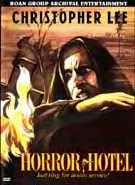
Plot: A young college student finds her life in jeopardy when she visits a small New England town known for its history of witchcraft. I briefly looked at this film in my Halloween horror movie guide, but I thought I’d give it a slightly more extensive examination after watching it again on DVD. After all, I like the film a lot and it’s my website. So there. I can’t call this a classic, but it’s a definite gem. We open with the burning of witch Elizabeth Selwin in the 17th century township of White Wood, Massachusetts. Here the hallmarks of the film are already apparent: The cast is extraordinarily good, the direction is crisp, the black and white photography remarkably moody. While the canny viewer will note that the entire film, including the outdoor scenes, was shot on sets (in England, in fact), liberal use of dry ice fog helps to keep the mood seriously bleak. This is a textbook example of how to shoot a movie and transcend some pretty obvious budgetary restraints. Cut to the present day. Well, 1960, in any case. Pretty college student Anne wants to do some fieldwork for her History of the Occult class. Her instructor, Professor Maitland (Christopher Lee, doing a good job with an American accent), suggests that she visit White Wood. She agrees, garnering much disapproval from her beau Bill and her brother Dick, both of whom view matters of the occult as being somewhat risible. Anne drives through the fog out to the deserted town. This is a typically nice sequence, including her asking directions of a local who warns that "not many God fearing folks visit White Wood nowadays." Needless to say, however, she continues on. Along the way she offers a lift to a man who’s the spitting image of Jethro Caine, one of Selwin’s fellow Satanists. He directs her to the local Raven’s Inn before seeming to disappear from the seat next to her. Anne finds much weirdness in White Wood, but initially treats it as a bit of a lark. By the time she realizes what’s going on she’s in real danger. Meanwhile, first Bill and then Dick, concerned at her long absence, follow her trail to the remote community. There they must overcome their own disbelief in black magic if they are to defeat the town’s evil forces. I really don’t want to get into this film in any detail. If this is the kind of thing you enjoy you should watch it for yourself. You won’t be disappointed. I will note, however, that the film has an absolutely terrific climatic sequence. It’s not quite up there with Fiend Without A Face’s, but it’s surprisingly close. Horror films centering on Devil worship and black magic are an often overlooked sub-genre, but one containing a number of interesting and atmospheric little films. In this list I’d include not only Horror Hotel but Curse of the Demon, Burn, Witch, Burn, The Devil Rides Out (also starring Christopher Lee) and, of course, Rosemary’s Baby. Notably, the latter two films are also out on disc. Unfortunately, the marvelous Curse of the Demon is owned by Warner Brothers, the one studio seemingly determined not to release their catalog of films on DVD. More on this subject can be found at the extremely useful DVD Drive-In site. Horror Hotel is available on DVD from Image. The disc isn’t one of the best I’ve seen (I have a letterboxed video version that I think actually looks better), but it’s certainly serviceable. The only extra included is the film’s trailer, which I definitely suggest you view only after watching the actual film. I’ve also heard that another company (Anchor Bay, maybe?) is due to release a DVD of the movie, so that one might be a bit sharper looking. Summation: A very neat little chiller. ______________________________ Teenage Monster
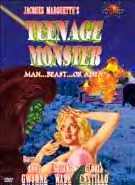
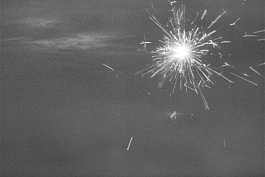
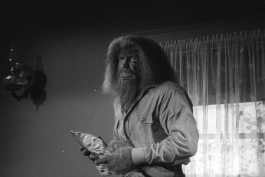
Plot: A sparkler turns a kid living in the *cough* Old West into a mentally challenged middle-aged tall hairy guy. Oh, and he kills people. That’s the ‘monster’ part. Teenage Monster was one of the few sci-fi or horror films from the ‘50s that I hadn’t seen before. Therefore I was pleased to learn that it was due out on DVD as part of the voluminous Wade Williams collection. My sense of expectation was only slightly tempered by the fact that the picture had the reputation of being pretty weak tea. A reputation, I can now attest, that proved to be well earned. Even so, I’m glad to have gotten another elusive obscurity under my belt. That’s the sort of thing that makes one a ‘fan,’ I guess. The film’s problems are both basic and manifold. First, boy, is it dull. Teenage Monster manages to squeeze in at least two hours worth of boredom into its scant 65 minute running time. Second, it’s cheap. Cheap, cheap, cheap. Third, the film’s ‘sci-fi’ elements are pretty tenuous. A meteor (represented, literally, by a grip waving a sparkler past a skyscape photograph) turns a kid into a big, lumbering homicidal idiot. In other words, basically Lenny from Of Mice and Men. So what makes a big, lumbering homicidal idiot a ‘monster’? Uh, well, he’s really hairy. I mean, really quite hairy indeed. So basically this is a cheapo western about a widow, her gold mine and her big lumbering homicidal idiot son. Doesn’t sound like much of a movie, does it? But hey, add a sparkler, a little makeup, some yak fur and the hands from a gorilla suit and you’ve suddenly got one of those monster flicks that the kids are so keen on. Yeah, that’s the ticket. We open at the rustic cabin of the Cannon family. Jim, the father, ekes a living out of the property’s basically played out goldmine, dreaming of the day when he hits another rich vein of ore. Ruth is his loving wife, worried that he drives himself too hard. Charles is their ten-year-old son. Over an excruciatingly long dialog sequence (cheap, cheap, cheap…) we learn basically what I outlined above. Oh, and that Charles wants a pony. This latter fact is mentioned six times, just in case we missed it the first five times. The boy and his father are outside the mine when the infamous sparkler makes its appearance. Long story short, Jim is killed and Charles ends up with burns on his face. Cut to seven years later. Charles is now a really tall middle-aged man in blue jeans and a denim shirt, adorned with some cheap burn scars and wearing a lot of yak fur. He also sounds like White Fang from the old Soupy Sales show. He spots a guy in the woods and beats him to death. Because, you know, he’s a monster and all.
Here the film basically becomes that Western I described earlier. Ruth keeps nagging Charles to stay hidden in the mine, for fear that the local townspeople will do away with him. It turns out that Charles has murdered various folks and livestock before this. Then Ruth finds that elusive vein of gold Jim was so sure of. Thus leaving her with the problem of how to cash in whilst keeping Charles a secret. Various plot threads pop up as we meander towards the purported climax. Bob, the town sheriff, pines for Ruth, not knowing about the whole Charles thing. Meanwhile, Charles sneaks out every five minutes and kills somebody, getting the locals in an uproar. He also kidnaps Cathy, a young lady, for obvious albeit implied purposes. Ruth finds the terrified girl and frees her, only to offer her $500 a month to hang around and act as a companion for Charles. (This would have been an enormous sum of money in the late 19th century.) Cathy proves to be a bad apple, though. Her lover is Marv, a sleazy gambler type, and he steals her dough. Cathy gets the bright idea of siccing Charles on him. Exit Marv. That’s about it, we follow these various lackluster threads until enough running time has expired to (barely) call this a film. The biggest bit follows Cathy as she pulls an Ygor and uses Charles as her instrument of revenge against the world. It all ultimately ends up pretty much where you’d guess. I realize that if you really strain at it, you can interpret all of this as a savvy comment on adolescence. Charles is unsuccessfully coping with new feelings and uncontrollable urges, his sudden height and hairiness, the raging hormones that allow a pretty girl to lead him around by the nose, etc. Believe me, though, you’d be putting more work into this than the filmmakers did. Teenage Monster sports the usual collection of might-have-beens and never-weres. Ruth was played by Anne Gwynne. Ms. Gwynne had earlier starred in such features as Universal’s House of Frankenstein and Weird Woman. That, unfortunately, proved the peak of her career, as she slid down to movies like Dick Tracey Meets Gruesome and, well, this. Although thirty-nine when this was made, Ms. Gwynne looked quite a bit younger (I thought she was in her late twenties, maybe). Because of this, makeup was used to make her look her actual age in the later part of the movie. Soon after this Ms. Gwynne gave up on film work. Cathy is played by Gloria Castillo, familiar to B-Fest ’01 attendees as the female lead of Reform School Girl. Ms. Castillo began her career with a decent supporting role in the classic Night of the Hunter. Then she later starred in this, Reform School Girl and Invasion of the Saucer Men before herself leaving the business. With Cathy she’s been handed a role that calls for slicing the ham thick, and she proves worthy of the task. Charles the Furry Adolescent is played by the 50 year-old Gil Perkins, a big Australian fellow. Mr. Perkins played bit parts in a lengthy career ranging from King Kong to The Magnificent Ambersons to Spartacus. Unfortunately, his role here remained one of his ‘bigger’ parts. His other claim to genre fame was as Bela Lugosi’s stand-in as the Monster in Frankenstein Meets the Wolf Man. Due to Bela’s frail health – he was in his mid-60s when the film was made -- it’s actually Perkins who battles Lon Chaney’s Larry Talbot at the end of the picture. Jacques Marquette directed this film. Around this time he produced and/or provided the cinematography for such flicks as Varan the Unbelievable (the English inserts), The Brain from Planet Arous, Attack of the 50 Foot Woman, and some Roger Corman stuff. Not much after this he decided to exclusively focus (har har) on cinematography. He continued to steadily work this capacity for decades after, notably on several television series.
Summation: Lame, lame, lame, but if you’re like me, you’ll need to see it for yourself anyway. ______________________________ Unknown Island (1948)
Plot: A remote island filled with dinosaurs? Who ever heard of such a thing? Made prior to the ‘50s sci-fi boom that produced the likes of Godzilla, The Beast From 20,000 Fathoms and King Dinosaur, Unknown Island falls instead into an earlier tradition of adventure-oriented pictures, ala The Lost World or King Kong. (Adventure films being what they had before the day of the Action movie.) Probably the oddest thing about the picture is that it was shot in color, quite a rarity for cheapo genre fare of that era. Film buffs, meanwhile, will be pleased by the cast of familiar actors like Virginia Grey, Richard Denning and Barton MacLane. (And boy, does Ms. Grey look good in slacks!) Practically everyone who acted in this had an extensive movie career. Grey and Denning even ended up back together in 1954’s killer robot epic Target Earth. Trivia addicts, meanwhile, will be interested to learn that Denning was married to Evelyn Ankers, the premiere scream queen of the ‘40s. And let’s not slight our old friend Ray "Crash" Corrigan, on hand playing the film’s killer ape. (Er, I mean, sloth. More on that later.) Corrigan is best remembered today for starring in serials like The Undersea Kingdom, but he was also one of Hollywood’s busiest ‘ape suit’ men. He also played the monster in It, The Terror from Beyond Space, the film Ridley Scott ripped-off for Alien. Unknown Island is actually a pretty neat little picture. It’s no King Kong, but if it sported special effects of the same caliber, it’d be a lot closer than you’d think. The script is pretty well written, the characters well etched – I especially like how no one ever does anything especially stupid – and the acting by the veteran cast is solid across the board. And for an obviously low-budget film, the production values are often better than you’d expect. I especially like the suitably seedy bar in which they open the movie. Still, I don’t want to oversell the picture either. The characters are sharply drawn – I especially like Captain Tarnowski – but they also stay well within the bounds of established types. There’s Carole, the Spunky Heroine. Fairbanks, the manly but caring hero. Osborn, the selfish fiancée who’s doomed to be dumped for Fairbanks. Finally there’s Tarnowski, the vulgar, roughhewn and borderline crazy sea captain. These are roles that benefit greatly from the experienced actors filling them out. Meanwhile, there are the dinosaurs. As mentioned, these are not exactly in King Kong’s league. They’re not even close. Realized either as static props pulled by strings or men in not-terribly-good suits, the prehistoric beasts on display here are less than credible. In fact, they’re so inept they become rather charming. We open in a dive of a bar in Singapore. The oddly well-dressed Ted Osborne and his fiancée Carole enter, looking for a Captain Tarnowski. Tarnowski runs a tramp steamer and also captures animals for zoos and such. Osborne and Carole seek to charter his boat. Commandeering a private room (which serves to establish Tarnowski’s brawling skills), they lay things out. Osborne, we learn, was a navy pilot in the Pacific. He once got lost and ended up flying over a remote island. Upon that island he saw what he believes to living dinosaurs. Tarnowski is intrigued by this fantastic story, and with reason. A year earlier he rescued a shipwrecked sailor named Fairbanks, found drifting on a raft. Half out of his mind, the guy raved about an island he and his crewmates drifted up on. According to his story, the island was infested with giant monsters that killed everyone but him. Ever since, Fairbanks has been a pathetic drunk. Tarnowski sends his first mate Sanderson to the bar to fetch Fairbanks, who more or less lives here cadging drinks. Fairbanks happily follows after being offered a shot, but panics when told that they intend to return to the dreaded isle. He flees, after which Tarnowski comes to terms with Osborne and Carole. It’s here, to his amused disgust, but the captain learns that it’s Carole, not Osborne, who is funding the expedition. Osborne’s justifications for taking money from, you know, a woman are rather weak, supplying up our first clue that Osborne will not end up being our hero. We moreover never figure out what he does for a living. He goes to the island to take photos that will bring him fame (as he oft recounts), but we never learn if he’s meant to be a scientist or what. The voyage begins. Fairbanks is along for the ride, shanghaied at Tarnowski’s orders. Here we get one of the fastest recoveries in movie history. Tarnowski pays a visit to his quarters. He finds the shirtless and quite alert Fairbanks shaving off his three-day growth. OK, perhaps actually having to face his fear would snap Fairbanks out of his drunken stupor. Let’s even buy that he can decide on a dime to give up the liquor. Even so, his unclad torso looks surprisingly buff for a guy who when rescued was "nothing but skin and bones," and then spent a solid year living on booze.
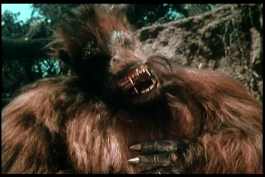
The pacing is pretty swift in this picture, it being only seventy minutes long and pretty packed with action. Even before they reach the island Tarnowski and Sanderson have to deal with a mutiny by the crew’s lascars (East Indian native sailors). Tarnowski is so tough that when the revolt begins he tells Sanderson to leave his gun behind. Instead, the two of them proceed to put down the rebellion using only belaying pins! Once on the island things proceed about as you’d expect. Fairbanks and Carole inevitably find themselves growing attracted to one another, which Carole tries to suppress. Meanwhile, there’s one exact moment when you know that Osborne is being written off by the script. One of the lascars screams from off camera and all the men grab rifles and rush to his aid. Except Osborne, that is. He grabs his camera, so he can take pictures of the attacking dinosaurs. After that, you know that even should he somehow get off the island alive he’ll never get the girl. Tarnowski can be viewed as the bad guy, but I think that’s unfair. I like rather like the character, although I probably wouldn’t if I actually knew the guy. He’s the archetypical sea captain. He’s lecherous and tough, a born brawler. He’s also got a manic sense of humor, and his braying laughter soon gets on everyone’s nerves. At one point he sneaks up on the nervous Sanderson and grabs his shoulder with a pair of clawed tongs. The panicked Sanderson draws his pistol and spins, nearly blowing Tarnowski’s head off. Enraged by the prank, he offers to do just that should the captain ever try another such stunt. Tarnowski responds with another pitched gale of laughter. Eventually Tarnowski gets "jungle fever" and crosses over into outright madness. A situation exacerbated by his prescription for dealing with the fever, which is to down bottle after bottle of whiskey. Having a boat hidden away from the rest of the stranded party -- the lascars stole the boat they arrived in, and their camp was burned down in the excitement – he kidnaps Carole and offers to take her with if she’ll put out. (This is only implied, of course, but pretty strongly.) Carole, hoping to buy time, agrees. Even half-crazed with fever, though, Tarnowski does have a code of sorts. When he tries to put a move on her, she slaps him in the face. He doesn’t get anything, she explains, until he gets her off the island as promised. Despite the fact that he could easily overpower her, he accepts this. They have a contract and he’ll take deliver on his end before collecting what he’s due. Another highlight of the film is Corrigan’s monster. This is portrayed via his trusty ape suit, although with the face altered somewhat and equipped with fangs. Hilariously, they refer to this as a "giant sloth"! Apparently they didn’t want to come out and call it a gorilla because then someone might accuse them of ripping off King Kong. (Heaven forefend.) The sloth proves the real menace of the picture. It gets an elaborate entrance, crashing through brush outside the camp (before halting whilst awaiting its cue to emerge) for at least a minute straight. Meanwhile, our characters ready their weapons behind a rock, their faces all sweaty and sporting expressions of raw horror. Then the ape, er, sloth, finally comes into shot before wandering off after a dinosaur.
What I loved was that we see the sloth twice after this. Once it horribly slays somebody, later it fights one of the film’s less-than-awesome T-Rexes. (Hmm, you know, if it were an ape rather than a sloth…) The thing that killed me was that in its first two appearances we never got any impression that it was more than gorilla-sized. However, in the last scene it strolls into shot and we see that it’s nearly as big as the T-Rex, so it must be like fifteen feet tall or so. I thought this was hilarious as, again, there had been no previous clue to its mammoth size. For instance, when it approaches the camp in its first scene, they fail to film it from a low angle to suggest size. Also, the sweating actors, watching the beast approach, are staring straight forward rather than looking up into the air. I wonder if the director even told them that the beastie was supposed to be a giant, or if they only learned this when they saw the completed film. Unknown Island is available on DVD, one bereft of extras, even so much as a trailer. Even so, it’s definitely worth a look. The picture and sound quality are pretty good for a fifty year-old cheapie. Summation: A must see for dinosaur and adventure movie fans. -by Ken Begg |