Another feature of... |
|
Another feature of... |
|
|
for May 2001
This special edition of Video Cheese is meant as a follow-up to the recent B-Master’s Roundtable on Body Part Movies. Needing, as usual, a worse example of the breed than most of my more B-Movie oriented sitemasters, I ended up doing They Saved Hitler’s Brain. This was a film I conveniently had on hand, and on DVD to boot. I had considered The Crawling Hand, which I felt fell more closely into the subject as defined, but was surprised to learn that I didn’t own a copy (that I could find) in my voluminous video holdings. As I noted in my prolog to my roundtable review, the two most numerous types of Body Part movies are those featuring Disembodied Brains and Killer Hands. One primary reason is the existence of two novels, each written by a European author, each of which profoundly influenced one particular sub-genre. The Disembodied Brain genre was created with author and German émigré Curt Siodmak’s 1943 novel Donovan’s Brain. (Siodmak remains most famous for writing the screenplay for The Wolf Man, thereby creating all the known ‘folklore’ about werewolves out of whole cloth. That’s right, the full moon, the silver thing, seeing the pentagram in the hands of upcoming victims, all sprung out of Siodmak’s head.) Adapted into numerous films and ripped-off in many others, his book tells of a scientist who revives the brain of a dead industrialist – in a fluid-filled tank, of course. The brain gains amazing mental powers, however, and soon is controlling the scientist as a tool for its revenge. Killer Hand movies, meanwhile, are largely derived from the oft-filmed 1920 French novel Le Mains d’Orlac by Maurice Renard. The novel was first filmed in a 1924 German adaptation reuniting Cabinet of Dr. Caligari director Robert Wiene with that film’s star, Conrad Veidt. From there would follow at least two more official adaptations – see below --as well as a number of unofficial ones. I originally intended to be more ambitious with this article. I had hoped to track down a number of other movies, include the ’24 version of Hands of Orlac and 1962’s Hands of a Stranger. Confusingly, the 1961 remake of Hands of Orlac also used Hands of a Strangler – note the additional ‘l’ -- as an alternate title. Both are based on Renard’s novel, apparently, although I guess it’s possible that the filmmakers of "Stranger" didn’t know of the book and were instead ripping off one of the film versions. In any case, my review of the 1961 film is below. I work in a public library, and though our interlibrary loan system I was able to access three of the films that follow. Meanwhile, The Crawling Hand I bought used over the Internet. Demonoid I already owned. At this point I had five films. I couldn’t immediately dig up a copy of Oliver Stone’s The Hand, so I let that one go. Meanwhile, I did find ‘collector’ copies (i.e., bootlegs) of the ’24 Hands of Orlac and Hands of a Stranger for sale on Ebay. Then it hit me that I was preparing to blow another fifty bucks just to lengthen out this article. So I let it go. I hope the completists out there will forgive me. I like silent film, though, so as soon as Kino or Image or somebody releases the first Hands of Orlac on DVD, I’ll write it up. _________________________________________ Mad Love
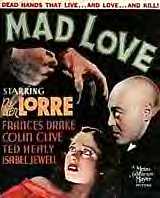
Plot: A concert pianist loses his hands in a train wreck. He becomes the recipient of a radical transplant operation, but learns that his new hands once belonged to a murderer. Now his new appendages come to have a murderous mind of their own. Or do they? Wow. This was one of comparatively few horror flicks from the ‘30s I hadn’t seen, and boy, it’s topnotch stuff. Keep an eye out, in fact. The film was produced by MGM, the company most aggressive in terms of releasing their backlog of genre flicks to DVD. Hopefully Mad Love will be released sometime soon on disc. Given the beauty of the movie’s cinematography, a digital release would be of great benefit. We open in Paris. Yvonne is a beautiful actress who stars in a Grand Guignol theater production. Or as much as one as they could show in a movie from this period. Her role is as a woman who refuses to name her lover and is thus dispatched via torture. Watching from the box he’s rented every night of the run is the brilliant if rather eccentric Dr. Gogol. Gogol is played by Peter Lorre, appearing here in his first American film. (Like many other of the luckier Germans, including his M director Fritz Lang, Lorre fled from the then recently installed Nazi government.) The actor sports a bald head here, which along with his bulging eyes and round head creates a genuinely strange and disturbing visage. After the show, the last of the season, Gogol goes backstage to praise Yvonne. Shocked to hear that she will not be returning to the stage, and more so that she is wed, Gogol declares his love for her. As mentioned, however, she’s married to Stephen Orlac (Colin Clive!), a famous English concert pianist. Even aside from that, however, she finds Gogol faintly repulsive. The stage manager breaks up their increasingly awkward conversation by arriving to escort his star to the wrap party. Oblivious to what’s going on, he also invites Gogol. In a truly uncomfortable scene, the Dr. is pushed into the line of those offering the new bride a kiss. Unable to control himself, he gropes at her desperately, an embrace from which she struggles free with equal fervor. Humiliated, he takes his leave. Leaving the theater, he sees some workmen disposing of the wax statue of Yvonne used to advertise the show. Obsessed with the legend of Galatea, a statue that came to life after its sculptor Pygmalion fell in love with it, Gogol purchases it. Our story might have ended here, but instead Stephen is involved in a train wreck. He survives, but his hands must be amputated. Knowing that her husband couldn’t live without them, Yvonne desperately seeks the aid of Dr. Gogol, who is renowned as a brilliant surgeon. After an examination he concurs that the hands must come off, but is tortured by Yvonne’s disappointment in him. Having witnessed the execution of a murderer that afternoon, an American circus knife thrower who killed his father, Gogol gets an insane idea. Perhaps the hands of the recently dead killer could be attached in place of Stephen’s ruined ones… The operation is a success, but Gogol keeps the truth from the couple. Meanwhile, although the hands function, they don’t play the piano very well. Stephen does notice, however, a new predilection and skill for throwing knives. When Stephen’s father ends up murdered with a knife, he begins to doubt his sanity. Is he being controlled by his new hands, or is Dr. Gogol pursuing a scheme to drive him insane? This is a pretty neat little picture. I especially like the short running time, which lasts under seventy minutes. Basically they utilize a lot of scenes, but each segment is keep to whatever length is necessary to get its point across. I’ve seldom seen a movie that contained so little fat on its bones. Also of note is an unusually complex level of characterization. Gogol seems practically schizophrenic. He obviously is deeply concerned with his patients’ welfare, but also is drawn to displays of physical pain and death. Meanwhile, his love for the beauteous Yvonne is pathetic but understandable. As a brilliant surgeon who finds himself driven to madness after he unexpectedly falls in love with a beautiful entertainer, he rather recalls the Bela Lugosi character from The Raven. Gogol is much more sympathetic, however. He tries to do the right thing, but when Yvonne inserts herself back into his life he goes over the edge. Yvonne, meanwhile, is callously willing to exploit Gogol’s feelings for her, despite the fact that she knows she will never reciprocate them. Admittedly, she does this to save her husband, but it does keep her from being one of the morally flawless heroines typical from films of that period. As well, when the termination of Orlac’s career threatens them with poverty, she isn’t given one of those "I don’t care as long as we have each other" speeches. Instead, she seems realistically concerned about the situation. Rollo, the executed knife-thrower, is also a different sort of character than you’d expect. A roly-poly little man, he accepts his sentence of death by guillotine as just and faces his fate with marked good humor. In fact, this lends weight to the idea that the whole ‘killer hands’ thing in Stephen’s head. Rollo might have slain his own father, but he hardly seems someone who’s in a perpetual murderous rage. Therefore the idea that his hands would constantly be seeking to commit mayhem seems unlikely. Then there’s Reagan, a wisecracking American newspaper reporter who provides a better than average example of what was at the time a copious cinematic breed. Ironically, Orlac himself is the film’s least interesting main character. They try to beef up the part by casting horror icon Clive in the role, but it’s no go. The film belongs to lead actress Frances Drake and Lorre. Clive is as much a co-equal star as Paul Henreid was with Humphrey Bogart and Ingrid Bergman in Casablanca. Mad Love was made by an interesting collection of people, in the cast as well as on the production side. Most of them, perhaps because the source novel was French, were European expatriates. For instance, author Guy Endore worked on the script. Endore also wrote the novel The Werewolf of Paris, later adapted by Hammer as Curse of the Werewolf. The film’s atmospheric and stylish direction was the work of German helmer Karl Fruend. Fruend worked primarily as a cinematographer, although he also directed The Mummy with Boris Karloff. Made in 1932, it was his first directorial assignment. Mad Love, although made only three years later, was oddly his last. As a cinematographer, Fruend had been in the forefront of the Expressionist movement in German cinema. There he worked on such genre fare as an early adaptation of Hound of the Baskervilles and director Paul Wegener’s Der Golem. Fruend also, like actor Lorre, worked in Germany with director Fritz Lang. All three would leave Nazi Germany and immigrate to the States. Once in America Fruend ended up at Universal Studios, working on such films as Dracula. As noted, he became a director for three years before returning to cinematography. He continued to work in this capacity in films for another twenty-odd years before shifting over to television work. For instance, he was for some years the head cinematographer for I Love Lucy. Peter Lorre became an international star after appearing in Lang’s 1931 production of M. A few years later he also left Germany, stopping in England to play the villain in Alfred Hitchcock’s The Man Who Knew Too Much. Then it was on to America, where Mad Love was his first film. Lorre’s subsequent career lasted another thirty years. Over time he grew plumper and his acting style grew more florid, even campy. He ended up doing a lot of comic horror roles, often alongside fellow ham Vincent Price. Lorre was most for his villains, but he also had his own detective series as Japanese (!) sleuth Mr. Moto and was equally adept at comedy. Ingénue Frances Drake as Yvonne is the film’s primary American star, and she does well with a juicier-than-normal woman’s part. As noted, her role is somewhat more morally shaded than the usual pristine heroines one typically sees in flicks of this period. We understand her motives in trying to save her husband’s career, but her use of Dr. Gogol is somewhat heartless of her. Her next role was as the heroine opposite Boris Karloff and Bela Lugosi (two other Europeans) in The Invisible Ray. She basically quit making films four years later, at the age of thirty-one. Living a long life, she died in 2000 at the age of ninety-two, long decades after most of those she worked with. Colin Clive needs no introduction here, I’d imagine. He played in the title role in Frankenstein, and returned to the part in Bride of Frankenstein. One of a colony of British players in Hollywood (although he was actually born to France, the son of a British Army officer), Clive worked often with English director James Whale, both in film and on stage. His specialty was neurotics, and he plays Orlac in his trademark fashion. His film career was cut short when he tragically died at the age of thirty-seven from tuberculosis, a condition exacerbated by his alcoholism, two years after this film was made. Supporting character actors here are equally interesting. Reagan is played by Ted Healy, most famous these days for three appendages of his own that developed a mind of their own. Rollo is portrayed by Edward Brophy, an actor who specialized in comic tough guy roles. His most famous appearance might be as the mug who holds a pajama clad Nick and Nora Charles at gunpoint in The Thin Man. Lastly, Gogol’s assistant is assayed by well known character actor Keye Luke. Mr. Luke was the first actor of Asian descent to be play the lead in an American film. This occurred when he took over the series role of detective Mr. Wong from Boris Karloff (!) in that character’s final screen appearance. He remains most famous as Charlie Chan’s Number One Son in that series of films. Meanwhile, back on the European front, Mad Love’s score was provided by Russian composer Dimitri Tiomkin. Mr. Tiomkin wrote music for over a hundred and fifty films, including numerous Frank Capra films such as It’s a Wonderful Life and Lost Horizon, Alfred Hitchcock’s classic Shadow of a Doubt and The Thing from Another World. The latter kicked off the onslaught of ‘50s sci-fi films that used the Theramin in their scores. He also won a Best Song Oscar for High Noon. Cinematographer Greg Toland
also worked on the film. Toland remains one of the most famous of
cinematographers, having worked on such films as Citizen Kane, The
Grapes of Wrath and The Best Years of Their Lives. Beast With Five Fingers
Note: Dr. Freex over
at the Bad Movie Report assembled a
full-length review of this film, with screen caps, for last week’s
roundtable. Readers may wish to read his more in-depth piece first,
although obviously it contains more spoilers than my short piece below. I
myself have refrained from reading the Good Doctor’s article as of yet,
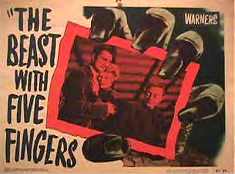
for obvious reasons. Plot: The disembodied hand of a crippled pianist (again with the pianists!) is seeking revenge from beyond the grave. Or is it? It might be that my feelings about this film are harsher than it deserves. Certainly its defects are exaggerated by having recently viewed the much superior Mad Love. Even so, the movie does have some small merits. We open with a lengthy (too lengthy, perhaps) introduction to Conrad Ryler, an American expatriate living in the small Italian village of San Diego in the early 1800s. He’s a bit of a conman, making a living by selling phony antiques to gullible American tourists. He’s also the friend of the autocratic retired pianist Francis Ingram. Ingram is crippled, only having the use of one hand – Conrad, a composer, created a one-handed Bach arrangement for him to play – and a bit of a monster. Only his beloved nurse Julie escapes his wrath. Julie, however, doesn’t return his feelings, and in fact intends to leave Italy. Conrad, in love with her himself, agrees to leave also. Live-in scholar Hilary Cummins (Peter Lorre, again!) fears this, as Julie’s intercession is the only thing keeping Ingram from denying him access to the pianist’s extensive library of ancient tomes. Ingram dies in an accident, tumbling down a staircase in his wheelchair. Two rapacious relatives, Raymond Arlington and his son Donald, show up to sell off his property. They are angered to learn, however, that a recent will left everything to Julie. She herself is less than pleased, as this ties her to the house. She stays only for Hilary’s sake, as the Arlingtons have made clear their plans to sell off the library. Meanwhile, Duprex, Ingram’s lawyer, sells his services to the Arlingtons, unethically promising to help break Ingram’s will. Soon it seems that, perhaps, Ingram’s disembodied hand is running around, dealing harshly with those who would seek to cheat Julie of her inheritance. Duprex, for instance, is soon found strangled to death. Meanwhile, Hilary is acting more and more unstable. Is Ingram really seeking vengeance from beyond the grave, or has the scholar gone off his nut and committed the crimes himself? As noted, the film suffers badly in comparison to Mad Love. First of all, it’s nearly a third again longer, and the extra running time ain’t helping any. In fact, the lethargic pace of the film is perhaps its primary deficit. As an example, the scene in which Ingram questions four different dinner guests as to whether they think him sane is interminable. For this blame director Robert Florey. Florey was originally meant to direct the 1931 Frankenstein, back when Bela Lugosi was briefly attached to play the Monster. Lugosi left in a huff, not wanting to play a mute or be covered with makeup, Florey got bumped for James Whale (thank goodness!) and Whale cast Boris Karloff. Florey instead got another Lugosi vehicle, Murders in the Rue Morgue. And so goes history. Another area where this film comes in second to its predecessor is in its cast. Robert Alda, Alan’s father, plays Conrad, and is none too hot. It’s not that he’s bad, but his entire performance seems based on Tyrone Power’s blasé Don Diego character from The Mark of Zorro, right down to the pencil mustache. Andrea King, as Julie, is competent at best, and easily outclassed by Francis Drake’s performance as Yvonne in Mad Love. J. Carrol Naish, last seen here in more dire straights in Dracula vs. Frankenstein, gives one of his trademark ethic characterizations as the town’s police chief. A small man, he, like Lorre, was often called upon to play Europeans or Asians. Italians, though, were a specialty, as Naish was perhaps most famous for starring in the comic radio series Life With Luigi. Except for Lorre, Naish probably provides the film’s most polished performance, but chances are that modern audiences will find his bordering-on-Chico Marx accent a bit much at least and offensive at worst. Although listed third in the credits, there’s no doubt that this is Peter Lorre’s movie. Charisma is a funny thing. Shorn of his grotesque bald dome and with his face grown leaner in the years since Mad Love -- a trend that would soon reverse itself -- his appearance here is much more prosaic. A small man with moist, protuberant eyes who speaks softly and with a pronounced lisp, Lorre is few people’s conception of a film star. Even so, when he’s on camera you can’t take your eyes off him. Florey seems aware of this, and uses him to keep the audience’s attention from flagging. More than once when other actors are the focus of a scene he’ll often place Lorre in the back of the shot. It’s inevitably him that draws our eyes. (I can only wonder, though, how the rest of the cast reacted to this.) In any case, Lorre carries the show on his broad shoulders. Things picks up considerably in the latter portions, when his character becomes the picture’s focus. I shudder to imagine what the same film would have been like with a lesser actor in this role. With his appearance here Lorre cemented his position as the most prominent actor in Killer Hand movies. Christopher Lee is probably next, given his supporting role in the 1962 remake of Hands of Orlac while also being terrorized by a Killer Hand in a segment of the horror anthology film Dr. Terror’s House of Horrors. Two other names should be mentioned here. One is Curt Siodmak, who provided the screenplay. As noted earlier, Siodmak wrote Donovan’s Brain, so it seems fitting that he should also make his mark on the Disembodied Brain’s only real Body Part rival. Unfortunately, this is not one of his better scripts, especially in comparison to, say, The Wolf Man. The comic relief stuff especially is painful. Even so, I believe that with a stronger cast and especially a director more dedicated to moving things along, this could have been a much better picture. Meanwhile, the original score is provided by the great film composer Max Steiner. Steiner provided music for nearly four hundred films in his decades long career, his most famous efforts including such scores as those for King Kong and Gone With the Wind Again. This score, however, is not one of his best. I personally found it a tad too florid for this particular movie, although it’s easy to believe that Florey requested such music. The special effects are a mixed lot. Usually the hand is represented by a real one, with the rest of the actor’s body blue screened off ala The Invisible Man. Less successful are a motorized ‘walking’ hand used in one shot and a simple rubber prop hand that Lorre repeatedly clutches to his chest. Worse is that each hand fails to really look like the other two. Also, while I don’t want to beat on director Florey too much, I was especially unimpressed with an eye-level POV shot from the hand’s perspective (!!) as it closes in to kill Duprex the lawyer. If we’re to think it’s the hand, then how is it seeing, much less floating off the ground? And if it’s an insane Hilary, then Duprex’s terror is comically exaggerated. Admittedly he’s a scrawny little fellow, but Lorre is hardy an Adonis, and you’d expect him in that case to put up a bit of a struggle. Another typical moment involves the feverish Hilary thinking he hears the disembodied hand playing Ingram’s signature piece on the piano. To indicate what is happening, the camera starts on Hilary, and we hear the music. Then it pans to a bewildered Julie, who stands next to him, and the music isn’t heard. Fine, not brilliant, but a nice flourish. Unfortunately, Florey liked it enough that the camera pans back to Hilary a second time. Music playing. Then back again to Julie. No music. Alright, a little clumsy, but maybe he wanted to make sure we ‘got’ it. However, we then go through this a third time! By which I was yelling, "Yes, you moron, we get it! Hilary’s only hearing the music in his mind!!" It’s interesting to note that Killer Hand movies seem to lend themselves to "Is it the Supernatural or Madness" plotlines. Aside from this and the Orlac adaptations, see The Hand by Oliver Stone. Summation: Flawed, but well worth a look for the sake of Lorre’s hypnotic performance. P.S. Having finished my piece, I rewarded myself by immediately going over and reading Dr. Freex’s review. It’s a typically erudite article, and his musings especially into how this film reflects the original Siodmak script for The Wolf Man are particularly insightful. I wish I could say I made the connection myself, but it’s a very interesting point nonetheless. _________________________________________ The Crawling Hand
Plot: An astronaut returning from space blows up real good, leaving only his alien possessed Killer Disembodied Hand for us to remember him by. When I piled up my five tapes for this article, I noticed that each was made in a different decade. Moreover each, I felt, was representative of the decade in which it was made. So I made that a little hook, as in the subtitle I assigned the films under their respective titles. If you look above, you will notice that I’ve cheated on this. To my surprise, The Crawling Hand proved to made not only in the ‘60s, but was actually produced a couple of years after the film I intended to call my ‘60s film. Still, I maintain that it is, in essence, a cheesy sci-fi film representative of those of the ‘50s. It abandons a supernatural explanation of events for a half-assed ‘science’ fiction one. (Here, for instance, for the first time we have a killer hand that is definitely physically real and animate.) It features a teenage protagonist who is misunderstood by adult authority figures. Heck, it even features a malt shop hangout where teens caper to bad jukebox Rock ‘n’ Roll. So I decided to stick with it as intended. The Crawling Hand is also the most Jabootuific of today’s line-up, although Demonoid has its moments. So this commentary will probably run a bit longer than the two above. Fans of Mystery Science Theater 3000 will remember the film appearing there. During that episode, Joel Hodgson made a remark that summed up the problem with the Disembodied Hand genre. Seeing the hand leap from the floor to a victim’s neck, he scornfully noted, "It couldn’t do that, it has no leverage." Indeed, Killer Hands often end up doing things that would seem beyond their physical powers. A manned rocket is due to return from a space mission, but has gone missing. This is the second ship sent to the moon, and looks to be the second not to be returning. At Space Operations (represented by your usual mass of stock footage coupled with a few cheap sets) the tension is palpable. Most frustrated are designated elder scientist Dr. Weitzberg and designated hunky scientist Steve Curan. Donna (Allison Hayes!), a secretary engaged to Lockhart, the ship’s captain, isn’t too thrilled either. Eventually the time limit on the ship’s available supply of oxygen runs out. So it’s a surprise when a message from the rocket’s captain comes through. Via viewscreen, of course. Aside from the fact that he should be dead, he’s possessed by some alien life-force. This the savvy viewer will deduce from the tons of mascara he’s wearing around his eyes. The situation results in some IMMORTAL DIALOG: Maddened,
Should-be-dead Astronaut:
"KILL!!" Lockhart relates, in between yelling "KILL!!", that he’s been without oxygen for twenty minutes. "That’s impossible!" Curan helpfully notes, just in case science isn’t our strong suit. Lockhart pleads for Curan to hit The Red Button (who never had a dinner), the one that explodes the ship. There’s also a Red Button on the rocket’s control panel, but Lockhart says "it won’t let me" push it. At the last moment, with the ship reportedly fifty or sixty thousand miles from Earth, Weitzberg pushes the button. Later the two listen to a recording of Lockhart’s final transmission. ("That’s one tape we don’t want Donna to transcribe," Curan sensitively notes.) Weitzberg advances his theory that Lockhart was kept alive by "an independent vital force." Presumably he means one of those little balls of light that are always infiltrating crewmembers of the Starship Enterprise. Anyway, the Technobabble Express leaves the station and is well down the tracks before the scene is over. Weitzberg then asks Curan to "back me up all the way!" when they present this theory to their boss. Oddly, Curan agrees, despite a rather obvious paucity of evidence. Even so, he has his doubts about it all. To which Weitzberg impatiently utters the classic line: "Throw out the logic pills when you swallow it!" Here, as you’d imagine, we cut to swinging teens cutting a rug at the local malt shop. The Inevitable Grumpy Old Propriety Who Beneath It All Has a Heart of Gold goes into his curmudgeon act. "No dancing, not allowed!" he orders. Examining a pet cage two girls have on their table, he continues, "No rats, not allowed!" Actually, yeah, you’d think, given that this is a restaurant and all. In any case, the comedy is *cough* heightened by the fact that the kids all ignore his grouchy edicts. Ah, good times. The two girls go into exposition mode. The statuesque blond is Marta, she has a bit of a vaguely Euro accent (Scandinavian, I’d assume), and the rats are for her grandfather, who’s a biology professor (Gee, I wonder if that last fact will come into play?), and her boyfriend is a pre-med student, and Patsy, the other girl, is the daughter of the town sheriff. The latter three facts, by the way, are revealed in a hopelessly awkward compound sentence. The referred-to boyfriend is loner Paul, who soon drives up to the shop. He leaps out of his mammoth convertible, not using the door, of course. When walking he slouches his shoulders and sticks his hands in his pants pockets, trying for that James Dean thing. An effect somewhat ruined, however, by his striped French Sailor shirt and the sweater yuppyishly tied around his neck. Marta pauses to drain her glass of milk (!) while engaging in a minor spat with the rather surly if Ricky Nelson-ish Paul that has Patsy putting a knowing smile on her face. Why, it must be love! The couple ends up at a secluded beach, with a ruggedly bare-chested Paul chasing Marta around. He trips, they jabber, they make out some. Ah, romance. (Oh, and she is Swedish.) She interrupts, however, because she’s still to put her suit on. Which is OK with me, because Marta indeed proves to be easy on the eyes. Appropriately dressed, they head into the water, running past a gauge of some sort. I’m guessing that this is from the exploded rocket ship, since the camera zooms in it and we hear an Ominous Music Sting. Back out a bit later, Paul pops the question, hoping to keep Marta from returning to Sweden. The mood is interrupted, however, when she stumbles across Lockhart’s severed hand on the beach. She screams (not that I blame her, although as far as she can tell its only a space glove and a shredded tunic sleeve) and asks Paul to take her away. He agrees, but being a good science-minded individual he wants to go back and grab the arm. A hysterical Marta refuses and they depart. Later Paul in seen in a basement, digging through a suspiciously small stack of old newspapers. One handily (no pun intended) features a large drawing of a spacesuit, and he sees that it matches what they found on the beach. He is interrupted by Mrs. Hotchkiss, his revolver-wielding landlady. She threatens to blow him away before realizing who he is. "I thought they’d carry a burglar out of here tonight," she explains. Now, I’m all for gun ownership, but jeez, lady. Gotta protect them old newspapers, right? Paul heads up to his rented room. There he tears down the shower curtain from the attached bathroom. Since Mrs. Hotchkiss doesn’t run in all guns a’blazin’ I can only assume that she’s still downstairs. Then he’s soon on the beach, looking for the hand. (I guess Marta didn’t mention finding a hand to the police or her grandfather or anything.) He finds it and wraps it inside the curtain. Then it’s back to Mrs. Hotchkiss’ basement – this guy really lives on the edge – where he tucks the package behind a shelf of his landlady’s preserves. Given that there’s a fridge down there, and that the hand is presumably starting to smell a bit, you might think he’d pop it in there. Also, now might be a good time to ask exactly what benefit Paul perceives to owning this artifact. Curan and Weitzberg get into another harebrained discussion, this one marked by their mutual dedication to the art of SHOUTING THEIR DIALOG!!! Weitzberg has a new meter that registers cosmic rays, or weird life-forms, or something. Meanwhile, Curan has a letter of resignation in his pocket. (Their boss wants to send up two or three rockets at once rather than one at a time, which, presumably, is logistically possible in this universe. This is opposed by our two scientists, although they never explain why.) And there’s a rat who went up into space before the manned flights, and came back a *gasp* murderous fiend, at least where other rats are concerned. Hearing Weitzberg’s theories, which frankly make little sense, Curan tears up his letter of resignation. Back in the utility room, the wrapped hand is moving around. This dislodges some mason jars, and Mrs. Hotchkiss is woken up. Needless to say, she reaches for her revolver – in this case it better be a hand gun (oh, c’mon, only one ‘hand’ pun, give me a break) – and heads downstairs. With the hammer fully cocked, by the way. Yep, that’s some safe gunmanship there, by golly. Especially as she noted before that the gun has a hair trigger. Anyhoo, she manages to make it down to the utility room without shooting her house cat, whereupon she finds some broken jars. She also finds *gasp* the now-empty shower curtain lying on the floor. Oddly, the Killer Disembodied Hand apparently paused (or should that be paws-ed – BWAHAHAHAHA!!) to neatly fold it up before skedaddling. (!!) She begins to clean up the mess. Having left her gun back in the kitchen, I suspect we’re to be all pins and needles that the hand will pop up and get her. Meanwhile, we cut away and see that the hand, which is beginning to look a little the worse for wear, is now ensconced in Mrs. Hodgkin’s bed sheets. In case you’re wondering what f/x technique they utilized, it’s the "filming the actor’s hand whilst keeping the rest of him off-camera" method. No fancy-smancy bluescreen effects here, by golly. Anyhoo, Mrs. H -- no, not Hitler -- returns to bed, with predictable – if woefully drawn out -- results. Apparently hoping to pad out the running time, er, add to the suspense, Mrs. Hotchkiss rises from bed to pour herself, ironically enough, a stiff one. (With ‘five fingers’, no doubt.) Then it’s back to bed. Then it’s back up again…c’mon, let’s do this already. It’s here that Joel Hodgson reacted to the leaping arm. Thus does Victim #1 go by the boards. In the struggle Mrs. Hodgkin’s gun is fired, waking Paul. He rushes over to find his landlady dead. (For a pre-med student, he doesn’t really try to do much for her.) In her hand he finds a scrap of the astronaut suit. The one that survived reentry into the Earth’s atmosphere. I guess they’re heat resistant but not tear resistant. Rushing to the pantry, he finds that the hand is gone. He calls in to the Sheriff, who is played by none other than Alan "The Skipper" Hale. (In other words, it’s about the same part he’d later play in The Giant Spider Invasion, a film that makes this one look like Laurence of Arabia.) I hope no one will mind if I avoid the overused "Little Buddy" references. Since it is now sometime early in the morning – this being obviously some hours after Paul collected the hand off of the pitch black beach – well, you have to admire the Sheriff’s dedication in being in the office. The Sheriff arrives and examines the scene. It’s evident that he suspects that Paul might be the culprit, although he allows Paul to stay living in the dead woman’s house. (!!) After the cops leave, Paul attempts to place a long-distance call to Dr. Weitzberg. (I’ll give them the benefit of the doubt and assume Weitzberg’s name was in the newspaper article he found earlier.) Behind him bum bum bum! we see the hand defying gravity and climbing straight up a staircase banister. This again is all rather drawn out, following the established long-and-slow-equals-suspenseful school of direction displayed earlier. The hand leaps for Paul’s throat. However, it’s scared off by the sirens of the ambulance (!!) coming to collect Mrs. Hotchkiss' body. In probably the most realistic scene in the picture, the attendants decide to raid the fridge for a couple of beers. After quaffing some brews they stumble across Paul’s prostrate form. One attendant is spooked and wants to leave him there (!) but the other demands they take him to the hospital. In the ambulance Paul dazedly wakes up and finds himself next to the stretcher holding the dead Mrs. Hotchkiss. It’s one of the film’s few authentically creepy moments, although they don’t execute it particularly well. Hearing Paul scream, the driver pulls over. Paul scrambles out the back and runs off. Back East, Curan and Doc are attending a meeting with a security official. He explains that a sheriff from a small town in California has sent in a fingerprint gleaned from a murder case. Curan and Doc are shocked to learn that it matches Lockhart’s print. I’m having some problems with the timeframe here. Even assuming the Sheriff would have the print ‘telephotoed’ to Washington – and why would he? – it would presumably take weeks before it got identified. I mean, 1963, they checked fingerprints manually back then, didn’t they? But according to the film this meeting is occurring the very next morning. Meaning that within a matter of hours the print was identified, the appropriate security offices contacted and Curan and Do sent for. Man, the government was really efficient back then. On the other hand, the Security Officer refers to "Astronaut Lockhart" – I guess, coincidentally, that Astronaut was his first name – without apparently realizing that the man is dead. I don’t know, wouldn’t the whole "Space Department Blows Up Returning Moon Rocket" story have been in the papers? You’d think. After butting heads with their boss again, Curan and Doc fly out to California to investigate matters. Here we cut back to Paul, who’s acting all sick and feverish. He returns to Mrs. Hodgkin’s house – exactly how long will he be allowed to live there, anyway? – and finds The Sheriff waiting for him. He orders Paul to stay close by the house and splits. Paul then begins to leave a taped message regarding his misadventures to Marta and her grandfather. However, he has a seizure, spontaneously sprouts mascara, and smashes the recorder. Curan and the Doc show up at the Sheriff’ office. Annoyed that the FBI has announced plans to bigfoot the case, he’s in little mood to allow members of the Space Department investigate the crime scene. The two go to the Hodgkin’s place, but a deputy is guarding it. Paul sees them from the window, though, and signals them to head to the rear of the house. (How does he know who they are? Ya got me.) When they arrive there he tosses them a note, telling them to return later that evening. The deputy hears them driving off and runs back to see what’s happening. This leaves the front unguarded and Marta runs up into the house. This is probably how things like the JonBenet Ramsey case get so messed up. Marta pleads with Paul to leave the house, he instead orders her to go – again providing us with a taste of his bad James Dean impersonation, or maybe he’s doing Brando – and then the deputy appears and escorts her out. Curan and the Doc visit the mortuary to view Mrs. Hodgkin’s body. Using the previously introduced, if still quite silly, Cosmic Ray Detector, Doc confirms, uh, something. Presumably they’re thinking at this point that Lockhart somehow made it back to Earth alive. Later they sneak into the Hodgkin’s house for their meeting with Paul. Curan nearly trips on a half-deflated gym ball that is lying in the pantry (??), while Doc finds traces of Cosmic Rays on the shelves where Paul hid the Hand. They follow this signal, tracing the Hand’s movements. Since the ‘trail’ leads up and across the ceiling I felt that whole thing raised more questions than it answered, but there you go. Paul shows up in his Ranger Rick guise. (Or, if you prefer, Alice Cooper. Whichever.) He attacks Curan and manages to flee the house. Curan and the Doc try to follow but the Deputy shows up and stops them. Actually, the Deputy comes through the same door that Paul left out of and less than ten seconds afterward, so I’m not sure how Our Possessed Protagonist got away. Anyhoo. Possessed Paul wanders through the darkened town and ends up attacking the proprietor of the malt shop. During the struggle the lights are turned off but the jukebox kicks in, providing both a strobe light effect and a rendition of "The Bird’s the Word" by the Rivingtons. This is presumably meant to lend the scene an effect that is artistic, or ironic, or some damn thing. In any case, Paul regains his senses before actually killing the guy and runs off again. Paul shows up at Marta’s bedroom window. He tells her he’s leaving town. There’s some boring Teen Angst stuff, yada yada. Eventually Paul turns his face away from her, and SHOCK!! SURPRISE!! when he turns back around he’s Possessed Paul. Apparently have never seen her beau wearing thick slabs of eye make-up before, Marta screams. PP attacks her but is interrupted by her grandfather, whereupon he again hits the road. Intermittently Lucid Paul goes in search of the Hand, hoping to destroy it. He heads back to the Hodgkin place. There, after an exhaustive thirty second search – I know, I timed it – he finds the Hand hiding in a closet. (Provide your own joke there.) Exactly how it managed to close the door on itself…oh, never mind. Also, if you’re going to make a movie called The Crawling Hand, maybe the Hand should have more than three or four minutes of screentime out of an hour and a half. Or perhaps they should have called the movie "The Dragging Hand." Wrapped in a blanket – no need to show a bad prop Hand that way – he pops the thing into his car trunk and drives off. Meanwhile, the Sheriff, with Curan and Doc, are on his trail. They arrive at the Hodgkin’s place mere seconds after he leaves. Radioed about a sighting of Paul’s car, they head off. Back to Paul. In a scene rather reminiscent of the Disembodied Alien Killer Hand sequence in Invasion of the Saucer Man, the Hand crawls out of the truck through the back seat and begins to stalk toward the unknowing driver. This goes on for a bit. The Hand eventually gets a hold of Paul’s throat after he pulls into a junkyard. Symbolism? You tell me. They struggle, and Paul inevitably wraps the Hand in his jacket. However, he then trips and the Hand gets away. (If I’m not mistaken, we are treated to a two second stop-animation bit here – which is repeated three times!) In a scene sure to inspire unbelieving giggles from the viewer, the Hand sneaks up behind Our Hero and trips him by grabbing his ankle (?). Paul responds by smashing a bottle and hacking away at his nemesis. The Sheriff Et Al show up right on cue. While the Sheriff is occupied trying to talk the dazed Paul into surrendering, the Hand, gushing blood from Paul’s attack, tries to scurry off. (I wouldn’t have thought at this point that the Hand would still be filled with blood, but there you go.) Then, in one of the funniest and most anti-climatic endings in sci-fi film history – although I must admit it maintains internal logic – the bleeding Hand is set upon by junkyard cats and eaten. (!!) Meanwhile, the Sheriff is still trying to avoid shooting Paul. As the cats rather graphically eat away at the Hand, his dementia leaves him, and he falls unconscious. Later the Doc runs the Detector over the hospitalized Paul and declares him free of, uh, whatever it was. Although he advances the theory that it was Paul’s fever that killed off the invading intelligence. OK, whatever. Then Marta comes in, and I half expected Paul to say "I had a dream. And you were there. And you. And you." Meanwhile, the Sheriff has seen the remainder of the Hand, still kicking I presume, and so Paul is off the hook. It’s been locked in a steel box, we’re told, and "in two minutes it’s gonna be on an airplane and no one will ever see it again." Whatever the heck that means. Maybe they’re going to parachute it down next to the Blob in the Antarctic. (Or on Gilligan’s Island. Oops, sorry, Skipper.) We cut outside to the same two ambulance attendants from earlier in the movie. They’re loading the box with the Hand in their vehicle, presumably to take it to the previously mention airplane. Oddly, they’ve also been given the key to the lock holding it shut. One of the guys is curious and wants to pop it open. He decides to risk it and…the words the end – apparently e.e. cummins worked on this movie -- pop out to a comical note of music. Har Har. Actually, I was envisioning some more along the lines of the opening of the MacGuffin Box in Kiss Me Deadly. Now that would have been funny!!
Summation: Boy, they don’t make ‘em like this anymore. _________________________________________ Hands of Orlac
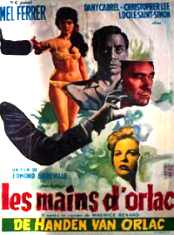
Plot: French/British co-production that redoes Mad Love. Chris Lee shows up to lend a...er, in support. Egads, what a suck-fest. Well, I’ve seen two new movies (and one, Beast with Five Fingers, that I hadn’t seen since childhood) for this article. One was brilliant, one wasn’t. This is the story of the latter. Where to start? The story here is completely different from Mad Love, first of all. So I’m not sure which film is truer to the book, not that it matters much. Unlike Mad Love, here the film revolves around its title character, pianist Stephen Orlac. Orlac is played in sweaty style by Mel Ferrer, an actor who most often made films in Europe. He also made the familiar journey from real movies to outright schlock as his career progressed. In latter years he appears in such flicks as The Great Alligator, Eaten Alive and Screamers (the fake guys-turned-inside-out movie). Here he attempts to ham it up, but he lacks a real talent for it. Making this more comical is that in transferring the film from widescreen to a full frame format for the video, the numerous close-ups are transformed into inanely close ones, with faces filling the screen. The tape I have also contains severe grain because of them blowing up the picture to a larger size. I’ve not seen the Rhino video release version commercially available, so perhaps these problems aren’t as noticeable there. Stephen Orlac flies to France to ask the beautiful Louise to marry him. The airport is fogbound, however, and the small aircraft crashes. Waking up with his hands encased in gigantic plaster casts, giving them an alien appearance, he dazedly conflates two nearby newspaper headlines. One is about the ruin of his hands, the other the execution of the murderous strangler Louis Vasseur. In what might have been an interesting bit, the French text swims around and is translated to English. This is done via animation, and I think that, perhaps, the idea is that the text is scrambled in his confused mind to indicate that he received Vasseur’s hands after losing his own. However, this potentially clever moment is ruined by the video's full frame formating. Because of this, the altering text runs off the screen and thus is made impossible to make out. Since this is perhaps the only clever moment in the film, the whole thing is doubly unfortunate. I went back later and, using the slo-mo button, I think I’ve more or less deciphered the above referenced changing headlines. We start with the two stories next to each other, LOUIS VASSEUR PAIE SES CRIMES and STEPHEN ORLAC PERO SES MAINS. Then the camera zooms in, which in full frame cuts off letters. We now see the headlines in English (again, I’m filling in for the offscreen text), as LOUIS VASSEUR LOSES HIS HEAD (obviously not an accurate translation of the prior French headline) and STEPHEN ORLAC LOSES HIS HANDS. The headlines then change to cartoon text and, in Orlac’s mind, continue to alter. First they become LOUIS VASSEUR WILL STRANGLE NO MORE and STEPHEN ORLAC WILL HE PLAY AGAIN? Then LOUIS VASSEUR WILL HE PLAY NO MORE and STEPHEN ORLAC WILL STRANGLE AGAIN. Then THE STRANGLER GETS THE KNIFE and THE STRANGLER STEPHEN ORLAC GETS NEW HANDS. Then we close in on the second headline, which now changes (I think, the closer we get the less text I can read) to STEPHEN ORLAC GETS THE HANDS OF LOUIS VASSEUR THE STRANGLER. Again, this all might have been neater if I didn’t have to spend ten minutes futzing with my slo-mo button and rewind to figure all of this out. Living in Paris after recovering, Orlac remains convinced that his hands aren’t his own. He has trouble playing the piano, an old ring doesn’t fit and an old pair of gloves rips at the seams when he attempts to don them. Moreover, during a stopover at a convenient carnival (?) he is talking into trying a grip-testing machine. To everyone’s amazement, including his own, he achieves an impossibly high score. This further troubles him, as everyone knows that strangler’s have greater grip strength than, say, concert pianists. I mean, why would pianists have strong fingers? This all, by the way, occurs in the first fifteen minutes of the film. Leaving a lot of tedious stuff to follow, a bizarre cinematic adoption of the military’s "hurry up and wait" philosophy. On an engagement trip in France, he becomes freaked about his hands again and runs off. Checking into a cheap hotel, he draws the attention of sleazy conman/stage magician Nero (Christopher Lee). Nero eventually learns of Orlac’s fears and schemes to drive him to the brink of madness, then blackmail him. A plan, need I add, that never comes to make any sense whatsoever. This doesn’t exactly help our interest in the film either. Nero presses his Eurasian lover/stage partner Li-Lang into service. She hates Nero, but fears him more and does as he commands. She vamps the drunken Orlac and almost gets him into bed, but Louise shows up and the couple head back to England. Nero follows, and various stuff happens. Then, thankfully, the movie ends. One word for this film: Boring! Disjointed is good, too. In fact, I guess you had your choice of vices here. The version I watched lasted an anything-but-lean eighty-two minutes. However, according to Leonard Maltin the French running time was 104 minutes! This footage undoubtedly filled in a number of evident plot holes apparent in this cut (for instance, the credits list Donald Pleasence as having a small part, but I either missed him or his role was cut out), but at what cost? Considering how dull the film is now, and filled with filler like two full musical numbers with singer Li-Lang, I can’t imagine sitting through the longer version. As it was, I was exercising the fast forward button quite a lot, not generally a habit of mine.
Summation: For fans of hideous musical scores and Christopher Lee completists. Otherwise, stick with Mad Love. _________________________________________ Demonoid
Plot: There’s a hand and it’s demonic and it possesses people and Stuart Whitman boxes a black guy…oh, wait, that all sounds too coherent. OK, now I’m getting pissed off. What is it with Killer Hand movies that they come so late in their respective cycles? First a classic ‘50s sci-fi flick like The Crawling Hand is made in 1963, and now a quintessentially ‘70s horror flick like Demonoid turns out to have been released in 1981. I’m no novice, and everything from the crappy film stock to the hairstyles to the overall sense of pessimism and nastiness screams of the post-Night of the Living Dead ‘70s. Heck, the stars here are Samantha Eggar and Stuart Whitman!! If that doesn’t say ’70, I don’t know what does. (Last Minute Addition: "Robert.L" on the IMDB maintains in his reader review that the film sat on the shelf for three years. If this is true, than my instincts were correct, and this was made in the ‘70s after all.) Speaking of Whitman, he was busy tilling the fields of Jabootu in this period. In 1980 (apparently), he starred in the desultory adventure pic The Mercenaries. In 1981 he played clerics both in this and (see if you can spot the satiric intent!) as Rev. Raver in Pia Zadora’s gut-bustin’ incest drama Butterfly. His most famous appearance insuch fare, meanwhile, is as the scientist responsible for a herd of killer rabbits in Night of the Lepus. We open in some undergrounds passages some centuries ago, or so I assume from the hooded yellow cloaks everyone is wearing. A robed figure steals a little hand-shaped metal box. Others in similar togs follow, and when they catch the thief it turns out to be a woman. A fight ensues, with the woman exhibiting more-than-human strength. (See, I could have done a PMS joke here but I didn’t.) Meanwhile, we keep flashing to a silhouetted demonic figure, one noticeably sans one hand. Eventually the woman gets her robe torn open, revealing some pendulous boobies, and then she gets chained to a wall. They cut her left hand off with an axe. Once it hits the floor, however, it tries to scramble away. One fellow impales it on a knife and secretes it back in its container. Cut to modern day Mexico. Jennifer Baines (Eggar) arrives to meet up with hubbie Mark. He’s the proprietor of a mine, and since he’s down below, Jennifer decides to follow. This proves an unwise idea, especially as she’s attired in high-heeled pumps. Shuffling along, she lightly brushes her fingers along a wall, dislodging a big pile of Styrofoam rocks. Behind them are some mummified bodies, all bereft of their left hand. The local workers are unhappy with all this, and the next day refuse to reenter the mine. Jennifer tells Mark that the two of them should go down to the lowest depths of the mine. After seeing a woman do this, she figures, the workers’ sense of machismo will force them to go back in. So down they go, eventually finding what appears to be a satanic torture chamber. Mark finds the hand case, mocks the one-handed devil statue on the nearby alter, and the two split. That night Mark, who is built ala George Kennedy and thus isn’t someone we wish to witness any bedroom antics from, luckily gets drunk out in the living room. He opens the case and a pile of dust falls out, whereupon he stumbles to bed with his wife. Utilizing the eldritch art of Bad Stop-Motion Animation, the dust turns back into a Hand. It scampers over to the couple’s bed and Mark begins wrestling with it. During the tussle, however, it seems to disappear. Jennifer watches in confusion as her husband flees the room. The next day she finds him out at the mine. He’s somehow herded all the workers in there (off-camera, natch) and blows up the mine, killing them all. We cut to the Sands Casino (!) in Las Vegas. Mark is on a bizarrely hot winning streak. Sleazy gambler Frankie sends Angela, a rather tired-looking floozie, over to try her wiles with him. (Angela is played by Russ Meyer regular Haji, who looks like she’s traveled a lot of hard miles since Faster Pussycat! Kill! Kill!) Meanwhile, Jennifer shows up in the casino lobby, searching for her errant spouse. Apparently she saw a story about his miraculous winning streak in a newspaper, although one that doesn’t seem to have commented on his earlier act of mass murder. Before she can locate him, Mark is kidnapped by Frankie and Angela. They take him to a shack out in the desert and threaten to cut off his hands (there’s a coincidence) if he doesn’t explain his winning ways. Instead Mark breaks free and kills his tormenters. He then seems to come to his senses and tries to hack off his animated appendage. Too late, though, for the Hand fights back and soon a kerosene-soaked Mark is going up in flames. The Hand itself burrows into the dirt for protection. Jennifer follows the body to Los Angeles, where it’s been transported for burial. (??) This leads her to the church of Father Callahan. The good Father is Irish (what else?). Or at least he is the roughly fifteen percent of the time that actor Stuart Whitman remembers to attempt an exaggerated Irish brogue. He’s also introduced whilst in prayer, and, by golly, Father Callahan’s a priest who – get ready for it – is having a crisis of Faith. Boy, that’s fresh. Jennifer at this point, without much in the way of buildup, seems to have figured out the situation. She asks Callahan to take her to Mark’s grave. However, we get there before them and see something shoot out of the ground. The effects here were rather poor, so I thought it was only supposed to be the Hand. Nope, turns out it was supposedly Mark’s entire charred body, still under the Hand’s control. Soon the two have found the desecrated grave, and Callahan calls the cops. Sgt. Matson responds and drives out to check on things. However, as he looks around the corpse drags itself over to his squad car and severs the Hand by repeatedly smashing its wrist in the car door, a technique I believe it learned from watching old Three Stooges shorts. Needless to say, Matson is soon himself being given a Hand. Although he doesn’t believe Jennifer’s story, Callahan ‘accidentally’ meets up with Sgt. Matson down at the local gym. The Sgt. seems fine, and even invites the priest to a sparring session. In the film’s most outrageous laugh-out-loud sequence, the doughy sixty year-old Callahan easily outboxes a muscular black man thirty years his junior. Eventually Matson seems to do better, but this is filmed in slo-mo and thus I’m assuming that it’s his supernatural powers giving him the, uhm, upper hand. Later Matson kidnaps Jennifer and takes her to the office of plastic surgeon Dr. Rivkin. He holds the doc and his cleavage-sporting nurse hostage, delivering the immortal line, "Either you cut off my hand off or I’ll kill you!" It seems that the Hand wants to possess Jennifer. I don’t know why, that’s just the plot. Using some sort of *cough, cough* laser scalpel (actually, I think it’s a wood etching wand) the Hand is soon removed. Seeing the beastie wiggling around, the nurse tries to run off and gets shot down for her trouble. (The Hand proves pretty handy, er, skillful with a sidearm, uh, hand gun…oh forget it!) Freed of its influence, Matson grapples with his dislodged digits before falling victim to the Hand’s established face-crushing move. Rivkin jumps in -- Jennifer halfheartedly tries to warn him, but comes off sounding like Willy Wonka softly warning "Don’t. Stop." -- and becomes the next possessee. By this time it’s the next morning (??). A cop and Cunningham make the scene just as Rivkin is preparing to remove the Hand so it can take over Jennifer. This results in a rather silly car chase that features bad chase music right out of a Starsky and Hutch episode. The participants end up in a train yard, the Hand causes Rivkin to kill himself (I think) and then frees itself by using a bypassing train to sever itself. And so on and so on. Eventually, Cunningham is possessed. Apparently addicted to the Hand’s evil powers, he appears to want to kill Jennifer so that he can keep it. Instead, at the *gasp* last minute, he sticks his Hand through a steel frame and skewers his wrist with a big screwdriver, trapping it. Then he uses a convenient blowtorch to burn the Hand to a crisp. And that’s that. Except for the inevitable (and thus less than shocking) stinger sequence where the Hand appears in Jennifer’s house and kills her. End picture. The most consistently funny part of the film is Samantha Eggar’s performance as Jennifer. Looking a great deal like reporter Cokie Roberts, she maintains a hilariously blasé attitude during the entire affair. Only when she meets her ultimate fate does she act very perturbed, and since she’s twirling around with a rubber hand glued to her head it’s hard to take things seriously. At one point, Father Callahan responds to her fantastic tale by telling her "You’re distraught, grieved, emotionally wrought." What makes the line hilarious is that she’s anything but. Instead she projects the cheery mien of a woman in a ‘70s Disney movie scheming to convince a reluctant hood (Keenan Wynn? Cesar Romero? Joe Flynn?) to sponsor the local Little League team, the one with the magically sentient ball-throwing machine. Certainly her husband’s grotesque fate doesn’t seem to overly affect her, and the best she can do after witnessing the bloodbath at Dr. Rivkin’s is to casually suggest that he not grab the Hand. Stuart Whitman is only marginally better. It’s clear that at this point in his career he didn’t care anymore, and he doesn’t even bother to amuse himself by broadly mugging, ala Bo Swenson. His only real contributions here are his maybe-it’s-there-and-maybe-it-isn’t Irish accent and the uproarious boxing scene, which in a film about a demonic killer hand remains easily its least believable sequence. Perhaps Whitman should have considered the fact that hams who chew the scenery with gusto are oft remembered while those who phone in their roles are quickly forgotten. Meanwhile, the extremely disjointed and episodic nature of the film is less surprising given that is was directed by Alfredo Zacharias, the hack responsible for the hilarious killer bee epic The Bees. This the kind of film that’s structured so that you can either increase or decrease the number of, uh, Hand-holders, depending on how long you want the film to last. In this, and indeed in its plot, the film is rather similar to The Hidden, although admittedly that film was somewhat better executed.
Summation: Typical ‘70s crapfest with the de rigueur downbeat finale. -by Ken Begg |