Another feature of... |
|
Another feature of... |
|
|
for
________________________
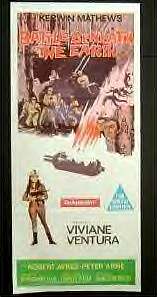
Plot: Dirty, stinking Chinese Reds are trying to undermine America. Literally! The phrase ‘comic book’ movie means different things to different people. Many would be literal: A comic book movie is a movie adapted from a comic book. Director Joel Schumacher, on the other hand, obviously believed the term meant a garish film where things didn’t have to make much sense. Hence his two disastrously awful Batman movies. To me a comic book movie is one set in a universe clearly not meant to be ours. The laws of science tend to be less rigorous, people and events are often a bit broader and more cleanly defined. Ideas that would be goofy in our universe, like people donning tights to fight crime, are simply assumed. Comic book movies, however, needn’t be about superheroes. Raiders of the Lost Ark, by this definition, is a comic book movie. Ditto Big Trouble in Little China. One of my favorite comic book movies is Horror Express, a film that manages to kick things off with a living caveman and proceeds to add another intellectually dubious plot premise every ten minutes or so, all while ably retaining the audience’s suspension of disbelief. Battle Beneath the Earth, which proves a very odd duck, falls into this category, too. It’s basically a fantasy soldier comic come to life. Here military guys take the place of the fantasy spies more common to the period. We open on the Strip in Las Vegas. Sorta. Actually, the film is shot almost entirely on sets, with stock footage used for establishing shots. A patrol car (driving ‘past’ a very obvious side projection) receives a report on a "listening disturbance" and goes to investigate. On the scene they find a crowd around an agitated man named Arnold Kramer. Shouting for quiet, Kramer lays with his ear to the ground. He keeps muttering about how "they’re all down there, crawling around like ants." Apparently Listening Without a License was against the law in those days, and he’s arrested. Cue jazzy ‘60s ‘spy’ theme music and campy credit visuals. Kramer, a seismic specialist, is institutionalized. He asks to see Jonathon Shaw (Kerwin Mathews!), a Naval Commander. Shaw himself is under a bit of a cloud at the moment. He was the designer of an underground laboratory that was destroyed in a mysterious incident, killing thirty crewmembers. Shaw goes to see Kramer -- "He saved my life in Korea," he informs somebody -- but he himself doesn’t put much credence in what Kramer says. Not helping is that the scientist is hilariously elliptical, pretty much solely because the movie isn’t ready to show its cards yet. Unconvinced, Shaw leaves and heads to a bar. A TV bulletin reports a mining cave-in in the very area of Oregon that Kramer was talking about. Thinking that pieces are starting to come together, Shaw heads for the office of the "Los Alamos (Underground) Atomic Detection Center", or so a sign would have us believe. And I’m especially unsure about why they needed the parentheses about ‘Underground,’ but there you go. However, the personnel at the Center remain highly dubious about Kramer’s theories. Shaw tours the collapsed mine to investigate further. (Does this guy have a job or anything?) Breaking through, he and the men with him discover a newly wrought tunnel with oddly smooth walls. They also find a medallion sporting the visage of a Chinese demon (!). Shaw returns to the Center with his information. It is determined that the tunnel was burned through the rock, presumably by some sort of advanced mining machine. "Such a machine is beyond our scientific knowledge at this time," Shaw is told. Kramer is brought in, vindicated but still bitter and somewhat jittery. He explains that in the course of his seismic investigations, he discerned lines of activity between China and the U.S. Shaw is sent in command of a squad of men -- is this something a Navy officer would be doing? -- to further investigate the tunnel he found. Hearing a noise, they hide and see a bizarre yellow tank-like vehicle drive by. (Get it? Yellow?) They follow this to a chamber where Chinese military personnel are guarding eight nuclear bombs. (!) The soldiers burst in and shoot down their opponents, after which they manage to disarm six of the bombs before being driven off by newly arrived troops. These activities have put some kinks in the Chinese invasion plans, but haven’t stopped them. We soon meet the person behind all this, General Chan Lu. Chan Lu is right out of a James Bond novel. He’s a renegade – the Chinese government is powerless to control him, as they’re sitting on a nuclear bomb he put there – he’s as erudite as he is ruthless and he has a pet hawk (!). All good supervillains have pets, don’tcha know. Kramer manages to create his own analog to the Chinese mining machines, which use twin lasers to burn through rock. Ours, however, is painted a more patriotic blue. Soon he and Shaw and Shaw’s squad are investigating a likely spot underneath a volcano. (One of my favorite things about this movie is that, despite the scope of the Chinese plot, Shaw is never assigned more than about fifteen guys. Another is that they sit around and wait for days on end before doing anything.) Also joining them is the beauteous Tila, a "top expert on volcanic passages." Tila has next to nothing to do here, but presumably the producers thought the film needed a girl in it. Needless to say, she and the hero end up together, even though there is no particular reason to think they should. One of the more disreputable aspects of the film is that all the major Chinese roles are played by Caucasian actors. Only the extras are actual Asians, and chances are this was more to save money on make-up than anything else. One wonders what the Asians actors thought about this. It’s hard to believe they were very happy with the situation, to say the least. 1967 might seem a little late for this kind of thing, but the same thing happened in the 1973’s big budget musical remake of Lost Horizon. On the other hand, although
obviously a film sporting an economical budget, things are professionally
mounted. An MGM production, the movie is played straight and benefits from
having an able, veteran cast. Of particular note is lead actor Kerwin
Mathews, well known to genre fans for playing the title role in The 7th
Voyage of Sinbad. Here he was in the midst of a downward slide that
would eventually see him starring in junk like Octaman.
Things I Learned:
Summary: Enjoyable schlock for the ‘60s James Bond crowd. __________________________________
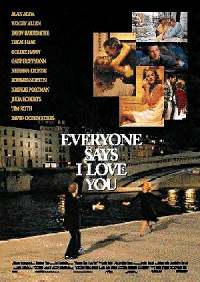
Plot: None to speak of. The film is Woody Allen’s homage to the carefree Hollywood musicals of the ‘30s. This review wasn’t really meant for the site. Instead, I wrote it as a note to The Warden, the proprietor of the superior Prisonflicks.com. We’ve been conversing for a while, and one of our running topics, ever since his review of Take the Money and Run, was Woody Allen and his movies. He found the movie much less funny than he remembered it, and I had had an identical reaction when I’d bought the film on DVD, maybe a year ago. Despite this, I still maintain some interest in Allen’s better work, and every once in a while will rent one of the films he made in the ‘90s, few of which I’d seen in a theater. I rented this particular DVD largely because it’s a musical, and I’m always interested in seeing someone try to revive this genre. I thought the fact that it was homage to the musicals of the ‘30s and ‘40s, using the music of tunesmiths like Cole Porter, would make it even more attractive to me. And to be fair, on its own the film is hardly awful, and it remains interesting for what it’s trying to do. But in relation to the rest of his work, not to mention his personal life – assuming you can separate the two – the movie provides copious evidence for why viewers like the Warden and I find Allen to be becoming an increasingly creepy and insular, even calcified, filmmaker. Please note, again, that this was not my intent when I obtained the disc. It’s just that my misgivings on these and other fronts kept growing as I watched the film.
I couldn’t help it, I swear. Still, the weight of all of Allen’s past movies, which increasingly seem to be simply variations on a theme, just impinges on his individual films now. And the collective weirdness definitely overwhelms this particular movie. Summary: Talk of Allen being the ‘Great American Film Director’ recedes a bit more into the past. ________________________________
Plot: Uhm… The In Crowd is basically one of those WB teen-angst shows brought to the big screen. This theoretically would allow for more explicit nudity and violence. Not in this case, though, for the film is rated PG-13. So why even bother, you ask? Indeed. After all, the WB provides hours of similar programming for free every week. We open with Beautiful Pneumatic Teen Blonde sitting in institutional garb in a large, empty room. Before her is a psychiatric review board. Oddly, this is shot so as to recall Jennifer Beals climatic dancing audition in Flashdance. Meanwhile, the camera, under some alternative rock piece (or ARP, from here on out), roams over the board members’ files. This clues us in that Adrien has Emotional Problems and has been tentatively diagnosed with ‘erotomania.’ The head doctor is Tess Harper, although since no one in the film’s target audience would know who that is, I’m not sure why they bothered. This is all shot like a really bad music video, which doesn’t exactly bode well for the next hour and a half plus. One Dr. Thompson is pushing for Adrien to be released to "The Club," which he maintains is "a controlled environment." (As we’ll see, it’s anything but. In fact, it’s about the worst place he could send someone with potential mental issues.) Head doctor Amanda (Harper), meanwhile, is more concerned, asking "What if she develops another obsession?" Whoa, slow down the dense psychiatric jargon, you two! Anyway, the idea is to set up a situation where Adrien might actually either be better or else just hiding her nuttiness. We’re not supposed to know yet, in other words, whether she will be our heroine or the movie’s villainess. Five minutes in and we get our second ARP. Henry is driving Adrien out to The Club. This self-contained spa/resort complex clearly exists in WB World, as its chock full of improbably beautiful teens, of both genders. Of course they’re also really rich and bratty. Except for Adrien’s middle class coworker Joanne, who is supposedly what a universe like this would regard as being ‘plain.’ (I.e., she’s an eight with a bad haircut and wardrobe as opposed to a trendily groomed ten.) Joanne takes Adrien around, showing her the ropes, but it’s obvious that Our Protagonist is more interested in the antics of The Beautiful People. The group is known by their victims as The Royal Swine. There’s Sheila, the big-breasted blond in the yellow bikini. She’s given a short haircut so that we can tell her apart from Adrien. The big-breasted brunette is Brittany. (You just know she’s going to be a bitchy Heathers-type, what with a moniker like Brittany). Sure enough, Brittany is identified as the ‘queen’ of her little clique. Other characters:
The gang soon plays a trick on Adrien, hiding a snake in a patio umbrella she cranks open. However, she proves to have no fear of snakes, plus, unlike all these wealthy dilettantes, she knows that Artemis is the Greek goddess of the hunt. We know because none of them could provide this tidbit for Sheila’s crossword puzzle. The implication being that they are too rich and jaded to bother with intellectual pursuits. (Which is why, I suppose, poor people always end up the best educated). Of course, if that’s true then it makes no sense for Sheila to be doing a crossword puzzle in the first place. Other, that is, than to provide a situation where all this can be demonstrated. In other words, IITS. Even funnier is the implication that Adrien’s non-fear of snakes and awesome grasp of trivia mark her to the gang as Someone to Be Watched. Meanwhile, we keep getting hints of something. For instance, Brittany seems to recognize Adrien, although she keeps this knowledge secret. Others of them, meanwhile, find her reminiscent of one "Sandra." And, eventually, Brittany starts Spinning A Nefarious Web. This begins when Adrien is sent to the improbably isolated pool area, which is deserted, natch. She turns around and sees Brittany floating face down in the pool. She pulls her from the water and starts giving her mouth-to-mouth (!), after which Adrien takes the ‘recovering’ Brittany to her room (?!) to get her into some dry clothes. This provides the film’s next ‘PG-13 side views of breasts’ shot. Wow, we even get some momentary nippleage. It also provides Brittany an opportunity to ferret out info on Adrien (a recurring prop postcard tells her that Adrien had been in the clinic), while at the same time getting into her confidence. So on we go with Lifestyles of the Rich and Callow and Cruel and Sex-Obsessed. Most of time I spent just trying to tell all the various characters apart, not that it really mattered much, and wondering why they couldn’t have shaved fifteen or twenty minutes off the hour and forty-five minute running time. I realize that it’s probably silly of me to even bother looking at a film like this, because it’s tailored for a very precise demographic: Teenagers who aren’t overly concerned with logic. (Hence the PG-13 rating; can’t be excluding all the fourteen and fifteen year-olds who would help the film turn a profit.) The same ones they made Cruel Intentions and The Skulls and Gossip for. It’s like a whole new genre: Beautiful Snotty Teen Movies. I also saw The Skulls when it came out, lured, as I was to this, by a sizable collection of bad reviews. But while the films are stupid, they aren’t entertainingly so. Instead, they’re just tedious and witless, which is especially a bad idea for what are putatively meant to be thrillers. And this holds true no matter how many barely-covered – or elliptically uncovered -- boobies and taut male pecs they thrust at the screen. It’s also hard to get ‘thrilled’ when your cast of characters is this thinly etched, not to mention unlikable. For instance, Brittany’s main ‘character’ trait (other than being bitchy and scheming) is that she’s constantly slathering on lip gloss in an ominous fashion, usually in loving close-ups. Meanwhile, the movie’s idea of horrifying decadence is less than De Sade-ian. Again, you’d think they’d at least pump up the sex and violence. Yet cut, tops, half a minute out of this and it could easily be shown on network television. There’s not even a lot of harsh language. (The ‘f’ word is used once, the limit for PG-13 movies.) Eventually we get a murder or two (why else provide so many characters, right?). And there’s the mystery girl-from-the-past Sandra, who might or might not be Adrian. Still, as I’ve noted, this lacks all the criteria for a successful thriller. First, the script is written in such a way that pretty much anybody can be doing anything. They don’t narrow down suspects so much as eventually toss a dart into a board and say, "That one there is the killer." Second, again, all the characters, including Adrien, are unlikable cardboard constructs, making it difficult to rouse much interest in which of them will be killed or identified as the film’s villain(s). Third, it’s the kind of movie where, when a step creaks, you know it’s being established for later in the movie. Meanwhile, the ending, where a character decides to confront a psycho-killer on their own, rather than calling in the cops, is just the icing on the cake. As in the interminable cat and mouse chase that follows, which lasts so long that it eventually seems become a parody of the breed. Actually, the single funniest thing about the film might be its DVD. For somebody thought the film rated an actual ‘Special Edition’ disc, one with more extras than ninety percent of the other DVDs out there. Here you not only get trailers and TV spots, a still photo gallery, fancy cast & crew bios (for 15 different people -- and Tess Harper isn’t even one of them!) with scrolling text, but deleted scenes (!), each with their own text intro; a music-only audio track; and, last but certainly not least, a giggling, girly audio commentary with gal pal actors Susan Ward (Brittany) and Lori Heuring (Adrien). HIP, IRONIC IMMORTAL DIALOG: Adrien, wistfully
surveying the Beautiful People: "Maybe in my next life." Adrien serves drinks at
a posh bash: Summary: Unless this is your thing, I really wouldn’t bother. _______________________________________ The Lost Idol
Plot: The race is on to reach a priceless artifact. First, let me ‘thank’ Andrew Borntreger of Badmovies.org. The owner of the deadliest collection of cinematic junk of anyone I know – which, considering my own collection, is saying something – he occasionally sends me care packages of tapes of odd little movies. This is one such. It’s right after the fall of Saigon. A small complement of American troops, the sole survivors of a much larger unit, is trying to hike their way out of Vietnam. They have a run-in with some V.C., but following a fierce firefight they manage to make their escape. They end up hiding from a storm on the grounds of an ancient, vine-covered temple. A fortuitous bolt of lightning breaks through a temple wall, revealing the idol of the title. The squad leader, Lt. Oliver, has the statue brought with them, over the protests of his noncom, Sgt. Kurt (Eric Estrada!). With the statue slowing them down, and the enemy on their tail, Oliver has the men hide the idol in a cave. The Lt. doesn’t intend to share, however, and subsequently massacres them. Kurt, however, is only wounded, and manages to make his escape to a nearby river. Oliver, meanwhile, is forced to retreat when some opposition soldiers show up. Kurt floats downriver and is saved by some villagers. As he recovers, he falls in love with a native woman and ends up marrying her and staying there. (I believe this is supposed to be happening in Cambodia, although the film entirely skips over the genocidal mass murder that occurred in that country during this period.) Oliver makes it back and, being the only one to tell the tale, receives not only a promotion -- from Lt. right to Major?! -- but a Silver Star. Boo! Hiss! Oddly, no one at the presentation ceremony mentions that his hair is too long. Even odder is that his hair remains the exact same length when we next see him, supposedly eight years later. He’s finally returned as a civilian to retrieve the priceless idol. His cover story is that he’s conducting a covert op to rescue some still imprisoned POWs. He also meets up with an old lover, Catherine, who is conducting humanitarian work in Cambodia. (Again, no mention of a quarter of the country’s population being slaughtered.) Here we’re well enough along to perceive the film’s main problem. The direction and editing during the action stuff is actually pretty good. The script is uninspired, to say the least, but so far has been serviceable. No, the film’s Achilles’ heel is the acting. I did have an insight here, which is why people like Eric Estrada will always have work. It’s easy to knock Estrada as an actor, especially given the legions of crap he’s appeared in. Even so, and even if he’ll never be a Lawrence Olivier, the fact remains that Estrada can stand in shot and speak his dialog in a natural sounding fashion. Which is more than you can say for anyone else in the movie, all of whom make the simplest line sound artificial. This is the kind of movie where someone says "Hi, there," and sounds like they’re lying. In this company, Estrada looks like a veritable god of acting. John Phillips, who plays Oliver, also wrote the script. He’s hardly the worst actor here, but that leaves a lot of ground for sucking. I assume he got the villain part in exchange for providing the screenplay. The worst actor by far, though, is Myra Chason, who plays Catherine. She is awful, on a scale with the woman who played Valaria in Robot Holocaust. Even someone like me can go years without seeing someone giving this epically poor of a performance. In this I blame director Phillip Chalong (aka Chalong Pakdivijit), albeit with a caveat. A native of Thailand, Chalong has a history of directing lame action pictures in that country. Of the ones that have appeared here (by which I’m going by those listed on the IMDB), we see a pattern of his hiring minor ‘name’ American actors to play his leads. 1971’s H-Bomb starred Chris Mitchum. 1976 saw S.T.A.B., starring Greg Morris of TV’s Mission Impossible. In the ‘80s he produced Gold Raiders with generic action lead Robert Ginty. 1990 saw The Lost Idol with Estrada. Chalong's last known production was done the following year, Gold of the Samurai with both Sam "Flash Gordon" Jones and the ubiquitous Jan-Michael Vincent. While a competent action director, as I’ve indicated, Mr. Chalong shares certain weaknesses with other Asian helmers. First the film's musical score is awful, attempting to be lyrical when it should be exciting, and thus undermining the action sequences. A bigger problem is that Asian directors, as any fan of Japanese giant monster movies knows, have no idea what English should sound like. Hence they tend to cast roles featuring Americans characters with the worst actors imaginable. That’s bad enough when these are basically bit parts, like the Yanks who periodically popped up in Toho's Godzilla flicks of the '90s. But when you hire a Myra Chason as a lead, watch out. Oliver meets up with Don, an old friend and owner of a Thai sex bar. Oddly, while this is used to showcase many skimpily-dressed and quite beautiful woman for the exploitation crowd, none of them are topless. We also get a perfunctory bar brawl, with a huge French (I think) bodybuilder taking on four guys. I’m assuming he’ll be joining Oliver’s team. And, yep, I’m right about the bodybuilder, only I guess he’s German. His name is Cristoff, or something. Meanwhile, Kurt is living a life of bucolic bliss, complete with Lovable Little Daughter. (I really hope this isn’t one of those movies where they kill his family so as to provide him with ‘motivation.’) Then it’s back to Oliver and Katherine for a bad make-out scene. I’m note sure why Andy Borntreger sent me this particular film, but its worth owning just to hear Myra Chason’s stenographer-like read of the line "Hold me tight and never let me go." And certainly no line captures the idea of Romance quite like her breathy, "You make me feel so secure." Oliver meets his crew of 10 "tough sons-of-bitches." Meanwhile, Katherine stops by Oliver’s and gets assaulted by some thugs ransacking the place. First, though, she displays some rather marginal martial arts prowess, accompanied by the sort of foleyed-in sound effects that usually indicate the presence of Moe, Larry and Curly. Then she gets questioned by a French guy who sort of looks like actor James Cromwell, if he were wearing a lot of silver aerosol coloring in his hair. She’s saved when Oliver and Cristoff appear and kill the henchmen, although the French guy escapes. Kurt is chopping wood when Oliver appears. In a plot device that rather strained my credulity, Oliver doesn’t try to kill Kurt, he wants to recruit him to join the recovery team. (!) I can think of a number of things wrong with this. Not the least of which is that Oliver, who’s undoubtedly planning to double cross the mercenaries working for him, would presumably not want them to learn of how he massacred his own soldiers for the idol earlier. Plus Kurt would be able to blow his MIAs cover story. And…well, you get me. Oliver warns Kurt to think his ‘offer’ over and leaves. His young daughter is left to bring an offering to the local Buddhist monks, and gets kidnapped by Oliver’s men. This provides Estrada with a acting moment that proves a little bit over his head. Anyhoo, he shows up at the appointed time and his family goes free. Then the team heads off on their way into Cambodia. Meanwhile, Katherine has entered the country via a Red Cross visa. Then, when Oliver’s men arrive near the cave containing the idol, they find a VC military base planted directly in front of it (!). From this point we get another forty-five minutes of miscellaneous perfidy and torture and action stuff, most of which you can probably figure out for yourself. I want to be fair, as always, so let me mention that the local color, provided as it is by natives of the region, is quite ably communicated. This was especially true in the portrayal of Kurt’s life in a small rural Thai rural village.
Summary: Has its goofy moments, but a comparatively well-mounted actioner. I’ve certainly seen a lot worse. Except for Myra Chason, of course. She’s a hoot. -by Ken Begg |