|
|

for
October 2000
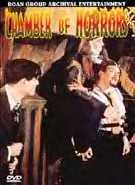
Chamber of Horrors
(1940)
Plot: A plucky young woman
is threatened by a murderous plot to steal a family fortune.
The mystery novels of Edgar
Wallace have inspired enough films to earn him a spot on the most-adapted
authors list. His excessively gothic tomes inspired a number of mostly
British adaptations in the ‘30s and ‘40s. Perhaps the most famous of
these was the Bela Lugosi movie The Human Monster, a.k.a. Dead
Eyes of London. An even greater spurt of adaptations emanated from
West Germany in the ‘60s. These tended, unsurprisingly, to be rather
more baroque and grotesque than the earlier English films, and often
starred cult icon Klaus Kinski. Perhaps Allday Entertainment, the fine
folks behind the two highly recommended Dr. Mabuse DVDs, will release some
of these latter films someday.
Made in England under the
more sedate title of The Door with Seven Locks, Chamber of Horrors is
basically a murder mystery sporting some outlandish touches. It should be
said that if you don’t have much patience for creaky old films, this
probably won’t do a lot for you. Yet those who do enjoy such fare will
find of merit here. We’ll start with the spirited cast. Leslie Banks,
memorable as the crazed Count Zaroff in the classic 1932 version of The
Most Dangerous Game, basically plays a riff on that role as the
villainous Dr. Manetta. Grievously wounded in World War I, part of Banks’
face was paralyzed, resulting in a memorably sinister look. Our heroine,
meanwhile, is portrayed by Lilli Palmer. Forty-five years later, Ms.
Palmer would goofily assay the role of Michael Caine’s mother in the
execrable The Holcroft Covenant. And let’s not forget the actor who
plays our blithe, wisecracking hero Dick Martin, stiff upper lip firmly in
place. Amusingly enough for a hero fully in the Bulldog Drummond mold –
the film’s director, Norman Lee, had in fact earlier made a Drummond
film --- the role is assayed by one Romilly Lunge (!).
We open on the inevitable
Dark and Stormy Night. (Yes, even in 1940 this was a tad corny.) The dying
Lord Selford is dictating instructions for the disposition of his estate.
Since this is adapted from a Wallace novel, these are exceedingly
convoluted. Moreover, the instructions are being left with Dr. Manetta.
Since audiences of that time would have recognized Banks to be a veteran
heavy, Manetta’s incipient villainy would have been a given. Also on
hand are Craig, a sinister looking butler sporting a beak of a nose and a
hilarious greasy black Shemp toupee, the weasly looking Bevan Cody and his
Margaret Hamilton-ish wife Ann. Selford’s estate is to be left to his
young son John. Should he pass away, the bequest will pass on to Selford’s
distant Canadian relative, June Lansdowne. The main set-up, though,
revolves around the family jewels (no, you pervert, real jewels).
These are to be sealed in the family tomb behind the, that’s right, Door
with Seven Locks. The box containing the heavy iron keys is to be left
with the family lawyer, Havelock.
We jump forward ten years.
The vivacious June is now living in London with her wacky, man-hungry
roommate Glenda. (‘Man-hungry’ being the pre-Sexual Revolution analog
to ‘slutty’.) June gets a letter from a Mr. Silva, containing one of
the seven keys and warning of a conspiracy against her. She goes to meet
him in a nursing home, but he’s inevitably shot to death through a
secret panel before he can fully spill the beans. This is, of course,
after the two are spied upon through the obligatory
portrait-with-removable-eyes. I’m telling you, this movie has it all.
June runs out into the hall and finds Ann Cody, dressed as a nurse. When
they returned to Silva’s room, though, his body is gone and the bed is
made up. (Given the time frame here – roughly twenty seconds -- the only
way this would work is if they wheeled in and substituted a second bed
through a rather largish secret panel.) Cody tells June that she must have
imagined the whole thing, as the hospice is supposedly vacant.
Cut to Scotland Yard. Here
we meet the obvious hero of the piece, Dick Martin. He’s just resigned
from the CID (Criminal Investigation Department) and is yakking with his
former superior, Inspector Sneed. Sneed, like Glenda, is a comic relief
second banana. He always seems to be sleeping, in fact he’s borderline
narcoleptic, and he looks like Trotsky when he dons his glasses. The
reason Dick’s resigned, we learn, is because he’s recently come into
an inheritance. That way he can hook up with June at the picture’s
conclusion, but without the awkwardness of her being financially better
off then he is. I mean, c’mon, this was 1940, after all. (Lest you think
I exaggerate, June cavalierly offers to give up her inheritance at film’s
climax, so that this won’t be an issue between them.) Anyway, June
arrives to report Silva’s death. Dick, already bored with his looming
life of ease, offers his services as a private man ‘o action to the
comely young woman.
Luckily the movie’s too
short to indulge in the thing where the police fail to believe June.
Instead, Dick accompanies her and Glenda back to their apartment. Finding
a burglar ransacking the women’s improbably gigantic bedroom, they
engage in one of those ‘40s fistfights. You know the ones, where every
punch is a wild roundhouse sort of deal and the film’s sped up. Dick
naturally gets the better of his opponent after they trash most of the
room, but a compatriot of the intruder knocks him out from behind.
Luckily, however, June had left the key with her landlord, so it remains
safe. Dick warns her of the danger she’ll be in if she continues to
pursue the matter. Our Heroine remains unperturbed. "When I was
fifteen I spun a coin," she explains. "Tails, home girl, cooking
and knitting. Heads, adventure. Heads it was!" You go, girl!
The two visits Selford’s
lawyer, Havelook, a rather Donald Pleasence-y individual. He explains that
Selford’s heir, John, is afflicted with a paralyzed right hand. Due to
this he has for some time been touring abroad, on doctor’s orders.
Havelock is shocked to see June’s key, as the entire set is supposed to
be locked up in the office safe. When the container is brought out,
though, they *gasp* find that the keys are missing. The chap in
charge of the keys was Foster, who retired some time before. Havelook had
been introduced to the fellow by none other than Dr. Manetta, who’s
currently renting the Selford manor house. June and Dick head out there to
check into things.
I won’t go too much into
the remaining plot. Let’s just say that the conspirators don’t take
kindly to June’s interference, and that things will get worse for her
before they get better.
- Look, June’s carrying on a
conversation with Glenda while the latter is scrubbing herself in
the bath. Then she stands up behind a towel! Implied nudity!
Ha-cha-cha!
- Uhm, isn’t June sitting between the
gun and Silva? So how does he end up being shot without she
sustaining injury?
- Enlightened wisdom from Insp. Sneed:
"Women are like tiger cats. They ought to be caged at sixteen
and shot at twenty!" Uh, OK.
- Typical Brit: First thing Dick does
after being knocked out is readjust his tie and get his hair in
order. I also like how he one-handedly buttoned his suit jacket when
he first rushed his opponent. There’s a proper way to do
everything, I suppose.
- Cornball Element #27: The fake hazard
sign that diverts the main characters’ car onto a potentially
fatal byway.
- Watch out! Your toy model car almost
drove off that matte painting!
- So Craig the butler is Manetta’s
Sinister Mute Henchman? Didn’t Count Zaroff also have one of those
in The Most Dangerous Game? Well, it’s a small world, after
all.
- Uh, wasn’t Zaroff also a
decadent aristocrat driven out of his home country by
revolutionaries? Boy, these two would get along great.
- Manetta has a collection of torture
instruments, eh? (Shades of Bela Lugosi in The Raven.) And he’s
a direct descendant of Torquemada? Oh, brother.
- Manetta’s only companion is his pet
monkey Bepo? Oh-Kay.
- Yep, that’s a Door with Seven Locks,
all right.
- OK…what? The jewels are to be given
to John’s bride when he gets married? So as a precursor to the
wedding they’re supposed to go into the tomb and get them? Yeah,
that’s jolly.
- Cornball Element #42: The
Locked-in-the-Tomb Scene. Ooo, Spoo-ky.
- Listen, that gun might have had a
silencer on it earlier. But it doesn’t now, we can see that
clearly. So why isn’t it making any noise?
- Hmm, I wonder if we’ll be seeing
that Iron Maiden again later in the film.
- Yes, it’s a good hero who runs off
for the night and leaves the heroine in the isolated house of the
probable villain of the piece. Good job, Dick.
- Oh, now I get it. Bepo’s in the
movie so that he can accidentally reveal the location of one of the
keys. Well, that’s convenient.
- June wants to avoid phoning Dick from
Manetta’s house. I can see her point, but I’m not sure that
sneaking out through the secluded, foggy woods is the best way
around that.
- I thought they sedated June after they
caught her. Plus she appeared to have a concussion. So why’s she
so spry?
- When are people going to learn: It’s
never a good idea to blackmail a murderer.
- June escapes and then climbs into a
passing car without checking to see who’s driving it. Frankly, she
deserves whatever she gets after that one.
- Why didn’t the villain’s
compatriot, who’s already been captured, warn Craig the butler
that Sneed was behind him?
- Manetta’s a pretty obliging villain.
First he poisons himself, then he explains the plot before he dies.
- Ha ha, Dick almost ran over those two
women walking down the road. What a card!
- Why do I get the feeling that if I
started to tug at any of these plot threads, the whole thing would
unravel? Well, never mind.
Summation: Fun but
old-fashioned and cliché-ridden murder mystery. Won’t be the cup of tea
for all viewers. I must say, though, it’s kind of nice to watch a movie
in which murder is still considered to be a rather shocking affair,
instead of being taken for granted as it is today.
___________________________________________________________________
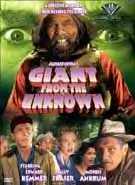
Giant from the Unknown
(1958)
Plot: The Diablo Giant,
a renegade Spanish Conquistador, awakens from suspended animation and goes
on a rampage.
Director Richard Cunha
churned out four dandy little ‘50s sci-fi turkeys, of which this is
clearly the best. Frankenstein’s Daughter, meanwhile, is one of
the worst Frankenstein knock-offs, and Missile to the Moon is a
remake of the Sonny Tufts classic, Cat-Women of the Moon (!!!).
Both of those are wildly entertaining and sure to turn up here someday.
The forth, She Demons, I haven’t seen. Based on its pedigree,
though, it’s bound to be good. And I’m sure it’ll arrive on DVD
presently, as the three prior films have already, as part of the Wade
Williams Collection. I already own quite a number of these, including the
three Cunha films mentioned. Other titles already available include four
Ed Wood titles, Kronos, Teenagers from Outer Space and
Jabootu fave The Beast of Yucca Flats. Although generally short on
the extras we’ve come to love, each sports incongruously gorgeous
transfers.
Pine Ridge, a small
mountain community in California, is up in arms about some recent
livestock mutilations. Driving the panic is the subsequent brutal murder
of a local resident. The townspeople are starting to whisper about on old
Indian curse, centered on the area known as Devil’s Crag. They are
encouraged in this by the bitter Indian Joe, a destitute native only too
happy with the events in question. The town Sheriff does what he can to
discourage such talk. Instead, he lays his suspicions on Wayne Brooks, a
young scientist living nearby. Brooks was not only known to be feuding
with the victim, but shares a longstanding mutual animosity with the
Sheriff. He’s warned to stay in town until the killer has been
apprehended.
The plot thickens with the
appearance of eminent archeologist Prof. Cleveland. He arrives with his
(duh) beauteous daughter Janet to search for evidence of a renegade band
of conquistadors led by the murderous Vargas, also known as The Diablo
Giant. Brooks, of course, offers to show him around the mountains and also
makes time with Janet. Before they leave, Cleveland examines some
artifacts that Brooks has dug up over the years. The most startling of
these is a lizard that Brooks maintains was trapped in a rock for over
five hundred years. When the rock was broken open, the lizard sprung out,
still alive. Brooks’ theory is that the lizard had been in a state of
suspended animation. Cleveland, though, is more interested in pieces of a
stone cross. This is evidence, he feels, that the local Indians of five
hundred years ago had met Vargas’ troop.
A number of genre pros
worked on this modest pleaser. Morris Ankrum plays Prof. Cleveland, a rare
role out of uniform for the veteran of such films as The Giant Claw,
Kronos, Beginning of the End, Earth vs. The Flying
Saucers and many more. Lead Edward Kemmer (Wayne Brooks) also played
the school teacher hero in Earth vs. the Spider. His wife in that
film was played by Sally Fraser, who also portrays Janet, his romantic
interest here. Ms. Fraser also appeared in such flicks as It Conquered
the World and War of the Colossal Beast. Bob Steele, who assays
the Sheriff, was a busy character actor who appeared in Atomic
Submarine and a boatload of Westerns. Gary Crutcher’s (Charlie
Brown) sole other credits appear in 1972 in the ‘Willard with
snakes’ picture Stanley and the following year’s Superchick.
How’s that for a career! Lastly, the film’s villain was limned
by 6’ 6" wrestler Buddy Baer, brother of the champion heavyweight
boxer Max Baer. His most memorable appearance other than this was probably
as the Giant in the weird color Abbott & Costello musical fantasy Jack
and the Beanstalk.
Two other names of note
were involved here. First, the film’s music was composed by Albert
Glasser, who scored an immense number of ‘50s sci-fi films. These
include Attack of the Puppet People, The Neanderthal Man, Monster
from Green Hell, The Cyclops, The Amazing Colossal Man and
its sequel; Teenage Caveman and many more. Anyone who worked for
Cunha, Bert I. Gordon and Roger Corman is OK in my book. The weirdest name
associated with the film, though, is Jack Pierce (!), former head of the
makeup department at Universal. There he was the creator of such indelible
icons as Karloff’s Frankenstein Monster and Chaney Jr.’s Wolf Man. His
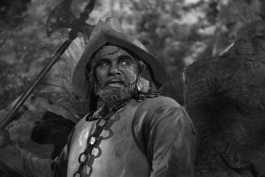
work here is rather more modest. Vargas is given gray, dead-looking skin,
hair streaked with dirt and sports a long scar on his forehead.
Giant from the Unknown
was Cuhna’s first, and again best, movie. A runaway production that shot
mostly on location in Big Bear, California (where they unsuccessfully
tried to hide from the unions), the film was finished almost exactly two
months after they decided to make it. The budget was a paltry $55,000.
Their biggest problems included a freak snowstorm during the climatic
scene, necessitating some rather unconvincing optical snow effects to be
added to shots already in the can, and the fact that the long fight filmed
between Brooks and Vargas was ruined when they found that that camera
shutter had stuck closed (!!). Having lost a day of shooting, they only
had time for a truncated reshoot of the scene.
Perhaps the oddest thing
about the movie, though, is how tenuous its claim to being a sci-fi movie
is. Sure, Vargas is a conquistador who arises from a five hundred year
sleep to terrorize the community. Still, he doesn’t have any
preternatural strength or invulnerability or anything. He could just have
easily been just a hugely big psychopath and most of the film’s events
wouldn’t have been impacted in the least.
Meanwhile, the funniest
boner is that we are shown Vargas’ resurrection, and it takes place after
the animal mutilations and the murder that have everyone in Pine Ridge
riled up. Apparently no one associated with the film noticed this little
faux pas.
- I’m constantly flabbergasted at how
good these things look on DVD. Even The Beast of Yucca Flats
transfer is beautiful. And, if anything, black & white looks even
better on disc than color.
- Nice credit sequence, especially the way
they scroll up the screen. This is actually fairly fancy and dynamic
for this kind of thing.
- I’ve seen plenty of obviously
Caucasian actors playing natives in my time, but the fellow cast as
Indian Joe is right up there.
- I don’t want to be picky, but why is
Vargas known as the ‘Diablo Giant’? I could see either El Diablo
Grande or The Devil Giant. But what’s with the half Spanish/half
English moniker?
- It’s bad luck to toast with a water
glass? I never heard that one.
- Brooks shows the Clevelands his ‘lab.’
The extent of the scientific equipment appears to be a couple of
beaker on the lab table, partially filled, that’s right, with a
colored liquid. Looking upon this bounty, the Professor notes
approvingly, "It’s very complete!" (!!)
- My mistake, he has a mortar and pestle,
too, up on that shelf.
- Janet screams and a big blare of
dramatic music follows. Why? She opened a box and found *gasp*
a small lizard inside. ("He’s quite harmless in there,"
Brooks explains. Yeah, but for heaven’s sake don’t let it escape,
or who knows how many would die?)
- Intuitive Leap Theater Presents:
Brooks: "That
ugly little fellow [the lizard] is the leading character in a thesis I’m
preparing on the subject of Physical Antiquities."
Cleveland: "Physical Antiquities?! You mean that this animal
is related to an extinct species?!"
- "It’s the only one in
existence," Brooks avers. OK, Brainiac, how the heck do you know that?
- Hey, if a lizard could survive for
centuries in suspended animation, then what about a man?! (Bum
bum bum!)
- Janet, were you going to kiss Brooks
after the first date? Why, you little slut.
- The location shooting in Big Bear really
helps to lend the film some verisimilitude. Too bad many (although not
all) of the forest scenes were obviously – and I mean obviously --
shot on a stage. I half expected the actors to point off-camera while
we cut to some stock footage of elephants fording a river.
- Janet serves the men coffee!
- So that Jimmy Olsen-esque gawky teenager
is named *snort* Charlie Brown? (Jabootu Trivia: What’s the
other bad sci-fi movie featuring a character named Charlie Brown.) And
his constant cries of "Jeepers!" only add to the humor.
- Janet asks what she should do while the
men folk search for relics. "Well, since you’ve made the
beds," her father observes (in the tents?), "you can
wash the dishes and tidy up camp." Brooks tosses in his two
cents. "And then start lunch. And plenty of it!" Ah, the ‘50s.
- The animated gird overlay of the
mapped-out area they’re searching is a nice touch.
- Janet serves the men coffee, again!
- The first thing Janet does when she gets
tired of fooling around with the metal detector? She sits on a log and
fixes up her face with her pocket compact (!!).
- So the artifacts are found when Janet
mistakenly goes in the wrong direction -- just like a girl! -- and
then leaves her compact behind. And just when Cleveland and Brooks
were about to give up the search. Gee, haven’t seen anything like that
before.
- Holy crap, do metal detectors really
make that much noise?
- Janet’s gone out in the field with her
father for three years and is still started when an ancient skull is
unearthed? I mean, it’s not like we’re talking a small lizard in a
box, here.
- If Vargas was recently released from a
layer of rock (like the lizard) by an electrical storm, why is he now
all covered with soil and leaves and stuff?
- Boy, not only was Vargas preserved for
five hundred years, but so were his pants and tunic.
- Is Vargas being alive really the first
theory they would formulate after finding his armor but no bones?
- Janet and Brooks go out for a romantic
walk in the *cough* woods. They stop before a large wall
photograph of a moonlit lake for a little smooching. When employing
the photo backdrop idea, though, here’s a hint: Don’t take such a
picture when it’s breezy. The ‘lake’ here sports an oddly
permanent ripple pattern. This becomes rather noticeable after, oh,
three or four minutes.
- Vargas leers at Janet’s shadow, cast
upon the tent wall as she undresses. I have to assume that it’s on
purpose that you can see the outline of both of her breasts (Bill
Warren’s essential tome Keep Watching the Skies reports that
actress Fraser wore pasties for this bit). This all must have seen
rather provocative for the time, especially with the monstrous and
degenerate Vargas lurking nearby.
- Janet grabs her revolver in a panic and,
as Andy Borntreger would write: RANDOM ACT OF GRATUITOUS VIOLENCE
AGAINST A COT!
- Ann Brown, Charlie’s sister (isn’t
that Sally?), tells him to go on to work. She’ll be OK, she’s got
their father’s rifle at hand. Then she wanders over to the well
unarmed. Du-uh.
- I don’t even want to think about what
was supposed to happen between Vargas capturing Ann and his killing
her. Yuck.
- So your theory is that tannic acid in
the ground here works as a preservative? Science!
- Time-wasting subplot seven: The Sheriff
arrests Brooks for Ann’s murder, even though two witnesses state he
never left the camp.
- If Brooks believes that Vargas is alive
(and has stolen his armor back from them), then why would he ask the
sheriff to stop by Indian Joe’s cabin to look for evidence? Once
they got there and didn’t find anything wouldn’t the Sheriff just
be more pissed off than before? Unless it’s just to find something
spooky to show the audience…
- There hang’s Injun Joe, he’s movin’
kind of slow. Actually, he’s not movin’ at all.
- Cleveland disappears and Janet goes to
look for him, instead finding Vargas. Gee, too bad neither of them
thought to carry one of their guns with them, given the whole, you
know, homicidal giant guy thing.
- Knocked out Dad, attractive daughter,
horny preserved ancient giant…Good gravy, they totally ripped-this
movie off in Eegah!
- Watch that foam rubber ‘boulder’
wiggle when Janet leans against it. Hee hee hee.
- Boy, those cars just never start when
you need ‘em to, do they?
- Yeah, leave your suspect in the police
cruiser with the keys in the ignition. Nice work, Brainiac.
- The inevitable car chase, and…watch
out! A balsa wood fence!
- Yep, if those guys scrunch up real tight
as they cruise through the fence, we’ll never be able to tell they’re
stuntmen.
- Yes, the chase was exciting and all --
well, not really, but I appreciate the effort --, yet wasn’t it
unnecessary? I mean, Cleveland had seen Vargas grab Janet. So why not
just tell the Sheriff and get the nearby posse going instead of
driving off and getting shot at? (Well, OK, so the Hero could
courageously head off after Janet on his own. Check.)
- You know, earlier the Sheriff looked
like a jerk for accusing Brooks without any evidence. Still, his
"I read this thing all wrong" apology is rather goofily
worded. "Sorry, Brooks. I never even stopped to consider the
possibility that a resurrected five hundred year-old gigantic
conquistador was responsible for these crimes. I guess I was just
blinded by our mutual dislike."
- Charlie is left behind and told to guard
the campsite. "I’ll guard the camp with my life!" he
replies. Make sure you do, Charlie. If Vargas ever got his hands on
those canvas tents, folding chairs and that coffee pot…well, I don’t
even like thinking about it.
- Should the posse really track through
all that heavy brush with those lit flares? (It does look kind of
neat, though.)
- Look, I wouldn’t want a big giant guy
tossing large rocks at my head. I’m just saying that it doesn’t
look all that impressive on the screen, is all.
- Oh, c’mon, he’d be Swiss cheese by
now.
- Yeah, sneak up behind the wounded Vargas
and then hit him with your rifle. I guess this guy just isn’t
up on the whole ‘gun’ concept.
- One of the drawbacks of a crystal-clear
digital picture is that things like the piano wires attached to that
guy really are obvious. This rather diminished our surprise when
Vargas picked him up over his head. The character, though, was so
surprised that he then turned into a dummy.
- I know you don’t want Charlie trailing
along with you, Brooks, but you don’t have to be such a prick about
it. "And try to forget her [your just recently slain and no doubt
brutally sexually assaulted dead sister] for the time being."
Words of wisdom, my friend.
- Of course, no one keeps an eye on the
kid (in a roughly twenty by twenty foot campsite), and he sneaks away
to reap himself some justice. As he’s not the hero, I think you can
imagine how successful he is.
- They hear shots and instantly assume it’s
Charlie. What about they sentry they left behind? And why is no one
else in the camp bothering to react to the shots?
- There’s Charlie on the ground, all
beat up. Better move his spine around a lot.
- Now it’s snowing, now it’s not. Now
it’s snowing…
- Uh, didn’t Vargas drop that axe in the
woods earlier?
- Here comes the Sheriff. Yeah, just stand
there and watch Brooks take the guy on with a stick, ya maroon. Don’t
draw your weapon and help out or anything.
- What’s worse, the semi-transparent
matte shot of Vargas as he falls over a dam into the waters below, or
the semi-transparent matte shot of Glenn Manning in The Amazing
Colossal Man as he falls over a dam into the waters below. You
decide.
- To be fair, though, even knowing that
the cascading waters were matted in (as mentioned in Keep Watching
the Skies), I still can hardly tell.
- If Vargas smashed through that railing
when he fell, how comes it’s noticeably whole in the next shot?
- One reason these old sci-fi mellers work
better than more recent ones was their often abbreviated running
times. This one runs under eighty minutes. Tack another twenty minutes
on this and we’re talking Boredom City.
Summation: A decent ‘50s
sci-fi flick with a fairly unique premise. DVD includes the typically
bombastic trailer and some informative liner notes by genre pro Tom
Weaver.
___________________________________________________________________
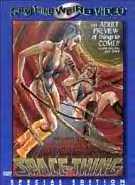
Space Thing
(1967)
Plot: A guy with a lot
of back hair reads from Sci-Fi magazines and then dreams of being on a
spaceship mission featuring a lot of soft-core sex.
I’m a little fearful of reviewing this right after last month’s Nude
on the Moon. I don’t want to foster the impression that I spend a
lot of time watching this stuff. Having now watched a few such pictures, I
think I can safely say I won’t become addicted to the genre. However, it
must be admitted that the Something Weird video company does some of the
best DVDs on the market. Here we get the film, a commentary track with SW
head Mike Vraney and the flick’s original producer, smutmaven David. F.
Freidman, as well as two amusing non-sex related shorts. A gallery of
advertising inserts is also included. I wish these guys were in charge of
the ever-growing collection of discs in the Wade Williams collection (see
above).
According to the disc’s
commentary track, Space Thing is one of SW’s best sellers. This
is unsurprising. As ‘sex’ films, the pictures produced by Dave
Friedman now seem rather tame. (Although often much seamier than most
modern porn.) Certainly you can see much more explicit fake sex any Friday
night on cable. Yet the film has much going for it in terms of whatever
nerds and geeks make up the market for these things. First, it functions
as a parody of the bad sci-fi films of the previous decade. Moreover, it
serves as an overt riff on what James T. Kirk was presumably up to with
those space women on Star Trek every week. Finally, the flick is,
as the commentary notes, pretty hilariously bad stuff. "If this wasn’t
a little crotchy," Vraney notes, "this would be the most famous
‘worst science fiction movie’ of all time." Personally, I think
that’s a bit much. Still, it can be pretty amusing, although the
recurrent pausing for unerotic sex sequences works to diminish this
aspect. These bits work for me though. They give me an excuse to check
over my e-mail while waiting for the ‘action’ to end.
We meet our protagonist in a opening bit of filler material. He’s shown
lying in bed and reading sci-fi magazines while his annoyed
wife/girlfriend/whatever tries to entice him into a little action. This is
‘funny.’ Being the kind of movie it is, he does eventually succumb to
her, shall we say, surgically enhanced charms. This prolog, unconnected
from the rest of the film, was apparently added so as to stretch out the
film’s running time to a robust seventy minutes.
We eventually cut to what
is presumably meant to be the guy’s dream. He’s the captain of a
spaceship, represented by a badly lit and slightly modified model kit of
the USS Enterprise hanging from a string. In a touch that goes nowhere, we
learn that he’s been marooned by mutineers. He manages to drift by a
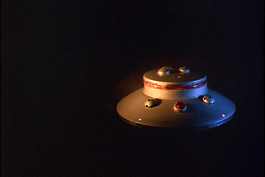
Terranian vessel, itself the model kit from the old Invaders TV
show. If I’m following this, the Alien guy is the hero and the Earth
people are the villains. Here we cut to the hilarious title credits,
written in the Goldie Hawn Laugh-In style with Day-Glo paints on a
woman’s body. Although we see rather more of this body than we did of
Goldie’s. Back inside the, uh, economically envisioned starship, Our
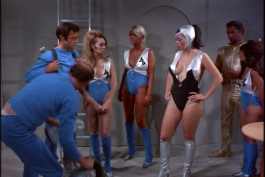
Hero comes aboard in human guise. He introduces himself as Col. James
Granilla (or something), and is met by the ship’s cruel and barely
clothed Captain Mother. "A female Captain!" He narrates in
surprise. "The Terranians are even odder than I thought!"
So we go, as Granilla tries to sabotage the ship while learning of this
strange human thing called Sex. "I knew now," he narrates,
"that in order for my disguise to be proper, I would have to learn
their intimate ways. A disgusting thought." He’ll be aided in this
endeavor by his race’s innate ability to turn invisible. Various
couplings (sorta) occur until he gets the chance to blow up the ship and
massacre everyone with a bomb. It’s the Feel Good Movie of the Year!
- Nude girl, sporting tons of make-up, and
guy in underwear. Check.
-
Jazz score, sometimes bad and sometimes good. Check.
- Yuck, way too much back hair on
that guy. And the extreme close-up of the woman tonguing his hairy
chest? That I could have done without.
-
Ah, the asteroid field featuring hunks of papier-mâché rocks hanging on
strings. (Actually, the commentary says they were cotton.) A classic.
- It’s the year 2069. I get it. How
droll.
-
Your escape pod is called a ‘space canoe’? That’s a new one on me.
- Why are they blowing talcum powder on
that *cough* spaceship? Is that supposed to be ‘space dust’
or something?
-
I’m assuming from the various naked female buns on display throughout
the film that the ‘health club’ idea hadn’t really caught on yet.
- Actors’ names on display: April
Playmate, Mercy Mee, Ronnie Runningboard (!), Fancher Fague, Legs
Benedict (!!) and Stan Isfloride. Meanwhile, the camera is manned by
Sy Klops, Allus Dropsit is the Key Grip and the script is by Cosmo
Politan.
-
OK, so the guy’s uniforms are blue stretch pajamas. Still, do we need so
much Plumber’s Crevasse here?
- Granilla’s cover story is that he’s
from Kansas, eh? Har har.
-
The ladies’ spaceship uniforms really don’t seem very practical.
- Awesome special effects. Granilla turns
invisible by turning off the camera and turning it back on once he’s
moved out of shot. Take that, ILM!!
-
It’s not only a round bed, it’s a Space Round Bed!
- Time to check my e-mail.
-
Sheesh, that guy’s got a hairy back, too. Buy a razor, for Pete’s
sake. And shouldn’t you be taking your pants off at some point?
- What kind of ‘latrine duty’ is there
on a spaceship?
-
"Ignite Retrograde Rockets!" Yep, somebody did their homework
here.
- Captain Mother prefers the chicks, eh?
Well, that figures.
-
Spaceship navigation panels are built out of plywood? Oh, I’m sorry, Space
Plywood.
- Hey, Dick Van Patten!
-
Hmm, a flagellation scene. There’s a paper to be written on how porn in
less sexually open societies (see the underground ‘erotica’ of
Victorian England, for instance) often features spankings and whippings,
while the mainstreaming of sex media tends to homogenize such kinky
elements out.
- Wait a minute, she’s not cut and
bleeding, there’s just red paint on the whip. (Which explains why
the whip stops ‘cutting’ her after a while.)
-
Dude, pull up your pajama bottoms!
- Space Scuba Tanks!
-
I hope I’ve gotten some more e-mail in the last ten minutes.
- So a fully clothed man making out with a
naked woman constituted dirty movies back in the ‘60s?
-
Boy, those Space Chairs look like upside-down plastic garbage cans.
- Yikes! That woman is definitely cruising
for some skin cancer. Stay out of the sun, I’m telling ya!
-
Ah, the old "Food Pills’’ gag.
- Hmm, it was dark when they landed, but
now the sun’s out on this ‘asteroid.’
-
Yeah, putting the toy spaceship they’re using in the foreground of the
shot really makes it look ‘big.’ Not.
- Here’s a tip when on an Away Mission
on rocky terrain. Bring a blanket so as to facilitate sex.
-
NOO! Keep that woman inside the ship! Don’t let her back out into the
sunlight! You know, I think I can actually see her skin turning to
leather.
- Out of e-mail. Well, that’s what the
fast forward button on your remote control is for.
-
Ha! Dick Van Patten can’t get any!
- Shouldn’t you be taking off your pa…oh,
never mind.
-
Wow, they use the same special effect technique for a guy getting
disintegrated as when someone turns invisible.
- Dude, I know you’ve been trying to
destroy the ship, but you’ve got a disintegration pistol now and
only there’s only five crewmembers left. And one of them’s Dick
Van Patten. Go to town!
-
How did they get off the asteroid? "As luck would have it,"
Granilla explains, "Captain Mother remembered the ship had another
reserve fuel supply." Well, that explains why she’s the captain, I
guess.
- This is probably the first movie to
feature a guy who destroyed a ship and killed everyone because he
feared trying to satisfy four sex-hungry women. Somehow I can’t see
Captain Kirk going out like this.
-
So "micro atomic bombs" are "deadly destructive when
activated," eh? And you light them with a match? Well, that’s The
Future for you.
- Shouldn’t the words "The
End" be written on that woman’s butt cheeks rather than her
hands?
Extras:
- As usual, the four-minute (!) preview
is in many ways better than the movie. It’s also full of the de
rigueur smutty puns involving scenes in "the cockpit" and
the like. "It’s the Planet of the Rapes!"
-
Roll-Oh the Robot is a hilarious black & white three minute
short from the ‘40s or ‘50s. It chronicles the adventures of an Ozzie
& Harriet-esque woman who has a typically goofy and cumbersome robot.
Said automaton is activated with a panel featuring oddly specific buttons
like Answer Door, Wash Dishes, Make Bed, Fix Furnace and, my favorite, Get
Hat. I don’t know, if I only had eight buttons I might have made
different choices. It’s an amazing Glimpse into The Future!
- The Dance of Tomorrow is one of
those insanely expensive-looking Industrial Shorts they used to
feature on MST3K. Made somewhere in the mid-to-late ‘50s, I’d
think, and lasting four and a half minutes. This one is a color
musical subject introducing various futuristic concept cars at an
auto show. The presenters have been furnished with designer togs to
match each car. A man identifies the car, a woman the clothes.
"A magnificent El Dorado Town Car by Cadillac!"
"Ensemble by Christian Dior of Paris!" The best is a
Firebird 2 which looks like the Batmobile. They end up driving it in
a model town that looks out of Logan’s Run. This thing is
simply demented. We could actually use a whole DVD of such material.
Listening, Something Weird?
-
Us usual, the gallery of advertising stuff is cool, but SW discs still don’t
allow you to pause (or speed up or slow down) as they flash by so that you
can give them a better look. When are they going to fix this? Everybody
complains about it. There’s six and a half minutes (!) of this.
The Commentary:
-
Obviously, the commentary with the gregarious Mr. Friedman is the
highlight there. How many of the anecdotes are strictly true is left for
us to decide, but tidbits like the film’s star Steve Vincent (i.e.,
Steve Stunning) being trained as an "opera star" are pretty
amusing. A good tour of low-budget sexploitation filmmaking.
- "We could show beaver,"
Friedman explains, "but not pickles."
-
The Dick Van Patten guy (Ronny Runningboard, nee Dan Martin) was, in
actuality, a Los Angeles county Deputy Sheriff (!).
- "He really wanted to be in movies
in the worst way. And he was!" Rimshot, please.
-
Carla Peterson plays Captain Mother, and was Vincent’s ladyfriend.
- Mercy Mantello, the chick who gets
whipped, was used as a model by David "The Rocketeer"
Stevens, who went on to do the artwork for SW’s Space Thing video
release.
-
Friedman explains that the comical names in the credits also kept the
actors from becoming ‘known’ to their audience. Because, of course, if
any of them became ‘names,’ they could then demand more money. This
did eventually occur in the hardcore porn business, as they note.
- Shot in 35mm color, the film’s
budget, Friedman thinks, was seventeen to eighteen thousand dollars.
-
Vraney asks about the obligatory lesbian scene, prompting the bizarre
analogy that "All of my films…were very rigid in their
construction. Almost like a medieval morality play." Then he reveals
one of the most closely held secrets of the sexploitation field. It turns
out that such sequences weren’t meant for the ladies in the audience,
but rather for the men, many of who apparently enjoy watching two women
going at it. Call the papers.
- Some especially interesting material
deals with the actual business end of the film. Friedman, obviously
not a sci-fi fan, thought the film was awful -- he’s still
obviously embarrassed by it -- and would tank. He evens reports that
he was unsure whether to release it or not. However, unsurprisingly
to us genre fans, I’m sure, the film made major money on the
grinder market, especially on California’s plush Pussycat Circuit.
Friedman was amazed when he learned that the Pussycat theaters
planned to hold the film over.
-
The money we’re talking here seems amazing. With prints and advertising,
Friedman estimates that Space Thing cost somewhere under thirty
thousand to get to market. Meanwhile, the first run just at the Pussycat
theaters would bring in somewhere in the area of $45,000. That was before
it showed anywhere else in the state of California, much less throughout
the country.
- Friedman goes into a long story about
a fellow he had to fire from the movie. It’s pretty impressive
that he still seems to regret firing a guy thirty years earlier, or
remembers so much detail about working with the guy.
-
Even after Space Thing had continued to run for years in theaters,
Friedman still loathed it. When Vraney first made his deal with Friedman
to take his old negatives and sell tapes of them through the Something
Weird label, he found a dusty copy of the film and inquired about it. From
the title he was hoping it was a sci-fi picture, which he knew would sell
well. "Kid," Friedman supposedly replied, "you don’t want
that movie! That’s the absolutely worst thing I ever put out!"
Again, this remained a SW bestseller for years, and undoubtedly remains
so, given its DVD release.
Summation: Plenty of
yucks and some funny featurettes, as well as the interesting commentary
track.
-by Ken Begg
|