Another feature of... |
|
Another feature of... |
|
|
for October 2001 (1979)
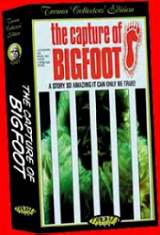
Plot: Mountain yokels attempt the title goal. The reason I bought this tape is simple: Bigfoot and Yeti movies generally suck. Big time. Bigfoot. Curse of Bigfoot. Half Human. The Legend of Boggy Creek. Return to Boggy Creek. Creature of Black Lake. Man Beast. Snowbeast. Snow Creature. Night of the Demon. Shriek of the Mutilated. (The last two being the Bigfoot movies for gorehounds, by the way.) Except for Hammer’s thoughtful The Abominable Snow Man, Bigfoot movies traditionally provide everything the dedicated Jabootuist looks for. Unfortunately, this entry in the oevre proved disappointingly lame. Not that it’s very good, or that it doesn’t have its laughable moments. On the whole, though, it’s just another uninspired and oft tedious genre flick. To the good are some (initial) attempts at characterization. To be bad…well, to start with, notice I said "attempts" at characterization. Ha, Sheriff Cooper is a grump, but he also spends his time alone honing his bad Bogart impression. The park ranger hero and his wife have a ‘sexy’ bantering relationship, or so I assume. Unfortunately, the sound is often so bad that I couldn’t make out much of their repartee. Said audio problems, meanwhile, are due to the film’s less than lavish budget. The acting ranges from stiff to poor, with the biggest ‘name’ being George ‘Buck’ Flower. Look, when a B-Movie fan sees the names ‘Hopkins’ and ‘Kennedy’ in the cast, he wants Bo and George, not Katherine and Richard. Then there’s the story. As soon as two trappers identify the unseen beastie they’ve captured as being a young’un, the vet genre buff will be packing his bag for another visit to Gorgoville. One problem is that we’ve way too many characters here. There’s Garrett, the park ranger hero. He comes equipped with a wife named Karen. Karen, meanwhile, has a young teenage brother named Jimmy, who has a sidekick named Randy. Sheriff Cooper is the local fuzz. Olsen is the bad guy who wants to capture Arak the Bigfoot (since when do they have names?) at any cost, and is incidentally, that’s right, the richest, most powerful man in town. Needless to say, he’s the film’s obligatory Captain Ahab character, whose obsession with catching Arak will cost any number of human lives. Plus there’s an array of fur trapper/Bigfoot fodder guys, including Buck Flower as Jake. We open with a mediocre folk/pop song and shots of big fluffy dogs pulling a dog sled. Since I bow only to Homer Simpson in my fascination for fluffy dogs, I gave the film a couple of points for this. We then join the trappers mentioned above, who have a mysterious something in a canvas wrapped cage. If we had any doubts about their long-term prospects, the POV shots from the woods we see, accompanied by ragged breathing sounds, confirm our suspicions. One man quickly buys it, with the director sagely keeping the attacking beast largely unseen. The creature in the cage escapes, and the second trapper, badly mauled, climbs into the dog sled and heads back to town. We soon see him at the hospital, barely alive. From there the storyline goes about where you’d expect. Olsen proves that humans can be the biggest monsters of all (wow!), Garrett’s young brother-in-law bonds with Li’l Bigfoot, Li’l Bigfoot is recaptured and used as bait to catch Daddy, etc. In fact, in order to exploit the pathos fully, Li’l Bigfoot gets himself shot, if not fatally. From there it goes pretty much by rote. Frankly, I had expected
better (or, rather, worse) from director/co-writer Bill Rebane. He has an
admirable body of work in the Jabootuish fields, starting as the director
of the classic cheesefest Monster a-Go-Go (!). It was over ten
years before he resumed helming movies, producing a series of cheapie
sci-fi flicks in his native Wisconsin. These include such titles as Rana:
The Legend of Shadow Lake, The Alpha Incident and the modern
classic The Giant Spider Invasion. The Capture of Bigfoot
must have made some amount of money on video or something, because Rebane
followed it up three years later with The Legend of Bigfoot. His
last opus was 1987’s Blood Harvest, a slasher film starring Tiny
Tim (!!).
Summation: For undiscriminating monster movie buffs and Bigfoot completists. The bigass Arak monster suit’s pretty amusing, though. __________________________________ aka Snakes(1974)
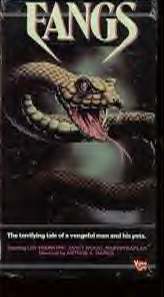
Plot: A weird old coot goes on a murder spree. Well, I’ve got to give the film this: I had no friggin’ idea where it was going. From the title and the box art I figured it would be a typical killer snake movie. Instead, the film turned out – eventually -- to be a bizarre black comedy, ala Motel Hell. I think. Let’s put it this way, either it’s a black comedy made by some definitely strange people, or it’s a straight horror film made by psychopaths. The weirdness starts out fairly slow but eventually builds into outright perversity. We open with a credit sequence, white text on black cards. This is accompanied by a rousing rendition of Stars and Stripes Forever. (!!) Meanwhile, you have to admire the gall of a film that lists John Phillip Sousa in the "Music" credits, as if he wrote his stuff especially for this movie. This segues to a scene of small kids in a school band, marching around and playing a grating version of the same piece. This goes on long enough to really get on your nerves. Then we start meeting our cast of characters. Mrs. Williams is a school teacher in this small rural town. We spend much time meeting her young students, but this proves to be misdirection. The kids, we learn, collect small animals for a smelly old coot named Snakey. (Les Tremayne!) Snakey lives out on an old homestead and has a large collection of snakes. Being rather indigent – in a nice country touch, the driver’s door of his old car won’t close, and has to be wired shut – he relies on the boys’ efforts to feed his snakes. One boy, however, fears the wrath of Brother Joy, a local religious leader. He apparently feels that feeding small animals to snakes amounts to murdering God’s little creatures. When we meet Brother Joy, however, he’s oddly unprepossessing. This was the first really off-kilter thing about the film. The actor playing him looks like someone you’d get to play a 1950’s small town accountant. We also meet Burt (Richard Kennedy!), Snakey’s only pal. For instance, he lets Snakey lives out on his unused property. We learn that Burt is planning to leave town shortly and return with a new bride. Next we meet Sis and Bud. Sis owns the local small grocery store, which Bud helps run. Bud is a looming doofus, sort of a bigger, chunkier and somewhat more malign Gomer Pyle gone to seed. Sis is his sibling, and she’s a huge woman who looks like she’d nicely fill that bill as the sadistic head guard at a woman’s prison. This is appropriate, since she proves to be, and I’m sure this is how she was described in the script, of the persuasion once known as a Bull Dyke. In one of the film’s early indications of strangeness, both of them try to put moves on Miss Williams when she comes in for some groceries. Indeed, they almost pressure her into stepping into their house next door for a little visit. Miss Williams escapes this fate, however, when Snakey comes in for supplies. Then we get another longish scene with Snakey sparring with Sis and Bud, who eventually feed him a novelty piece of candy impregnated with hot sauce. These scenes in the grocery go on for a long time, seven minutes or more, and indeed we’ll spend most of the film on character scenes before we start getting to the then near-constant mayhem. An amusing bit here is the highly visible presence of Dad’s Root Beer. One wonders what the product placement guy thought when he saw the finished film. We eventually learn that Wednesday is Snakey’s big day. First he collects food for his beloved snakes. Then he and Burt get together at the latter’s house and have ‘concerts,’ raucously listening to marches on the stereo – including "Stars and Stripes Forever" – and chugging down beers. It was following this that I began to realize (sorta) what a freakshow this movie was going to be. See, Snakey next takes Lucifer, his biggest snake, over to Miss Williams’ house, where she, uh, engages in acts of sexual congress with it. (!!) This is portrayed through shadows on Miss Williams’ bedroom wall, ones that leave little doubt as to what’s going on. Then, just in case that’s that not quite gross enough, fatasses Sis and Bud come over. They use their (misconstrued) take on her relationship with Snakey to blackmail her. The three then enter the house, presumably for…well, frankly, I don’t want to presume about it. The following week everything goes to hell for Snakey. (It was about here that I was startled to realize that he was the film’s main character.) Brother Joy convinces the boys not to collect animals for him anymore. Then Miss Williams makes it clear that she’s only interested in Snakey’s snakes and not, er, Snakey’s snake. If you know what I mean and I think you do. Then he goes over to Sis’s store to threaten not to shop there anymore, whereupon Bud goes outside and beats Lucifer to death. The last straw, though, is when he goes over to Burt’s. Ivy, Burt’s new wife, is a hot young thing and she wants his full attention. Burt reluctantly tells Snakey that their weekly concerts are off, at least for now. Snakey explodes in frustration and storms out, although not before watching through a window as Ivy does a striptease for her hubbie. (Ivy’s clothing here is the very un-finest in Slutwear, circa 1974. Nor did I ever need to see so much of Richard Kennedy’s bare chest and beer gut.) The next day Burt goes out to make peace with Snakey. He gets mad when Snakey insults Ivy, though, and tells his former pal to get off his land. In response, Snakey smacks Burt in the head with a rock and kills him. He drives Burt’s car up to the nearby mountains and pushes the vehicle, and Burt, over a cliff. We then watch as the smiling Snakey walks through a meadow full of sunflowers as he returns home. Burt’s murder occurs at about the forty-eight minute mark, and after that it’s one killing after another. First Snakey vengefully kidnaps Ivy, grabbing Burt’s revolver along the way. Ivy is kept tied up and will be brought out periodically to watch Snakey as he murders most of the rest of the cast. Needless to say, snakes will be his weapon of choice. Then it’s up to the cliff and over the side with the victim and their car. Things all end with the obligatory ‘70s nihilistic ending. Meanwhile, all I could think of was how lame the town sheriff must be. How in a town this small could the disappearance of six or seven people, including the two folks who run the town’s grocery store, go unnoticed? To be fair, I certainly can’t say that the movie was predictable. At least until Snakey’s repetitive murder spree begins. On the other hand, I can certainly say that I found events pretty sleazy and unpleasant. Snakey’s habit of stripping his more rotund victims down to their underwear, for instance, ain’t helping. I can only assume that the picture was meant as a very black comedy, because it’d be downright horrifying if it weren’t. As noted, Les Tremayne plays the skuzzy sociopathic Snakey. Mr. Tremayne is well known to genre fans for his numerous roles in sci-fi films of the ‘50s and ‘60s. Prominent amongst these would be the considerably more dapper General Mann in George Pal’s War of the Worlds and the goat-obsessed writer in The Slime People. Tremayne also appeared in Angry Red Planet, Monolith Monsters and Monster of Piedras Blancas. He also provided narration for Forbidden Planet and the American version of King Kong vs. Godzilla (!!). Fans of ‘70s TV schlock will recall him from his role of ‘Mentor’ in the old Shazam series. He also worked for Larry Buchanan, playing the Chester Morris part in Creature of Destruction, Buchanan’s remake of The She-Creature. Bruce Kimball, who played Bud, worked in many grade Z productions, including The Mighty Gorga, Dracula vs. Frankenstein, Brain of Blood and The Thing with Two Heads. Meanwhile actress Alice Nunn, who played Sis, won cult movie immortality by assaying Large Marge in Pee Wee’s Big Adventure. In one of those weird coincidences, meanwhile, Richard Kennedy was the fellow who hammily portrayed the villainous Olsen in The Capture of Bigfoot. To be fair, he’s more restrained here. Chances are these are about the only two movies I’ll ever see him in, and I saw them both in the same weekend. Go figure. Summation: Weird stuff. __________________________________ aka Elsa Fräulein SS(1976)
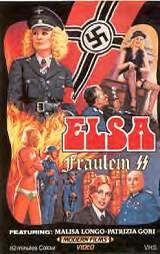
Plot: It’s WWII, and an SS Colonel/whore/madam (you know the kind) uses her mobile military brothel to identify traitors to the Reich. When I saw the video box for this I was a little discomforted. I am, essentially, pretty squeamish. I was buying tapes on Ebay and bought Fraulein Devil on the basis of its risible title (and cheap price). So when I saw the juxtaposition of nude chicks and Nazis on the video box I was naturally uneasy. The last thing I wanted to see was something along the line of the Ilsa films or those gross Nazi Love Camp movies. I didn’t have to worry. Despite an array of elements that seem to be asking for trouble, the picture is far more goofy than anything else. This is largely because due to some hilarious dialog, which, as in many dubbed foreign films, sounds ludicrous when translated into English. We open with several minutes of Nazi stock footage, Hitler and marching storm troopers and such, accompanied by rather cheerful classical music. (!!) Eventually we see the Nazis in retreat from Paris. Then we finally start our film proper, if you can call it that. For instance, to help get across what the finale of the stock footage sequence meant, our first ‘new’ footage is of a couple dozen extras in German army uniforms staggering down a road while pretending to be wounded. Then, still afraid we won’t get it, a narrator comes on and explains that things aren’t going well for the Reich. With fatalism comes an increase of supposedly traitorous thought in the armed forces. Hence the Gestapo is spending ever more time and resources ferreting these ‘traitors’ out. Then "a lowly Major suggests a diabolical scheme." Said scheme involves fitting out a train to function as a high-class mobile brothel. This will be sent along the front to reward the hard fighting officers of the Reich. It’s covert purpose, however, will be to track the conversations of the officers while they’re at their, uh, least guarded moments. The Major is pleased that his plan has been so avidly accepted, by the Fuehrer no less. However, from there things don’t go as well. "The reward he received," the Narrator explains, "was not the one he expected." First of all, despite his assumptions, the Major will not be put in charge of the operation. That role will be reserved for a well-known German prostitute (!), Elsa Ackermann, who will be awarded the rank of Colonel in the SS (!!). Moreover, she’ll be given "unlimited powers…and decorated with the Iron Cross." Plus she was personally appointed by Hitler himself, in recognition of her "unblemished devotion to the Fatherland." (Given her line of work, the phrase "unblemished devotion" seems somewhat ambiguous.) Sweet gig, eh? Oh, and there’s another part of his reward The Major wasn’t expecting. Here we again learn an important lesson about working for evil bosses, like Hitler, or Blofeld, or Bill Gates. That’s right, since he now represents the number one security risk on this oh-so Top Secret mission, they’ve decided to have him liquidated. Of course, Blofeld would have pushed a button after making this announcement and the guy would have fallen into a concealed piranha tank. These guys, however, are considerably less high tech. "This is preposterous!" the flabbergasted Major complains as guards hustle him to his death. And, really, it’s hard to argue with him. Oh, and I simply must pay homage to the other guy in this scene. He endows his character with an outrageous variety of extremely broad and overworked facial tics. I haven’t seen such a cornball attempt to gain audience attention in I don’t know how long. Next we meet our two main characters. Elsa is the newly minted SS Colonel (seen admiring her new officer’s cap), Franz her lover. This scene sets up the pair’s rather purple love/hate dynamic. This will drive the film, as well as providing some of its chunkiest wads of mirth-inducing dialog. The middle-aged Franz is a Major, and usually found crawling into a bottle. He did a Pygmalion job on Elsa, who he found as a street whore. Now she’s his superior officer. (I hate when that happens.) Moreover, he’s losing whatever faith in the Reich he ever had, a plot thread that will be further exploited as the film progresses. Anyway, Franz is drunkenly bemoaning his fate, leading to the following exchanges: Elsa:
"You’re drunk. You don’t know what you’re saying!" Later they exchange further insults (and backstories): Elsa, sneering:
"And what about you, my friend Franz? And your ‘special tastes’?
The brilliant Major Holbach! The handsome toast of the town, who’s only
able to obtain an erection with a whore!" The scene ends when Elsa returns to the room in a see-through nightie and thigh-high leather boots. She makes the inebriated Franz lick her boots. This, given her exaggerated facial contortions and fevered graspings of her riding crop (!), she apparently finds, er, to her liking. Making the bit even better is that it’s accompanied by cheesy romantic music (!!) provided by what sounds like a fellow playing a Wurlitzer organ, one whose major musical inspiration is the oevre of Mr. Burt Bacharach. When we next see Elsa she’s in her full SS regalia and being presented with her train. Inside a nearby building, various uniformed women are being, uh, examined for this special assignment. This, of course, involves mostly stripping out of their clothing. Elsa, meanwhile, is giving the candidates a ‘yea’ or ‘nay.’ Amusingly, no one seems to find any of this out of the ordinary. Later Elsa gives informs her workers of the rules. It’s here we learn that all the women have brought disfavor on themselves in some way. However, by, um, serving the Fatherland in this capacity, they may regain the good graces of the Reich. This plot thread is introduced and then never really mentioned again. Let’s see here. Well, the French Resistance doesn’t know what the purpose of the train is, and is curious. Moreover, we learn, they have an agent onboard the train itself. This tidbit conveyed we move on. We see a number of German brass cavorting with the women in the train’s common room. Their behavior is presumably meant to be Bacchanalian and all, although somehow I doubt that the Marquis De Sade would be tipping them his hat in admiration. Next we waste some of the film’s meager running time – it runs under an hour and a half – as an officer at the piano plays a bawdy song in Elsa’s honor. Since they didn’t translate it from the original French, I’m not sure exactly what the lyrics are supposed to be saying. This is sung by one of the girls, a blonde wearing a black derby, black feather boa, black teddy, black fishnet stockings and garters, smoking a cigar and sitting back with her legs splayed well apart. In other words, the obligatory ‘Looks Like The Sally Bowles from a Road Show Production of Cabaret’ Woman. Her guests occupied, Elsa sneaks out of the room as the song progresses. (And really, who can blame her?) Meanwhile, the plan is going like gangbusters. Elsa is seen in the train’s secret listening room, monitoring the microphones hidden in the girls’ rooms. One officer, who’s not even taken off his uniform yet, is overheard opining that Hitler must be done away with. At this Elsa and a guard burst into the room, whereupon the fellow is escorted outside and executed. Oh, and the victim is told to run for it, only to be shot in the back when he tries it. I think you have to do this sort of thing at least once a year to your Villain’s union card. A montage shows the train traveling around and various traitors being executed. Eventually Elsa is seen firing the fatal shots herself, from which she evidently derives some sort of kick. Oddly, even though fellow after fellow is taken right outside the train and shot, no one ever seems to figure out what it’s true purpose is. Hans is soon assigned to the train as its French interpreter. (Is that the kind of job normally filled by a SS Major?) This established, we cut to a young German soldier mucking around in the common room. Elsa finds him and takes him back to her room. Cue the Wurlitzer of Romance. Surmising that the fellow is a virgin, Elsa orders him to undress and then seduces him. This heralds your basic simulated sex sequence, punctuated by further lounge music. Then we cut to the train screeching to a halt – get it? – and Elsa gets dressed. She then returns with a guard, and reveals that she knew the guy was a deserter. She orders him taken off the train and executed. See, that’s just the kind of chick she is. He manages to break loose and run off, but he’s quickly cornered and shot down. (If you watch the guy, he grabs his head after being shot, probably because he was hit by the burning powder and wadding from the blank.) We get more wrangling between Franz and Elsa. Despite his increasingly subversive sentiments, she refuses to turn him in. (Although, she spits, "Just the thought of our filthy love sessions makes me sick!!") After their fight, Franz stalks out to seek, what else, a drink. Liselotte, one of the girls, calls him into her room. He insults her too, she insults him back, and then he leaves. But we know it must be love. Sure enough, moments later he returns. He even refuses a drink when she offers him one. Franz then experiences a flashback. This uses real stock footage of the war to detail his battlefield experiences in Russia (we can tell from the white camouflage uniforms). These are the horrors that have soured him on the Reich. Cue the Wurlitzer as one of the girls picks up an officer in the common room. The organ playing continues (I mean the music, you perverts!) as Liselotte and Franz – the latter still in his full uniform! – engage in some simulated fornication. Then the train is attacked by an Allied plane – unseen, of course – and the girls hide under the vehicle. Then the French Resistance is seen planning, er, something. And yes, that’s about how incoherent things are. Elsa pops into Franz’s room, jealous over his attentions to Lisalotte. She’s not ready to give him up yet, I guess. And so she makes him listen over the bug as his new paramour, uh, entertains another client. (Given that Liselotte would have no say over this, I’m not exactly sure why she expects this to drive a wedge between the two.) Humorously, the two continue to snipe at one another right in front of the monitoring staff. "Your so-called ‘system’ makes me vomit!" Franz reveals. Here we’ve got about another half hour left. After further shenanigans of a similar, Franz begins to help Liselotte, who is – surprise – the previously indicated Resistance spy onboard the train. This leads to a finale that, I must admit, didn’t go anywhere near where I assumed it would. Either it was meant to be a downbeat ending, or else they were setting up a sequel. I’d like to take a moment to mention Claude Gros, credited here, as in Zombie Lake, with as being responsible for ‘Montage.’ A check of Mr. Gros’ no-doubt partial list of credits on the IMDB reveals a bizarre string of Nazi themed movies, many with a sex angle. Aside from this and Zombie Lake, these include The She Wolf of Spilberg, Helltrain (aka Love Train for the SS) and Convoy of Girls, yet another film whose plot devices include Nazis and brothels.
Summation: In pretty bad taste, but nowhere near as perverse as Fangs. More than a few humorous moments. __________________________________ (1974)
Plot: An American Interpreter on holiday is caught up in political intrigue. This will, I hope, prove to be the dullest of the films I’m looking at in this issue. [Future Ken: Luckily it was so.] Yawn. Second, it’s not, as the box art tries to sell it to be, a Blaxploitation flick. Said imagery features a black woman dressed like a street hooker and sporting gigantic cleavage, holding a M60 machine gun at the ready. As I’ve intimated, this does not accurately sum up the picture. Instead, the movie’s an attempt at a Hitchcock-esque ‘Mistaken Man’ thriller, only one featuring a largely black cast. Which would be fine, if it was a good film. But it isn’t. Actress Diana Sands is Honeybaby, an interpreter from Harlem who’s won some sort of around-the-world trip. She’s brought along her wacky young cousin Skiggy as her traveling companion. Also along is Sam, the fellow documenting her trip for the commercial sponsors. Sam, we can tell, is a dweeb, because first, he’s white, and second, is initially seen with a blob of sunscreen lotion on his nose. We catch up with them on a boat taking them to Beirut (!). Also on board is an Asian woman covertly transporting a microdot. Two smugglers, meanwhile, are on the shore and watching the boat’s progress. One is played by the distinguished black actor Calvin "The Beast Must Die" Lockhart, the other’s a dweeb. We can tell, because first, he’s white, and second, is bossed around by his cranky mother. The two are alarmed to see Customs officials board the boat and seize the Asian woman. Before she’s taken away, though, she manages to plant the microdot in Honeybaby’s passport. And you can take it from there. To be frank, I had trouble following the plot. Maybe because the film doesn’t present it well, maybe because I was too bored to give the movie my full attention. Anyhoo, Lockhart proves to be the ‘good’ smuggler, and he ends up getting (surprise) romantically involved with Our Heroine. The main idea had something to do with the dead body of a revered African leader. Evil forces need his preserved body for some baroque nefarious purpose. Therefore the film provides two McGuffins. First is the actual corpse, second is the microdot, which contains the ‘formula’ that somehow would keep the body perfectly preserved. There’s miscellaneous torture and the occasional murder and even a cyanide suicide capsule, but none of it adds up to much. Like I said, this isn’t properly a Blaxploitation flick. Although Diana Sands looks something (sorta) like Pam Greer, she’s no action hero. During one shootout sequence she looks terrified, and has trouble figuring out how to shoot her pistol. Which makes sense, actually, for a woman who’s an interpreter by trade. Meanwhile, the villains are black, not white, and while the two main white characters are a bit doofus-y, they aren’t outrageously so. Still, the video box would have you think otherwise. In addition to the deceptive art is an equally misleading tagline: "She’s after your money, honey." In fact, at no point in the film is the character after anyone’s money. A note on the IMDB indicates that the film was never completely finished. This is substantiated by a weird bit where actor J. Eric Bell, who played Skiggy, enters a projection room at the beginning of the film and begins to explain the convoluted plotline. (!!) Then he starts watching the film. (!) Unfortunately, it may be that the film was uncompleted due to its star’s cancer. Sands died of her affliction in 1973 at the premature age of 39, apparently with two films still in the can. Lockhart, meanwhile, remained a successful character actor and occasional lead, appearing in films up until the early ‘90s. Genre appearances include Cotton Comes to Harlem and Myra Breckinridge (!) before he graduated to more mainstream fare like Coming to America and Predator 2. He also appeared for David Lynch in a couple of pictures. Meanwhile, despite a prominent "Introducing" credit, J. Eric Bell never acted in another film. Director Michael Schultz remains active in television, lensing episodes of shows like Charmed and Boston Public. Early in his career he helmed such ‘black’ classics as Carwash and Cooley High before moving on to the infamous Sgt. Pepper’s Lonely Hearts Club Band. Summation: Pretty lame stuff. -by Ken Begg |