Another feature of... |
|
Another feature of... |
|
|
|
The Trial of Billy Jack -
Jabootu's Bad Movie Dimension
(1975)
Conversely, you can save yourself a whole lot of time and pain by clicking on the banner below and reading a review that's both funnier and, believe it or not, shorter...
These cards refer to a series of tragic events. In each, the cited number of student protestors were killed or wounded by either police officers (South Carolina State, Jackson State, Southern University) or National Guardsman (Kent State). Sans context, however—in at least three of the cases referenced, for instance, the shootings occurred after acts of student violence—the raising of their specter here, specifically to justify the fantastical and highly paranoid events Mr. Laughlin will portray later in the picture, remains highly mendacious, and more than a little morally suspect. We’ll get further into this later. The owl lands before a Wise Old Indian Man—is there any other kind?—chanting atop a butte. Below him, a very long funeral procession, made up of American Indians, marches across the arid landscape. Another card appears: "Freedom School 3 Dead 39 Wounded". I have to admit, seeing this fictional statistic conjoined to the earlier, authentic ones, roiled my stomach.
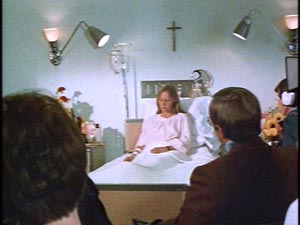
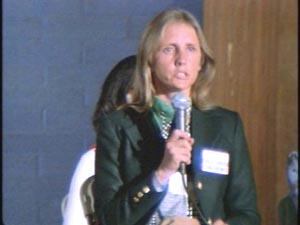
We cut to Jean (Delores Taylor, a.k.a. Mrs. Tom Laughlin), Billy Jack’s love and the administrator of the Freedom School. She lies in a hospital bed and is being interviewed by the press. "Ms. Roberts, did it ever happen before that so many thousands of rounds were fired into the dormitories in such a short period of time?" one reporter asks. Which, I don’t know, seems like an oddly specific, not to mention idiosyncratic, query. "It’s happened many times before," Jean responds, referring to the real life shootings cited above. There’s a word for this, and it’s lying. ‘Thousands’ of shots were not fired at any of the cited events, nor did any of them see rounds fired into ‘dormitories.’ On the other hand, it’s a clever kind of lie. Many will object that harping on the validity of such details is morally grotesque, given the larger fact that students were killed during each event. (Unless, of course, the statement made was instead, "Thousands of shots were fired by federal agents into the Weavers' home at Ruby Ridge." Then, I suspect, such minutia would be endlessly scrutinized.) I speak from experience. I was once discussing on an Internet chat board why Stalin has been so unrecognized as a symbol of evil in this country, as opposed to Hitler. One young fellow hotly replied that it was because of the 12 million people murdered in Nazi death camps*. (When I later mentioned that Stalin had liquidated many more millions of his own citizens than Hitler had, he was shocked to be told this.) I pointed out that the generally accepted figure was actually six million, whereupon my motives in correcting the number became the focus of the conversation. No one came out and said so directly, but there were some less than subtle insinuations that I was a Nazi apologist, and that my fixation on Stalin was an attempt to fudge the horrors of the Third Reich. [*Editor Ken: Jabootu Proofreading Minister Carl Fink notes that the 12 million figure is indeed widely recognized as accurate. Looking around the Internet, I’ve found estimates of "more than six million" (MSN Encarta) to, indeed, "over 12 million" (the Holocaust Project). The Simon Wiesenthal Center puts the total around 11 million, and I’m more than willing to accept their research. Grotesquely, even this larger figure pales compared to the tens of millions of citizens murdered by Stalin and Mao, although given the enormity of the crimes, such distinctions are indeed difficult for any sane person to grasp.] In any case, apparently feeling that the deaths of eleven students weren’t tragic enough (and correctly so, in terms of justifying the events that will be portrayed during the next three hours), the Laughlins, who cowrote the movie, will continue to systematically exaggerate the circumstances under which they occurred. I’m somewhat skeptical that Tom Laughlin fully deserves the title his DVDs grant him, i.e., "The pioneer of independent film." However, he certainly helped pave the way for such later cinema paranoiacs as Oliver Stone, not to mention serial liar Michael Moore. Any personal fears that I was making a mountain from a molehill on this issue disappeared once I restarted the movie after writing the above comments. Following the above quoted statements, Jean deftly moves from preposterous exaggeration to overt fantasy. She rambles on about the four actual events, then continues "or any one of a dozen [!] others," where "students are slaughtered by trigger-happy police-types." Really? A ‘dozen’ other incidents were ‘students’—emphasis on the plural—were ‘slaughtered’ by the authorities? Wow. In that case, I guess it would be petty to ask her opinion of student violence, riots, ROTC bombings and the like. Even this early in the proceedings, the Laughlins have abandoned the rhetorical scalpel—well, OK, they never used a scalpel; let’s say a big honking butcher knife—in favor of a chainsaw. A chainsaw, moreover, equipped with a rusty, gnarled chain. Thus we cut to one of the victims of the Freedom School Massacre, who proves to be a pretty little blond girl lying in an oxygen tent. Oh, the Humanity. We return to Jean’s hospital bed. "Has Washington replied to your request for an investigation?" a reporter asks. "Are you kidding?" Our Heroine snorts. "Remember after Kent State, when Attorney General John Mitchell said there was no need to explore the causes of the killing, because he knew in advance the causes couldn’t possibly be the National Guard or the police?" (Considering no police were involved in that particular shooting, actually, I’ll give him the latter.) The reporter follows up. "But didn’t an FBI report prove there were no shots fired by the students, and there was grave culpability on the part of the National Guard?" This is pretty clumsy agitprop, by the way, writing the script so that the reporters’ questions in themselves reinforce what the film is asserting. (Not that this is especially unbelievable, admittedly, given what the actual press is like.) On the other hand, I really adore the fact that roughly one second after they suggest that only complacent morons would believe that the Gov’ment would actually investigate such a shooting, they attempt to substantiate the point by quoting an FBI report on just such an incident. One that, they themselves admit, found the National Guard "culpable." Nor do they mention that a report of the real life President’s Council on Campus Unrest—whose existence seems to have slipped Jean’s mind—found the shooting "unnecessary, unwarranted, and inexcusable." I was planning to get into all this later. However, since they’re serving us this crap now, we may as well address it. First, I should stipulate that I’m one of those people who has a difficult time buying into conspiracy theories. The idea that any group can keep any sort of secret for more than a short time is historically suspect. For example, I believe Lee Harvey Oswald, more or less acting alone, shot and murdered JFK. This film, on the other hand, is a veritable bible for ‘70s conspiracy nuts. We’ll get to that later, too. Let’s stick with Kent State at the moment,
however. Again, we’re being fed half-truths here. It’s accurate, for
instance, to state that no shots came from the students. However, nobody
ever really asserted that this was the case. Now, you can believe, as the
Laughlins apparently did—and perhaps still do—that the shooting was more or
less an intentional act of the government’s. Pursuant to this, the governor calls out the Guard. The students respond with further unrest and the usual ridiculous list of demands from the authorities. This general state of affairs continues on for about two and a half days. During this period, the unruly students continue to harass the Guardsmen, both verbally and by assaulting them with rocks, etc., as they earlier had done with the police. The authorities react by breaking up some of the gatherings with tear gas, after which the Guard withdraws from the campus. Finally, on the fourth day of all this, the Guard returns to the school grounds with orders to disperse another large student gathering. The students refuse to leave, and again subject the troops to attack by rocks and other missiles. The students were again gassed, although this failed to entirely break up the demonstration. Finally, and tragically, a number of Guardsmen* fire into the remaining crowd. Four students are killed. [*Different accounts indicate different numbers of shooters. Proofreader Bill Leary provided this Wikipedia link about the shooting. Drawing from various sources, they state that 28 of the 70 Guardsman opened fire, ultimately expending 61-67 shots. For myself, I don't find the number of bullets fired unlikely, given the number of casualties, but I do think it a bit dubious that 28 men would each fire an average of well under three shots.] The above facts are all pretty well established. That leaves the matter of what motivated the shooting. Was it a conspiracy? Did the Guardsmen who fired into the students have orders to do so? Had they decided themselves in advance to shoot into the crowd at some juncture? Or did one of them, either due to shattered nerves or, indeed, a literally murderous reaction to the unrest, fire into the crowd, triggering an automatic response from his comrades in arms? I believe the latter scenario to be much more believable. I believe the same to be true in terms of the larger question. Was there an orchestrated conspiracy of violence against (often violent) student protestors? Or were each of the four fatal shootings referenced above ‘merely’ unconnected incidents, amongst hundreds of similar confrontations between agents of the government and irate young people, where violence occurred due to accident or even conceivably on purpose, but without being in any way tied to the other shootings? I’ll put my money on the latter. Does that excuse the killings? No. Did the war in Viet Nam or racial injustice or whatever rationale excuse acts of radical violence, arson, murder or robbery? No. There is one difference, though. The blowing up of ROTC centers and murderous bank robberies were without doubt vicious, premeditated criminal acts. The shootings by cops and Guardsmen, in contrast, are quite possibly—and almost certainly in some of the cases—unpremeditated. That’s why this film is so repugnant. Sure, I’m willing to buy that there were reasons to be to be wary of, or even to outright fear, the government. Much less defensible incidents since, like those at Ruby Ridge and Waco, are stark reminders of that. Still, such events remain aberrations, and are in no way emblematic of the way we as a nation do things. Therefore, to encourage downright paranoia about our government, in service of promoting, ultimately, armed insurrection against it, is horrifying. Most defenders of the Billy Jack films—and the comments of some of them can be found on the IMDB—argue that people like me have no standing to criticize the Laughlins’ philosophies because we weren’t around back then. Well, that’s crap. I wasn’t around when people in this country owned slaves, either. Does that mean I can’t be abhorred by Birth of a Nation? Should I hold my tongue on Das Juden because I didn’t grow up in the Germany of the ‘20s and ‘30s? I actually have heard this argument in person from a relative. He’s a good guy, but he was your typical anti-establishment type back in the ‘60s. To this day, you really don’t want to get him going about Nixon. When this occurs, I generally just sit back and listen to him rant, generally with wry amusement. These guys may have hated Nixon, but boy, he’ll never be forgotten as long as these aging hippies are around. However, one day the same relative started rhapsodizing about Fidel Castro. At that point I couldn’t take it anymore, and we got into it pretty good. Let me sum up my position: If you feel motivated to continue to rave decades later about what a malign, horrible tyrant Nixon was, go to it. Sure, I’ll think you’re a bit silly, but hell, I probably loathed Clinton nearly as much. (Not enough to start yelling about him at the drop of a hat twenty years from now, though, I think.) However, if at the same time you bleat about the Evil Nixon you continue to view benignly murderous dictators and thugs like Castro or Che Guevera, well, guess what? You’re just an asshole. You can pretend that you and your dope-smoking ilk saved America, or Amerikkka, from the clutches of an evil, Sauron-like madman. However, you'd better not then champion people whose deprivations were a hell a lot worse than ineptly trying to burgle the headquarters of a political opponent, in hopes of procuring an edge in an actual, you know, election. Speaking of, how many of those has Castro held over the years? You know, when he’s not tossing people in jail for decades because they loaned books to their fellow citizens? After all, that’s happening right now, in the 21st century, not thirty years ago. Hmm, this doesn’t bode well. I’m on the fourth page of this review, and we’re only seven minutes into this 170-minute movie. Best move on. There will, after all, be plenty of opportunities for my own ranting later on. Believe me, we haven’t seen anything yet. Anyway, Jean, sobbing at the Injustice of It
All, fears that she may have to close the Freedom School. Oh, no! Where will
youngsters learn street theater and other empty political gestures? (Not to
fear, as the recent protests against the War in Iraq indicate.) Meanwhile,
one particularly sympathetic reporter—the same one who’s been feeding Our
Heroine all the softball questions throughout the above scene—stays behind.
She offers to write a book about the events leading up to the ‘massacre,’
which of course is a mechanism for the film to lay before us the Whole
Story. Under the woman’s sympathetic prodding, Jean thinks back to when it
all began.…
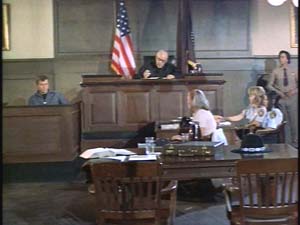
Fittingly enough, the tale begins with the titular trial, the one stemming from Billy’s murderous (if admittedly somewhat justified) rampage in the previous film. "That was four, four and a half years ago," Jean muses. And believe me, by the time this picture finally ends, it’ll feel like we’ve lived through every minute of it. "What they were really trying was each man’s right to find his own center," she continues. "To follow his own conscience and do his own thing, without hurting or interfering with anyone else." Hmm, that’s funny. I thought Billy was tried on account of those killings he committed. However, I guess that’s not really the sort of thing ‘They’ try people for. Cue a flashback to one of the funniest movie trials in film history. Despite the movie’s title, the actual trial of Billy Jack doesn’t take up much of our time. What’s there, though, is cherce. We start with Billy on the stand. The prosecutor, who seems to have an improbable amount of leeway in what issues he can raise before the court, is apparently responding to some earlier statement from Our Hero. Throughout this, the camera pans across the courtroom. Eventually it alights upon Billy, at which point it begins to move in on him just as he formulates his answer, a response which blows the mind of the all the squares here in the court. Incredulous Prosecutor:
""What you’re saying then is that it doesn’t make any difference to
you whether this jury finds you innocent or guilty. That it doesn’t
make any difference to you, whether you live or die. And you expect
us to believe that you have absolutely no fear of the death
penalty?"
[Wowsers!!] At the prosecutor’s behest, Billy continues to ramble on about Death and his place in everyone’s life for several more minutes. At this point I begin to wonder whether the judge was being paid by the hour. Because, I don’t know, this all seems kind of extraneous to the matter at hand. I’d expect the students at the Freedom School, stoned out of their gourds on ganja—like, admittedly, much of the audience during the film’s theatrical release—to find this stuff, like, you know, all awesome and stuff. Oh, wait. That’s right. Nobody at the Freedom School does drugs. It provided the sanctuary from dope and other mind-altering substances that the radical youth of the ‘60s and ‘70s so craved. Never mind. We cut away here to meet the piece’s villain. For whatever reason, they couldn’t get a lot of the cast members from the previous film to return. Thus Billy Jack’s good-guy sheriff has resigned, we’re told. Meanwhile, the Boss Hogg-like Posner has left town and sold all his holdings to his banker brother. (!!) Needless to say, the latter Posner will prove an even more nefarious character than his sibling. The prosecution tries to muddy the waters by denying that Jean was raped by the original Posner’s son, who Billy went on to kill. We cut to Jean on the stand. "So [another missing character from the previous movie] lies [about the rape] and you swear to it," the Prosecutor asks. Billy’s defense attorney rather lazily objects, and the Elderly White Judge replies with an epically bored "Sustained." Admittedly, he’s sat here longer than we have listening to Billy and Jean blather on about their goofy philosophical beliefs. In any case, the Prosecutor’s badgering provokes a burst of outraged yelling from the Freedom School students in the gallery, as well as (surprise!) a bout of oh-so-superior sanctimoniousness from Jean.
In the next scene, Billy’s back on the stand. I’m not sure how this alternating witness thing works, but anyway. His defense attorney leads him through his military service. It turns out, and I hope that you’re sitting down as you read this, that Billy served in Viet Nam, but was booted out after he tried to blow the whistle on a My Lai-type massacre.
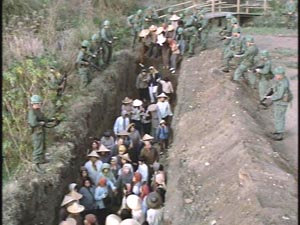
However, unlike in real life, this atrocity was not the unauthorized result of men driven mad by war. Instead, Billy’s platoon enters a village and herds all the villagers down into a large, deep trench. (Where this came from is left unexplained. The excavation is huge, but seems to have been found there when the soldiers arrived.) The villagers are naturally entirely innocent of aiding the enemy in any way and solely consist, as Billy notes, of "women, children and old men," who were "frightened and very eager to please." They are kept standing in the hole for hours "in the boiling sun"—humorously, the sequence was, in fact, shot on a conspicuously overcast day, but never mind—while the squad awaits orders. Said orders, "clear as hell, direct from Saigon," eventually come through. As you’ve no doubt intuited, the squad is explicitly, and illegally, I might add, commanded to murder the entire helpless village. Naturally, the squad leader immediately knows that he’ll have problem with Billy over this, and turns to him. "If you fellows refuse, all hell can break loose, you know that." Billy turns away, with a minutely different facial expression from his normal one, which presumably is meant to convey his disgust or despair at Man’s Cruelty or something of the like. The only other soldier who bats an eye at all this is, of course, black, and thus himself someone who has presumably experienced America’s ingrained Injustice and Oppression. Oddly, unlike in Viet Nam, but in accordance with Laughlin’s worldview, pretty much all the casually murderous soldiers are white. The squad’s commanding officer, however, does pause to ask, "God all mighty, what is happening to us?" I don’t know, maybe the problem is that guys like you—according to this scenario, at least—didn’t do your clear duty by disobeying such patently illegal orders. The massacre commences, as the assembled troops open fire down into the open trench. A loud music cue helps us to understand how this whole thing is, you know, bad and sinister and stuff. Just in case we might still fail to ‘get’ this, however, the film helpfully provides us with such vignettes as an officer offhandedly executing a crying infant with his sidearm, while another soldier shoots a fleeing little boy in the back. As with his pimping of the school shootings, Laughlin’s critique of My Lai loses the credibility it should have had, due to his using the tragedy as a scaffold on which to construct another of his paranoid conspiracy theories. As with the Abu Gharib prison scandal in Iraq, the massacre at My Lai was a shameful blot on an already controversial American war effort. While it was perhaps an inadequate framework upon which to mount a truly pertinent critique of our fighting in Viet Nam, it surely had great symbolic value and put pressure on those who supported the war. The fact that the ranking officer at My Lai, Lt. Mike Kelly, was never prosecuted remains a sorry stain on the nation’s generally proud military history. However, even with all this material at hand, the Laughlins can’t leave enough alone. Instead of a grotesque atrocity, one that could arguably (if, I believe, unsuccessfully) be used to question our conduct of the overall war, Laughlin advances the theory that such events were routine, and, in fact, actual policy fostered by not only our entire military chain of command, but, ultimately, the White House itself. Even Oliver Stone, perhaps because he actually served in Viet Nam, never suggested anything of the like when he too fictionalized My Lai in Platoon. Unlike Laughlin, he found the horror of the situation enough of an indictment of the war. And it’s not like Stone himself has been particularly chary of rewriting history. The Laughlins’ technique, as already demonstrated by their employment of the school shootings, has a certain, seductive surface appeal. Like all conspiracy nuts, they attempt to bamboozle the ignorant with a glut of precise but ultimately irrelevant data. Thus a supposedly objective but actually sympathetic interviewer—Jean’s friendly reporter, Billy’s defense attorney—asks Our Heroes questions that take as a given the truth of the assertions we are presented with. Upon being served up one of these fat softballs, which, of course, are in the script they themselves have written ("The American government intentionally murders innocent people all the time with genetically modified great white sharks, isn’t that true?"), they respond with a calmly recited blizzard of dates and references to specific—if not always concretely identified—reports and news stories. However, the trick is that despite the skein of concrete details they offer, the theories these facts supposedly support, in fact, constitute mighty leaps into fantasyland. Thus, Billy provides this anecdote of a fictional incident that he, a fictional character, actually witnessed. I guess if you’re whacked out on pot, this might be enough ‘evidence’ to convince you of the validity of what we’re being told. However, after relaying the fact that the orders came "directly from Saigon," i.e., Army headquarters, we get this: Defense Attorney: "So, it was the senseless slaughter of and sadistic brutality, coming as official orders from Washington, that turned you against America?" Huh? How the hell did we suddenly come to understand that the order to kill these innocent civilians came "from Washington"? Hell, why not just say, "So, given that we’ve established that Richard Nixon personally took time from his regularly scheduled sacrificing of a baby to Satan, to call overseas on his phone carved from the skull of a black man he lynched in Alabama, so as to order your superior to murder any eager to please women, children and old men you might have come across…" Another example of this con game occurs when Billy expresses his disgust of Nixon. This stems from the fact that the President, Billy feels, broke his well-reported "sacred promise" to fully investigate Mei Lei and see the perpetrators of any misdeeds brought to justice. However, the basis of this assertion isn’t predicated on the fact that the actual participants of the killings were or weren’t convicted of crimes. Instead, based solely on his patently fictional account of a similar atrocity, the idea is that Nixon broke his word because he didn’t attempt to prosecute pretty much the entire chain of command, up to and including, as Billy asserts, "colonels and generals and White House aides who ordered the whole affair but were mysteriously let off scott free." Oh. Them. By the way, can I again ask why all this is being explored, and at such length, at Billy’s trial for killing at least two men here in the states, years after he left the Army? Or was 1975 prior to the period in which ‘relevancy’ was considered an issue in criminal proceedings? In any case, Billy is *gasp* found guilty of involuntary manslaughter. We are naturally meant to deem this a gigantic miscarriage of justice, and so the Freedom School students in the gallery explode in righteous indignation. The problem being that Billy is, in fact, quite guilty. In the previous film, he clearly out and out murdered a man. His subsequent killing of a deputy might be called self-defense, given the circumstances, but later Billy shot another cop during a standoff with the police. Even if that fellow survived, such an act would represent, at the very least, assault with a deadly weapon. The fact that Billy is sentenced to five years in jail, I thought, was more a grotesque example of judicial leniency than of being unjustly railroaded by an Eee-vil Guv’ment. Lest others also come to this conclusion, we
then cut to the judge’s chambers. There we find the town elders, and learn
that *gasp* the fix was in. Moreover, Billy’s trial was really but
part of an attempt to close the Freedom School, presumably because Middle
America shies from freedom like a vampire from sunlight. However, some of
the assembled predict that Jean will manage to make the school prosper, even
without Billy’s help. "It’s going to take off like a wildfire," one of them
gloomily cautions.
So Billy goes to prison, like Earnest after him. Jean explains, via narration, that Billy is then adopted by the students as a role model. Since one of the few things the Freedom School actually concretely stands for is pacifism (well, until later on in the movie, anyway), I was wondering how exactly this would work. Since the film glosses over this seemingly key issue, however, such speculations were doomed to remain unsatisfied. Sure enough, the Freedom School indeed blossoms under Jean’s stewardship. "The entire school was built by and owned by the kids," Jean notes, although again the actual mechanics of this statement, which seem to me rather vague, are left unexplained. The motivating idea of the school, meanwhile, is predicated on "the simple philosophy that where there is Power there can never be Love, and where there is Love, there is no need for Power." (I think I’d put the emphasis on the word ‘simple’ in that sentence.) On the other hand, having a deadly martial artist around to kick the asses of any rednecks who bother you apparently remains pretty handy. Which, actually, raises another point. Why is the school only threatened by violence when Billy is around to deal with it? The school flourishes wildly while he’s in prison, and is only targeted by the forces of Amerikkka, coincidentally enough, after he’s been released. Well, that’s convenient.
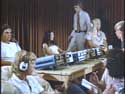
Anyhoo, this all leads into a waaay too long passage detailing the School’s growth during the years of Billy’s confinement. Remember again, as I document what we are shown here, that all the money for this institution is supplied to Jean and the students by the government and private citizens. First we see some of the kids hooked up to
scientific apparatus. Oops, wait, the devices are "Bio Feedback" monitors,
so I guess I should take back the ‘scientific’ part. These are employed, as
Jean notes, because the kids believe "you can’t really understand other
people until you understand yourself." (Wow. That’s deep.) And, of
course, one can’t really understand oneself unless you put sensors on your
forehead that cause the indicator arrow in a gauge to wiggle back and forth.
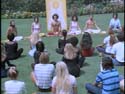
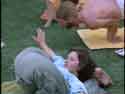
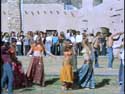
However, the School isn’t just on the cutting edge of Western Technology. They also hold outdoor classes in yoga. Sadly, though, the students are not naked during these, nor do they turn and say ‘Zoom’ to one another, so I don’t really get the point. Even so, the kids learn "meditation and body exercises, all kinds of dance, even belly dancing." Belly dancing?! No wonder the outside world feels threatened. And, as Sonny Bono once noted, the beat goes on. "Music, band, drill team, arts, crafts, advanced physics, mathematics, psychology, classics, even into athletics." Here we get several shots of the school’s soccer field and tennis courts. It was while gazing upon the latter, by the way, that I completely lost hope that Laughlin would elect to edit out even a single piece of footage he shot. Anyone wondering why the film’s three hours, well, there you go. It’s because they couldn’t bring themselves to lose anything this golden. Meanwhile, you might be saying, ‘Wait…athletics? Hmm, that sounds suspiciously bourgeois for the Freedom School.’ Have no fears on that score, however. "Even into athletics," Jean informs us, before clarifying, "which they called ‘yoga athletics.’ From Yoga Tennis to Yoga Football and every sport in between." Yoga athletics, to the layman’s eye, appears quite similar to regular athletics. The difference being, presumably, that they are a lot more groovy and, like, you know, Relevant and stuff. But wait! Why take my word for it? This is, after all, The Trial of Billy Jack, and thus we have plenty of time for Jean to expand upon this or any other subject in which we, the viewer, are certain to be so fascinated about. "The idea," she continues, "always being that the thrill of participating and the self-discipline one develops while training, preparing and learning, made one a winner for the rest of his life, no matter how well he played, or how the temporary contest came out. And so winning and losing or worrying about someone grading your effort was just not all that important anymore. Growing and having the fun of doing, that was the important thing." Wow! Actually, this explains a lot. The Laughlins, quite apparently, made The Trial of Billy Jack as an example of Yoga Filmmaking. Yes, now it all makes sense. I mean, does it really make any difference who ‘directed’ well, or who wrote a ‘good’ script, or if the people playing various the roles could ‘act’? Hell, no! Not was long as everyone was growing and having the fun of doing! But, wait, there’s more! For… Hey! Get back here, you bastard! If I have to sit through this dreck, you do, too. Anyway, the school used some of their grant money (cripes, how many millions of taxpayer dollars were being squandered here at Hippie U?) to build—aside from the soccer field, football stadium, tennis courts and Olympic-sized outdoor pool—a radio station and recording studio. Here we cut to a pretty blond teenager, who warbles a rather awful ‘70s-style pop ballad. Her verbal proficiency at this task suggests one who’s spent a lot of time listening to Maureen McGovern albums, yet failed to learn much from them. In any case, these records, we learned, are taken into town by the kids and sold door to door. The revenues from which, I guess, go to help the school, uhm, build more Yoga Tennis Courts or something. But wait! Why take my word for it? This is, after all, The Trial of Billy Jack, and thus we have plenty of time for Jean to…wait, I think we’ve gone over this already. Anyway. "With some of the royalties," Jean explains, "they started an institute for child abuse and children’s rights. In working with these abused and orphaned children, they were stunned to find out what was secretly going on in children’s orphanages and juvenile courts, state institutions for disturbed and retarded children, children’s hospitals, and education in general." Actually, I had a bit a trouble swallowing the idea that the students were amazed to learn all this. In the Billy Jack films, pretty much every parent we see (at least in society at large, i.e., White America—and we see a lot of them) subjects his or her children to horrific emotional and/or physical abuse. Fearing that Jean won’t continue on, given her natural reticence and all, the reporter prompts her with another rather leading question. "Is that when they started a native-type [??] newspaper and magazine and then began those scorching exposés on government corruption and consumer rip-offs?" (Scorching exposés? But those are the most dangerous kind!!) Jean confirms that this is so. "And it was in doing those exposés that our troubles really began!" For these, you see, so threatened the Powers That Be, the horrible, murderous, racist government that was providing all the funds for the Freedom School…er, anyway. Cut to a bunch of kids discussing what Injustice they should scorchingly expose next. "We’ve been digging," one young lady notes. (Digging?! No wonder the Government is petrified!) "Remember, in December of ’73 the Interior Department called in, what was it, 250 oil executives to work on fuel allocation, right? So we started digging behind that, and we found out that the Oil Barons and the White House manipulated the energy crisis, including the Israeli War! Just, just unbelievable profits! [Oh, my gosh! If there were profits involved, then you know something evil was going on!] It makes the Alaskan Pipeline look like kid stuff!" Actually, I think this scheme went even higher than the kids think. For instance, I believe that the Oil Barons were in fact just following the orders of the Petroleum Dukes, and so on, with the trail ultimately leading all the way up to the throne of the Fossil Fuel King. And, man, I didn’t even know the Six Day War was part of the energy crisis! I thought it was just a bunch of Arabs trying to utterly destroy a country full of Jews. But now that I think about it, I realize that the whole ‘staged energy crisis’ thing passes the Occum’s Razor test a lot more convincingly. The kids realize that this is political dynamite, which "will blow the lid off the Capitol!" Thus they must gird their righteous loins. "We’ll have the FBI, the CIA (huh?), the plumbers [Note to Confused Young Readers: That’s an Obligatory Watergate Reference], the plumbers’ plumbers, the sequel to the plumbers [all right, enough with the plumbers already]… It’ll be a tremendous blow." Yeah, well, somebody’s been doing some ‘tremendous blow’ around here, that’s for sure. Another budding Woodward agrees. "If we don’t tell them our sources," she warns, "they can arrest us, just like that." To punctuate this remark, she doesn’t snap her fingers, but instead makes that finger-across-the-throat gesture. Uh, OK. "That’s true," another concurs. "In ’72, the LA Times spent $200,000 in legal fees defending their reporters from subpoenas!" (Seriously, can you imagine spending an hour in a room with these people? Oh, and did I mention that we’re only twenty-three minutes into the film at this point, with two and a half hours yet to go?) "They’re either going to blow us up altogether," yet another Truth Seeker declares, "or they’re just going to close the school down." You know, maybe it’s just me, but it seems like there’s a lot of ground between ‘blowing up’ the school and ‘closing it down.’ Therefore, this seems as good a place as any to point out one of the various internal contradictions of the Billy Jack series, one which the Laughlins don’t give any indication of being aware of. To wit, the Outside World (or at least the section of it in Middle America) is incessantly portrayed in these pictures as being hopelessly corrupt, racist, close-minded and violently malign. Yet, we’ve also seen that it’s from various state grants and the charity of the local community that has allowed Jean and her students to renovate an "abandoned military academy" into this monstrously huge institution. Needless to say, this quite glaring dichotomy is never addressed. A similar issue involves the incessant fretting that Billy will be assassinated by the Powers That Be before he is released from prison. That’s just the way the country is, I guess. Yet in the movie previous to this, after an armed Billy has holed up after murdering the son of a local bigwig and then a deputy sheriff, a state government official arrives at the scene with instructions that Billy must not be harmed under any circumstances. In fact, they even allow themselves to be extorted by Jean for grant money for the Freedom School if she’ll talk him into surrendering. I don’t know, if the Power Structure wanted Billy dead, I’d say killing him while he’s engaging in a prolonged, violent shootout with the police—during which he shoots down at least one additional officer—might be a good time for it. Instead, they negotiate in utter good faith with Jean and sure enough, see that Billy receives medical care and a fair trial—fair, hell, they let him blab on about whatever the heck he feels like—after he surrenders. Moreover, in the My Lai scene, Billy’s squad leader warns him that if he refuses to follow their orders, he’ll be tried and hanged. I’m assuming this did not in fact occur, since we’ve no indication that Billy is supposed to be a zombie (other, perhaps, than Laughlin’s acting) or some other variety of revenant. Meanwhile, when Billy subsequently brought charges against pretty much his entire chain of command, the Army counter-threatened to try him for cowardice in the field. Billy, of course, steadfastly refused to yield. In spite of all these threats, however, Billy never gets any jail time we know of until after he’s killed at least two people, and even then his sentence is rather light. And, as noted above, for a government supposedly set on bringing around his demise, they don’t seem to be in much of a hurry about it. Billy not only fails to be assassinated, in fact, but he quite peacefully serves out his ludicrously lax five-year sentence, and even that has a year shaved off for good behavior. Perhaps I’m bit of a hard ass, but being incarcerated for two years for each person one has killed hardly strikes me as indicative of an implacably brutal dictatorial regime. Even so, neither Billy nor Jean ever pause to reevaluate their paranoia in light of any of these facts. Anyway—and believe me, I’m sorry to have to say this—but we need to get back to the Freedom School’s scorching exposés. "The fantastic response made the kids determined to bring their exposés to a wider public. So they decided to build their own TV station." We see an event being held at, I guess, the Freedom School’s gigantic football stadium. "They put on a Fourth of July-type* fundraising drive," Jean continues—and continues—and continues—and continues—"which they called, ‘1984 Is Closer Than You Think.’" (Actually, it was a lot closer to them at the time than to us, now.) You know, if I were Satan, and I really hated George Orwell, I’ve had made him watch this movie just so I could see the look on his face when this line is heard**. I’d have taped his reaction and I’d just sit around and watch it over and over again on a big TV monitor. [*Good thing it was only a Fourth of July type event. Otherwise, it might have been tainted with patriotism and national pride and all those other horrible things.] [**Per a query by Carl Fink, this is not meant to indicate that I assume Orwell to be in Hell. However, if he's in Heaven, I don't think he'd be subjected to The Trial of Billy Jack, and the gag wouldn't work. To the extent it does, anyway.] "It culminated in the largest band and drill team marathon ever held in this country," Jean explains. And explains. And explains. And explains. "Kids came from all over the US and Canada, at their own expense, and every night the donated coliseum (donated coliseum?!) was filled." By the way, was this before their scorching exposés got the school blown up/closed down, or after? Here we cut to the blond singer I mentioned before, whose singing skills have actually deteriorated since the last time we heard her. I’m sure it’s completely a coincidence, but it was right here that I remembered that the Laughlins would have had a daughter about the singer’s age just around the time this movie was made. Not that I’m suggesting anything, I’m just saying. It was about this time that Billy Jack was murdered. Er, released from prison. It’s sort of like the school being blown up or shut down, I guess, especially since neither of those things has happened. Anyway, Jean remembers the time well, since "Ford had just shocked the nation by pardoning Nixon and agreeing to let him destroy the tapes." Huh? I remember the first part, but, uh, aren’t the tapes—I’m assuming she means the ones from the Oval Office—in a national archive somewhere, being released as they’re transcribed? Also, it’s a bit of an exaggeration to say the entire nation was ‘shocked’ by the pardon. The fact is, many just wanted Nixon to go away, and considered his being forced to resign punishment enough. "We were all so angry," Jean continues, "at the way politicians at every level of government constantly used television to lie, con and manipulate people." Why, yes, I’m sure it was one of the six hundred things she and her students were most angry about that week. In any case, "The kids decided to use television to fight television before it was too late." Yes, it’s always nearly too late with these people. And so the Continuing Crisis continues. By the way, don’t you require an FCC license to run a TV station? It seems again like the government could be doing a lot more to interfere with the school than they have apparently chosen to. "They took their investigations, being done in the magazines, right into the streets," Jeans explains, "where the public could see for themselves the secret deals and the rip-offs right where they were happening." ("Tonight! Millions of your tax dollars are being spent to allow a bunch of self-righteous hippies to play ‘Yoga Sports.’ Learn the facts at eleven!")
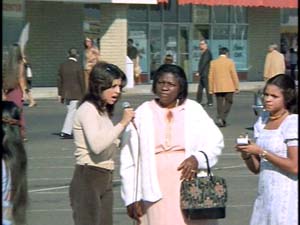
The report we see is on a woman who missed three payments on her furniture, whereupon the store repossessed it. To my surprise, the focus of the story wasn’t, "Local Store and Woman Freely Enter Into Contract, Woman Violates Terms of Same, Loses Furniture" but rather the opposite. The ‘rip-off’ occurring here, as I don’t see how it can be described as a ‘secret deal,’ even by these folks, is that the store didn’t just say, "Look, if you can pay us, that would be nice. Don’t worry about it, though." On the other hand, the woman in question is black and old, and was in the hospital at some point, so you can see how mean that was. As you’d expect from hippies, the student reporters don’t exactly have the entire ‘capitalism’ thing down. (Although I notice no one besides the store had been providing the lady with furniture.) "After you missed your payments," one budding Bernstein asks, "you found that they had destroyed your furniture [destroyed her furniture?] and repossessed it [what, after they destroyed it], and now they refuse to refund the money to you on which you had paid on it for two years before they had repossessed it?" First, glad the Freedom School’s ‘Yoga English Language’ classes are doing so well. Second, yes, when you go into default on a contract, they repossess the merchandise and keep the money you’ve already paid. Wow, way to blow the lid off this previously unknown aspect of contract law. Inside the store, the small sales staff is watching the report (it’s live?), thus probably tripling the amount of people seeing it. The manager moans that he didn’t want to repossess the furniture, but, you know, the not-paying-for-it thing. However, lest this makes him look too sympathetic, he also moans that he was "just following orders"—WHICH IS EXACTLY WHAT THE NAZIS SAID!!!!!—and also tosses off an ugly racial slur. After all, we wouldn’t want the lady’s Economic Oppressors to come off too well. Finally, though, the "home office" calls and demands he replace the woman’s furniture with new stuff, free of charge. "Those crazy, lousy kids," he complains. Yes, if it hadn’t been for them and their dog (a zany pop culture reference; look at me, I’m Quentin Tarantino… hey, that’s another zany pop culture reference!) you would have gotten away with it. ‘It’ being following through on the terms of the contract you and the woman legally entered into. Thanks for preventing that outrage, Mystery Gang! That’s how powerful the Freedom School TV reports have become, I guess. (And where is the "home office," and how can they possibly be seeing the report? I mean, college radio and TV signals generally travel about half a block, and that’s on a good day. This was well before cable, remember.) Meanwhile, I’m assuming the store started a new advertising campaign: "Buy your living room set at Phil’s Furniture, and if you miss three payments, we’ll replace your purchase with newer furniture for free!" In any case, it’s now obvious that the kid’s TV Station is on the verge of bringing Corporate Amerikkka to its knees. "It was shortly after that that they started bugging our phones," Jean elucidates, "and the FBI started making mysterious and routine calls to the school." Wow, mysterious and routine? Is nothing beyond their malign powers?! Anyway, what did they expect would happen once they started messing with the local furniture store? We then see one of these Gestapo-like FBI
raids. This involves a pair of agents appearing in the school cafeteria,
presenting their IDs and asking some of the students to talk to them. In
response, the students stand up and walk away from them. Man, who wouldn’t
crack under that sort of pressure? The reporter asks Jean if she had any proof that their phones were being bugged. ("Contact the President! Those crazy, lousy kids are exposing the doughnut store tomorrow!") "Yeah," Jean replies. "One of the kids, I think he was a graduate of CalTech, not only developed a device that would tell us when our phones were being tapped, but he and another couple of electronic geniuses developed a lie detector that was even more accurate than the polygraph machine." Using this device, they can tell if someone is lying from listening to them on television. (!!!!) Actually, I suspect Jean might be exaggerating this story in the telling. (For instance, I love that "I think" after asserting he was from CalTech. "There was a guy, I think he was a doctor or something who had worked on secret bioweapons experiments for the military, and he said…") In reality, I believe the described lie detector was more in the nature of a bong. See, after you got stoned from it, you would gain the magical ability to listen to politicians on TV and tell that they were prevaricating. "Dude! That’s guy’s, like, totally lying! Hey, where are the Doritos?"
Anyway, they are able to test this device on a TV interview just then being conducted with the Governor. "And so it is your contention then, Governor," the reporter asks, "that the threat of exposure by the Freedom School television station [I kid you not, this is really what the interview is about] will in no way find any wrongdoing or kickback of this federal money ever touching the state capital.*" (Man, those Yoga English classes are really catching on!) "As God is my witness," the Governor begins, and we tune out, because it’s well known that only hypocrites and liars mention God. Hey, where are those Doritos? [*It should be noted that the reporter in this case is actually supposed to be a professional broadcast journalist, yet he still says things like, "…that the threat of exposure by the Freedom school television station will in no way find any wrongdoing…" Huh?] Somehow this proves the lie detector works, and the kids debate how to use their awesome new power. "Think of what this machine would do to Advertising Industry," one young lady gushes. "It would just blow it apart." This is true. Imagine the exposés: "Hey! Her hands are not in fact soaking in it right now! Quick, call the others! We’re marching on the corporate offices of Ogilvy & Mather!!" Seconds later, of course, another student suggests that they "get the tapes of the Watergate hearings and run them through this thing, and we find out the Truth." Needless to say, all of the other kids are blown away by this totally far out idea. Of course, with the Freedom School now threatening the entire stranglehold of power of, er, The Man, or whatever, the government twists the screws some more. No, they don’t cancel the school’s grants, because, uhm, anyway. Instead, now FBI agents start harassing family members of kids attending the school. Hmm. Maybe the kids should do television stories on that, rather than exposing stores that repossess your furniture if you stop paying for it. During this period, of course, Billy was still in jail. No one ever visited him, as he couldn’t stand to have them see him "caged up like an animal." Meanwhile, Jean held her breath for the entire four years, "hoping he hadn’t given them an excuse to extend his sentence or even kill him." The reporter muses over this. "So you really didn’t think they’d let Billy out alive?" she queries. "No," Jean replies. "Not even if they had to shoot him when he was going through the gates on parole." As noted earlier, they not only don’t kill Billy, they shave 20% off of his ludicrously lax minimum jail term for good behavior. Those fascists!! Unfortunately, Jean couldn’t be there to pick him up when he was released. You see, this happened on the very day that the Freedom School was hosting "our first international seminar on child abuse." I’m sure Billy understood, though, because The Cause in all its myriad facets comes first. "The kids had [three guesses] done an exposé on child abuse, child battery, and how widespread it is here in this country," Jeans explains (and explains, and explains…). "Pretty soon," she continues, "we were recognized as one of the few places that could successfully help parents who battered their children." Cut to Jean, in a weird, Annie Hall-esque man’s suit, showing a couple of child abuse experts around their facilities. During this tour we meet Danny, a young lad of maybe ten, who is in many ways the film’s poster child. Danny is missing a hand, and they nicely present the (real life) stump of his arm in a nice, juicy close-up.
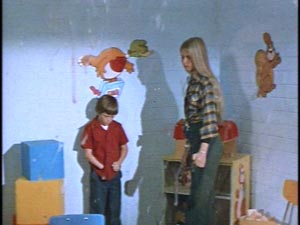
His own father cut off Danny’s hand "in a fit of rage." Due to this and other abuses, the lad generally doesn’t interact well with others. This is dramatized when Carol (the ‘singer’ from earlier in the movie) offers him a cup of soda, which he violently knocks away. This either indicates the deep emotional scars resulting from his abusive childhood, or else suggests that he’s a 7Up man. Carol, we learn, is the only one that hasn’t given up on Danny, even after their "professional staff" has. "You don’t really think she’ll succeed?" one of their visitors snorts. "You obviously don’t know Carol," Jean responds. And hell, if nothing else works, they can call in Elvis for that hugging therapy. Cut to Billy getting out of jail. "Come on, Tough Monkey," a guard sneers as he opens Billy’s cell. ("Tough Monkey?") Of course, the guard gratuitously strikes Billy with his baton. He knows Our Hero won’t fight back, lest he have his sentence extended. "Now, Indian Buck," the guard continues, so that we get that he’s racist as well as brutal, "move out." Cut back to the Child Abuse Seminar, where Jean is conducting an extended—and I mean, extended—Q&A session. Cripes, this movie is so discursive it makes Moby Dick look like it was written by Hemingway. By the way, at this point in the movie we’re a little over half an hour in, with nearly two and a half more hours to go. Like nearly every other scene in this picture, I could spend a couple of pages on it and still not really give it a full accounting. However, we’ll never get through this review that way. So I’ll skip over most of the stuff. Because being against child abuse just isn’t indicative of that old Laughlin looniness, they start discussing more abstract forms of it. This includes, inevitably, parents who shout during Little League games. Yes, that… cutting off hands… it’s all bad. However, the general concept behind the School’s technique for reforming abusive parents is summed up in this question: "Your complete claim, then, is that by loving these battering parents, instead of punishing or confining them, that that actually works in stopping further beating of their children?" Barbarians who actually, you know, jail parents who beat their kids have a reform rate of—according to Statmaster Jean, anyway—under 25%. "Ours, on the other hand, is over 90%." Uh, yeah. And that number, I should note, is complete sciencematifical. The blather continues. One fellow, for instance, strenuously declares that "the whole fate of the human race," depends upon, er, the work that people like they themselves do, I guess. Thus he asks if Jean believes her insights have any greater applicability outside of the narrow issue of child abuse. Amazingly, Jean does believe this, noting that the Freedom School is built upon the same principles. This leads, naturally, to a discussion regarding the nature and defination of pacifism. (Somebody, shoot me. Even the film’s discursions have discursions.) In sum: Jean: "The
thing that we’ve got here is a living, dynamic, positive force that
has the ability to change the most warped lives, turn on the most
confused and lost people, and I think we all literally feel here
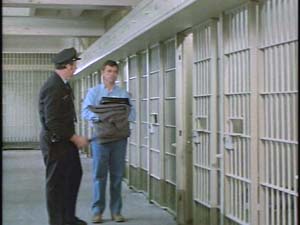
that it could possibly rebuild the world!" We cut to the prison, where Billy is receiving his personal possessions prior to being freed. The Warden (no, not the one at Prisonflicks) shows up with a typically Oily Flunky and tries to hustle Billy into attending a joint press conference. Of course, Billy reacts to this blustery entreaty with icy disdain and walks out. Cue a burst of inspirational music. Here one nearby trustee turns to another and opines that Billy will soon be back behind bars. "No way," his comrade confides. "They’ve already got him marked." The first trustee is shocked. "You mean they’ll kill him?" he asks. Man, prison inmates just aren’t are hardboiled as they used to be. On the other hand, the info network seems to be working fine, given how some of the cons know that ‘They’ have Billy marked for the big sleep.
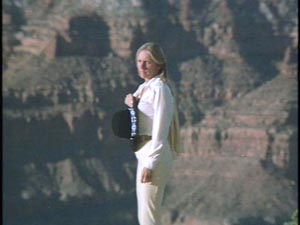
Cut to Jean, standing with her back to the camera. She’s atop a butte, with gorgeous vistas laid out before her. She soon sees a car approaching. Eventually it arrives and Billy climbs out. She turns, and we see that she’s brought Billy’s trademark wide brim hat. (!) She and Billy had only declared their love for one another at the end of the previous film, just before he was taken into custody, and so this is their first real time together. There follows a poorly chosen directorial flourish in which each is treated to a camera zoom from a distance, which makes the scene play like something out of a soap opera parody. The goofy music doesn’t help either. Even so, the climax of the scene has them simply holding each other for a long period, perhaps hours. The restraint of this, rather than the more formulaic passionate lip lock, is quite refreshing. Cut to the next morning. The consummation of their relationship is only implied, and it struck me that the Laughlins were surprisingly prudish on sexual matters, especially given the times. Jean looks over at Billy. He’s back in his trademark hat and denims. Standing before a waterfall, he blows smoke from a pipe in various directions, in such a manner as to imply that he’s conducting a ceremony of some sort. There follows a bit to which the uninitiated can only responds with startled guffaws and vigorous eye-rolling. Jeans hears a sharp call and looks up in the sky, where an eagle has suddenly appeared above them. This majestic creature circles around a while. ‘Mystical’ music is heard, and eventually the noble bird comes to land upon Billy’s outstretched arm. (!!) I mean, really, what can you say to something like that? The symbolic connotations are so overripe that it’s nearly impossible to take the image seriously, although there’s little doubt that Laughlin intended us to. This sequence, therefore, is pretty representative of Laughlin as a filmmaker. Everything is just entirely excessive. First, there’s the pretentious use of expensive helicopter shots to portray what is admittedly some beautiful scenery. (To be fair, I believe that Laughlin funded this film out of his own pocket, so I guess he was entitled to helicopter shots if he wanted them.) The music, meanwhile, is just a little too lush. Finally, there’s the self-parodying image of an eagle majestically alighting upon the noble Billy’s arm. Laughlin is one of those people for whom too much is never enough. As I noted earlier, Laughlin also exhibited an increasing messianic streak as the series progressed. The gag with the eagle certainly points in that direction. This impression is duly reinforced, meanwhile, when Billy arrives at the Freedom School and finds himself lovingly engulfed by hordes of cheering people, seemingly hundreds and hundreds of them. Frankly, what this most called to mind were the larger scaled but strikingly similar crowd scenes in Richard Attenborough’s hagiographical Gandhi. Inside the school, and with waaay too
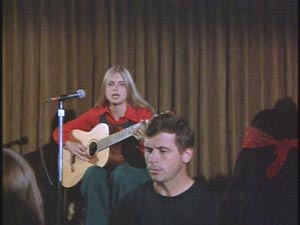
much running time left to go, we are, er, treated to a song Carol has
written about Billy. This adds to the sense that the Laughlin brood were a
tad too self absorbed, as Carol is indeed played by the daughter of the man
playing the character she’s singing a typically earnest anthem to. Moreover,
the younger Ms. Laughlin talents as a lyricist prove a rough equivalent to
those pre-teen female artists whose works oft feature unicorns leaping
across rainbows in outer space: "Shed a tear, Running Deer. "When they took you from the church, "Shed a tear, Running Dear…"
Soon the entire pack of kids are singing the chorus as Billy manfully struggles to contain his tears. Carol as well becomes increasingly verklempt as the song progresses, perhaps because she was now wishing she’d worked on it a little longer. In any way, there soon isn’t a dry eye in the place, and everyone can feel the love in the room, and we in the audience begin wondering when those promised government killers are going to show up. Billy is next led outside. There he is astonished to find pacifist Jean taking martial arts lessons from Master Han of Korea, this worthy being Laughlin’s real-life Hapkido instructor. (Watch for when Jean supposedly performs a leaping kick, and they apparently use an edit to disguise the fact that she doesn’t pull it off.) The end result of this, especially when Jean rather implausibly dumps Billy on his ass after he chortles at her, is apparently meant to represent ‘comedy.’ However, much like the Germans, the Laughlins prove the sort of markedly intense folks who don’t really get the whole ‘humor’ thing. Meanwhile, in a weird editing choice even for this movie, Jean’s Wacky, In-Your-Face-Aide (think a hippy-lesbian Sandra Bernhardt…er, a younger one) blows a line, then tries it again with more success, and both takes are kept in the film. Soon Billy is—surprise—talked into displaying his skills. He and Han do a couple of kicks, after which the latter produces an ordinary black cane. "I haven’t seen one of those in a long time," Billy avers. Huh? I mean, we’re not exactly talking the Flying Guillotine here. Anyway, Han uses the cane to help flip over his assistant. This accomplished, he hands the cane to Billy, who duplicates the feat. "You and I, in America, are the only ones I know who can do that," Han preens afterward. Actually, their demonstration isn’t all that impressive, although I’ll give Laughlin the benefit of the doubt and assume he didn’t want to pimp up his moves. Anyway, even pulled punches and kicks represent a vast improvement over more warbling folk singing.
-Review by Ken Begg |
|||||||||||||||||||||||||||||||||||||
|
|