Another feature of... |
|
Another feature of... |
|
|
|
The Trial of Billy Jack -
Jabootu's Bad Movie Dimension The Trial of Billy Jack Page 2
In any case, we haven’t really wandered completely off track in the roughly ten minutes since the child abuse conference. Therefore Carol comes out to report that Running Deer—wait, the Running Deer?! Fabled-in-song Running Deer??—and his sons are apparently lost up on a mountain top, where they illegally went to hunt deer. Moreover, the State Police and the Ranger station have refused to help find them. "They don’t give a damn when Indians are involved," one fellow acidly notes. Whatever. This leads to a long sequence, which again must have eaten a pretty good hole in Laughlin’s wallet. This features helicopter search teams—although given that the State and Federal agencies have declined to help, I’m not exactly sure where these came from—joining skiers from the Freedom School and heading up into the raging blizzard to help find the missing party. The two sons are quickly located, although one of them is dead. Meanwhile, none other than Jean and Billy come across the comatose Running Deer, and radio in for a chopper.
Running Deer is taken to the local hospital. There the attending physician refuses to treat the man’s severe frostbite because, you know, he’s an Indian and this is the White Man’s Hospital. (C’mon, now. In 1975?) Billy, of course, is about to force the guy to treat Running Deer when Doc Sampson, the token Good White Guy from Billy Jack—but not the green-haired, superpowered psychologist from The Incredible Hulk—makes an appearance. He’s enough of an authority figure that he manages to get Running Deer treated, although he gets a lot of dirty looks in the process. "I’ll take the responsibility," he fearlessly declares, despite the no doubt dire consequences that await him, like probably being drawn and quartered. We next cut to Running Deer in court. Amazingly, the sitting judge and prosecutor prove to be the ones from Billy’s trial. Moreover, despite it being four years later, they both look exactly the same, and even sport the exact same haircuts as they did earlier. Anyhoo, Running Deer’s attorney is a firebrand Indian woman who argues that as a Native American, her client is not subject to the White Man’s laws. Uh, yeah. Sure. I guess it’s like diplomatic immunity. Like, if he killed a bunch of guys, they’d have to let him go and stuff. However, the justice of this nuanced legal argument is ignored. Running Deer convicted of trespassing and illegally hunting deer, probably because, I don’t know, he was in fact guilty of those charges. Oh, and because of the Racist System. However, in light of the death of Running Deer’s son, the prosecutor pleads for the court to reduce the supposedly mandatory one-year prison sentence for poaching. "Hey," one Socially Concerned young spectator ejaculates at this apparently inadequate display of mercy, "don’t rip your pants, Buster!" This wry witticism garners a big laugh from her comrades in the gallery. I don’t know, should they all be stoned while actually sitting in court? The Judge indeed cuts the sentence down to ten days in jail, with the rest of the year on probation. (I guess ‘mandatory’ doesn’t mean what I think it does.) Needless to say, the kids from the Freedom School, who amazingly are still allowed to sit in the gallery during court proceedings following presumed years of such shenanigans, erupt in anger at the horrible injustice of this. Now, purely because I’m a monstrous, unfeeling right-wing crank, I’d like to point out that Running Deer shouldn’t necessarily be cut any slack because his son perished on the mountain. In fact, he easily could have been brought up on a charge of felony homicide, since his kid died during the commission of a crime. So I’d say ten days in jail is pretty frickin’ lenient. But then, I guess I’m some kind of super-fascist or something, since I think that even Indians should go to jail if they break the law. Perhaps they managed to deduce that the audience’s Outrage-o-Meter™ wasn’t likely going to register off the charts due to a ten-day jail sentence. Therefore, when we cut outside, we see some troglodyte cops harassing the kids. Supposedly they’ve gotten a report that the students are carrying drugs. Of course, we know this isn’t true, because one of the three rules of the Freedom School is that no one use is allowed to use controlled substances. (Yeah, yeah, I know. Just go with it.) Anyway, they’ve got the kids up against their school bus and are conducting intrusive searches. In fact, one of Jean’s assistants, a woman with a pixie haircut who I eventually learned two hours in* is named Russell, has her breasts crudely groped by one of the leering pigs. Again, I find it weird that the only sexual acts portrayed in the Billy Jack series are violently misogynistic ones. There are multiple rapes in Born Losers, rape both actual and statutory in Billy Jack, and now this. Meanwhile, the kids at the Freedom School—and despite my calling them ‘kids’, the majority of them are seemingly of college age—are apparently as sexless as they are drug free. I don’t know, isn’t this kind of weird, especially for a film that otherwise is so strenuously of the ethos of the ‘70s? [*Despite being three hours long, The Trial of Billy Jack is one of those inexplicable movies where many of the recurring characters are seldom if ever referred to by name. In fact, many of these characters might not have had names even in the script. The film’s extended closing credits list, again, only the character names of Billy Jack, Jean Roberts and Doc, with all of the other actors just listed sans role. Meanwhile, the credits listed on the IMDB assign many of the characters the name of the actor playing them. Thus actress Lynn Baker plays ‘Lynn’ and Michelle Wilson plays ‘Michelle’ and so on. The androgynously named ‘Russell,’ meanwhile, is played by actress Russell Lane, who appeared in two Billy Jack movies.] One kid shouts that they can’t conduct these searches without a warrant, which under the circumstances might or might not be true. In any case, the menacing cops threaten to arrest him. For what, I’m not exactly sure. Of course, when did the Gestapo need a ‘reason’ to arrest someone? A bit later, the kid decides to chuck an orange at the cops, thus making himself eligible for a Darwin Award nomination. At this the cops give chase, and administer a savage beating when they corner him in an alley. The chase, by the way, is accompanied by the sort of action music that wouldn’t pass muster in an episode of The Rookies. A crowd of bystanders follows, like a hundred or more of the Freedom School kids, but they disperse when ordered to by the cops. That’s some good civil disobedience there, by golly. However, as they leave, a stoic figure appears in their wake. It’s (bum bum bum) Our Hero, Billy Jack. "We’ve got a tough monkey here," one cop notes. (‘tough monkey’?) They try to chase Billy off, too, but he remains. "Somebody else need a lesson here?" one cops drawls. "Yeah," answers another, "our tough monkey here." OK, I’m sorry, but wasn’t ‘jive-ass turkey’ the stupid ‘70s epithet of choice? Anyway, Billy starts removing his boots. The first time he did this, in Billy Jack, it was kind of cool. Now the notion that he must doff his footware before strutting his stuff becomes increasingly comical each time it happens. Apparently his foes could neutralize Billy by sneakily squirting some Super Glue in his boots, thus keeping him from taking them off. The cops now realize who this Awesome Figure must be: Shoeless Joe Jackson. Er, Billy Jack. At this they immediately start panicking, despite there being four of them and they having weapons and stuff. One nervously declares that he’ll have to shoot Billy. However, when Our Hero starts running in their direction—in slow-motion yet, very much like the Lou Ferrigno Incredible Hulk, which doesn’t exactly help the scene’s dramatic impact—they all just scamper off. See, bullies are all cowards, and when you stand up to them, they fold like a non-Chinese Laundry. (Whew! Just narrowly ducked a racist comment there!) That’s exactly how it always works in real life, too, of course. By the way, the cops were just about to leave anyway, so Billy didn’t really accomplish much here. On the other hand, The Man missed another pretty good opportunity to shoot Billy Jack under circumstances that would probably be legally justified, especially given how corrupt the System supposedly is. (Not that we’ve seen much actual evidence of this.) Nor do they show up later with a warrant and arrest Billy for assaulting police officers or even obstruction. Man, these are some inefficient Tools of the Oppressive State. As a break from this heart-pounding episode of quite near almost veritable action, we cut to…a bunch of people griping about The Man. Yes! Boy, you just can’t get enough of this stuff. This is, according to the DVD chapter titles, a ‘tribal council meeting,’ with the firebrand female lawyer and a couple of her fellow Indian activist comrades basically running the show. The activists are spouting off about how the Gov’ment has the right to completely do what they want with all Indian lands. This sounds a little suspect, and of course the source of these assertions isn’t exactly lending them much support. Meanwhile, I wondered again why none of these people ever took these grievances to higher courts. Lawyer Chick starts laying it out: "They control our water, they control our plumbing, they control our worship [??], they control our land, and they control our money, they control every damn thing in our lives!" Here I expected a high-minded and altruistic call for the right to establish a casino, but strangely the subject never comes up. Their government agent, who for some reason is in attendance, suggests that they lease their lands to industrial concerns if they wish to generate their own money. This, naturally, is viewed as some sort of evil plot or something. Frankly, I’m not sure what the activists actually want, as the dialogue here tends to veer around an awful lot. In a particularly charming moment, one Indian says of another, "That’s not Yellow Hawk, that’s Little Uncle Tommie Hawk…He’s a bought and paid apple and you know it!" (Bought and paid apple? Tough monkey? What the hell?) After a bit of this, Lawyer Chick kicks in again: "They control our health! They control…" Wisely, the sound fades away here as we cut over to Jean having a word with Billy. Next the activists start babbling about bringing cases before, what else, the International Court. I’m not sure what jurisdiction this institution has over American citizens, given that it’s not elected by us and, you know, what with the whole U.S. Constitution and that kind of thing. However, this sort of talk rouses a quick response from the Indian Agent. "A person could get killed with foolish talk like that," he warns. Actually, I suspect the actor flubbed his line here. I’m pretty sure he was supposed to say, "That sort of talk could get a person laughed at mercilessly." I mean, that at least makes sense. I guess I’m wrong, though. "Many of us already have been," Lawyer Chick retorts. "Because if they can’t buy us off with scholarships and grants, they kill us." I’m sorry, what exactly was it again that you guys are agitating for? I mean, seriously, it would really help us in the audience follow what’s going on. You don’t want help from the Government, I guess, and you expect the ‘International Court’ to…do what now? Man, I’m confused. I’m not helped much by the following bit, either. Suddenly we cut to Billy Jack and a pair of the more authentic Indians leaving the meeting. "They voted ‘it’ down," one reports with disgust. Er, voted what down? (See what I mean?) Well, whatever it was, if Billy was for it, it must have been what the rest of the tribe should have supported. "That damn Yellow Hawk," one Authentic Indian sneers, "will probably get a personal invitation to the White House for that." Uh…yea-aah. I’m sure a leering Gerald Ford—certainly the most malign of Amerikkka’s presidents—is rubbing his hands together right now as he is told of the tribe’s feckless decision. Whatever it was and whatever it was about. Jean wonders how ‘They’ could have converted a Noble American Indian into their lackey. Hmm. He actually believes that the position he advocates would be better for the tribe? Or, to be slightly more cynical, he’s merely in it for personal gain, even if he is an Indian, and thus theoretically better than all that? "They caught him embezzling funds," Authentic Indian reveals. (Again with the ‘They’). "The White House promised to hush it up if he cooperated." Cripes, this is tin foil hat stuff. Seriously, the White House? By the way, I notice that they didn’t, in fact, ‘hush it up’ very well, since you’re talking about it now, you morons. The capper, though, is when he concludes these assertions with a casual, "You know, the same old story." (!!!!!) Yeah, if I had a buck for every time the White House has caught me embezzling funds and offered to hush it up, sorta, if I talked people into voting against… er… something that was somehow good for them, well, I’d be so rich I wouldn’t need to embezzle funds anymore. Although I probably would because I’m so damn greedy. Billy asks why Lawyer Chick and the Amazing Indian Activist Squad don’t "take it to the World Court just by yourselves?" Yeah. Or perhaps instead The People’s Court, since that’s a somewhat more dignified forum. "I mean," Billy continues, "you don’t have to bother with all these committee and tribal decision things." Ah, I see. If the sheep-like Masses are too stupid to follow your wise advice, you should attempt to ram it down their throats via supranational, extra-legal institutions. And if that doesn’t wise them up, there’s always the Gulag. I mean, you know, broken eggs and omelets and all that. Meanwhile, Posner—the film’s villain and the brother of the previous film’s villain, if you remember when he was briefly alluded to about fifty minutes ago—and a bunch of fellow fat cats are taking a hunting party, including a hefty supply of booze and whores (see previous notes re: sexuality), up into *gasp* the very mountains that Running Deer was sentenced to quite nearly two weeks in jail for trespassing on. Carl, the local sheriff, ineffectively attempts to send them home, which is purely so that we get that he’s powerless in the face of Posner’s The Man-ness. "On this bus," Posner sneers in reply, "we’ve got corporation presidents, Pentagon officials, Washington politicians and even the Lieutenant Governor!" Plus, I imagine, a brace of TV game show hosts and Mr. Clean. See, if Billy wants to see anything done, he’ll have to do it himself. Per usual. Cut to another raucous tribal council. Man, if you had to pick one word for this movie, it would have to be ‘dynamic.’ This time they’re complaining about the hunting party, which admittedly they have a fair beef with. I actually thought the best idea for dealing with the situation was one guy’s suggestion to take pictures of the guys cavorting with their whores and send them to the newspapers*, or, as another puts in, their wives. [*Oddly, no one suggests filming their antics and broadcasting the footage as part of one of those all-powerful Freedom School TV exposés. It’s like this film has ADD and can’t remember what it was burbling about fifteen minutes ago.] Instead, Billy Jack decides to organize a posse—composed, of course, "of anyone in this room who’s man enough to go with me"—and ‘arrest’ the party for trespassing on tribal land, prior to booting them off. This approach is of dubious legality, and involves sending an armed group to confront a bunch of similarly armed drunks. Frankly, I think the photography idea was a lot slicker, especially as it would turn the fat cats into subjects of public mockery. Run them off at gunpoint, and illegally, at that, and they are instead a group of prominent social leaders assaulted by a group of violent injuns. Lest common sense prevail, however, Billy seals the deal by scornfully asking, "Or are you afraid to stand up to the White Man, even when he’s [drunkenly] shooting at your wives and your children?" Thanks for your levelheaded leadership, Billy Jack. Cut to the hunters. The scene is set with an image of two naked hookers holding a board up over their heads. On the board are some empty liquor bottles, which members of the Fat Cat party are shooting to pieces. (!) Meanwhile, Posner is warning some other dudes about some "International Symposium on the Law," which is *gasp* threatening to give Indians legal rights, or some damn thing. Of course, the Fat Cats only oppose this sort of thing because it threatens their eee-vil power. I mean, what true blue American doesn’t wish to see an unelected and Constitutionally unconstrained international group—hey, ‘international’ has to be better than ‘national,’ right?—come in and start fixing this country up? Help, China! Help, Soviet Union! Help, Cuba, and the Sudan, and so many other more progressive places! They continue to talk in such a way as to lay out exactly how corrupt they are—it’s rather like listening to a meeting of the Legion of Doom—but soon find themselves surrounded by dozens and dozens of Billy’s righteous crusaders. We’re all supposed to cheer, of course, but frankly I found the scene kind of creepy. You get the idea that were the Indians to just start shooting down their tormentors, that many of the original audience members would have cheered that, too. Instead, and perhaps more horrifyingly, Billy Jack proceeds to deliver unto them some righteous speechifying. During this he alludes to a stack of comically fake dead ‘deer’ the hunters have gleaned. This conversation ranges from Running Deer’s jail sentence—which, again, was for ten days, rather than a supposedly legally mandated year—to the artificially low wages The Man pays Indians, to the corrupt (albeit, what’s that word…oh, yeah, legal) way an Eee-vil Corporation got a lease on the land the party is now hunting on. Billy also, and at some length, begins to calmly dismember all of their corrupt counter-arguments. This is like watching the most dearly loved fantasy of some disaffected fifteen year-old projected up on a screen. (Which, I guess, at least partly explains the film’s box office success.) You get to compel authority figures—parents, the cops, whatever—to debate their grossly arbitrary rules. They vainly and nervously attempt to defend their capricious strictures, but you coolly have an answer for every dodgy argument they make, until they themselves are forced to admit the righteousness of your cause, and let you stay out later than 8:00 on school nights and not have to get some stupid job during summer vacation, when Cosmic Justice itself dictates that you should be hanging out with your friends on your parents’ dime. My favorite such moment occurs when Billy asks an Eee-vil Corporation Head, "How much money did you donate to the Secret Campaign Fund?" (Love that ‘secret.’ Next Billy will be asking him how much advertising he does with the ‘Jewish Media.’) "One hundred and twenty-five thousand dollars," ECH answers in defeat. This rather violates the whole ‘secret’ thing, but there you go. "You know, I think I’ll just kill you right where you stand," Billy sneers, as he works the action on his rifle. Yes! Nothing spells J-U-S-T-I-C-E like shooting down unarmed sixty year-old men. You go, Billy Jack! The Lt. Governor points out that anything Billy’s men do here will come back to haunt them later. Man, I hate when the real world intrudes on things like that. Luckily, that won’t happen very often, at least in this movie. However, the Noble Natives instead elect to let the Fat Cats and their whores go on their way, although they take a photograph of each of them before they leave, I guess so they can prove who was there, or something. Meanwhile, Posner grabs Billy Jack and issues the usual threats and such. Cut to the Freedom School, where Sheriff Carl and Doc Sampson join Jean for lunch in the cafeteria. It seems that the pictures referenced above were indeed broadcast by the student’s TV station. Carl warns that this has brought a lot of additional heat down. Jean, however, notes that the students are granted complete and quite groovy autonomy on what they do with the TV station, so that there’s not much she can do about it, even if she wanted to. In one of the movie’s better moments, Carl and Doc argue that by refusing to make her own beliefs known, she is tacitly suggesting that the students are incapable of listening to her views without being unduly swayed. This is part of what’s so frustrating about these movies. While I myself would never agree with the Laughlin’s baseline politics, the films would be a lot more persuasive weere they to present opposing viewpoints without literally demonizing those who disagree with them. The film’s like a stream of consciousness monologue delivered by someone suffering from a high fever, who has occasional moments of lucidity but then quickly lapses back into gibberish. Here we’re about an hour and ten minutes into things, with a tad more than an hour and forty minutes left to go. Considering the already prodigious amounts of padding we’ve seen so far, the viewer might fairly wonder how it’s possible that we’ve not yet even reached the film’s halfway point, especially given that Billy’s actions have already made a confrontation with the villains seemingly inevitable. The answer is the movie is about to sideline us for nearly an hour with, among other things, Billy’s Vision Quest. That’s right, you can’t make a movie, at least since the late ‘60s, about American Indians and not have a Vision Quest scene in it. Laughlin’s fascination with Indian culture is intriguing, especially in the way that it will be echoed by fellow action maven Steven Segal two decades hence. Neither star was, in fact, of Indian descent, but both repeatedly played characters who have steeped themselves in American Indian culture. Amazingly, Segal probably comes out ahead on this score, since he never tried to play anyone who was actually part Indian himself. (Given his attempt, such as it was, to play a Russian in Half Past Dead, this was without doubt a wise call.) It’s actually kind of funny that Laughlin was so easily accepted as Billy, because frankly, he doesn’t remotely look to be of American Indian ancestry. He basically carries it off by acting all stoic, and with a lot of assistance, of course, from his famous hat. Segal attempted something similar with the beaded Indian jackets he sported for a series of films, although rather less successfully. In any case, Billy pursues his quest by asking for instruction from a Wise Old Indian™ named—inevitably—Grandfather. Grandfather speaks in an authentic Indian language, but his remarks are overlaid with a spoken English translation, and accompanied by the obligatory American Indian sounding-music. Billy opens things with a request that suggests he was adlibbing this part of the movie: "Grandfather, I would be honored if you would teach me how to pierce the veil and go to that other world and make my own inward journey to find my own center." Grandfather, meanwhile, is entirely with the Billy Jack program. "There are many enemies in this world waiting to destroy you," he reveals. "If you are to survive, you will have to find peace in yourself first." Billy agrees that this is so, and that this is why he wishes to make the inward journey. Grandfather warns that his chosen path is dangerous. (And pretentious, and boring, and interminable… mostly interminable.) It is "filled with terrifying evil. There are many demons of great power. It takes much wisdom to learn that they are of your own making." (Wow!) I don’t want to be mean, but this ‘ancient wisdom’ isn’t much different than something Dr. Phil might dish out. If I’m following this, Grandfather is basically telling Billy he has to stop being a can-don’t’er and start becoming a can-do’er. Indeed, when the exchange is viewed with a critical—or at least non-chemically altered—mind, there’s not much there:
Grandfather: "And first, you must learn to see your own shadow." Nice dodge, Grandfather. Also, if I’m following this, Billy must first learn to see his own shadow, which will allow him to survive the upcoming perilous inward journey, after which he will…see his own shadow. My head hurts. But that’s OK, but it’s all mystical and stuff, and therefore doesn’t have to be constrained by my limited White Man’s logic.
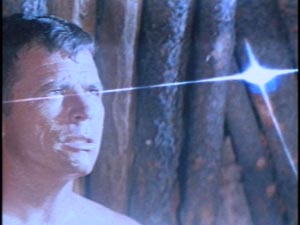
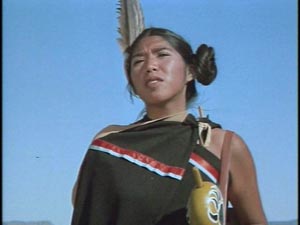
We cut to Billy sitting (presumably) naked in a sweat lodge. "I see it, Grandfather," he says to the apparently empty chamber. ‘It’ is a blue-tinted flame with shooting white sparkles cartoonishly superimposed before his face. Basically, it looks like one of those energy beings that were always economically invading the Enterprise on the original Star Trek. Meanwhile, Billy conducts a (I guess) telepathic conversation with Grandfather. Oops, wait, Grandfather is sitting in the lodge opposite Billy. We didn’t see him because the film’s DVD presentation is atrociously pan ‘n scanned, radically cropped from a 2.35 : 1 aspect ratio to fit a square TV screen. This is weird, actually, because Laughlin himself released the Billy Jack DVDs. For some reason he used what I assume is a TV print to put on the DVD, rather than a theatrical print, which I can’t quite figure out. You’d think he’d want to preserve the integrity of the film more than anyone else, especially given the fact that he’s always bent over backwards to associate himself with Billy Jack. "What color is [the flame]?" Grandfather asks Our Hero, and is told it’s blue. "That is a spirit looking to see if you are worthy," he explains. "It takes many forms." Then the flame disappears. "Where did it go?" Billy inquires. "When you can tell me where the flame comes from," Grandfather replies, "I will tell you where it goes when it goes out." Seriously, this is just generic mumbo-jumbo, and could just as easily have come from Master Po as he instructed young Grasshopper. As with Grandfather, Billy is speaking in a native language, over which we hear an English translation. The latter consists of him speaking in short, declarative sentences, relayed in a slight sing-song fashion. This is presumably an attempt to convey the flavor of whatever tribal tongue he is speaking in (lines that he sounds like he learned phonetically), but the effect is to make him sound like a learning impaired person reading from a Curious George book. From this we cut to a panoramic helicopter shot traveling along some beautiful mesa country. Soon we see Billy and Grandfather standing upon a magnificent butte. I have to admit, shots like this always make me queasy, as I suffer from severe acrophobia. "Grandfather," Billy asks via voiceover, "where will I look for my shadow demon?" Again, he is told it emanates from inside himself, and that it represents "all the evil in you that others can see in you, but you cannot." This goes on at great length, and I mean great length, but remains similarly murky and abstract. Then we get this, after Billy asks how he can recognize his evil side. "By the things in others that make you angry," he is told. "Whenever you get upset at someone or something, it’s because that quality that you’re upset about really exists in you." Well, guess what, that’s not even insulting dime-store psychology, it’s outright bullshit. So if I become angry upon seeing a rapist, or a child killer, or some moron in the KKK, I’m angry because inside I secretly want to rape woman or murder children or wear a sheet and expose myself to be a massive retard? Sorry, I don’t think so. It’s quite a leap from "we all have an evil side" to that sort of statement. Blah blah blah, and on we go. Even to the extent that Grandfather’s spiel is valid, it amounts to little more than a restatement of Michael Jackson’s "Man in the Mirror." Don’t try to change others, change yourself. Now, that’s all well and good, unless those others are pounding in your head while they force themselves upon your wife. As a Christian, I obviously believe we have a lifelong obligation to attempt to discern and confront our own inherently sinful natures, but this is taking that idea to a rather unworkable extreme. There’s definitely internal evil, but there’s external evil, too, and that must be confronted as well. And, in fact, Laughlin/Billy Jack knows this, because otherwise he’d become a pacifist like Jean. That would be admirable, but even Gandhi admitted that non-violence wouldn’t have worked against the Nazis. Billy asks for permission to "descend into the Cave of the Dead." (Oh, bru-ther.) Grandfather tells him he must first find his own vision, by which I assume he means a spirit guide. Then we cut to Jean, apparently sometime later, as she rides up on a horse to ask an Indian guy about Billy’s progress. He has been fasting, she is told, and awaiting his vision. However, she must go no further. "If a woman enters these sacred grounds, the medicine is lost," she is told. Jean jokes with the guy about this, but then placidly turns around and leaves. I wonder if she’d react so complacently if a Catholic priest was explaining why the Bible doesn’t allow for women to be ordained. Billy is heavily sweating atop a butte, sitting on the edge and with his feet dangling over the side. (Again, this fair gives me the heebie-jeebies. I’ll give Laughlin this; he’s a far braver man than I.) Meanwhile, Grandfather sits a short distance away, watching over him. Suddenly, a woman’s voice is heard. It’s the Vision Maiden, as played by Trinidad Hopkins (!), for whom this appears to be her entire thespian career. "Come, Billy Jack. Come, for I am going to show you the true nature of the White Man through all of history*. Come and look with me over this river of time." [*Good thing this wasn’t a white spirit telling a white guy about Indians all through history, because that would be racist.] "There’s St. Augustine," the Spirit suggests sarcastically, "preaching the Christian creed of Love to the Druid mumble mumble [yeesh, you’d think a Spirit Voice could speak up a little], with the tips of their lances dripping with blood." Oooh, burn! Snap! Oh, no, you did-int! You go, Vision Maiden! Anyway, during this another panoramic helicopter shot reveals the Spirit to be a woman dressed in traditional Indian garb, including, yep, a tall feather jutting up from her hair, and standing upon another isolated butte. I’m sure Laughlin thought all these aerial shots made his film look all cool and stuff, but to the modern eye it makes his movie seem like an extended Jeep Liberty commercial. "Oh, and there’s King Richard the Lionhearted," the Spirit continues, "slaughtering the heathen until they convert to Christianity. Here we see the lie of that old romanticism you were taught about the Crusades as a boy." Wow, kids in America used to learn about the Crusades? Well, we don’t have to worry about that sort of thing now. Meanwhile, given this present hour-long display of Romanticism about American Indian History and Mysticism, well, her snide tone is sort of rich. And hey, what happened to that stuff about the evil being inside us? The Crusades Romanticism Debunking continues: "See how they butcher this village of Jews, in the name of God, and Love?" Wow, your indictment of people who lived hundreds of years ago in a world and cultures that I can’t even remotely imagine is shaking me to my core. On the other hand, the idea that Richard the Lionhearted was pushing some Gospel of Love is pretty friggin’ hilarious. Who knew?
"And remember that great, brave Indian fighter, Kit Carson?" she continues. I think she might be skipping ahead a bit, chronologically speaking. "He had rounded up over 400 Navaho women, children and babies [oh, no… not children and babies!] in this cave [camera zooms in towards cave] and his men bravely and methodically shot them to death." I think you can assume the Spirit’s use of ‘great,’ ‘brave’ and ‘bravely’ is meant ironically. However, I can believe the ‘methodically.’ Let’s say Carson had twenty men on this job. That means that each man was responsible for shooting 20 women, children or babies. That would have required quite an amount of time, and multiple reloadings of whatever rifles, shotguns or revolvers they may have been equipped with. Such things were a lot more difficult back before the Maxim gun was invented. [I have been unable to find information to confirm this account. The massacre part sounds like an account, albeit more than a little altered and exaggerated, of an episode in which Spanish forces in 1805 killed a hundred or more Navajos, including perhaps 25 women and children, in circumstances (somewhat) similar to those described here. This took place in the aptly named Canyon Del Muerto. This has since been known as Massacre Rock, and is presumably the inspiration for the otherwise spurious account given here. Meanwhile, as far as I can tell the Laughlins conflated the Massacre Rock incident with Carson’s 1864 besiegement of the Navajos in the nearby or adjacent Canyon de Chelly. After their eventual surrender, Carson force marched thousands of the Navajos to a reservation, an event now known as the Long Walk. During this, hundreds of the Navajos died. Carson led what was certainly a brutal campaign, but I haven’t found any evidence that he ever participated in the sort of massacre described here. I welcome any information that would clarity this, however.] "What the White Man calls ‘the spread of civilization,’ his Christianity and so-called democracy," she lectures on, "have a secret shadow [Ken Howard?]; greed and power. Look well into your own heart, see how much of your violence comes from the same lust for power over other people." Here we cut to a weird insert shot of some Indian fellow—one of the activists we met earlier, I think—having his head shoved under water by White Men in order, presumably, to drown him. Billy Jack screams in outrage at this (Imagined? Metaphorical?) perfidy. This wakes Billy back to the ‘real’ world, and we are treated to further sweeping helicopter shots as he gazes around. We cut back to the childcare room at the Freedom school. Jean is in a corner, watching as Carol works with Danny, the one-handed lad introduced four or five hours back. (I think that’s right.) She’s building something with blocks, and trying to get him to join in, but he reacts by knocking over the tower she’s constructed. Watching through a window, Lynn reacts with frustration. "I don’t know where [Carol] gets the patience," she tells another student. We then cut outside, where Jean is giving the dejected Carol a buck-up speech. "You have to remember," Jean expositories, "Dan has been in over 20 foster homes, and was even put in solitary confinement in one detention home when he was four years old. He’s never known anything but brutality and rejection." Carol acknowledges all this, but is discouraged. "Every single expert told me he’s hopeless," she explains. Jean’s advice is basically to keep loving him and loving him and loving him, no matter what. Cut to what I guess is the Freedom School’s Petting Zoo. (I mean, why the hell not? They have everything else.) Here, a pack of the Groovy Kids is being lectured by some Representative of The Man while a miniature burro and calf look on in mute protest. "This school has no legal right to detain the child," RoTM maintains. "If we have to find Danny’s parents and get them to regain custody, we will." Yeah, after the kid’s spent at least six or seven of his ten years rotating through 20-plus foster homes? Sure. Man, the situations in this movie must be Ripped From the Headines, they seem so real. "If that doesn’t work," RoTM nazis on, "we’ll
have him committed to a mental hospital." In the original script, I think
the guy said they’d haul the lad away at gunpoint and tie him to train
tracks and cavort with whores while their group, including
stoned-out-of-their-minds Richard Nixon and Supreme Court Justice Abe
Fortas, watched him being squished by the 8:14 Express. Oh, and they would
have dissolved his other hand with battery acid first. However, they
apparently cut that dialogue out because, while it presented a totally
realistic portrayal of how things are done in this country, the lines sadly
drew laughter from naïve audiences who hadn’t yet rejected the old
romanticism they were taught about the Crusades as children. Carol, meanwhile, lays the cards on the table. "You’re just trying to get back at us because we’ve exposed the filthy conditions of your state hospitals!" she exclaims. "Why don’t you go and clean them up so they’re fit for human beings?" At this juncture even Bertolt Brecht might decide to move on to the next scene. However, the Laughlins still have a mess o’ speechifyin’ and truth tellin’ left in ‘em. One Authority Figure sneers that getting the courts on their side shouldn’t be too hard, given the "radical environment" the school represents. "What you men are really saying," Jean translates, being as she is so good at saying what others are really saying, "that this constant harassment and this bugging of our telephones [ooh, and don’t forget the awarding of all that state grant money…oh, wait], it’ll all magically stop if we decide to give up the Indian Rights Seminar." Her opponents deny this, but pretty unconvincingly. "Bugging your phones…but that would be illegal," one notes, drawing cynical laughs from the Groovy Peanut Gallary. Indeed, even without the Lie Detector Bong made by that guy that Jean thinks was maybe from CalTech, we can tell that the two are prevaricating. Cut to the two Representatives of the State joining the Groovy Gang in the Freedom School Super Science Lab. Here the kids are demonstrating their amazing Phone Tap Detector. Again, I like the way the various strawmen authority figures in this film—and in the previous movie, as when the local Town Council adjourned to the Freedom School in order to view a typically ghastly display of Improv Comedy—are so utterly compliant about going where they’re told so that they can be exposed for what they are. The School’s Tech Guy, Bugger [shouldn’t he be ‘Debugger’?], for instance, confirms that the phone before them is tapped. "It’s an Infinity type [bug]," he explains. "It is picking up everything being said in this room from this phone, without having to lift up the phone receiver." Hey, enough with that technical jargon! This isn’t a Tom Clancy novel! At Jean’s command, Bugger hits a switch on A Groovy Gadget, whereupon we cut to two squares in an office somewhere, who are monitoring and taping the above conversation... Uh, so the Freedom School is this gigantic facility, and the one phone they just happen to be sitting by is being monitored by two guys? Logically then, this would suggest that every phone on campus is getting similar treatment. Assuming the agents work in 8 hour shifts, and that the School has (rather conservatively) one hundred phones, that means The Man is laying out enough filthy, blood-stained lucre to field 600 agents a day just to attend to this particular chore! Anyway, one of the two is just sitting there and looking over a magazine centerfold, another example of decadent, disgusting objectifying-sexuality. His partner, meanwhile, reacts with panic when the phone tap feed cuts off. "It’s gone blank, I can’t hear anything!" he squeals. This is so dire a situation that the other guy actually puts his magazine down. It’s no good, though, for they have been flummoxed. Take that, Mr. Man! We cut to the town bank, where a reporter from the Freedom School, complete with an entire recording crew, is giving Posner—remember him, he’s the villain of the piece—the third degree. Again, why would Posner bother talking to these people? It’s not like they have subpoena power or anything. Scenes where the Joker lays out his entire evil plan because he has Batman and Robin tied up in a giant deadly Sno-Cone machine frankly make more sense. As you might expect by now, the Reporter’s queries sound like they’re being issued by a particularly didactic Fourth Estate ‘Bot: "Mr. Posner, allegations have been made that the eighty million dollar trust that was given to you by the Indian Bureau for the land sale was turned over to you as trustee instead of the bank in Wyoming and that this is because of your heavy campaign contributions in Washington." And yes, the actress playing the reporter does have to stop to audibly gasp for air in the middle of all that. Now, you might notice that the Reporter’s remark is not, in actually, a question. Even so, Posner reacts angrily to the accusation, apparently made by… somebody. We then cut back to the Freedom School, where the Groovy Gang is monitoring the telecast with their Magical Groovy TV Lie Detector. The best moment comes when Posner looks at Indian student Patsy Littlejohn (Sacheen Littlefeather—really) and calls her "Princess," garnering a outraged chorus of watermelon, watermelon catcalls from the observing Groovy Gang. One great thing about the film’s using non-professional actors is that the amateur cast members often can’t quite get their wads of stilted dialogue out. Sometimes they just run out of steam mid-sentence. On more than one occasion I could only catch what they were saying by going back and turning the volume on my TV set way up: "Aren’t you responsible," Patsy inquires, "for helping Eisenhower back in the ‘50s affect the transfer of, uh, Indian trust monies to local banks here and throughout the state so that you, could, uh, invest it, uh, at great personal profit?" Posner directly denies the, well, I guess it’s a charge. Back at FSHQ, a woman transfixed with the Power of Truth runs into the broadcast control booth, yelling "What does it say? What does it say?" ‘It,’ of course, being the Magical Groovy TV Lie Detector. Bugger confirms that it says Posner is "lying through his teeth!" Gasp! Not Posner?! Then what middle-aged white capitalist authority figure can we trust?! Needless to say, the Powers that Be cannot allow this to stand. Therefore we cut up to the roof of the School’s transmitter building, where a man is skulking around the broadcast tower. Ominous music plays, to let us know that he isn’t one of those good guys who would be skulking around at night around a broadcast tower. In any case, The Man’s Plan ‘A,’ it’s now evident, is to blow up the Tower. (Plan ‘B’, should that fail, is to stop regularly conducting protracted, hostile television interviews at the request of the people who you are doing everything you can to undermine and destroy.) However, typically, the man is a numbnuts who is caught in an incendiary explosion so powerful that it changes his blue jeans and green jacket into brown overalls and his hair into a black knit cap. He emerges screaming and covered with flames. You might think this makes the mission unsuccessful, by the way. However, there is evidence that the French commandos who traveled to New Zealand back in 1985 and, er, ‘covertly’ blew up the Greenpeace flagship vessel Rainbow Warrior used this same plan. Cut to an ambulance on the scene, picking up the body. Sheriff Carl, ineffectual as always, apologetically explains that Posner has convinced the Governor to declare a state of martial law and to send the National Guard to occupy the local town. The stated rationale for this is a fear that the Freedom School’s radical students will retaliate for the bombing in kind. Everyone reacts to this news with angry incredulity and disdain. Despite that, with the deployment played up as a typically eee-vil ploy on The Man’s part, the movie’s very next scene indicates that the decision was actually pretty rational. Of course, I doubt if the Laughlins ever stopped to consider that. Actually, I’m also a bit confused as to why the Groovy Gang would be so against the National Guard occupying the town. Doc, for instance, reacts by furiously asking, "Why aren’t they out here guarding the school?!" See, you can’t win in a movie like this. Imagine the furor if the Sheriff instead said, "The Governor has decided to station the National Guard on campus. He says it’s to protect the students." Then the question would be, "The School?! Why aren’t they stationed in town, where the bomber came from?!" Seriously, I don’t get it. Well, OK, if you consider the National Guard to be purely an evil instrument of a fascist state, then I guess any appearance by them is suspect. However, you’d have to think that in the real world… ah. Never mind. "Well, as long as the laws work one way for the rich and one way for the rest of us [Huh? How does that even remotely apply here?], looks like there’s only one thing to do," Patsy cynically notes. At this we cut to a Student Forum—gad, the radical’s belief that everything can be solved with giant yakking sessions—where Patsy and some of her fellows are advocating exactly what we were just told was a ridiculous fear. By which I mean, they promote sneaking into town and, in the words of one fellow, "Bomb the hell out of them!" This is actually an interesting scene, and an indication of the films Laughlin could have made if he weren’t quite possibly schizophrenic. Here we see the students dedicated to a non-violent solution battling it out with the ones who want to advance their goals by any means necessary. Notably, Jean finally decides to add her two cents, despite her qualms about possibly being viewed as (Ick!!) an Authority Figure. However, Patsy responds virulently to her request to speak. Moreover, it’s pretty clear that this is solely because she knows Jean will advocate non-violence. If Patsy thought Jean would be supporting the bombing of the town, there’s little doubt she would be actively pushing Jean to speak. Instead, Patsy gratuitously insults Jean and the students arguing against violence by predicting that the other students will blindly follow whatever position Jean takes. Jean, already uncomfortable with actually, you know, acting like an adult and standing up for her beliefs, literally throws her arms up in the air and walks out, her piece unsaid. Now, this is all pretty sharply observed stuff, and no surprise there, as the Laughlins had probably spent quite a lot of time engaging in exactly these sorts of debates. And I say that despite the fact that the film, by which I really mean the Laughlins—it’s really difficult to separate the two—obviously have a lot more tolerance and sympathy than I do for those argue for a campaign of violence. No, the reason I say Laughlin is
schizophrenic—and let me state this clearly, so that you can agree or
disagree—is that he can at one moment advance the most paranoid fears, then
himself (through his films) completely undercut the basis of those fears a
second later, and not even notice the contradiction. For instance, as noted before, the film earlier had several characters pushing the idea that Billy Jack would never be allowed out of prison (and, even before that, the Army) alive. Well, he was, and in fact we never see any evidence that the State actually wanted him dead. In fact, I again reference Billy Jack, in which a state official arrived on the scene of Billy’s stand-off with the law, the one during which Billy had already killed at least one police officer, with the sole concern of ending the stand-off with Billy still alive. In furtherance of this, he actually allows the government to be blackmailed by Jean. Do you see what I mean? It’s like half of Laughlin had written a script that actually shows the government taking extreme measures to keep Billy alive, at a juncture when it easily could have arranged and justified his death. Yet at the same time, the other half of him writes scenes that assure the viewer that the State / Powers that Be / The Man / Whatever will do anything it takes to see that Billy is killed. Moreover, not only does Laughlin hold these two conflicting views at the same time, but it seems likely that he doesn’t expect us to notice this dichotomy either. From everything we’ve seen up to now, and in more than one movie, there’s no reason to believe that the State wants Billy dead, at least to the extent of arranging his demise. Despite that, when two cons exchange gossip to the effect that Billy is a marked man, we’re obviously meant to take it as gospel. This is another, similar situation. The reactions to the Governor’s stated fear of violent retaliation from the students of the Freedom School against the town immediately paint them as a patently outrageous and cynical lie. Yet twenty seconds later we indeed see a group of students advocating exactly that, a spree of violence—"bombing the hell out of them" doesn’t sound like a call for a measured response—and even playing dirty politics to keep opposing views from being heard. And yet again, we’re apparently not supposed to notice. Ultimately the film argues against meeting violence with violence (although it seldom seems wholeheartedly). Even so, it obviously views the radical’s impulse to employ violence as understandable and actually quite justified. These people are still on the side of the angels, and Billy, and Laughlin, still have no enemies to the Left. Laughlin approaches nuance in scenes like this, shades of gray, but he just can’t embrace it. His worldview is Manichean—in the political sense, of course, not the theological—and just will not allow him to make that final leap. To an extent, this might also be driven not
only by Laughlin’s hypocrisy, but by that of his audience. While he doesn’t
brand the radical students as evil, as he does any number of others, the
film does definitely take the side of the non-violent in this debate
sequence. We can tell, because the main audience identification
characters—Jean, Carol, and Lynn—all argue against striking back. This is why Billy Jack retains an
audience far beyond that which still champions The Trial of Billy Jack.
(That, and the fact that Billy Jack isn’t three friggin’ hours long.)
It would be hard to find something who disagrees more strongly with Mr.
Laughlin’s politics than myself. Yet—and I doubt he will ever understand why
or even really believe it to be the case—even an admitted right-winger like
myself derives immense satisfaction out of watching Billy beat the crap out
of a bunch of racist thugs molesting a little girl*. [*One difference being that for Laughlin, the main issue is
that that little girl is an Indian. For me, it’s that she’s… a little girl.] Anyway, moving on. (And yes, I fully appreciate the irony of the fact that I bitch about the length of the movie but then offer up an equally interminable review—not that the two are entirely unrelated.) We cut to the National Guard arriving in town. For some reason, they drive into town with their sirens (?) blaring (??). A reactionary Old Man—we can tell, he’s wearing a string tie—looks on with approval. "Thank God we’ve got a governor with guts," he avers. I assume this fellow is not meant to be speaking for the Laughlin. Meanwhile, the Radical students are hoping to get Billy’s support for their agenda, and have gone to the foot of the mountain where his Vision Quest ceremony is taking place. (So much for Patsy’s not wanting her fellow students to be swayed by an authority figure.) However, they find their way stymied by Blue Elk, who is guarding the mountain while Billy and Grandfather conduct their busines. This leads to a discussion about taking drugs, and off we go onto yet another extraneous tangent, this one redolent of Laughlin’s strange brand of Puritanism. Of course, anyone who studies martial arts to the degree he has is going to be big on discipline, which itself is sort of antithetical to the entire ‘hippy’ thing. Even so, I really wonder what his mass audience thought of his occasional preaching against the casual use of sex and drugs. I imagine they just sort of ignored it and waited for him to kick some middle-aged white dude in his fat, florid face. "You mean they purify themselves to take drugs?" a bewildered Hippy Girl asks. Taking drugs, Blue Elk explains, is properly a mechanism to meet the Divine Spirit. "If one is not totally prepared to meet him," he warns, "if one has not fasted or purified oneself thoroughly, or if outsiders interfere [here he gives them a Significant Look], the Spirit would be angry, and make Billy sick, or even take him away."’ Obviously this dude knows what he’s talking about, because he’s, you know, an Indian, so the hippy students struggle to grok it all. "Like when a kid is spaced?" one inquires. "Off in Stoney Land?" However, they’re still not getting the sacred part. "No, no," Blue Elk explains. "You people don’t know anything about the Other World, or about the Power that could so easily kill you." By the way, congratulations. Halfway through the above quoted line of dialogue, we hit the film’s exact halfway point, and… Hey, quit your bitching. You think reading this entire endless review is unpleasant? [Assuming anyone has.] Imagine writing it. Anyway, Blue Elk continues on—of course he does, he’s in The Trial of Billy Jack—about why only Indians should do drugs, blah blah. This basically amounts to the fact that they don’t do it "for kicks or to get high," as with foolish hippies. And by doing so, he cautions, they "run a great danger." By the time he finishes, you’re half expecting Mr. T and Nancy Reagan to come out and tell the kids to Just Say No.
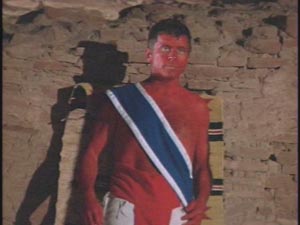
Finally, the students are told to return the next day, at which point we cut back to Billy’s ceremony. This is currently ensconced in a cave wherein a pair of flour-covered Indians are chanting and dancing around a fire. Some Elders, meanwhile, observe them from the sides. Then a curtain is shoved aside to reveal Billy, who enters shirtless and wearing a wide blue and white sash. Oh, yeah, and his entire upper body and head, except his hair, is covered with red paint. Then it’s back up to the mountain top, where
Grandfather’s teachings are again translated for us Palefaces. "You are
going to descend to the Cave of the Dead, where our people were massacred,"
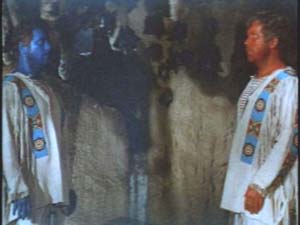
he informs his student. As Billy is lowered a huge distance down the cliff face via a rope*—man, I don’t dig that—Grandfather gives him warning. "Be very careful," he advises, "because there are many spirits there who would like to take you with them, and others who do not want to pass on to the Next World, so they would like to enter and possess your body. The souls of these dead wreak [sic] for vengeance, and they will know your heart. If it is that of a White Man, you will not survive." Gee, racism is cool when it’s perpetrated by members of a discrete, insular minority! [*As Jabootu proofreader Bill Leary points out, this seems a lot of work to get into a cave that was accessible enough to allow for the massacre of hundreds of people.] "There will be demons also," Grandfather continues. (Hmm, maybe I would have gone down that rope after all. This guy just won’t shut up.) "If you show any fear, they will tear you to pieces, and the ghosts will possess your soul. If you show that you are not afraid, no matter what they do, the demons will stop terrifying you and become your friends." Weird behavior for a demon, you’d think, but there you are. Actually, I think Syd Hoff did a kid’s book like that, Danny and the Demon. Hey, wait, it just hit me! The murder trial wasn’t "The Trial of Billy Jack." This is! It’s a metaphysical trial! I get it! Wowsers! "Are you afraid?" Grandfather asks. "You once taught me," Billy explains, "that courage is not the absence of fear, but the conquest of it." Wow, I was taught the same thing one time! Only I didn’t learn it from a wise Indian Elder, but from fortune cookie. Finally, as Billy is actually being lowered down into the cave itself, Grandfather is heard to warn, "Beware most of all the Red Eyed Demon. By his screams you will know him. [Well, that and his red eyes, you’d think.] He is the most powerful of all the demons, and because you will do much good if you survive, he will kill you on the spot if you show any fear." Soon Billy, or a reasonable facsimile thereof, has been lowered to the floor of the cavern. Lighting up a torch he brought with him, he goes on a tour. I was sort of hoping he’d meet up with Zontar, but the latter probably had better things to do. However, Billy does come across a hissing cobra. Needless to say, it’s appearance here in (I’m assuming) New Mexico is a little odd, which I guess is that point. Still, you’d think an Indian spirit would have enough respect for the land to appear in the guise of an indigenous reptile. "No cobras live in this country, my friend" Billy observes. I hope he’s as knowledgeable about emus or hippos, just in case he sees any of those. On the other hand, he’s presumably speaking for our benefit, since there isn’t any one else down there with him. I mean, he seems to be addressing the Spirit, but wouldn’t a spirit just know what he’s thinking? In any case, Billy asks the Spirit, or Demon, or whatever, to leave, and it disappears in a burst of badly superimposed flames, allowing Our Hero to proceed on his way. Entering a large cavern, Billy hears animal roars, and sees a nest of rattlesnakes. Then a mysterious wind—because it’s in a cave, oooh, spooky—comes through and blows out his torch. Then the screen turns a negative blue through the use of the reliably cheesy solarization effect, and suddenly Billy finds himself wearing a full fringed and beaded Indian buckskin rig. It’s white with turquoise highlights, and thus looks very fashionable against his currently bright red skin. He also has spontaneously generated some think beard stubble, and actually ends up looking a bit like CSI’s William Petersen. Billy hears more roars, but drops the unlit torch and slowly begins to make his way through the large contingent of rattling snakes. The roars and screams get louder at times—humorously, we occasionally hear the mewling screech used as the voice of the monstrous arachnid in Bert I. Gordon’s Earth vs. the Giant Spider, which itself lived inside a cavern. So I might not get Zontar, but hey, close enough. Billy takes his sweet time walking through the snakes, because this is, after all, The Trial of Billy Jack, and continues to hear the disembodied screams, as well as seeing bats that make cat noises. (!) Eventually the bats begin climbing all over him, but he fights to remain calm. Comically, when the bats are actually clambering over his torso, we never see Laughlin’s face in the shot, and when we see both his face and some bats at the same time, the latter are suddenly… oddly doll-like. I’m just saying. Suddenly Billy sees some glowing eyes in a shadowed area of the cave, apparently represented via some highly sophisticated penlights. Then’s a brief animation of a big green snake head, or some damn think. Our Hero, however, steadfastly refuses to break.
At this, the bats disappear, and Billy is standing before a superimposed blue flame effect. This disappears and he finds himself confronted with his exact opposite, only Ersatz Billy is painted blue rather than red. "You’re me," he observes, lest we somehow don’t ‘get’ the doppelganger idea. "I am your inner self,’ Blue Billy clarifies. "Someday when you fully accept your fate and your death, then you will have me as your inner guide." Blah blah blah. Oh, man, I can’t believe there’s still an hour and twenty minutes of this movie left. That’s a whole friggin’ film right there. Blue Billy tells Real Billy that his problem is that he’s too empirical—sorry, I think I just had a brain aneurism—and tells him to return to the desert for (NONONONONO!!) more lesson from the Spirit Maiden. So saying, Blue Billy disappears, and the blue solarization effect is used again, and we get a cheesy B-movie sci-fi sound effect, and then Red Shirtless Sash Billy finds himself beneath the blazing desert sun. A Spirit Maiden (literally) appears before him, holding a white bunny rabbit. (!) "I am here to show you the way to the house of the Great One," she says (oh, man, let that be the Great One from Robot Monster—please!!), "but first you must prove yourself generous of heart." Billy proclaims himself ready, and she points out a surrealistic assembly of guys raucously cheering on a football game in a living room set plunked down in the middle of the desert. Among this group is a Football Player, a Pimp (and yes, he’s black), a guy who looks like the Skipper from Gilligan’s Island, an Army officer, a lounge lizard, a minister and, I’m pretty sure, Marvel Comics’ Stan Lee. The Maiden directs him to go slap one of the men, and then to take whatever is given him in return without defending himself. Billy is bewildered, but game. Striding forward, he chooses the Sea Captain, perhaps because he’s the burliest of the bunch. "I don’t think you’re going to particularly like this," Billy chuckles, and slugs the guy. (Actually, she said he should slap the guy, but hey, in for a penny, am I right?) Sure enough, the guy retaliates and plants one on Billy’s kisser. However, when Billy straightens up the men and furniture are gone, and before him stands the Maiden and her bunny, who I think she calls George. "That man was on the lowest level, and reacts only with animal instinct," she explains. "Treated with violence, he was immediately pulled down to the violent animal level, no better than the man who hit him." Actually, I’d say a guy who would walk up and punch a stranger in the face is quite a few rungs lover than a guy who is punched for no reason and then returns the favor, but then, I’m not a wise Spirit Maiden. She further explains that the second man is thus "controlled by the animal in the man who hit him," and there’s a kernel of validity there, but I’m not sure how practicable that philosophy is. Billy is then confronted with a lecture class set out in the desert. A groovy young teacher---we can tell from his Greg Brady hair—is lecturing on the evils of war and capitalism and all that stuff. Needless to say, Billy is a lot less comfortable smacking some dude who’s righteously attacking giant soft drink conglomerates than some fat working class dude watching a football game, but he does as the Maiden commands. "This is probably going to seem as stupid to you as it does to me, but…" Our Hero notes, but he goes ahead and clouts the guy. The Teacher doesn’t react psychically, but instead starts screaming at Billy, and his students join in. Then they disappear, too. "He was on the second level," the Maiden explains. I thought that might be the level for guys who can’t handle themselves in a fight and so take a punch rather than toss one back—that being the level I tend to live on—but this proved wrong. "He could not be pulled down to the level of the brute beast, acting on physical violence," she ‘explains,’ (I mean, really, I think we already figured out where this is going), "but was easily pulled away from what he was doing and lost control of his own center. So he too did not own his own soul, but could quickly be controlled by another." Yeah, imagine being "pulled away from what you are doing" solely because some dude just comes up and punches you in the face. There’s no doubt that guy has serious control problems. Because this is The Trial of Billy Jack, we must now see the third level illustrated. Good grief, Spirit Maiden, I think we’ve kind of hashed out where you’re going with all this. Yet rather offensively—and for this movie, quite weirdly—Billy is then told to go punch Jesus in the face. (!!) Good to know that the Son of God is available on demand for a damn Pagan Indian spirit. And wow, how brave! Actually, if Laughlin really wanted to be brave, he’d have had Billy walk up and hit Buddha in the face. Boy, I’d like to have seen the reaction to that one. Apologizing, and noting "I have no idea why I’m doing this," (yeah, this exercise is so damn hard to figure out), Billy slaps Jesus. By the way, since Billy is employing violence at the Maiden’s command, isn’t he being "controlled by another"? I guess I’m not getting all this. Anyway, and you might want to sit down unless this following part blows your mind, but Jesus just takes the slap and, well, turns the other cheek. (Oooh, Big Man, Billy. That’s like making faces at one of the Buckingham Palace Guards.) "I feel sorry for you," Jesus replies. "Only a child thinks that being a man is being tough and violent. Someday you may learn that being a man has to do with self-discipline over one’s [something] and one’s emotion, with a deep and compassionate understanding for other people’s feelings." Great, a Jesus who sounds like a therapist on Oprah. Billy then returns to the Maiden, who notes that "This man has reached the third level." Oh, now I get it. Still, as a Christian it’s good to know that Jesus reached the highest of the three rungs of human spiritual progress. Billy however, intuits that there is a fourth level. (Ooops, sorry, Jesus. Still, third level is pretty good.) She tells him no more, however, but explains after Billy asks that he can never go to his Spiritual Guide, but that the Guide will appear to Billy when he feels like it. Ooh, Big Man. Now his job (oh, brother, would somebody please edit this thing!) is to accept his Shadow, which represents his own weaknesses and flaws, the ones that make him who he is and… Hey! Isn’t that that same speech Captain Kirk is always giving about what it means to be Human? That’s the punch line to all this tripe?! I must still be on the first level, because that makes me want to be controlled by another and punch the people who made this ferschlugginer movie in the face. Billy makes to ask the Maiden another question, but she has disappeared, and the cackle of Grandfather indicates that Our Hero has (finally!) returned to the ‘real’ world. Only when Billy comes aware, he’s no longer sharing a butte with Grandfather, but is seated on another. Oh, wow, somebody, get Rod Serling in here, stat! Then we get the film’s six hundredth helicopter shot, showing Billy (or a reasonable facsimile) sitting atop a hugely tall but terrifyingly narrow rock outcropping. All I can say is, Noooo, thanks!
-Review by Ken Begg |
|||||||||||
|
|